Calculate the deviation of internal energy for Freon at a p=3atm and T= -451F from the...
Calculate the deviation of internal energy for Freon at a p=3atm and T= -451F from the ideal gas.
Homework Answers
 please
upvote it if you have satisfied... thankyou....
please
upvote it if you have satisfied... thankyou....Add Answer to:
Calculate the deviation of internal energy for Freon at a p=3atm
and T= -451F from the...
Learning Goal Internal Energy of an ideal gas The internal energy of a system is the...
 Learning Goal Internal Energy of an ideal gas The internal energy of a system is the energy stored in the system. In an ideal gas, the internal energy includes the kinetic energies (translational and rotational) of all the molecules, and other energies due to the interactions among the molecules. The internal energy is proportional to the Absolute Temperature T and the number of moles n (or the number of molecules N). n monatomic ideal gases, the interactions among the molecules...
Calculate the internal energy of one mole of helium gas at a temperature of 280K. Assume...
Calculate the internal energy of one mole of helium gas at a temperature of 280K. Assume ideal gas behavior.
Calculate the change in internal energy, change in enthalpy, work done, and the heat supplied in...
Calculate the change in internal energy, change in enthalpy, work done, and the heat supplied in the following processes: (a) An ideal gas is expanded from 5 bar to 4 bar isothermally at 600 K (b) An ideal gas contained in a vessel of 0.1 m3 capacity is initially at 1 bar and 298 K. It is heated at constant volume to 400 K. (Assume that Cp = 30 J.mol-1.K-1)
Calculate the internal energy change of a one mol sample of an ideal gas that releases...
Calculate the internal energy change of a one mol sample of an ideal gas that releases 9.3 J of heat and has 5.2 J of work done on it.
Isotherms Adiabatic process T. Figure 1 5. Given is the P-V diagram, a gas system from...
 Isotherms Adiabatic process T. Figure 1 5. Given is the P-V diagram, a gas system from state is undergoing a thermodynamic process which lead to a different state f. Assume the gas is monoatomic and following the ideal gas condition ) Show that the, area under i-flineP 1-7 i) If the system contains 5 mol of this gas with an initially temperature of 293 1 m3 to Vi K. Calculate the work done by the system expanding from V -4m3...
(a) One mole of a monoatomic van der Waals gas obeys the equation of state A3. ) (V-b)=RT (p+ and its internal energy is expressed as U CvT where Cv is the molar isochoric heat capacity of an ideal g...
 (a) One mole of a monoatomic van der Waals gas obeys the equation of state A3. ) (V-b)=RT (p+ and its internal energy is expressed as U CvT where Cv is the molar isochoric heat capacity of an ideal gas. The gas is initially at pressure p and volume V (i) Explain the physical meaning of the parameters a and b in the equation of state of the gas (ii) Write down the equation that defines entropy in thermodynamics. Define...
2. Consider free expansion of a gas when the internal energy U remains constant. Derive: a) the e...
 2. Consider free expansion of a gas when the internal energy U remains constant. Derive: a) the expression for (дт/avJu in terms of P, T, Cv and (ap/aT)v b) the expression for (as/aV)u in terms of P and T c) using equations obtained in a) and b) calculate (expression for) the change of temperature AT and change of entropy AS for a free gas expansion from Vi to V2.
2. Consider free expansion of a gas when the internal energy...
2. Consider free expansion of a gas when the internal energy U remains constant. Derive: a) the expression for (дт/avJu in terms of P, T, Cv and (ap/aT)v b) the expression for (as/aV)u in terms of P and T c) using equations obtained in a) and b) calculate (expression for) the change of temperature AT and change of entropy AS for a free gas expansion from Vi to V2.
2. Consider free expansion of a gas when the internal energy...
2. One mole of a monoatomic van der Waals gas obeys the equation of state and its internal energy is expressed as U-Суг...
 2. One mole of a monoatomic van der Waals gas obeys the equation of state and its internal energy is expressed as U-Суг_ _ where Cv is the molar isochoric heat capacity of an ideal gas. The gas is initially at pressure p and volume V. (i) Explain the physical meaning of the parameters a and b in the equation of state of the gas (ii) Calculate the heat transferred to the gas during reversible isothermic expansion to the volume...
An isolated system contains an ideal gas with state parameters: U, T, S, P, V, M,...
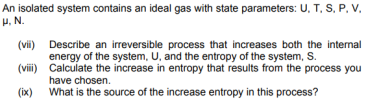 An isolated system contains an ideal gas with state parameters: U, T, S, P, V, M, N. (vii) (viii) Describe an irreversible process that increases both the internal energy of the system, U, and the entropy of the system, S. Calculate the increase in entropy that results from the process you have chosen. What is the source of the increase entropy in this process? (ix)
A process has been proposed whereby an ideal gas is taken from P=10 bar and T=300...
A process has been proposed whereby an ideal gas is taken from P=10 bar and T=300 K to P=1 bar and T=500K in a closed system. During the process the system performs 1,000 [J] of work and receives 6,430 [J] of heat from the surroundings at a constant temperature of 300 K. The constant pressure heat capacity of the gas cp=30 [J/(mol K)] . Gas constant R=8.314 [J/(mol K)]. (a) (7 pts.) What is the change of molar internal energy...
 Learning Goal Internal Energy of an ideal gas The internal energy of a system is the energy stored in the system. In an ideal gas, the internal energy includes the kinetic energies (translational and rotational) of all the molecules, and other energies due to the interactions among the molecules. The internal energy is proportional to the Absolute Temperature T and the number of moles n (or the number of molecules N). n monatomic ideal gases, the interactions among the molecules...
 Isotherms Adiabatic process T. Figure 1 5. Given is the P-V diagram, a gas system from state is undergoing a thermodynamic process which lead to a different state f. Assume the gas is monoatomic and following the ideal gas condition ) Show that the, area under i-flineP 1-7 i) If the system contains 5 mol of this gas with an initially temperature of 293 1 m3 to Vi K. Calculate the work done by the system expanding from V -4m3...
 (a) One mole of a monoatomic van der Waals gas obeys the equation of state A3. ) (V-b)=RT (p+ and its internal energy is expressed as U CvT where Cv is the molar isochoric heat capacity of an ideal gas. The gas is initially at pressure p and volume V (i) Explain the physical meaning of the parameters a and b in the equation of state of the gas (ii) Write down the equation that defines entropy in thermodynamics. Define...
 2. Consider free expansion of a gas when the internal energy U remains constant. Derive: a) the expression for (дт/avJu in terms of P, T, Cv and (ap/aT)v b) the expression for (as/aV)u in terms of P and T c) using equations obtained in a) and b) calculate (expression for) the change of temperature AT and change of entropy AS for a free gas expansion from Vi to V2.
2. Consider free expansion of a gas when the internal energy...
2. Consider free expansion of a gas when the internal energy U remains constant. Derive: a) the expression for (дт/avJu in terms of P, T, Cv and (ap/aT)v b) the expression for (as/aV)u in terms of P and T c) using equations obtained in a) and b) calculate (expression for) the change of temperature AT and change of entropy AS for a free gas expansion from Vi to V2.
2. Consider free expansion of a gas when the internal energy...
 2. One mole of a monoatomic van der Waals gas obeys the equation of state and its internal energy is expressed as U-Суг_ _ where Cv is the molar isochoric heat capacity of an ideal gas. The gas is initially at pressure p and volume V. (i) Explain the physical meaning of the parameters a and b in the equation of state of the gas (ii) Calculate the heat transferred to the gas during reversible isothermic expansion to the volume...
 An isolated system contains an ideal gas with state parameters: U, T, S, P, V, M, N. (vii) (viii) Describe an irreversible process that increases both the internal energy of the system, U, and the entropy of the system, S. Calculate the increase in entropy that results from the process you have chosen. What is the source of the increase entropy in this process? (ix)
Most questions answered within 3 hours.
-
Where is the error in this code sequence?
String s1 = "Hello";
String s2 = "ello";...
asked 10 months ago -
Financial data for Joel de Paris, Inc., for last year
follow:
Joel de Paris, Inc.
Balance...
asked 10 months ago -
Consider this reaction:
Al2(SO4)3 (aq)+ BaCl3
(aq) Al2Cl6 (aq)- +
3BaSO4(s) . What is the...
asked 10 months ago -
Suppose that Savneet is considering increasing her
recent random sample from 20 car rentals to 40...
asked 10 months ago -
Trucks arrive at an unloading terminal at an average rate of 120
per hour.
Trucks arrive...
asked 10 months ago -
Why are methanol and ethanol completely soluble in water while
octanol is not very little soluble....
asked 10 months ago -
A facilities manager at a university reads in a research report
that the mean amount of...
asked 10 months ago -
When the CuSO4 is rehydrated by adding water to the anhydrous
compound, is this an endothermic...
asked 10 months ago -
A ray of sunlight is passing from diamond into crown glass; the
angle of incidence is...
asked 10 months ago -
A block of mass 0.249 kg is placed on top of a light, vertical
spring of...
asked 10 months ago -
how do the kidneys compensate in the presences of acidosis
a) trigger hyperventilate
b) reserve acid...
asked 10 months ago -
Question 501 pts
The rental rate of capital to the firm increases. Which of the
following...
asked 10 months ago