
Homework Answers
Add Answer to:
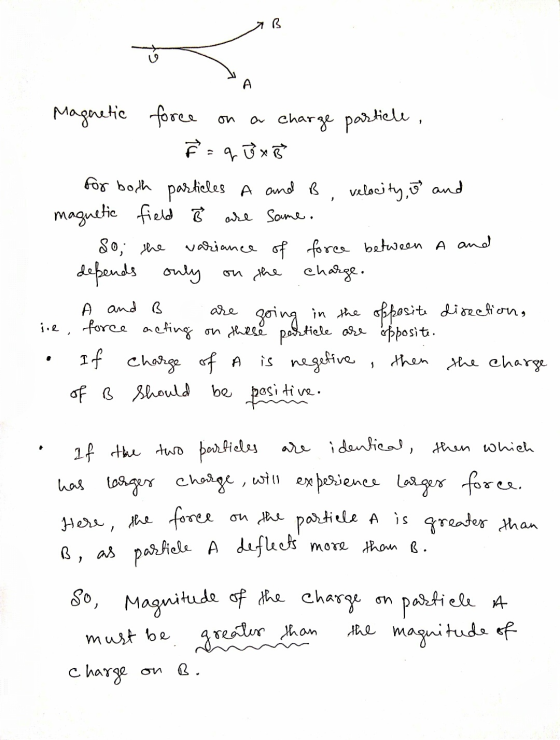
The paths of two particles (A and B) are shown in the diagram below. Their velocities...
Two particles, alpha and beta, with the same speed enter a region with a uniform magnetic...
 Two particles, alpha and beta, with the same speed enter a region with a uniform magnetic field is directed either into the page or out of the page and perpendicular to their velocities (in the figures, the magnetic field is zero in the unshaded region and non-zero in the shaded region). The particles have the same magnitude charge but different masses. Particle alpha is negative; particle beta is positive. The particle's trajectories are shown below: Which of the following statements...
Particles of various masses, charges, and speeds are injected into a region in which a uniform...
Particles of various masses, charges, and speeds are injected into a region in which a uniform E⃗ field and a uniform B⃗ field are perpendicular to each other. All the particles are initially moving in the same direction. Which two conditions must be simultaneously fulfilled for the particles to continue moving in a straight line after entering the region? Select the two correct statements. Please provide an explanation. The particles must have the same mass. The particles must have the same charge....
Five particles follow the paths shown in the figure as they pass through a magnetic field...
 Five particles follow the paths shown in the figure as they pass
through a magnetic field B, which is indicated by the dots or x's
in the figure (dot = out of the page, x = into page). What can you
conclude about the charge of each particle? (If your answers for
charges of particles 1, 2, 3, 4, and 5, are, respectively, +, 0, +,
-, 0, then enter: +0+-0 into the computer.)
Five particles follow the paths shown in the figure as they pass
through a magnetic field B, which is indicated by the dots or x's
in the figure (dot = out of the page, x = into page). What can you
conclude about the charge of each particle? (If your answers for
charges of particles 1, 2, 3, 4, and 5, are, respectively, +, 0, +,
-, 0, then enter: +0+-0 into the computer.)
3. The diagram below shows the trajectories of three charged particles moving in a uniform magnetic...
 3. The diagram below shows the trajectories of three charged
particles moving in a uniform magnetic field of strength B. The
field points into the plane of the paper. The particles are moving
in the plane of the paper. The direction in which each particle is
moving is shown by the arrows. (a) For each particle, find if the
charge is positive or negative (Q>0 or Q<0). Q1: Q2: Q3: (b)
Assume all particles have the same velocity (v) and...
3. The diagram below shows the trajectories of three charged
particles moving in a uniform magnetic field of strength B. The
field points into the plane of the paper. The particles are moving
in the plane of the paper. The direction in which each particle is
moving is shown by the arrows. (a) For each particle, find if the
charge is positive or negative (Q>0 or Q<0). Q1: Q2: Q3: (b)
Assume all particles have the same velocity (v) and...
Velocity Selector-multiple choice
 The Velocity SelectorIn experiments where all the charged particles in a beam are required to have the same velocity (for example, when entering a mass spectrometer), scientists use a velocity selector. A velocity selector has a region of uniform electric and magnetic fields that are perpendicular to each other and perpendicular to the motion of the charged particles. Both the electric and magnetic fields exert a force on the charged particles. If a particle has precisely the right velocity, the...
[3] Five particles follow the paths shown in the figure below as they pass through a...
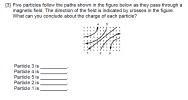 [3] Five particles follow the paths shown in the figure below as they pass through a magnetic field. The direction of the field is indicated by crosses in the figure What can you conclude about the charge of each particle? RX x X x X X X 2 Particle 3 is Particle 4 is Particle 5 is Particle 2 is Particle 1 is
have tried +-+0-, --+0+, +++0-, and --+0- and theyre all incorrect Five particles follow the paths...
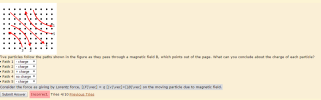 have tried +-+0-, --+0+, +++0-, and --+0- and theyre all
incorrect
Five particles follow the paths shown in the figure as they pass through a magnetic field B, which points out of the page. What can you conclude about the charge of each particle? Consider the force as giving by Lorentz force, [(F)\vec] = q [(v)\vec]x[(B)\vec] on the moving particle due to magnetic field.
have tried +-+0-, --+0+, +++0-, and --+0- and theyre all
incorrect
Five particles follow the paths shown in the figure as they pass through a magnetic field B, which points out of the page. What can you conclude about the charge of each particle? Consider the force as giving by Lorentz force, [(F)\vec] = q [(v)\vec]x[(B)\vec] on the moving particle due to magnetic field.
Physics problem 15 Two charged particles are moving with different speeds and directions. Charge q,--110. C BECAREFUL OF q1's SIGN) and q2 -3x10¹⁵ C. The diagram indicates their relative location...
 Physics problem
15 Two charged particles are moving with different speeds and directions. Charge q,--110. C BECAREFUL OF q1's SIGN) and q2 -3x10¹⁵ C. The diagram indicates their relative locations, speeds, and trajectories. v, 3000 m/s v2 2000 m/s 41 3 mm 42 4 mm what is the B-field (magnitude and direction) that particle #2 generates at particle #l's location? a) b) What is the magnitude of the magnetic force particle #1 is experiencing? c) What is the direction of...
Physics problem
15 Two charged particles are moving with different speeds and directions. Charge q,--110. C BECAREFUL OF q1's SIGN) and q2 -3x10¹⁵ C. The diagram indicates their relative locations, speeds, and trajectories. v, 3000 m/s v2 2000 m/s 41 3 mm 42 4 mm what is the B-field (magnitude and direction) that particle #2 generates at particle #l's location? a) b) What is the magnitude of the magnetic force particle #1 is experiencing? c) What is the direction of...
The drawing shows the paths taken by 4 different particles in an magnetic field that is...
 The drawing shows the paths taken by 4 different particles in an magnetic field that is directed into the paper. All four particles have the same mass and speed. List the particles in order of their charge magnitude, largest to smallest. B. into paper O 2, 1, 4,3 O 3, 2, 1,4 O 4, 1, 2, 3 O 4, 2, 1, 3 O 3, 4, 2, 1 The drawing shows the paths taken by 4 different particles in an magnetic...
Two charged particles are moving with equal velocities of 3.70 m/s in the +x-direction. At one...
Two charged particles are moving with equal velocities of 3.70 m/s in the +x-direction. At one instant of time the first particle with a charge of 8.60 ?C is located at x = 0 and y = +1.80 cm, and the second particle with a charge of -4.70 ?C is located at x = 0 and y = -1.80 cm. 1. What is the y-component of the magnetic force on the first particle due to the second? 2. How fast...
 Two particles, alpha and beta, with the same speed enter a region with a uniform magnetic field is directed either into the page or out of the page and perpendicular to their velocities (in the figures, the magnetic field is zero in the unshaded region and non-zero in the shaded region). The particles have the same magnitude charge but different masses. Particle alpha is negative; particle beta is positive. The particle's trajectories are shown below: Which of the following statements...
 Five particles follow the paths shown in the figure as they pass
through a magnetic field B, which is indicated by the dots or x's
in the figure (dot = out of the page, x = into page). What can you
conclude about the charge of each particle? (If your answers for
charges of particles 1, 2, 3, 4, and 5, are, respectively, +, 0, +,
-, 0, then enter: +0+-0 into the computer.)
Five particles follow the paths shown in the figure as they pass
through a magnetic field B, which is indicated by the dots or x's
in the figure (dot = out of the page, x = into page). What can you
conclude about the charge of each particle? (If your answers for
charges of particles 1, 2, 3, 4, and 5, are, respectively, +, 0, +,
-, 0, then enter: +0+-0 into the computer.)
 3. The diagram below shows the trajectories of three charged
particles moving in a uniform magnetic field of strength B. The
field points into the plane of the paper. The particles are moving
in the plane of the paper. The direction in which each particle is
moving is shown by the arrows. (a) For each particle, find if the
charge is positive or negative (Q>0 or Q<0). Q1: Q2: Q3: (b)
Assume all particles have the same velocity (v) and...
3. The diagram below shows the trajectories of three charged
particles moving in a uniform magnetic field of strength B. The
field points into the plane of the paper. The particles are moving
in the plane of the paper. The direction in which each particle is
moving is shown by the arrows. (a) For each particle, find if the
charge is positive or negative (Q>0 or Q<0). Q1: Q2: Q3: (b)
Assume all particles have the same velocity (v) and...
 [3] Five particles follow the paths shown in the figure below as they pass through a magnetic field. The direction of the field is indicated by crosses in the figure What can you conclude about the charge of each particle? RX x X x X X X 2 Particle 3 is Particle 4 is Particle 5 is Particle 2 is Particle 1 is
 have tried +-+0-, --+0+, +++0-, and --+0- and theyre all
incorrect
Five particles follow the paths shown in the figure as they pass through a magnetic field B, which points out of the page. What can you conclude about the charge of each particle? Consider the force as giving by Lorentz force, [(F)\vec] = q [(v)\vec]x[(B)\vec] on the moving particle due to magnetic field.
have tried +-+0-, --+0+, +++0-, and --+0- and theyre all
incorrect
Five particles follow the paths shown in the figure as they pass through a magnetic field B, which points out of the page. What can you conclude about the charge of each particle? Consider the force as giving by Lorentz force, [(F)\vec] = q [(v)\vec]x[(B)\vec] on the moving particle due to magnetic field.
 Physics problem
15 Two charged particles are moving with different speeds and directions. Charge q,--110. C BECAREFUL OF q1's SIGN) and q2 -3x10¹⁵ C. The diagram indicates their relative locations, speeds, and trajectories. v, 3000 m/s v2 2000 m/s 41 3 mm 42 4 mm what is the B-field (magnitude and direction) that particle #2 generates at particle #l's location? a) b) What is the magnitude of the magnetic force particle #1 is experiencing? c) What is the direction of...
Physics problem
15 Two charged particles are moving with different speeds and directions. Charge q,--110. C BECAREFUL OF q1's SIGN) and q2 -3x10¹⁵ C. The diagram indicates their relative locations, speeds, and trajectories. v, 3000 m/s v2 2000 m/s 41 3 mm 42 4 mm what is the B-field (magnitude and direction) that particle #2 generates at particle #l's location? a) b) What is the magnitude of the magnetic force particle #1 is experiencing? c) What is the direction of...
 The drawing shows the paths taken by 4 different particles in an magnetic field that is directed into the paper. All four particles have the same mass and speed. List the particles in order of their charge magnitude, largest to smallest. B. into paper O 2, 1, 4,3 O 3, 2, 1,4 O 4, 1, 2, 3 O 4, 2, 1, 3 O 3, 4, 2, 1 The drawing shows the paths taken by 4 different particles in an magnetic...
Most questions answered within 3 hours.
-
Where is the error in this code sequence?
String s1 = "Hello";
String s2 = "ello";...
asked 11 months ago -
Financial data for Joel de Paris, Inc., for last year
follow:
Joel de Paris, Inc.
Balance...
asked 11 months ago -
Consider this reaction:
Al2(SO4)3 (aq)+ BaCl3
(aq) Al2Cl6 (aq)- +
3BaSO4(s) . What is the...
asked 11 months ago -
Suppose that Savneet is considering increasing her
recent random sample from 20 car rentals to 40...
asked 11 months ago -
Trucks arrive at an unloading terminal at an average rate of 120
per hour.
Trucks arrive...
asked 11 months ago -
Why are methanol and ethanol completely soluble in water while
octanol is not very little soluble....
asked 11 months ago -
A facilities manager at a university reads in a research report
that the mean amount of...
asked 11 months ago -
When the CuSO4 is rehydrated by adding water to the anhydrous
compound, is this an endothermic...
asked 11 months ago -
A ray of sunlight is passing from diamond into crown glass; the
angle of incidence is...
asked 11 months ago -
A block of mass 0.249 kg is placed on top of a light, vertical
spring of...
asked 11 months ago -
how do the kidneys compensate in the presences of acidosis
a) trigger hyperventilate
b) reserve acid...
asked 11 months ago -
Question 501 pts
The rental rate of capital to the firm increases. Which of the
following...
asked 11 months ago