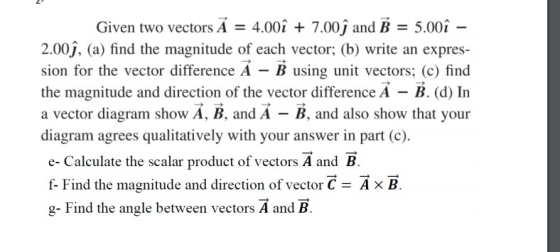
Can you please answer all parts with explanations trying to figure out where i am going wrong.
Homework Answers
Ans:
In general, a vector is defined as
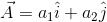
 .
.
Given:

a) The magnitude of each vector
In general, the magnitude of a vector can be defined as,





b) Vector difference:



c) The magnitude of the vector difference:

e) Calculate the scalar product of vectors :

f) Find the magnitude and direction of the
vector 


g) Angle between vectors A and B:




Add Answer to:
Can you please answer all parts with explanations trying to
figure out where i am going...
I am getting stuck with the algebra solving for V2f/getting the wrong answer, but i'm not...
 I am getting stuck with the algebra solving
for V2f/getting the wrong answer, but i'm not sure where im going
wrong-- please show all steps in a handwritten solution. Thank
you!!
A proton that has a mass m and is moving at 310 m/s in the +î direction undergoes a head-on elastic collision with a stationary carbon nucleus of mass 12m. Find the velocities of the proton and the carbon nucleus after the collision. Vp m/s î V carbon =...
I am getting stuck with the algebra solving
for V2f/getting the wrong answer, but i'm not sure where im going
wrong-- please show all steps in a handwritten solution. Thank
you!!
A proton that has a mass m and is moving at 310 m/s in the +î direction undergoes a head-on elastic collision with a stationary carbon nucleus of mass 12m. Find the velocities of the proton and the carbon nucleus after the collision. Vp m/s î V carbon =...
Full answers and working out please. B -B (A+B) (B+A) (A-B) B FIGURE 1.3 FIGURE 1.4...
 Full answers and working out please.
B -B (A+B) (B+A) (A-B) B FIGURE 1.3 FIGURE 1.4 (1) Addition of two vectors. Place the tail of B at the head of A; the sum, A+B, is the vector from the tail of A to the head of B (Fig. 1.3). (This rule generalizes the obvious procedure for combining two displacements. Addition is commutative: A+B=B+A; 3 miles east followed by 4 miles north gets you to the same place as 4 miles...
Full answers and working out please.
B -B (A+B) (B+A) (A-B) B FIGURE 1.3 FIGURE 1.4 (1) Addition of two vectors. Place the tail of B at the head of A; the sum, A+B, is the vector from the tail of A to the head of B (Fig. 1.3). (This rule generalizes the obvious procedure for combining two displacements. Addition is commutative: A+B=B+A; 3 miles east followed by 4 miles north gets you to the same place as 4 miles...
Can someone solve #6, that’s the one I don’t understand Phys 11A HW1 to grade Find...
 Can someone solve #6, that’s the one I don’t understand
Phys 11A HW1 to grade Find the components of the three vectors as shown. a-8m, b-6m, c-5m. Find a +b-c both, graphically and analytically 1. 30° 40° 20 2. Findi j+ k in unit-vector notations. Is it a unit-vector? Justify your answer 3. Vector a is 3m long and is 60° above x-axis in the first quadrant. Vector b is 5m long and is 50° below the x-axis in the...
Can someone solve #6, that’s the one I don’t understand
Phys 11A HW1 to grade Find the components of the three vectors as shown. a-8m, b-6m, c-5m. Find a +b-c both, graphically and analytically 1. 30° 40° 20 2. Findi j+ k in unit-vector notations. Is it a unit-vector? Justify your answer 3. Vector a is 3m long and is 60° above x-axis in the first quadrant. Vector b is 5m long and is 50° below the x-axis in the...
Hi, I need the full worked solution/explanations for ALL parts of this question please. Please do...
 Hi, I need the full worked
solution/explanations for ALL parts of
this question please. Please do not skip steps and
underline all final answers. The final answers to all
parts are provided below the question. Neat handwriting is greatly
appreciated. Thank you! :)
Question 4 Consider the contour curve given by (а) Identify a unit vector perpendicular to the curve at the point (-1, 1) (4 marks) (b) Consider the scalar field fx, y, )y-y+xyz Identify the maximum value of...
Hi, I need the full worked
solution/explanations for ALL parts of
this question please. Please do not skip steps and
underline all final answers. The final answers to all
parts are provided below the question. Neat handwriting is greatly
appreciated. Thank you! :)
Question 4 Consider the contour curve given by (а) Identify a unit vector perpendicular to the curve at the point (-1, 1) (4 marks) (b) Consider the scalar field fx, y, )y-y+xyz Identify the maximum value of...
Please answer all. The displacement vectors A and B shown in the figure below both have...
 Please answer all.
The displacement vectors A and B shown in the figure below both have magnitudes of 3.70 m. The direction of vector A is θ = 38.5° (a) Find A B graphically magnitude direction o counterclockwise from the +x axis (b) Find A B graphically magnitude direction o counterclockwise from the +x axis (c) Find B A graphically magnitude direction o counterclockwise from the +x axis (d) Find A 2B graphically magnitude direction o counterclockwise from the +x...
Please answer all.
The displacement vectors A and B shown in the figure below both have magnitudes of 3.70 m. The direction of vector A is θ = 38.5° (a) Find A B graphically magnitude direction o counterclockwise from the +x axis (b) Find A B graphically magnitude direction o counterclockwise from the +x axis (c) Find B A graphically magnitude direction o counterclockwise from the +x axis (d) Find A 2B graphically magnitude direction o counterclockwise from the +x...
If you understand how to add vectors, you can skip to the final paragraph where the...
If you understand how to add vectors, you can skip to the final paragraph where the problem is stated. To add vectors together, draw each vector on its own graph with the base on the origin and the arrow head drawn in the direction of the vector. The length of the vector is the magnitude. Make a right triangle with the vector as the hypotenuse. Use trig to find the two sides of the right triangle. The side along the...
Please solve using matlab and show your work so I can see where I am going...
 Please solve using matlab and show your work so I can see where
I am going wrong. Your help is appreciated
(12 points) Use polynomial interpolation and central difference techniques to compute f and f at x 0.5 using the following unequally spaced data. 1.0 0.0 2.0 f(x) 15.0 2.0 11.0 Hint: fit a parabola through the three data points.
Please solve using matlab and show your work so I can see where
I am going wrong. Your help is appreciated
(12 points) Use polynomial interpolation and central difference techniques to compute f and f at x 0.5 using the following unequally spaced data. 1.0 0.0 2.0 f(x) 15.0 2.0 11.0 Hint: fit a parabola through the three data points.
Please show all work and explain steps So that I can see where I am going...
 Please show all work and explain steps So that I can see where I
am going wrong.
After having been in position 1 for a long time, the switch in the circuit as shown below was moved to position 2 at t-os, were Vo-14 V, R1-2 Ω, R2 = 148 Ω, R3-40 Ω, and L-1 H OL (a) Determine () and VL(O) iL(:0.000 (A); VL(o):0.000 (V) You are correct ies ur receipt no. is 146-1674 (b) Determine iL(O) and Vi(O):...
Please show all work and explain steps So that I can see where I
am going wrong.
After having been in position 1 for a long time, the switch in the circuit as shown below was moved to position 2 at t-os, were Vo-14 V, R1-2 Ω, R2 = 148 Ω, R3-40 Ω, and L-1 H OL (a) Determine () and VL(O) iL(:0.000 (A); VL(o):0.000 (V) You are correct ies ur receipt no. is 146-1674 (b) Determine iL(O) and Vi(O):...
Simple AC circuit problem (I WILL DOWNVOTE IF YOU DO NOT EXPLAIN WHERE I AM GOING...
Simple AC circuit problem (I WILL DOWNVOTE IF YOU DO NOT EXPLAIN WHERE I AM GOING WRONG). Problem: Obtain the overall impedance Z given the following info: Real Power = 1000 W, Power Factor = 0.8 leading, Vrms = 220 V I am doing the following: Get the power angle phi by taking the inverse cosine of Power Factor. phi = 36.87 degrees. From the power triangle, Q = (Real Power) x tan(phi). Q = 750. S = P +...
Please answer step C: I have the answer, but am not following the substitution of the...
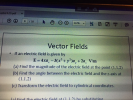 Please answer step C: I have
the answer, but am not following the substitution of the trig
transform identities.
apter123.pdfx 8 18 117% Vector Fields If an electric field is given by . (a) Find the magnitude of the electric field at the point (1.1,2) (b) Find the angle between the electric field and the z-axis at (c) Transform the electric field to cylindrical coordinates
Please answer step C: I have
the answer, but am not following the substitution of the trig
transform identities.
apter123.pdfx 8 18 117% Vector Fields If an electric field is given by . (a) Find the magnitude of the electric field at the point (1.1,2) (b) Find the angle between the electric field and the z-axis at (c) Transform the electric field to cylindrical coordinates
 I am getting stuck with the algebra solving
for V2f/getting the wrong answer, but i'm not sure where im going
wrong-- please show all steps in a handwritten solution. Thank
you!!
A proton that has a mass m and is moving at 310 m/s in the +î direction undergoes a head-on elastic collision with a stationary carbon nucleus of mass 12m. Find the velocities of the proton and the carbon nucleus after the collision. Vp m/s î V carbon =...
I am getting stuck with the algebra solving
for V2f/getting the wrong answer, but i'm not sure where im going
wrong-- please show all steps in a handwritten solution. Thank
you!!
A proton that has a mass m and is moving at 310 m/s in the +î direction undergoes a head-on elastic collision with a stationary carbon nucleus of mass 12m. Find the velocities of the proton and the carbon nucleus after the collision. Vp m/s î V carbon =...
 Full answers and working out please.
B -B (A+B) (B+A) (A-B) B FIGURE 1.3 FIGURE 1.4 (1) Addition of two vectors. Place the tail of B at the head of A; the sum, A+B, is the vector from the tail of A to the head of B (Fig. 1.3). (This rule generalizes the obvious procedure for combining two displacements. Addition is commutative: A+B=B+A; 3 miles east followed by 4 miles north gets you to the same place as 4 miles...
Full answers and working out please.
B -B (A+B) (B+A) (A-B) B FIGURE 1.3 FIGURE 1.4 (1) Addition of two vectors. Place the tail of B at the head of A; the sum, A+B, is the vector from the tail of A to the head of B (Fig. 1.3). (This rule generalizes the obvious procedure for combining two displacements. Addition is commutative: A+B=B+A; 3 miles east followed by 4 miles north gets you to the same place as 4 miles...
 Can someone solve #6, that’s the one I don’t understand
Phys 11A HW1 to grade Find the components of the three vectors as shown. a-8m, b-6m, c-5m. Find a +b-c both, graphically and analytically 1. 30° 40° 20 2. Findi j+ k in unit-vector notations. Is it a unit-vector? Justify your answer 3. Vector a is 3m long and is 60° above x-axis in the first quadrant. Vector b is 5m long and is 50° below the x-axis in the...
Can someone solve #6, that’s the one I don’t understand
Phys 11A HW1 to grade Find the components of the three vectors as shown. a-8m, b-6m, c-5m. Find a +b-c both, graphically and analytically 1. 30° 40° 20 2. Findi j+ k in unit-vector notations. Is it a unit-vector? Justify your answer 3. Vector a is 3m long and is 60° above x-axis in the first quadrant. Vector b is 5m long and is 50° below the x-axis in the...
 Hi, I need the full worked
solution/explanations for ALL parts of
this question please. Please do not skip steps and
underline all final answers. The final answers to all
parts are provided below the question. Neat handwriting is greatly
appreciated. Thank you! :)
Question 4 Consider the contour curve given by (а) Identify a unit vector perpendicular to the curve at the point (-1, 1) (4 marks) (b) Consider the scalar field fx, y, )y-y+xyz Identify the maximum value of...
Hi, I need the full worked
solution/explanations for ALL parts of
this question please. Please do not skip steps and
underline all final answers. The final answers to all
parts are provided below the question. Neat handwriting is greatly
appreciated. Thank you! :)
Question 4 Consider the contour curve given by (а) Identify a unit vector perpendicular to the curve at the point (-1, 1) (4 marks) (b) Consider the scalar field fx, y, )y-y+xyz Identify the maximum value of...
 Please answer all.
The displacement vectors A and B shown in the figure below both have magnitudes of 3.70 m. The direction of vector A is θ = 38.5° (a) Find A B graphically magnitude direction o counterclockwise from the +x axis (b) Find A B graphically magnitude direction o counterclockwise from the +x axis (c) Find B A graphically magnitude direction o counterclockwise from the +x axis (d) Find A 2B graphically magnitude direction o counterclockwise from the +x...
Please answer all.
The displacement vectors A and B shown in the figure below both have magnitudes of 3.70 m. The direction of vector A is θ = 38.5° (a) Find A B graphically magnitude direction o counterclockwise from the +x axis (b) Find A B graphically magnitude direction o counterclockwise from the +x axis (c) Find B A graphically magnitude direction o counterclockwise from the +x axis (d) Find A 2B graphically magnitude direction o counterclockwise from the +x...
 Please solve using matlab and show your work so I can see where
I am going wrong. Your help is appreciated
(12 points) Use polynomial interpolation and central difference techniques to compute f and f at x 0.5 using the following unequally spaced data. 1.0 0.0 2.0 f(x) 15.0 2.0 11.0 Hint: fit a parabola through the three data points.
Please solve using matlab and show your work so I can see where
I am going wrong. Your help is appreciated
(12 points) Use polynomial interpolation and central difference techniques to compute f and f at x 0.5 using the following unequally spaced data. 1.0 0.0 2.0 f(x) 15.0 2.0 11.0 Hint: fit a parabola through the three data points.
 Please show all work and explain steps So that I can see where I
am going wrong.
After having been in position 1 for a long time, the switch in the circuit as shown below was moved to position 2 at t-os, were Vo-14 V, R1-2 Ω, R2 = 148 Ω, R3-40 Ω, and L-1 H OL (a) Determine () and VL(O) iL(:0.000 (A); VL(o):0.000 (V) You are correct ies ur receipt no. is 146-1674 (b) Determine iL(O) and Vi(O):...
Please show all work and explain steps So that I can see where I
am going wrong.
After having been in position 1 for a long time, the switch in the circuit as shown below was moved to position 2 at t-os, were Vo-14 V, R1-2 Ω, R2 = 148 Ω, R3-40 Ω, and L-1 H OL (a) Determine () and VL(O) iL(:0.000 (A); VL(o):0.000 (V) You are correct ies ur receipt no. is 146-1674 (b) Determine iL(O) and Vi(O):...
 Please answer step C: I have
the answer, but am not following the substitution of the trig
transform identities.
apter123.pdfx 8 18 117% Vector Fields If an electric field is given by . (a) Find the magnitude of the electric field at the point (1.1,2) (b) Find the angle between the electric field and the z-axis at (c) Transform the electric field to cylindrical coordinates
Please answer step C: I have
the answer, but am not following the substitution of the trig
transform identities.
apter123.pdfx 8 18 117% Vector Fields If an electric field is given by . (a) Find the magnitude of the electric field at the point (1.1,2) (b) Find the angle between the electric field and the z-axis at (c) Transform the electric field to cylindrical coordinates
Most questions answered within 3 hours.
-
Where is the error in this code sequence?
String s1 = "Hello";
String s2 = "ello";...
asked 10 months ago -
Financial data for Joel de Paris, Inc., for last year
follow:
Joel de Paris, Inc.
Balance...
asked 10 months ago -
Consider this reaction:
Al2(SO4)3 (aq)+ BaCl3
(aq) Al2Cl6 (aq)- +
3BaSO4(s) . What is the...
asked 10 months ago -
Suppose that Savneet is considering increasing her
recent random sample from 20 car rentals to 40...
asked 10 months ago -
Trucks arrive at an unloading terminal at an average rate of 120
per hour.
Trucks arrive...
asked 10 months ago -
Why are methanol and ethanol completely soluble in water while
octanol is not very little soluble....
asked 10 months ago -
A facilities manager at a university reads in a research report
that the mean amount of...
asked 10 months ago -
When the CuSO4 is rehydrated by adding water to the anhydrous
compound, is this an endothermic...
asked 10 months ago -
A ray of sunlight is passing from diamond into crown glass; the
angle of incidence is...
asked 10 months ago -
A block of mass 0.249 kg is placed on top of a light, vertical
spring of...
asked 10 months ago -
how do the kidneys compensate in the presences of acidosis
a) trigger hyperventilate
b) reserve acid...
asked 10 months ago -
Question 501 pts
The rental rate of capital to the firm increases. Which of the
following...
asked 10 months ago