


Homework Answers


Add Answer to:
Question 2 Figure 2: Flow between two inclined plates Consider a two-dimensional plates, as shown in...
1. As seenfrom figure, there is a laminar and viscous fluid flow betweentwo parallel plates where...
 1. As seenfrom figure, there is a laminar and viscous fluid flow betweentwo parallel plates where the one is moving with velocity y, other one is stationary. There exists pressure gradient in x direction. The bottom stationary plate is a porous plate andfluid is injected into the channel with V velocity. If theflow is steady, fully developed and incompressible flow, derive the velocity profile. Uo Vo
1. As seenfrom figure, there is a laminar and viscous fluid flow betweentwo parallel...
1. As seenfrom figure, there is a laminar and viscous fluid flow betweentwo parallel plates where the one is moving with velocity y, other one is stationary. There exists pressure gradient in x direction. The bottom stationary plate is a porous plate andfluid is injected into the channel with V velocity. If theflow is steady, fully developed and incompressible flow, derive the velocity profile. Uo Vo
1. As seenfrom figure, there is a laminar and viscous fluid flow betweentwo parallel...
A fluid shown in (Figure 2) flows through the narrow region AB between two smooth plates...
 A fluid shown in (Figure 2) flows through the narrow region AB between two smooth plates that are 20 mm apart and 2 m deep. Use the x- and y-axis intersection as the origin. If the change in pressure is PB-PA-5 kPa, determine the volumetric flow rate through region AB. Assume the fluid is a Newtonian fluid with a viscosity of 0.148 N -s/m2 and density of p 960 kg/m3. Express your answer in the appropriate units to three significant...
4. Consider fully developed Couette flow-flow between two infinite parallel plates separated by distance h, with...
 4. Consider fully developed Couette flow-flow between two infinite parallel plates separated by distance h, with the top plate moving and the bottom plate stationary. The flow is steady, incompressible, and two-dimensional in the xy- plane. Use the method of repeating variables to generate a dimensionless relationship for the x component of fluid velocity u as a function of fluid viscosity , top plate speed V, distance h, fluid density p, and distance y Show all your work. Hint: u...
I asked this previously and wasn't given an answer, just methods that I could use. It...
 I asked this previously and wasn't given an answer, just methods
that I could use. It was really unhelpful. I woudl thankful to
whoever actually solves this.
Question 2 free surface fluid 1 fluid 2 fR h2 plate moves at constant speed U Figure 2: Bottom plate moves at constant speed under two unmixed fluids Consider a two-dimensional Newtonian, steady state, incompressible flow of two fluids over an infinite horizontal plate moving at speed U 1 m/s, as shown in...
I asked this previously and wasn't given an answer, just methods
that I could use. It was really unhelpful. I woudl thankful to
whoever actually solves this.
Question 2 free surface fluid 1 fluid 2 fR h2 plate moves at constant speed U Figure 2: Bottom plate moves at constant speed under two unmixed fluids Consider a two-dimensional Newtonian, steady state, incompressible flow of two fluids over an infinite horizontal plate moving at speed U 1 m/s, as shown in...
Consider a fully developed laminar flow of an incompressible Newtonian fluid between two infinite parallel plates,...
 Consider a fully developed laminar flow of an incompressible
Newtonian fluid between two infinite parallel plates, separated by
a distance of 2B. The z coordinate is the direction of the flow.
The width of the plates is 2W (direction y). The coordinate axis is
located half of the 2 plates.
a) Obtain the distribution of speeds in steady state.
b) Obtain the expression for the maximum velocity and write the
velocity distribution of part a) as a function of the...
Consider a fully developed laminar flow of an incompressible
Newtonian fluid between two infinite parallel plates, separated by
a distance of 2B. The z coordinate is the direction of the flow.
The width of the plates is 2W (direction y). The coordinate axis is
located half of the 2 plates.
a) Obtain the distribution of speeds in steady state.
b) Obtain the expression for the maximum velocity and write the
velocity distribution of part a) as a function of the...
10. Immiscible fluids Two immiscible incompressible Newtonian fluids flow together through in thedirection two lates separated...
 10. Immiscible fluids Two immiscible incompressible Newtonian fluids flow together through in thedirection two lates separated by a distance H in the y-direction. Let us make thé top plate /move with ection while fixing the bottom plate. At steady state, however, there be a little slip velocity of the more dense fluid only at the lower boundary The flow constant vetocity V in the x-dir is ynidirectional and faminar. For convenience, we take that x is the flow direction and...
2. Consider a polymer (with density p and viscosity u) flowing in between two parallel plates...
 2. Consider a polymer (with density p and viscosity u) flowing in between two parallel plates in a vertical position. Both plates are stationary at x = 0 and x = h. A downward pressure is applied - dp/dz which is constant across the z-direction, which is also aided by gravity acting on the negative z-direction. Starting with the Navier-Stokes equations, find the simplified equation that defines the fluid velocity vz. State your assumptions to achieve this simplified equation. (7pts)...
Consider the two-dimensional, incompressible flow with constant properties in the entry region of a horizontal channel...
 Consider the two-dimensional, incompressible flow with constant properties in the entry region of a horizontal channel shown in the figure below To- a) Write the ful equations for conservation of mass and of momentum in the r and y directions, and the equation of thermal energy. (10) (b) Simplify the equations, as they apply to this case. Explain your simplifications. (10) (c) Nondimensionalize the simplified governing equations, defining your nondimensional pa- rameters. (10) (d) Simplify the nondimensional equations for the...
4. A laminar, one-dimensional flow far from the entrance is occurring between two parallel plates, as...
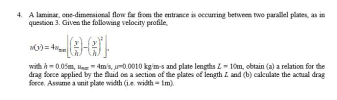 4. A laminar, one-dimensional flow far from the entrance is occurring between two parallel plates, as in question 3. Given the following velocity profile, 11(y)= 4ux with h = 0.05m, Umax = 4m/s. u=0.0010 kg/m-s and plate lengths L = 10m, obtain (a) a relation for the drag force applied by the fluid on a section of the plates of length L and (b) calculate the actual drag force. Assume a unit plate width (i.e. width = 1m).
please solve (va20) for me thanks!! :) V VISCOUS FLOWS Page 38 nar flow between two infinite plates a distance h apart driven by a pressure gra- Va20. For lami dient, the velocity profile is [constan...
 please solve (va20) for me thanks!! :)
V VISCOUS FLOWS Page 38 nar flow between two infinite plates a distance h apart driven by a pressure gra- Va20. For lami dient, the velocity profile is [constant] [linear] [parabolic] [hyperbolic] [elliptic] [error func- tion], and the flow rate Q is proportional to h to the power is driven by the top plate moving at a speed U in the absence of any pressure gradient, the velocity profile is [constant] linearl Iparabolic]...
please solve (va20) for me thanks!! :)
V VISCOUS FLOWS Page 38 nar flow between two infinite plates a distance h apart driven by a pressure gra- Va20. For lami dient, the velocity profile is [constant] [linear] [parabolic] [hyperbolic] [elliptic] [error func- tion], and the flow rate Q is proportional to h to the power is driven by the top plate moving at a speed U in the absence of any pressure gradient, the velocity profile is [constant] linearl Iparabolic]...
 1. As seenfrom figure, there is a laminar and viscous fluid flow betweentwo parallel plates where the one is moving with velocity y, other one is stationary. There exists pressure gradient in x direction. The bottom stationary plate is a porous plate andfluid is injected into the channel with V velocity. If theflow is steady, fully developed and incompressible flow, derive the velocity profile. Uo Vo
1. As seenfrom figure, there is a laminar and viscous fluid flow betweentwo parallel...
1. As seenfrom figure, there is a laminar and viscous fluid flow betweentwo parallel plates where the one is moving with velocity y, other one is stationary. There exists pressure gradient in x direction. The bottom stationary plate is a porous plate andfluid is injected into the channel with V velocity. If theflow is steady, fully developed and incompressible flow, derive the velocity profile. Uo Vo
1. As seenfrom figure, there is a laminar and viscous fluid flow betweentwo parallel...
 A fluid shown in (Figure 2) flows through the narrow region AB between two smooth plates that are 20 mm apart and 2 m deep. Use the x- and y-axis intersection as the origin. If the change in pressure is PB-PA-5 kPa, determine the volumetric flow rate through region AB. Assume the fluid is a Newtonian fluid with a viscosity of 0.148 N -s/m2 and density of p 960 kg/m3. Express your answer in the appropriate units to three significant...
 4. Consider fully developed Couette flow-flow between two infinite parallel plates separated by distance h, with the top plate moving and the bottom plate stationary. The flow is steady, incompressible, and two-dimensional in the xy- plane. Use the method of repeating variables to generate a dimensionless relationship for the x component of fluid velocity u as a function of fluid viscosity , top plate speed V, distance h, fluid density p, and distance y Show all your work. Hint: u...
 I asked this previously and wasn't given an answer, just methods
that I could use. It was really unhelpful. I woudl thankful to
whoever actually solves this.
Question 2 free surface fluid 1 fluid 2 fR h2 plate moves at constant speed U Figure 2: Bottom plate moves at constant speed under two unmixed fluids Consider a two-dimensional Newtonian, steady state, incompressible flow of two fluids over an infinite horizontal plate moving at speed U 1 m/s, as shown in...
I asked this previously and wasn't given an answer, just methods
that I could use. It was really unhelpful. I woudl thankful to
whoever actually solves this.
Question 2 free surface fluid 1 fluid 2 fR h2 plate moves at constant speed U Figure 2: Bottom plate moves at constant speed under two unmixed fluids Consider a two-dimensional Newtonian, steady state, incompressible flow of two fluids over an infinite horizontal plate moving at speed U 1 m/s, as shown in...
 Consider a fully developed laminar flow of an incompressible
Newtonian fluid between two infinite parallel plates, separated by
a distance of 2B. The z coordinate is the direction of the flow.
The width of the plates is 2W (direction y). The coordinate axis is
located half of the 2 plates.
a) Obtain the distribution of speeds in steady state.
b) Obtain the expression for the maximum velocity and write the
velocity distribution of part a) as a function of the...
Consider a fully developed laminar flow of an incompressible
Newtonian fluid between two infinite parallel plates, separated by
a distance of 2B. The z coordinate is the direction of the flow.
The width of the plates is 2W (direction y). The coordinate axis is
located half of the 2 plates.
a) Obtain the distribution of speeds in steady state.
b) Obtain the expression for the maximum velocity and write the
velocity distribution of part a) as a function of the...
 10. Immiscible fluids Two immiscible incompressible Newtonian fluids flow together through in thedirection two lates separated by a distance H in the y-direction. Let us make thé top plate /move with ection while fixing the bottom plate. At steady state, however, there be a little slip velocity of the more dense fluid only at the lower boundary The flow constant vetocity V in the x-dir is ynidirectional and faminar. For convenience, we take that x is the flow direction and...
 2. Consider a polymer (with density p and viscosity u) flowing in between two parallel plates in a vertical position. Both plates are stationary at x = 0 and x = h. A downward pressure is applied - dp/dz which is constant across the z-direction, which is also aided by gravity acting on the negative z-direction. Starting with the Navier-Stokes equations, find the simplified equation that defines the fluid velocity vz. State your assumptions to achieve this simplified equation. (7pts)...
 Consider the two-dimensional, incompressible flow with constant properties in the entry region of a horizontal channel shown in the figure below To- a) Write the ful equations for conservation of mass and of momentum in the r and y directions, and the equation of thermal energy. (10) (b) Simplify the equations, as they apply to this case. Explain your simplifications. (10) (c) Nondimensionalize the simplified governing equations, defining your nondimensional pa- rameters. (10) (d) Simplify the nondimensional equations for the...
 4. A laminar, one-dimensional flow far from the entrance is occurring between two parallel plates, as in question 3. Given the following velocity profile, 11(y)= 4ux with h = 0.05m, Umax = 4m/s. u=0.0010 kg/m-s and plate lengths L = 10m, obtain (a) a relation for the drag force applied by the fluid on a section of the plates of length L and (b) calculate the actual drag force. Assume a unit plate width (i.e. width = 1m).
 please solve (va20) for me thanks!! :)
V VISCOUS FLOWS Page 38 nar flow between two infinite plates a distance h apart driven by a pressure gra- Va20. For lami dient, the velocity profile is [constant] [linear] [parabolic] [hyperbolic] [elliptic] [error func- tion], and the flow rate Q is proportional to h to the power is driven by the top plate moving at a speed U in the absence of any pressure gradient, the velocity profile is [constant] linearl Iparabolic]...
please solve (va20) for me thanks!! :)
V VISCOUS FLOWS Page 38 nar flow between two infinite plates a distance h apart driven by a pressure gra- Va20. For lami dient, the velocity profile is [constant] [linear] [parabolic] [hyperbolic] [elliptic] [error func- tion], and the flow rate Q is proportional to h to the power is driven by the top plate moving at a speed U in the absence of any pressure gradient, the velocity profile is [constant] linearl Iparabolic]...
Most questions answered within 3 hours.
-
Where is the error in this code sequence?
String s1 = "Hello";
String s2 = "ello";...
asked 10 months ago -
Financial data for Joel de Paris, Inc., for last year
follow:
Joel de Paris, Inc.
Balance...
asked 10 months ago -
Consider this reaction:
Al2(SO4)3 (aq)+ BaCl3
(aq) Al2Cl6 (aq)- +
3BaSO4(s) . What is the...
asked 10 months ago -
Suppose that Savneet is considering increasing her
recent random sample from 20 car rentals to 40...
asked 10 months ago -
Trucks arrive at an unloading terminal at an average rate of 120
per hour.
Trucks arrive...
asked 10 months ago -
Why are methanol and ethanol completely soluble in water while
octanol is not very little soluble....
asked 10 months ago -
A facilities manager at a university reads in a research report
that the mean amount of...
asked 10 months ago -
When the CuSO4 is rehydrated by adding water to the anhydrous
compound, is this an endothermic...
asked 10 months ago -
A ray of sunlight is passing from diamond into crown glass; the
angle of incidence is...
asked 10 months ago -
A block of mass 0.249 kg is placed on top of a light, vertical
spring of...
asked 10 months ago -
how do the kidneys compensate in the presences of acidosis
a) trigger hyperventilate
b) reserve acid...
asked 10 months ago -
Question 501 pts
The rental rate of capital to the firm increases. Which of the
following...
asked 10 months ago