
Homework Answers
![レ。 )보 elument dヌ Yn し7% dィ F ) -L. ]喋d.ld. anial adntio Aadns conduction](http://img.homeworklib.com/images/9ad32dd6-093c-4a70-a949-15d92e4f4e75.png?x-oss-process=image/resize,w_560)
Add Answer to:
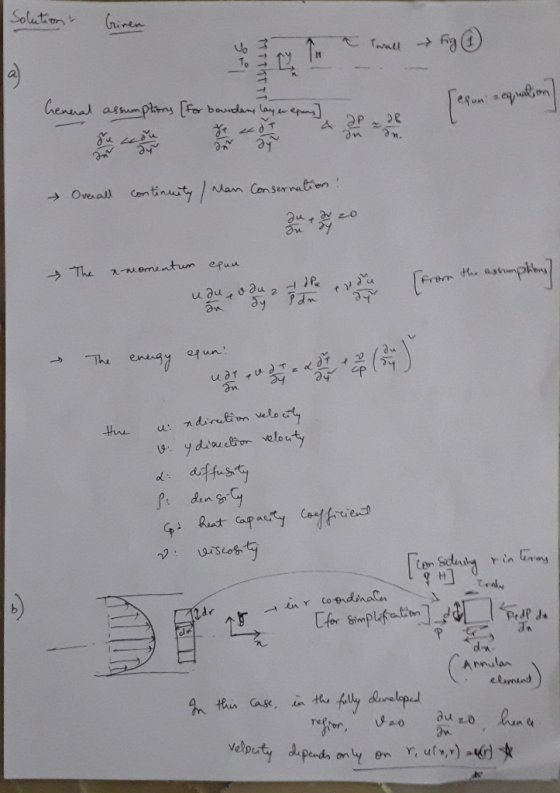
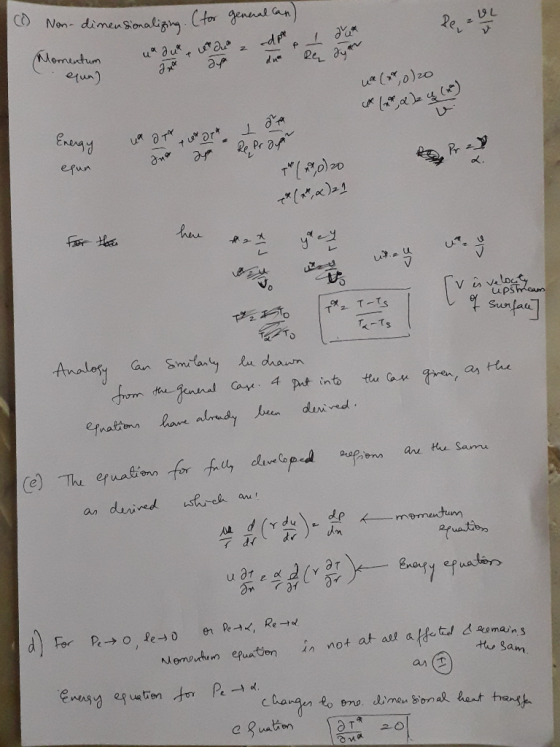
Consider the two-dimensional, incompressible flow with constant properties in the entry region of a horizontal channel...
Problem 5. Consider a (i) steady, (ii) incompressible, axisymmetric, (iv) fully- developed, (v) constant viscosity, (vi) laminar flow in a circular pipe. Assume that the pipe is horizontal, so that a...
 Problem 5. Consider a (i) steady, (ii) incompressible, axisymmetric, (iv) fully- developed, (v) constant viscosity, (vi) laminar flow in a circular pipe. Assume that the pipe is horizontal, so that any gravitational effects can be ignored It is known that an incompressible, constant viscosity fluid can be described by the continuity equation in cylindrical coordinates together with the Naiver-Stokes equations (ak.a., momentum eqns) in cylindrical coor- dinates Ov 00. Or 9-moment um 11ap 2-momentum plus the appropriate boundary conditions. Starting...
Problem 7 (20 Points Fully developed flow between two, flate, infinite, parallel plates can be described...
 Problem 7 (20 Points Fully developed flow between two, flate, infinite, parallel plates can be described using the boundary layer equation in nondimensional terms where Note that D is the separation distance between the plates and V is the velocity of the upper plate. There are two very important simplifications that can be made to this equation in fully developed internal flow. Make these simplifications and solve for u* as a function of y* (get me the equation of u'...
Consider a two-dimensional, fully-developed, steady viscous flow of water through a duct of constant one-centimeter width...
 Consider a two-dimensional, fully-developed, steady viscous flow of water through a duct of constant one-centimeter width in the y-direction. There is no pressure variation through the flow but the water flows in the positive x-direction, which is the direction of the gravity force. $y = 0 and gx = g. (a) Using the continuity and momentum equations, determine the magnitude of the v component of velocity and develop the ordinary differential equation that governs the u component of velocity. (b)...
Please make the hand writing legible. Thanks Consider the situation depicted below, in which an incompressible...
 Please make the hand writing legible. Thanks
Consider the situation depicted below, in which an incompressible fluid flows over a flat surface of solid. Upstream of the surface, the fluid has velocity U and uniform temperature To. As the fluid is viscous, both a momentum boundary layer, and a thermal boundary layer form, and heat is transferred to the solid surface. A convective coefficient h can be used to describe the dimensional heat transfer rate to the solid, and is...
Please make the hand writing legible. Thanks
Consider the situation depicted below, in which an incompressible fluid flows over a flat surface of solid. Upstream of the surface, the fluid has velocity U and uniform temperature To. As the fluid is viscous, both a momentum boundary layer, and a thermal boundary layer form, and heat is transferred to the solid surface. A convective coefficient h can be used to describe the dimensional heat transfer rate to the solid, and is...
Question 2 Figure 2: Flow between two inclined plates Consider a two-dimensional plates, as shown in...
 Question 2 Figure 2: Flow between two inclined plates Consider a two-dimensional plates, as shown in figure 2. Assume that pressure increases 30°. Acceleration due t o Pa and the channel height is h 10 cm inclined at te the velocity profile of the flow. State your assumptions and show your work. onal Newtonian, steady state, incompressible flow of a fluid be- by 1 kPa/ a dynamic viscosity of H1-1 x 10 amic viscosity of uo wall towards the right....
Consider the steady, incompressible flow of depth h of a liquid of known density ρ and...
 Consider the steady, incompressible flow of depth h of a liquid
of known density ρ and unknown viscosity µ down a flat plate as
shown in Figure 1. Air is the fluid above the liquid layer. The
force of gravity is in the vertical direction with acceleration g,
and the plate is at an angle θ with respect to the horizontal.
Assuming the coordinate system as shown, with x aligned with the
flow direction, and y normal to the plate,...
Consider the steady, incompressible flow of depth h of a liquid
of known density ρ and unknown viscosity µ down a flat plate as
shown in Figure 1. Air is the fluid above the liquid layer. The
force of gravity is in the vertical direction with acceleration g,
and the plate is at an angle θ with respect to the horizontal.
Assuming the coordinate system as shown, with x aligned with the
flow direction, and y normal to the plate,...
Consider the turbulent flow of air, density 1.2 kg/m3 and kinematic viscosity 1.5x10⁻⁵m2/s, through a channel bounded by two infinitely wide parallel plates 0.2 m apart. At a certain downstream locati...
Consider the turbulent flow of air, density 1.2 kg/m3 and kinematic viscosity 1.5x10⁻⁵m2/s, through a channel bounded by two infinitely wide parallel plates 0.2 m apart. At a certain downstream location where fully-developed conditions apply, the wall shear stress is measured to be 0.027 N/m2. a. Determine the streamwise mean velocities at locations 0.25 mm and 1 cm from the wall. b. At which of these two locations do you expect to find the larger Reynolds shear stress.
BIG UPVOTE FOR RIGHT ANSWER Viscous fluid flow 2nd edition Frank White I need answer of...
 BIG UPVOTE FOR RIGHT ANSWER
Viscous fluid flow 2nd edition Frank White
I need answer of 2.17
I have attached 2.14 question and solution for reference.
2.17 As an extension of Prob. 2-14, consider the heat-transfer
aspect by assuming a uniform entrance profile T = To and an exit
profile approximated by T(r) = T0(1.5 + 0.5r2/ri). For flow with
constant (p, F, cp, k) and negligible kinetic- and potential-energy
changes, use the integral relations to compute the total heat...
BIG UPVOTE FOR RIGHT ANSWER
Viscous fluid flow 2nd edition Frank White
I need answer of 2.17
I have attached 2.14 question and solution for reference.
2.17 As an extension of Prob. 2-14, consider the heat-transfer
aspect by assuming a uniform entrance profile T = To and an exit
profile approximated by T(r) = T0(1.5 + 0.5r2/ri). For flow with
constant (p, F, cp, k) and negligible kinetic- and potential-energy
changes, use the integral relations to compute the total heat...
Alt 9) Gas A, in fully developed, laminar air flow, enters a tubular inhaler of A...
 Alt 9) Gas A, in fully developed, laminar air flow, enters a tubular inhaler of A in radius and I in reacts at the inner wall of the inhaler to fom gas B. The per unit area is-r.-k"C. To obtain the Ca profile we do the shell rate of A balance of mass transfer, where the generation term is a catheter of radius Rc placed in a small artery of radius R as shown the moves at a constant speed...
 Problem 5. Consider a (i) steady, (ii) incompressible, axisymmetric, (iv) fully- developed, (v) constant viscosity, (vi) laminar flow in a circular pipe. Assume that the pipe is horizontal, so that any gravitational effects can be ignored It is known that an incompressible, constant viscosity fluid can be described by the continuity equation in cylindrical coordinates together with the Naiver-Stokes equations (ak.a., momentum eqns) in cylindrical coor- dinates Ov 00. Or 9-moment um 11ap 2-momentum plus the appropriate boundary conditions. Starting...
 Problem 7 (20 Points Fully developed flow between two, flate, infinite, parallel plates can be described using the boundary layer equation in nondimensional terms where Note that D is the separation distance between the plates and V is the velocity of the upper plate. There are two very important simplifications that can be made to this equation in fully developed internal flow. Make these simplifications and solve for u* as a function of y* (get me the equation of u'...
 Consider a two-dimensional, fully-developed, steady viscous flow of water through a duct of constant one-centimeter width in the y-direction. There is no pressure variation through the flow but the water flows in the positive x-direction, which is the direction of the gravity force. $y = 0 and gx = g. (a) Using the continuity and momentum equations, determine the magnitude of the v component of velocity and develop the ordinary differential equation that governs the u component of velocity. (b)...
 Please make the hand writing legible. Thanks
Consider the situation depicted below, in which an incompressible fluid flows over a flat surface of solid. Upstream of the surface, the fluid has velocity U and uniform temperature To. As the fluid is viscous, both a momentum boundary layer, and a thermal boundary layer form, and heat is transferred to the solid surface. A convective coefficient h can be used to describe the dimensional heat transfer rate to the solid, and is...
Please make the hand writing legible. Thanks
Consider the situation depicted below, in which an incompressible fluid flows over a flat surface of solid. Upstream of the surface, the fluid has velocity U and uniform temperature To. As the fluid is viscous, both a momentum boundary layer, and a thermal boundary layer form, and heat is transferred to the solid surface. A convective coefficient h can be used to describe the dimensional heat transfer rate to the solid, and is...
 Question 2 Figure 2: Flow between two inclined plates Consider a two-dimensional plates, as shown in figure 2. Assume that pressure increases 30°. Acceleration due t o Pa and the channel height is h 10 cm inclined at te the velocity profile of the flow. State your assumptions and show your work. onal Newtonian, steady state, incompressible flow of a fluid be- by 1 kPa/ a dynamic viscosity of H1-1 x 10 amic viscosity of uo wall towards the right....
 Consider the steady, incompressible flow of depth h of a liquid
of known density ρ and unknown viscosity µ down a flat plate as
shown in Figure 1. Air is the fluid above the liquid layer. The
force of gravity is in the vertical direction with acceleration g,
and the plate is at an angle θ with respect to the horizontal.
Assuming the coordinate system as shown, with x aligned with the
flow direction, and y normal to the plate,...
Consider the steady, incompressible flow of depth h of a liquid
of known density ρ and unknown viscosity µ down a flat plate as
shown in Figure 1. Air is the fluid above the liquid layer. The
force of gravity is in the vertical direction with acceleration g,
and the plate is at an angle θ with respect to the horizontal.
Assuming the coordinate system as shown, with x aligned with the
flow direction, and y normal to the plate,...
 BIG UPVOTE FOR RIGHT ANSWER
Viscous fluid flow 2nd edition Frank White
I need answer of 2.17
I have attached 2.14 question and solution for reference.
2.17 As an extension of Prob. 2-14, consider the heat-transfer
aspect by assuming a uniform entrance profile T = To and an exit
profile approximated by T(r) = T0(1.5 + 0.5r2/ri). For flow with
constant (p, F, cp, k) and negligible kinetic- and potential-energy
changes, use the integral relations to compute the total heat...
BIG UPVOTE FOR RIGHT ANSWER
Viscous fluid flow 2nd edition Frank White
I need answer of 2.17
I have attached 2.14 question and solution for reference.
2.17 As an extension of Prob. 2-14, consider the heat-transfer
aspect by assuming a uniform entrance profile T = To and an exit
profile approximated by T(r) = T0(1.5 + 0.5r2/ri). For flow with
constant (p, F, cp, k) and negligible kinetic- and potential-energy
changes, use the integral relations to compute the total heat...
 Alt 9) Gas A, in fully developed, laminar air flow, enters a tubular inhaler of A in radius and I in reacts at the inner wall of the inhaler to fom gas B. The per unit area is-r.-k"C. To obtain the Ca profile we do the shell rate of A balance of mass transfer, where the generation term is a catheter of radius Rc placed in a small artery of radius R as shown the moves at a constant speed...
Most questions answered within 3 hours.
-
Where is the error in this code sequence?
String s1 = "Hello";
String s2 = "ello";...
asked 11 months ago -
Financial data for Joel de Paris, Inc., for last year
follow:
Joel de Paris, Inc.
Balance...
asked 11 months ago -
Consider this reaction:
Al2(SO4)3 (aq)+ BaCl3
(aq) Al2Cl6 (aq)- +
3BaSO4(s) . What is the...
asked 11 months ago -
Suppose that Savneet is considering increasing her
recent random sample from 20 car rentals to 40...
asked 11 months ago -
Trucks arrive at an unloading terminal at an average rate of 120
per hour.
Trucks arrive...
asked 11 months ago -
Why are methanol and ethanol completely soluble in water while
octanol is not very little soluble....
asked 11 months ago -
A facilities manager at a university reads in a research report
that the mean amount of...
asked 11 months ago -
When the CuSO4 is rehydrated by adding water to the anhydrous
compound, is this an endothermic...
asked 11 months ago -
A ray of sunlight is passing from diamond into crown glass; the
angle of incidence is...
asked 11 months ago -
A block of mass 0.249 kg is placed on top of a light, vertical
spring of...
asked 11 months ago -
how do the kidneys compensate in the presences of acidosis
a) trigger hyperventilate
b) reserve acid...
asked 11 months ago -
Question 501 pts
The rental rate of capital to the firm increases. Which of the
following...
asked 11 months ago