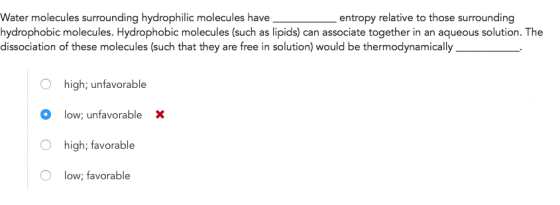
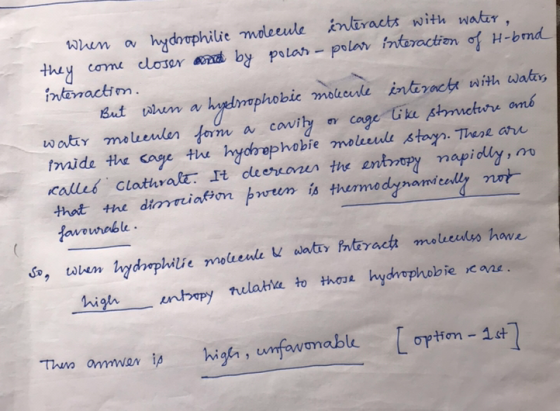
Water molecules surrounding hydrophilic molecules have ____________ entropy relative to those surrounding hydrophobic molecules. Hydrophobic molecules (such as lipids) can associate together in an aqueous solution. The dissociation of these molecules (such that they are free in solution) would be thermodynamically ____________.
Homework Answers
Add Answer to:
Water molecules surrounding hydrophilic molecules have
____________ entropy relative to those surrounding hydrophobic
molecules. Hydrophobic molecules...
30 Chapter 4 Water SELF-TEST Do You Know the Terms? ACROSS Describes a solution with a...
 30 Chapter 4 Water SELF-TEST Do You Know the Terms? ACROSS Describes a solution with a IH jor Hydro molecules can form energetically favorable interactions with 6. Water is often referred to as the because of its ability to hydrate molecules and screen Describes the concentration (and therefore of OH in an aqueous 8. The ion product of water, it is 1 x M in aqueous solutions at 25 C. 9, The describes the relationship between pH and the pk.of...
FILL THE BLANK The membranes of fishes that live in extreme cold have a high proportion...
FILL THE BLANK The membranes of fishes that live in extreme cold have a high proportion of _________________ hydrocarbon tails, enabling them to stay fluid.For example, cold-adapted organisms such as winter wheat increase the percentage of _________________ phospholipids in their membranes in the autumn to prevent the membranes from solidifying during winter.There are two major populations of membrane proteins: ___________ and _____________.Integral proteins penetrate the hydrophobic interior of the lipid bilayer, usually completely spanning the membrane as ________________ proteins.________________ proteins...
please help as soon as possible ergent please i dont have any question left to post...
 please help as soon as possible ergent
please i dont have any question left to post if you help to
answer all will be so thankful
Question 12 (1 point) Which diagram best describes an aqueous solution of copper chloride (Cuci)? Water molecules are omitted for clarity matom anion cation Figure A 8 O Figure B Figure c Figure D စ္ဆ၀၉ Figure E Question 10 (1 point) For the process O2(9) 20(9), AH = 490 kJ mort What would be...
please help as soon as possible ergent
please i dont have any question left to post if you help to
answer all will be so thankful
Question 12 (1 point) Which diagram best describes an aqueous solution of copper chloride (Cuci)? Water molecules are omitted for clarity matom anion cation Figure A 8 O Figure B Figure c Figure D စ္ဆ၀၉ Figure E Question 10 (1 point) For the process O2(9) 20(9), AH = 490 kJ mort What would be...
41. Find the mismatched pair: A) Entropy (ΔS)—measurement of disorder in a thermodynamic system B) First...
41. Find the mismatched pair: A) Entropy (ΔS)—measurement of disorder in a thermodynamic system B) First Law of Thermodynamics—Energy in a system is not created nor destroyed, only transformed C) Second Law of Thermodynamics—The entropy of a perfect crystal at 0 K is exactly equal to zero. D) Standard free energy (Go )—The useful energy in a system E) ΔG < 0—Energetically favorable (spontaneous) reaction 42. Which of the following reactions is unfavorable? A) NaCl dissolving in water (ΔG <...
Hope the genius can help me those questions. Thanks ♥️ Name 1. Definitions. Fill in the...
 Hope the genius can help me those questions.
Thanks ♥️
Name 1. Definitions. Fill in the blank with the LETTER of the most appropriate term from the following A. Bronsted-Lowery acid C. strong acid E. weak electrolyte G. weak acid I. Arrhenius acid B. D. electrolyte base H. ions J. Arrhenius base L. autoionization of water N. Boyle's Law P. Charles Law S. pressure V. manometer X. Dalton's Law K. hydronium ion M. pH scale O. combined gas law R....
Hope the genius can help me those questions.
Thanks ♥️
Name 1. Definitions. Fill in the blank with the LETTER of the most appropriate term from the following A. Bronsted-Lowery acid C. strong acid E. weak electrolyte G. weak acid I. Arrhenius acid B. D. electrolyte base H. ions J. Arrhenius base L. autoionization of water N. Boyle's Law P. Charles Law S. pressure V. manometer X. Dalton's Law K. hydronium ion M. pH scale O. combined gas law R....
4. Inspired by the natural design of cell membranes, you have invented a strange new semi-permeable...
 4. Inspired by the natural design of cell membranes, you have invented a strange new semi-permeable membrane consisting of a water-impemeable base layer interspersed with hydrophilic transmembrane glycoproteins which form three types of channels. Channel type 'A' is approx imately 3 angstroms in diameter and lined with negative charges Channel type 'B' is approximately 3 angstroms in diameter also but lined with positive charges Channel type C is approximately 4 angstroms in diameter and electrically neutral This membrane separates two...
10. If you pour water in a glass cylinder, you see upper and lower meniscus. If...
10. If you pour water in a glass cylinder, you see upper and lower meniscus. If you use a plastic cylinder, the surface appears flat. Which of the following properties of water is responsible for the formation of the meniscus? High heat of vaporization Cohesion and Adhesion Excellent solubility maintenance of pH 17. If you were to make 200 mL of 3% sugar solution, how much sugar would you have to weigh? 2 g 12 g 6 g 1.5 g...
t in the orams ts. Conductivity Chem 113 Reading Assignment 1. Read sections 8.2-8.3 in your...
 t in the orams ts. Conductivity Chem 113 Reading Assignment 1. Read sections 8.2-8.3 in your lecture text. 2. Review Sample Exercise 8.4 on pages 326-327 of your lecture text. Introduction Properties of Solutions: Electrolytes and Non-Electrolytes In this experiment, you will discover some properties of strong electrolytes, weak electrolytes, and non- electrolytes by observing the behavior of these substances in aqueous solutions. You will determine these properties using a conductivity Probe. When the probe is placed in a solution...
1. Four elements make up 96% of the molecules involved chemical a) Oxygen, (0), b) Nitrogen...
 1. Four elements make up 96% of the molecules involved chemical a) Oxygen, (0), b) Nitrogen (N), c) Carbon (C), d) Hydrogen (H) Ne in chemical evolution. Which of the following is not one of these? 2. During Chemical Evolution, elements reacted with each other to form sl norga compounds is thought to have been a critical solvent for elements and simple molec Oxygen ef Water molecules? a) Formaldehyde b) Carbon dloxide c) Ammonia d lipid bilayer was important because:...
QUESTION 6 Allenosine-5-monophosphate (AMP) can react with inorganic phosphate ion (P;) in water to form Adenosine-5'-diphosphate...
 QUESTION 6 Allenosine-5-monophosphate (AMP) can react with inorganic phosphate ion (P;) in water to form Adenosine-5'-diphosphate (ADP) according to the following chemical equation: AMP (aq) + P; (aq) = ADP (aq) Solution concentrations of AMP, Pi, and ADP were measured at 25°C after the reaction reached equilibrium and found to be 0.241 M, 0.563 M, and 0.132 (that is 10-6 M), respectively. Use these observations to answer questions 6-8: What is the equilibrium constant (Keq) for the synthesis reaction of...
 30 Chapter 4 Water SELF-TEST Do You Know the Terms? ACROSS Describes a solution with a IH jor Hydro molecules can form energetically favorable interactions with 6. Water is often referred to as the because of its ability to hydrate molecules and screen Describes the concentration (and therefore of OH in an aqueous 8. The ion product of water, it is 1 x M in aqueous solutions at 25 C. 9, The describes the relationship between pH and the pk.of...
 please help as soon as possible ergent
please i dont have any question left to post if you help to
answer all will be so thankful
Question 12 (1 point) Which diagram best describes an aqueous solution of copper chloride (Cuci)? Water molecules are omitted for clarity matom anion cation Figure A 8 O Figure B Figure c Figure D စ္ဆ၀၉ Figure E Question 10 (1 point) For the process O2(9) 20(9), AH = 490 kJ mort What would be...
please help as soon as possible ergent
please i dont have any question left to post if you help to
answer all will be so thankful
Question 12 (1 point) Which diagram best describes an aqueous solution of copper chloride (Cuci)? Water molecules are omitted for clarity matom anion cation Figure A 8 O Figure B Figure c Figure D စ္ဆ၀၉ Figure E Question 10 (1 point) For the process O2(9) 20(9), AH = 490 kJ mort What would be...
 Hope the genius can help me those questions.
Thanks ♥️
Name 1. Definitions. Fill in the blank with the LETTER of the most appropriate term from the following A. Bronsted-Lowery acid C. strong acid E. weak electrolyte G. weak acid I. Arrhenius acid B. D. electrolyte base H. ions J. Arrhenius base L. autoionization of water N. Boyle's Law P. Charles Law S. pressure V. manometer X. Dalton's Law K. hydronium ion M. pH scale O. combined gas law R....
Hope the genius can help me those questions.
Thanks ♥️
Name 1. Definitions. Fill in the blank with the LETTER of the most appropriate term from the following A. Bronsted-Lowery acid C. strong acid E. weak electrolyte G. weak acid I. Arrhenius acid B. D. electrolyte base H. ions J. Arrhenius base L. autoionization of water N. Boyle's Law P. Charles Law S. pressure V. manometer X. Dalton's Law K. hydronium ion M. pH scale O. combined gas law R....
 4. Inspired by the natural design of cell membranes, you have invented a strange new semi-permeable membrane consisting of a water-impemeable base layer interspersed with hydrophilic transmembrane glycoproteins which form three types of channels. Channel type 'A' is approx imately 3 angstroms in diameter and lined with negative charges Channel type 'B' is approximately 3 angstroms in diameter also but lined with positive charges Channel type C is approximately 4 angstroms in diameter and electrically neutral This membrane separates two...
 t in the orams ts. Conductivity Chem 113 Reading Assignment 1. Read sections 8.2-8.3 in your lecture text. 2. Review Sample Exercise 8.4 on pages 326-327 of your lecture text. Introduction Properties of Solutions: Electrolytes and Non-Electrolytes In this experiment, you will discover some properties of strong electrolytes, weak electrolytes, and non- electrolytes by observing the behavior of these substances in aqueous solutions. You will determine these properties using a conductivity Probe. When the probe is placed in a solution...
 1. Four elements make up 96% of the molecules involved chemical a) Oxygen, (0), b) Nitrogen (N), c) Carbon (C), d) Hydrogen (H) Ne in chemical evolution. Which of the following is not one of these? 2. During Chemical Evolution, elements reacted with each other to form sl norga compounds is thought to have been a critical solvent for elements and simple molec Oxygen ef Water molecules? a) Formaldehyde b) Carbon dloxide c) Ammonia d lipid bilayer was important because:...
 QUESTION 6 Allenosine-5-monophosphate (AMP) can react with inorganic phosphate ion (P;) in water to form Adenosine-5'-diphosphate (ADP) according to the following chemical equation: AMP (aq) + P; (aq) = ADP (aq) Solution concentrations of AMP, Pi, and ADP were measured at 25°C after the reaction reached equilibrium and found to be 0.241 M, 0.563 M, and 0.132 (that is 10-6 M), respectively. Use these observations to answer questions 6-8: What is the equilibrium constant (Keq) for the synthesis reaction of...
Most questions answered within 3 hours.
-
Where is the error in this code sequence?
String s1 = "Hello";
String s2 = "ello";...
asked 10 months ago -
Financial data for Joel de Paris, Inc., for last year
follow:
Joel de Paris, Inc.
Balance...
asked 10 months ago -
Consider this reaction:
Al2(SO4)3 (aq)+ BaCl3
(aq) Al2Cl6 (aq)- +
3BaSO4(s) . What is the...
asked 10 months ago -
Suppose that Savneet is considering increasing her
recent random sample from 20 car rentals to 40...
asked 10 months ago -
Trucks arrive at an unloading terminal at an average rate of 120
per hour.
Trucks arrive...
asked 10 months ago -
Why are methanol and ethanol completely soluble in water while
octanol is not very little soluble....
asked 10 months ago -
A facilities manager at a university reads in a research report
that the mean amount of...
asked 10 months ago -
When the CuSO4 is rehydrated by adding water to the anhydrous
compound, is this an endothermic...
asked 10 months ago -
A ray of sunlight is passing from diamond into crown glass; the
angle of incidence is...
asked 10 months ago -
A block of mass 0.249 kg is placed on top of a light, vertical
spring of...
asked 10 months ago -
how do the kidneys compensate in the presences of acidosis
a) trigger hyperventilate
b) reserve acid...
asked 10 months ago -
Question 501 pts
The rental rate of capital to the firm increases. Which of the
following...
asked 10 months ago