
Homework Answers

Add Answer to:
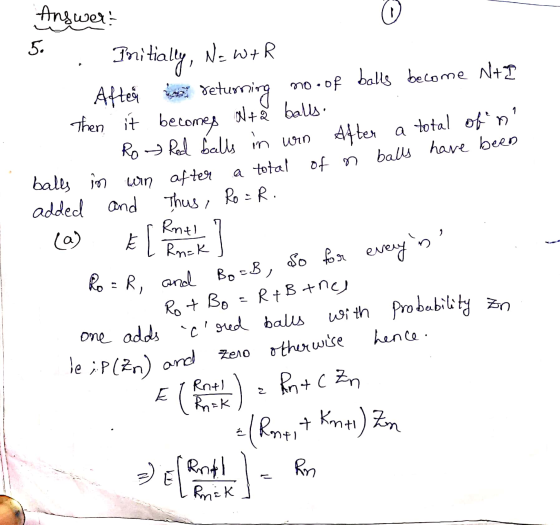
5. Polya's Urn +R • Begin with an urn containing W white balls and R red...
8) For Polya's urn model with r red balls, b black balls and parameters cE N...
 8) For Polya's urn model with r red balls, b black balls and parameters cE N (the number of extra balls we insert every time) and n EN,n 2 3 (the number of times we perform the a) Show that the probability that the k-th chosen ball (k e (1,...,n]) is red is equal to b) Given that the second chosen ball was red compute the probability that the first one experiment), do the following: was red as well.
2. Consider an urn that contains red and green balls. At time 0 there are k balls with at least one ball of each color. At time n we draw out a ball chosen at random.We return it to the urn and add o...
 2. Consider an urn that contains red and green balls. At time 0 there are k balls with at least one ball of each color. At time n we draw out a ball chosen at random.We return it to the urn and add one more of the color chosen. Let X be the fraction of red balls at time n. Show that Xn is a martingale with respect to the filtration (X0,Xi, ,Xn). At time n there are nk balls,...
Suppose that there is a white urn containing two white balls and three red balls and...
 Suppose that there is a white urn containing two white balls and three red balls and there is a red urn containing three white balls and four red balls. An experiment consists of selecting at random a ball from the white urn and then (without replacing the first ball) selecting at random a ball from the urn having the color of the first ball. Find the probability that the second ball is red. The probability of the second ball being...
Show all work and steps! don't skip any steps. 28. Polya's urn model supposes that an...
 Show all work and steps! don't skip any steps.
28. Polya's urn model supposes that an urn initially contains r red and b blue balls. At each stage a ball is randomly selected from the urn and is then returned along with m other balls of the same color. Let Xk be the number of red balls drawn in the first k selections. (a) Find ELXi] (b) Find ELX2] (c) Find ELX3] (d) Conjecture the value of E[X], and then...
Show all work and steps! don't skip any steps.
28. Polya's urn model supposes that an urn initially contains r red and b blue balls. At each stage a ball is randomly selected from the urn and is then returned along with m other balls of the same color. Let Xk be the number of red balls drawn in the first k selections. (a) Find ELXi] (b) Find ELX2] (c) Find ELX3] (d) Conjecture the value of E[X], and then...
An urn initially contains r red balls and s black balls. A ball is selected at random but not rem...
 An urn initially contains r red balls and s black balls. A ball is selected at random but not removed and a balls of the same color as the selection are added to the urn. The process is then repeated with a balls of one color or the other added to the urn at each epoch. With each addition the population of the urn increases by a and it is helpful to imagine that the (a) What is the probability...
Urn R contains n red balls and urn B contains n blue balls. At each stage...
 Urn R contains n red balls and urn B contains n blue balls. At
each stage a ball is selected at random from each urn and they are
swapped. Show that the expected number of red balls in urn R after
stage k is:
**(1+(1-3)
Urn R contains n red balls and urn B contains n blue balls. At
each stage a ball is selected at random from each urn and they are
swapped. Show that the expected number of red balls in urn R after
stage k is:
**(1+(1-3)
(b) At time n = 0, an urn contains 2m balls, of which m are red...
 (b) At time n = 0, an urn contains 2m balls, of which m are red and m are blue. At each time n = 1, ..., 2m, a single ball is randomly selected and taken away with no replacement. Hence, at time n, the urn has 2m – n balls. Let Rn denotes the number of red balls remaining in the urn at time n. For n= 0,..., 2m – 1, let B Rn Pn = 2m - in...
Question 3. (exercise 3.11-13 in textbook) An urn contains r red balls and b blue balls....
 Question 3. (exercise 3.11-13 in textbook) An urn contains r red balls and b blue balls. A ball is chosen at random from the urn, its color is noted, and it is returned together with d more balls of the same color. This is repeated indefinitely. What is the probability that (a) The second ball drawn is blue? (b) The first ball drawn is blue given that the second ball drawn is blue? (c) Let Bn denote the event that...
Question 3. (exercise 3.11-13 in textbook) An urn contains r red balls and b blue balls....
 Question 3. (exercise 3.11-13 in textbook) An urn contains r red balls and b blue balls. A ball is chosen at random from the urn, its color is noted, and it is returned together with d more balls of the same color. This is repeated indefinitely. What is the probability that (a) The second ball drawn is blue? (b) The first ball drawn is blue given that the second ball drawn is blue? (c) Let Bn denote the event that...
(a) (2 pts) An urn contains 3 red and 5 green balls. At each step of...
 (a) (2 pts) An urn contains 3 red and 5 green balls. At each step of this game, we pick one ball at random, note its color and return the ball to the urn together with anoter ball of the same color. Prove by induction that the probability that the ball we pick a red ball at the n-th step is 3/8.
 8) For Polya's urn model with r red balls, b black balls and parameters cE N (the number of extra balls we insert every time) and n EN,n 2 3 (the number of times we perform the a) Show that the probability that the k-th chosen ball (k e (1,...,n]) is red is equal to b) Given that the second chosen ball was red compute the probability that the first one experiment), do the following: was red as well.
 2. Consider an urn that contains red and green balls. At time 0 there are k balls with at least one ball of each color. At time n we draw out a ball chosen at random.We return it to the urn and add one more of the color chosen. Let X be the fraction of red balls at time n. Show that Xn is a martingale with respect to the filtration (X0,Xi, ,Xn). At time n there are nk balls,...
 Suppose that there is a white urn containing two white balls and three red balls and there is a red urn containing three white balls and four red balls. An experiment consists of selecting at random a ball from the white urn and then (without replacing the first ball) selecting at random a ball from the urn having the color of the first ball. Find the probability that the second ball is red. The probability of the second ball being...
 Show all work and steps! don't skip any steps.
28. Polya's urn model supposes that an urn initially contains r red and b blue balls. At each stage a ball is randomly selected from the urn and is then returned along with m other balls of the same color. Let Xk be the number of red balls drawn in the first k selections. (a) Find ELXi] (b) Find ELX2] (c) Find ELX3] (d) Conjecture the value of E[X], and then...
Show all work and steps! don't skip any steps.
28. Polya's urn model supposes that an urn initially contains r red and b blue balls. At each stage a ball is randomly selected from the urn and is then returned along with m other balls of the same color. Let Xk be the number of red balls drawn in the first k selections. (a) Find ELXi] (b) Find ELX2] (c) Find ELX3] (d) Conjecture the value of E[X], and then...
 An urn initially contains r red balls and s black balls. A ball is selected at random but not removed and a balls of the same color as the selection are added to the urn. The process is then repeated with a balls of one color or the other added to the urn at each epoch. With each addition the population of the urn increases by a and it is helpful to imagine that the (a) What is the probability...
 Urn R contains n red balls and urn B contains n blue balls. At
each stage a ball is selected at random from each urn and they are
swapped. Show that the expected number of red balls in urn R after
stage k is:
**(1+(1-3)
Urn R contains n red balls and urn B contains n blue balls. At
each stage a ball is selected at random from each urn and they are
swapped. Show that the expected number of red balls in urn R after
stage k is:
**(1+(1-3)
 (b) At time n = 0, an urn contains 2m balls, of which m are red and m are blue. At each time n = 1, ..., 2m, a single ball is randomly selected and taken away with no replacement. Hence, at time n, the urn has 2m – n balls. Let Rn denotes the number of red balls remaining in the urn at time n. For n= 0,..., 2m – 1, let B Rn Pn = 2m - in...
 Question 3. (exercise 3.11-13 in textbook) An urn contains r red balls and b blue balls. A ball is chosen at random from the urn, its color is noted, and it is returned together with d more balls of the same color. This is repeated indefinitely. What is the probability that (a) The second ball drawn is blue? (b) The first ball drawn is blue given that the second ball drawn is blue? (c) Let Bn denote the event that...
 Question 3. (exercise 3.11-13 in textbook) An urn contains r red balls and b blue balls. A ball is chosen at random from the urn, its color is noted, and it is returned together with d more balls of the same color. This is repeated indefinitely. What is the probability that (a) The second ball drawn is blue? (b) The first ball drawn is blue given that the second ball drawn is blue? (c) Let Bn denote the event that...
 (a) (2 pts) An urn contains 3 red and 5 green balls. At each step of this game, we pick one ball at random, note its color and return the ball to the urn together with anoter ball of the same color. Prove by induction that the probability that the ball we pick a red ball at the n-th step is 3/8.
Most questions answered within 3 hours.
-
Where is the error in this code sequence?
String s1 = "Hello";
String s2 = "ello";...
asked 10 months ago -
Financial data for Joel de Paris, Inc., for last year
follow:
Joel de Paris, Inc.
Balance...
asked 10 months ago -
Consider this reaction:
Al2(SO4)3 (aq)+ BaCl3
(aq) Al2Cl6 (aq)- +
3BaSO4(s) . What is the...
asked 10 months ago -
Suppose that Savneet is considering increasing her
recent random sample from 20 car rentals to 40...
asked 10 months ago -
Trucks arrive at an unloading terminal at an average rate of 120
per hour.
Trucks arrive...
asked 10 months ago -
Why are methanol and ethanol completely soluble in water while
octanol is not very little soluble....
asked 10 months ago -
A facilities manager at a university reads in a research report
that the mean amount of...
asked 10 months ago -
When the CuSO4 is rehydrated by adding water to the anhydrous
compound, is this an endothermic...
asked 10 months ago -
A ray of sunlight is passing from diamond into crown glass; the
angle of incidence is...
asked 10 months ago -
A block of mass 0.249 kg is placed on top of a light, vertical
spring of...
asked 10 months ago -
how do the kidneys compensate in the presences of acidosis
a) trigger hyperventilate
b) reserve acid...
asked 10 months ago -
Question 501 pts
The rental rate of capital to the firm increases. Which of the
following...
asked 10 months ago