
Homework Answers
Add Answer to:
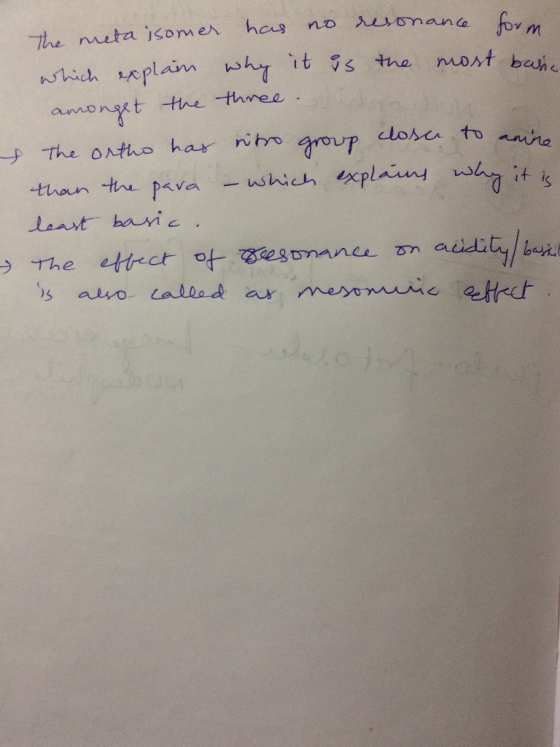
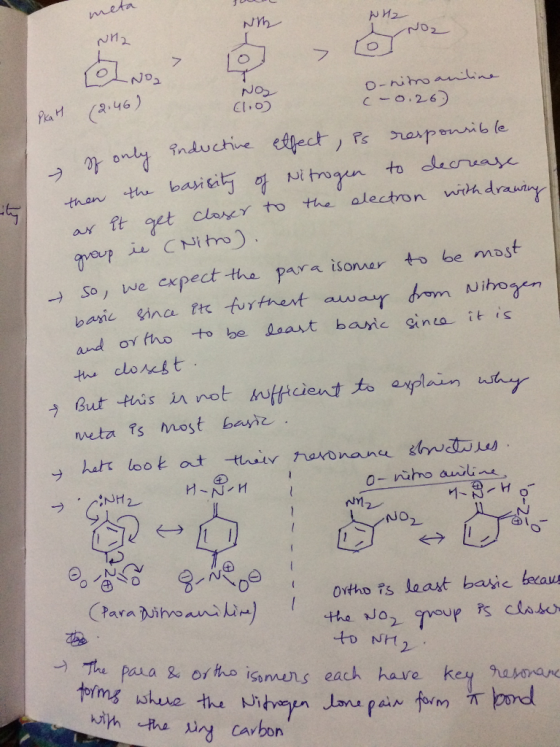
Problem 1: para-Nitroaniline is an order of magnitude less basic than meta-nitroaniline. Explain the observed difference...
please solve the following chemistry problem. Thank you . (6 points) Account for the fact that p-nitroaniline (pKa 1.0) is less basic than m-nitroanil 30. Draw resonance structures to support your...
 please solve the following chemistry problem. Thank
you
.
(6 points) Account for the fact that p-nitroaniline (pKa 1.0) is less basic than m-nitroanil 30. Draw resonance structures to support your argument. (The pKa va ine (pKa 2.5) by a factor of lues refer to the corresponding ammonium ions.)
(6 points) Account for the fact that p-nitroaniline (pKa 1.0) is less basic than m-nitroanil 30. Draw resonance structures to support your argument. (The pKa va ine (pKa 2.5) by a...
please solve the following chemistry problem. Thank
you
.
(6 points) Account for the fact that p-nitroaniline (pKa 1.0) is less basic than m-nitroanil 30. Draw resonance structures to support your argument. (The pKa va ine (pKa 2.5) by a factor of lues refer to the corresponding ammonium ions.)
(6 points) Account for the fact that p-nitroaniline (pKa 1.0) is less basic than m-nitroanil 30. Draw resonance structures to support your argument. (The pKa va ine (pKa 2.5) by a...
2. D type and strength of each substituents as activating(A) or outcome as ortho-para (O/P) or...
 2. D type and strength of each substituents as activating(A) or outcome as ortho-para (O/P) or meta(M) directors. (6 pts) you expect an electrophile to be attached to the ring You must identify the deactivating(D) and also the expected regiochemical 3. Use aromatic, non aromatic or antiaromatic concepts to explain the reactions or molecules shown (6 pts) Provide a curved arrow mechanism to show the formation of a aromatic carbocation intermediate Show the final product H-I The pK,values for the...
4. Explain why aliphatic amines are much less stable than those that have at least one...
 4. Explain why aliphatic amines are much less stable than those that have at least one aromatic group attached to the carbon-nitrogen double bond. 5. Write the structure(s) of the products you would expect to get if you react N- cinnamaldehyde-m-nitroaniline with catalytic hydrogenation (that means adding H2 and Pt or Pd).
Reaction 1: Nitration HNO3 NO2 H2SO4, H20 NO2 toluene NO2 ortho meta para Procedure for Reaction...
 Reaction 1: Nitration HNO3 NO2 H2SO4, H20 NO2 toluene NO2 ortho meta para Procedure for Reaction 1: 1) To a stirred solution of 3 mL (44.7 mmoles) 67 % HNO3 in 3.75 mL of water, H2SO4 (9 mL) was slowly added at 10-15 °C. 2) This nitrating solution was added dropwise with vigorous stirring to 4 mL (37.5 mmoles) of toluene while cooling in ice-water in order to maintain the reaction temperature between 15 and 25 °C. 3) Stirring was...
explain whether you would expect the POTENTIAL temperature to be greater than or less than their respective IN SITU tem...
 explain whether you would expect the POTENTIAL temperature to
be greater than or less than their respective IN SITU temperatures
for
a) air in altitude of 5km
b) seawater at a depth of 5km
3) Explain whether you would expect the potential temperature to be greater than or less than their respective in situ temperatures for: A) air at an altitude of 5 km B) seawater at a depth of 5 km
explain whether you would expect the POTENTIAL temperature to
be greater than or less than their respective IN SITU temperatures
for
a) air in altitude of 5km
b) seawater at a depth of 5km
3) Explain whether you would expect the potential temperature to be greater than or less than their respective in situ temperatures for: A) air at an altitude of 5 km B) seawater at a depth of 5 km
Explain this resonance and basicity problem? Why does the Guanidine top nitrogen have a negative dipole?...
 Explain this resonance and basicity problem? Why does the
Guanidine top nitrogen have a negative dipole? Doesn't the
resonance hybrid cause the bond to be less than 1 full bond so it
causes it to be a positive dipole? Also doesn't the resonance in
guanidine cause it to be a weaker base than ammonia?
17. (5) Let's decide which is the stronger base ammonia or guanidine. Circle one answer each in H2N parts (a) (c) below. Guanidine (a) What is...
Explain this resonance and basicity problem? Why does the
Guanidine top nitrogen have a negative dipole? Doesn't the
resonance hybrid cause the bond to be less than 1 full bond so it
causes it to be a positive dipole? Also doesn't the resonance in
guanidine cause it to be a weaker base than ammonia?
17. (5) Let's decide which is the stronger base ammonia or guanidine. Circle one answer each in H2N parts (a) (c) below. Guanidine (a) What is...
Can you please explain the details of how it’s solved and show the steps clearly? Also...
 Can you please explain the details of how it’s solved and
show the steps clearly? Also please circle the answer for all of
these questions. Any help would be greatly appreciated! Thank you
so much!
4. (25 points) Short answer questions on acidity and basicity. (4 points) Indicate whether the following salts act like acidic salts (AS), neutral salts (NS) or basic salts (BS) in pure water at 298 K a. MnSO4 RbNO NaHCO3 NH OOCCH iv. (8 points) For...
Can you please explain the details of how it’s solved and
show the steps clearly? Also please circle the answer for all of
these questions. Any help would be greatly appreciated! Thank you
so much!
4. (25 points) Short answer questions on acidity and basicity. (4 points) Indicate whether the following salts act like acidic salts (AS), neutral salts (NS) or basic salts (BS) in pure water at 298 K a. MnSO4 RbNO NaHCO3 NH OOCCH iv. (8 points) For...
Can someone help explain what magnitude is and how to work out the problem and get...
 Can someone help explain what magnitude is and how to work out
the problem and get the correct answer?
Sample Problem 1.01 Estimating order of magnitude, ball of string The world's largest ball of string is about 2 m in radius. Toball's builder most unhappy. Instead, because we want only the nearest order of magnitude, what is the total length L the nearest order of magnit ude, we can estimate any quanti of the string in the ball? ties required...
Can someone help explain what magnitude is and how to work out
the problem and get the correct answer?
Sample Problem 1.01 Estimating order of magnitude, ball of string The world's largest ball of string is about 2 m in radius. Toball's builder most unhappy. Instead, because we want only the nearest order of magnitude, what is the total length L the nearest order of magnit ude, we can estimate any quanti of the string in the ball? ties required...
1) Brief answers a) Explain why FeS is much less solute in water than Fe(OH)2 and Fe(OH)2 is much more soluble than Fe(O...
1) Brief answers a) Explain why FeS is much less solute in water than Fe(OH)2 and Fe(OH)2 is much more soluble than Fe(OH)3 b)will Cr3+react more strongly with Cl-or PR3. Why? 2) Brief answers a) Would you expect lead (Pb2+ soft to be found oxide in nature? b) Explain the following observation interns pf the HSAB theory: OH- + CH3HgS --> CH3HgOH +S2- Equilibrium displaced to the left.
POST LAB QUESTIONS. 1. If you used more water in your calorimeter, would the observed temperature...
 POST LAB QUESTIONS. 1. If you used more water in your calorimeter, would the observed temperature change upon the addition of the hot solid object be larger or smaller than the temperature change you observed? Explain. 2. Your instructor handed you a 1-L sample of a liquid and asked you to determine its specific heat. How would you determine the specific heat of the liquid using the equipment in this lab? 3. What effect would not covering the calorimeter cup...
 please solve the following chemistry problem. Thank
you
.
(6 points) Account for the fact that p-nitroaniline (pKa 1.0) is less basic than m-nitroanil 30. Draw resonance structures to support your argument. (The pKa va ine (pKa 2.5) by a factor of lues refer to the corresponding ammonium ions.)
(6 points) Account for the fact that p-nitroaniline (pKa 1.0) is less basic than m-nitroanil 30. Draw resonance structures to support your argument. (The pKa va ine (pKa 2.5) by a...
please solve the following chemistry problem. Thank
you
.
(6 points) Account for the fact that p-nitroaniline (pKa 1.0) is less basic than m-nitroanil 30. Draw resonance structures to support your argument. (The pKa va ine (pKa 2.5) by a factor of lues refer to the corresponding ammonium ions.)
(6 points) Account for the fact that p-nitroaniline (pKa 1.0) is less basic than m-nitroanil 30. Draw resonance structures to support your argument. (The pKa va ine (pKa 2.5) by a...
 2. D type and strength of each substituents as activating(A) or outcome as ortho-para (O/P) or meta(M) directors. (6 pts) you expect an electrophile to be attached to the ring You must identify the deactivating(D) and also the expected regiochemical 3. Use aromatic, non aromatic or antiaromatic concepts to explain the reactions or molecules shown (6 pts) Provide a curved arrow mechanism to show the formation of a aromatic carbocation intermediate Show the final product H-I The pK,values for the...
 4. Explain why aliphatic amines are much less stable than those that have at least one aromatic group attached to the carbon-nitrogen double bond. 5. Write the structure(s) of the products you would expect to get if you react N- cinnamaldehyde-m-nitroaniline with catalytic hydrogenation (that means adding H2 and Pt or Pd).
 Reaction 1: Nitration HNO3 NO2 H2SO4, H20 NO2 toluene NO2 ortho meta para Procedure for Reaction 1: 1) To a stirred solution of 3 mL (44.7 mmoles) 67 % HNO3 in 3.75 mL of water, H2SO4 (9 mL) was slowly added at 10-15 °C. 2) This nitrating solution was added dropwise with vigorous stirring to 4 mL (37.5 mmoles) of toluene while cooling in ice-water in order to maintain the reaction temperature between 15 and 25 °C. 3) Stirring was...
 explain whether you would expect the POTENTIAL temperature to
be greater than or less than their respective IN SITU temperatures
for
a) air in altitude of 5km
b) seawater at a depth of 5km
3) Explain whether you would expect the potential temperature to be greater than or less than their respective in situ temperatures for: A) air at an altitude of 5 km B) seawater at a depth of 5 km
explain whether you would expect the POTENTIAL temperature to
be greater than or less than their respective IN SITU temperatures
for
a) air in altitude of 5km
b) seawater at a depth of 5km
3) Explain whether you would expect the potential temperature to be greater than or less than their respective in situ temperatures for: A) air at an altitude of 5 km B) seawater at a depth of 5 km
 Explain this resonance and basicity problem? Why does the
Guanidine top nitrogen have a negative dipole? Doesn't the
resonance hybrid cause the bond to be less than 1 full bond so it
causes it to be a positive dipole? Also doesn't the resonance in
guanidine cause it to be a weaker base than ammonia?
17. (5) Let's decide which is the stronger base ammonia or guanidine. Circle one answer each in H2N parts (a) (c) below. Guanidine (a) What is...
Explain this resonance and basicity problem? Why does the
Guanidine top nitrogen have a negative dipole? Doesn't the
resonance hybrid cause the bond to be less than 1 full bond so it
causes it to be a positive dipole? Also doesn't the resonance in
guanidine cause it to be a weaker base than ammonia?
17. (5) Let's decide which is the stronger base ammonia or guanidine. Circle one answer each in H2N parts (a) (c) below. Guanidine (a) What is...
 Can you please explain the details of how it’s solved and
show the steps clearly? Also please circle the answer for all of
these questions. Any help would be greatly appreciated! Thank you
so much!
4. (25 points) Short answer questions on acidity and basicity. (4 points) Indicate whether the following salts act like acidic salts (AS), neutral salts (NS) or basic salts (BS) in pure water at 298 K a. MnSO4 RbNO NaHCO3 NH OOCCH iv. (8 points) For...
Can you please explain the details of how it’s solved and
show the steps clearly? Also please circle the answer for all of
these questions. Any help would be greatly appreciated! Thank you
so much!
4. (25 points) Short answer questions on acidity and basicity. (4 points) Indicate whether the following salts act like acidic salts (AS), neutral salts (NS) or basic salts (BS) in pure water at 298 K a. MnSO4 RbNO NaHCO3 NH OOCCH iv. (8 points) For...
 Can someone help explain what magnitude is and how to work out
the problem and get the correct answer?
Sample Problem 1.01 Estimating order of magnitude, ball of string The world's largest ball of string is about 2 m in radius. Toball's builder most unhappy. Instead, because we want only the nearest order of magnitude, what is the total length L the nearest order of magnit ude, we can estimate any quanti of the string in the ball? ties required...
Can someone help explain what magnitude is and how to work out
the problem and get the correct answer?
Sample Problem 1.01 Estimating order of magnitude, ball of string The world's largest ball of string is about 2 m in radius. Toball's builder most unhappy. Instead, because we want only the nearest order of magnitude, what is the total length L the nearest order of magnit ude, we can estimate any quanti of the string in the ball? ties required...
 POST LAB QUESTIONS. 1. If you used more water in your calorimeter, would the observed temperature change upon the addition of the hot solid object be larger or smaller than the temperature change you observed? Explain. 2. Your instructor handed you a 1-L sample of a liquid and asked you to determine its specific heat. How would you determine the specific heat of the liquid using the equipment in this lab? 3. What effect would not covering the calorimeter cup...
Most questions answered within 3 hours.
-
Where is the error in this code sequence?
String s1 = "Hello";
String s2 = "ello";...
asked 10 months ago -
Financial data for Joel de Paris, Inc., for last year
follow:
Joel de Paris, Inc.
Balance...
asked 10 months ago -
Consider this reaction:
Al2(SO4)3 (aq)+ BaCl3
(aq) Al2Cl6 (aq)- +
3BaSO4(s) . What is the...
asked 10 months ago -
Suppose that Savneet is considering increasing her
recent random sample from 20 car rentals to 40...
asked 10 months ago -
Trucks arrive at an unloading terminal at an average rate of 120
per hour.
Trucks arrive...
asked 10 months ago -
Why are methanol and ethanol completely soluble in water while
octanol is not very little soluble....
asked 10 months ago -
A facilities manager at a university reads in a research report
that the mean amount of...
asked 10 months ago -
When the CuSO4 is rehydrated by adding water to the anhydrous
compound, is this an endothermic...
asked 10 months ago -
A ray of sunlight is passing from diamond into crown glass; the
angle of incidence is...
asked 10 months ago -
A block of mass 0.249 kg is placed on top of a light, vertical
spring of...
asked 10 months ago -
how do the kidneys compensate in the presences of acidosis
a) trigger hyperventilate
b) reserve acid...
asked 10 months ago -
Question 501 pts
The rental rate of capital to the firm increases. Which of the
following...
asked 10 months ago