Suppose a textbook monopoly can produce any level of output at a constant marginal cost of...
Suppose a textbook monopoly can produce any level of output at a constant marginal cost of $5. Assume that the monopoly sells its books in two different markets that are separated by some distance. The demand curve in the first market is given by Q1=55-P1 and the demand curve in the second market is given by Q2=70-2P2. 1. What are the optimal quantity and price produced in each market? (1.5 point for Q1, 1.5 point for Q2, 1.5 point for P1, 1.5 point for P2) 2. Using your results from previous question, calculate the price elasticity of demand e1 and e2 in each market. Which market has the less elastic demand? (1.5 point for e1, 1.5 point for e2). Clarity of the answers: 1 point. Show the essential steps of your work. Only partial credit will be given if work not shown.
Homework Answers
Answer. To maximize profits, monoply choose the quantity at which, MR=MC.
For market 1,
TR = P*Q = (55-Q1)*Q1
So, MR = 55- 2Q1
Equating with MC,
55-2Q1 = 5
50= 2Q1
So, Q1 = 25 and P1 = 30.
For market 2,
TR = P*Q = (35-Q2/2)*Q2
So, MR = 35- Q2
Equating with MC,
35-Q2 = 5
30= Q2
So, Q2 = 30. and P2= 20.
2. For elasticity,

Market 1, Pe = 1 *(30/25) = 1.2
Market 2, Pe = 2* (20/30) = 1.33
So, market 1 has less elastic demand.
Add Answer to:
Suppose a textbook monopoly can produce any level of output at a
constant marginal cost of...
A monopolist can produce any level of output at a constant marginal cost of $5 per...
A monopolist can produce any level of output at a constant marginal cost of $5 per unit. Assume the monopoly sells its goods in two different markets separated by some distance. The demand curve in the first market is given by q1 = 65 − p1,and the demand curve in the second market is given by q2 = 90 − 2p2. (a) If the monopolist can maintain the separation between the two markets, what level of output should be produced...
2. A monopolist can produce any level of output at a constant marginal cost of $5...
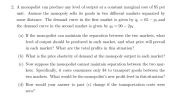 2. A monopolist can produce any level of output at a constant marginal cost of $5 per unit. Assume the monopoly sells its goods in two different markets separated by some distance. The demand curve in the first market is given by qı = 65 – pı,and the demand curve in the second market is given by 92 = 90 – 2p2. (a) If the monopolist can maintain the separation between the two markets, what level of output should be...
A monopolist is deciding how to allocate output between two geographically separated markets (East Coast and...
A monopolist is deciding how to allocate output between two geographically separated markets (East Coast and Midwest). Demands for the two markets are: Q1 = 15 - P1 Q2 = 12.5 – 0.5 P2 The monopolist’s total cost is C = 5 + 3(Q1 + Q2 ). What are the prices, outputs, profits in each market if the monopolist can price discriminate? Check that the profit maximizing price and its elasticity of demand have the following relation between markets: P1...
6. (3 points) Suppose that a monopoly can price discriminate between two markets: market 1 where the demand curve is gi...
 6. (3 points) Suppose that a monopoly can price discriminate between two markets: market 1 where the demand curve is given by 91 = 2 – P1, and market 2 where the demand is given by q2 = 4 – P2. Assume that the monopoly produces each unit at a cost of c=1. (a) Find {qM, PM, q2, px}. (2 points) (b) Suppose that price discrimination is no longer possible. Find {qM, pM}. (1 point)
Two firms produce closely-related products and have marginal costs MC1=10 and MC2=20. The market supplied by...
 Two firms produce closely-related products and have marginal
costs MC1=10 and MC2=20. The market supplied by firm 1 has demand
Q1=100-2p1+p2, while 2's market has demand Q2=100+p1-2p2. The two
firms are engaged in Bertrand price competition.
Two firms produce closely-related products, and have marginal costs MC1-10 and MC2-20. The market supplied by firm 1 has demand Q1 = 100-2p1+P2, while 2's market has demand Q2=100+p1- 2p2. The two firms are engaged in Bertrand price competition. 3(a)What is the intercept of...
Two firms produce closely-related products and have marginal
costs MC1=10 and MC2=20. The market supplied by firm 1 has demand
Q1=100-2p1+p2, while 2's market has demand Q2=100+p1-2p2. The two
firms are engaged in Bertrand price competition.
Two firms produce closely-related products, and have marginal costs MC1-10 and MC2-20. The market supplied by firm 1 has demand Q1 = 100-2p1+P2, while 2's market has demand Q2=100+p1- 2p2. The two firms are engaged in Bertrand price competition. 3(a)What is the intercept of...
4. Suppose a price-maker firm can produce any level of output it wishes at constant average...
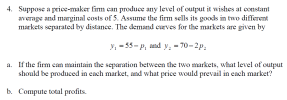 4. Suppose a price-maker firm can produce any level of output it wishes at constant average and marginal costs of 5. Assume the firm sells its goods in two different markets separated by distance. The demand curves for the markets are given by y; = 55– P, and y2 = 70–2p2 a. If the firm can maintain the separation between the two markets, what level of output should be produced in each market, and what price would prevail in each...
Two firms produce closely-related products, and have marginal costs MC1=10 and MC2=20. The market supplied by...
Two firms produce closely-related products, and have marginal costs MC1=10 and MC2=20. The market supplied by firm 1 has demand Q1=100-2p1+p2, while 2's market has demand Q2=100+p1-2p2. The two firms are engaged in Bertrand price competition. 3(a)What is the intercept of firm 1's price reaction curve? (One digit after the decimal point only) 3(b) What is the slope of firm 1's price reaction curve? (One digit after the decimal point only) 3(c) What is the intercept of firm 2's price...
Consider a monopolist selling in two markets. The demands in markets 1 and 2 are given...
Consider a monopolist selling in two markets. The demands in markets 1 and 2 are given by q1 =100−p1 q2 =120−1/2p2 Marginal cost is constant and given by MC = 20. There are no fixed costs. Find a) optimal output, price in market 1, b) optimal output and price in market 2 and c) total profit. What can we say about demand elasticities of the two markets at the optimal outputs?
Question 6 (1 point) Consider a monopolist which sells output in two markets, the home market...
 Question 6 (1 point) Consider a monopolist which sells output in two markets, the home market and the foreign market. The monopolist faces a linear demand curve of P1 - 20 - Q1 in the home market and P2 - 40-202 in the foreign market. The monopolists total cost is (Q=1500+q? What prices the monopolist charges in the home and the foreign market respectively? $11. $21. $12, S16 $6. $18 $18,528. none of the above Question 5 (1 point) A...
Two firms produce closely-related products, and have marginal costs MC1 10 and MC2=20. The market supplied...
 Two firms produce closely-related products, and have marginal costs MC1 10 and MC2=20. The market supplied by firm 1 has demand Q1-100-2p1+p2, while 2's market has demand Q2-100+p1 2p2. The two firms are engaged in Bertrand price competition. 3(a)What is the intercept of firm 1's price reaction curve? (One digit after the decimal point only) Question 8 1 pts 3(b) What is the slope of firm 1's price reaction curve? (One digit after the decimal point only) Question 9 1...
 2. A monopolist can produce any level of output at a constant marginal cost of $5 per unit. Assume the monopoly sells its goods in two different markets separated by some distance. The demand curve in the first market is given by qı = 65 – pı,and the demand curve in the second market is given by 92 = 90 – 2p2. (a) If the monopolist can maintain the separation between the two markets, what level of output should be...
 6. (3 points) Suppose that a monopoly can price discriminate between two markets: market 1 where the demand curve is given by 91 = 2 – P1, and market 2 where the demand is given by q2 = 4 – P2. Assume that the monopoly produces each unit at a cost of c=1. (a) Find {qM, PM, q2, px}. (2 points) (b) Suppose that price discrimination is no longer possible. Find {qM, pM}. (1 point)
 Two firms produce closely-related products and have marginal
costs MC1=10 and MC2=20. The market supplied by firm 1 has demand
Q1=100-2p1+p2, while 2's market has demand Q2=100+p1-2p2. The two
firms are engaged in Bertrand price competition.
Two firms produce closely-related products, and have marginal costs MC1-10 and MC2-20. The market supplied by firm 1 has demand Q1 = 100-2p1+P2, while 2's market has demand Q2=100+p1- 2p2. The two firms are engaged in Bertrand price competition. 3(a)What is the intercept of...
Two firms produce closely-related products and have marginal
costs MC1=10 and MC2=20. The market supplied by firm 1 has demand
Q1=100-2p1+p2, while 2's market has demand Q2=100+p1-2p2. The two
firms are engaged in Bertrand price competition.
Two firms produce closely-related products, and have marginal costs MC1-10 and MC2-20. The market supplied by firm 1 has demand Q1 = 100-2p1+P2, while 2's market has demand Q2=100+p1- 2p2. The two firms are engaged in Bertrand price competition. 3(a)What is the intercept of...
 4. Suppose a price-maker firm can produce any level of output it wishes at constant average and marginal costs of 5. Assume the firm sells its goods in two different markets separated by distance. The demand curves for the markets are given by y; = 55– P, and y2 = 70–2p2 a. If the firm can maintain the separation between the two markets, what level of output should be produced in each market, and what price would prevail in each...
 Question 6 (1 point) Consider a monopolist which sells output in two markets, the home market and the foreign market. The monopolist faces a linear demand curve of P1 - 20 - Q1 in the home market and P2 - 40-202 in the foreign market. The monopolists total cost is (Q=1500+q? What prices the monopolist charges in the home and the foreign market respectively? $11. $21. $12, S16 $6. $18 $18,528. none of the above Question 5 (1 point) A...
 Two firms produce closely-related products, and have marginal costs MC1 10 and MC2=20. The market supplied by firm 1 has demand Q1-100-2p1+p2, while 2's market has demand Q2-100+p1 2p2. The two firms are engaged in Bertrand price competition. 3(a)What is the intercept of firm 1's price reaction curve? (One digit after the decimal point only) Question 8 1 pts 3(b) What is the slope of firm 1's price reaction curve? (One digit after the decimal point only) Question 9 1...
Most questions answered within 3 hours.
-
Where is the error in this code sequence?
String s1 = "Hello";
String s2 = "ello";...
asked 10 months ago -
Financial data for Joel de Paris, Inc., for last year
follow:
Joel de Paris, Inc.
Balance...
asked 10 months ago -
Consider this reaction:
Al2(SO4)3 (aq)+ BaCl3
(aq) Al2Cl6 (aq)- +
3BaSO4(s) . What is the...
asked 10 months ago -
Suppose that Savneet is considering increasing her
recent random sample from 20 car rentals to 40...
asked 10 months ago -
Trucks arrive at an unloading terminal at an average rate of 120
per hour.
Trucks arrive...
asked 10 months ago -
Why are methanol and ethanol completely soluble in water while
octanol is not very little soluble....
asked 10 months ago -
A facilities manager at a university reads in a research report
that the mean amount of...
asked 10 months ago -
When the CuSO4 is rehydrated by adding water to the anhydrous
compound, is this an endothermic...
asked 10 months ago -
A ray of sunlight is passing from diamond into crown glass; the
angle of incidence is...
asked 10 months ago -
A block of mass 0.249 kg is placed on top of a light, vertical
spring of...
asked 10 months ago -
how do the kidneys compensate in the presences of acidosis
a) trigger hyperventilate
b) reserve acid...
asked 10 months ago -
Question 501 pts
The rental rate of capital to the firm increases. Which of the
following...
asked 10 months ago