
Homework Answers
Add Answer to:
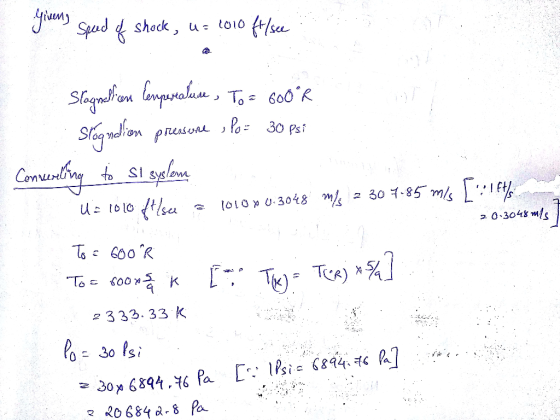
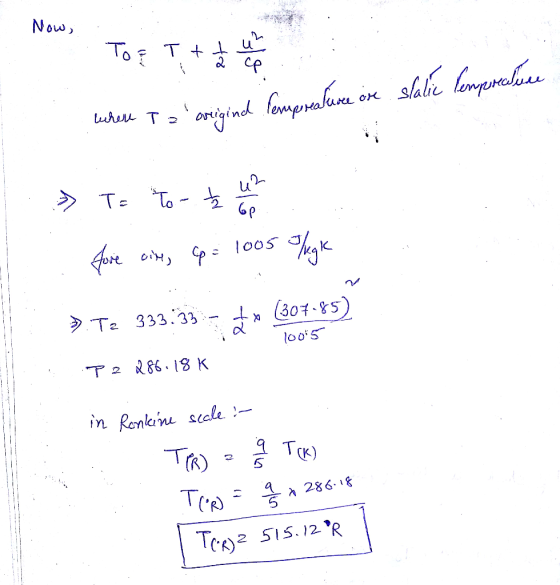
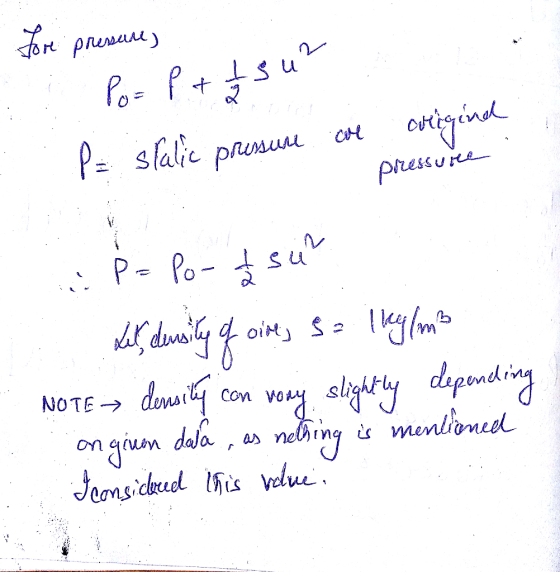
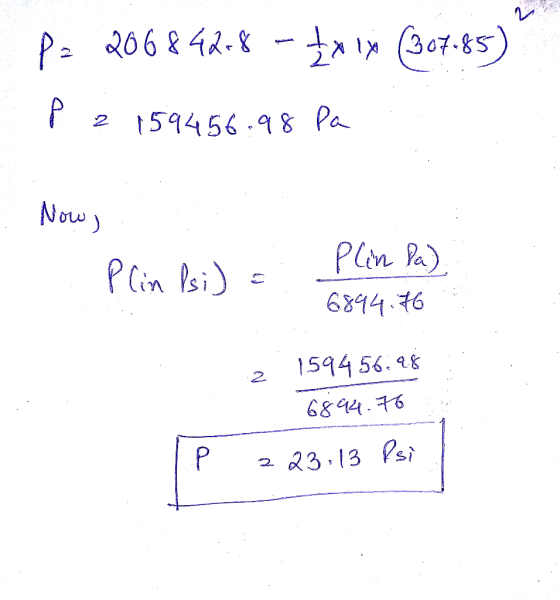
7.3. Air flows in a duct, and a valve is quickly closed. A normal shock is...
Air flows steadily and adiabatically through a horizontal straight pipe. The air enters the pipe at...
Air flows steadily and adiabatically through a horizontal straight pipe. The air enters the pipe at an absolute pressure of 100 psia, a temperature of 1000F, and a linear velocity of 10 ft/sec. The air leaves at 2 psia. Assuming ideal gas, determine the velocity and temperature of the leaving air?
3. A normal shock wave exists in Mach 2 stream of air having temperature and pressure...
 3. A normal shock wave exists in Mach 2 stream of air having temperature and pressure of 45°F and 30 psia, respectively. Calculate the Mach number, pressure, and temperature downstream of the shock wave.
2. Air flows through a converging-diverging nozzle. There is a normal shock in the divergmy section...
 2. Air flows through a converging-diverging nozzle. There is a normal shock in the divergmy section of the nozzle. The areas at throat, section 1. and section 2 are given in the figure below The sections 1 and 2 are located immediately upstream and downstream of the normal respectively. Therefore, the sections 1 and 2 are assumed to have the same area. There temperature and pressure are given as 300 K and 110 kPa, respectively. The entire isentropic except for...
V-3. Air flows at steady state through a horizontal, well-insulated, constant-area duct whose diameter is 0.75...
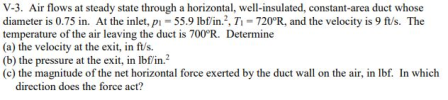 V-3. Air flows at steady state through a horizontal, well-insulated, constant-area duct whose diameter is 0.75 in. At the inlet, p1 = 55.9 lbf/in.2, T1 = 7200R, and the velocity is 9 ft/s. The temperature of the air leaving the duct is 700°R. Determine (a) the velocity at the exit, in ft/s. (b) the pressure at the exit, in lbf/in.2 (c) the magnitude of the net horizontal force exerted by the duct wall on the air, in lbf. In which...
UBAV Air flows through a converging-diverging nozzle diffuser. A normal shock stands in the diverging section...
 UBAV Air flows through a converging-diverging nozzle diffuser. A normal shock stands in the diverging section of the nozzle. Assuming isentropie flow, air as an ideal gas, and constant specific heat determine the state at several locations in the system. Solve wsing equations rather than with the tables Note: The Specific heat ratio and gas constant for air are given as k-1 and R 0.287 kJ/kg-K respectively Give Values Inlet Temperature: TI(K)-340 Inlet pressure: P1 (kPa) - 550 Inlet Velocity:...
Problem 3 (30%) Dry air flows from a reservoir in which the temperature is 200°C and...
 Problem 3 (30%) Dry air flows from a reservoir in which the temperature is 200°C and pressure is 600 kPa absolute. a) (20%) Assuming isentropic flow, calculate the temperature, pressure, and velocity when the Mach number is 2.1. Ti = °C P1 = kPa m V = b) (10%) A normal shock wave forms at the location where the Mach number is 2.1. Calculate the pressure and velocity after the shock wave. P2 = kPa
Problem 3 (30%) Dry air flows from a reservoir in which the temperature is 200°C and...
 Problem 3 (30%) Dry air flows from a reservoir in which the temperature is 200°C and pressure is 600 kPa absolute. a) (20%) Assuming isentropic flow, calculate the temperature, pressure, and velocity when the Mach number is 2.1. T, = °C P1 = kPa V1 = b) (10%) A normal shock wave forms at the location where the Mach number is 2.1. Calculate the pressure and velocity after the shock wave. p2 = kPa m V2 =
minimum of 3 significant figures please Dry air flows from a reservoir in which the temperature...
 minimum of 3 significant figures please
Dry air flows from a reservoir in which the temperature is 200°C and pressure is 600 kPa absolute. a) (20%) Assuming isentropic flow, calculate the temperature, pressure, and velocity when the Mach number is 2.1. T1 = °C P. = kPa 777 Vi = S b) (10%) A normal shock wave forms at the location where the Mach number is 2.1. Calculate the pressure and velocity after the shock wave. P2 = kPa m...
minimum of 3 significant figures please
Dry air flows from a reservoir in which the temperature is 200°C and pressure is 600 kPa absolute. a) (20%) Assuming isentropic flow, calculate the temperature, pressure, and velocity when the Mach number is 2.1. T1 = °C P. = kPa 777 Vi = S b) (10%) A normal shock wave forms at the location where the Mach number is 2.1. Calculate the pressure and velocity after the shock wave. P2 = kPa m...
Question 2 Soalan 2] (a) Air flowing steadily in a nozzle experiences a normal shock at...
 Question 2 Soalan 2] (a) Air flowing steadily in a nozzle experiences a normal shock at a Mach number of 2.5. The pressure and temperature of air are 61.64 kPa and 262.15 K, respectively, upstream of the shock The properties of air are k 1.4 and R = 0.287 kJ/kg K, and the properties of helium arek 1.667 and R 2.0769 kJ/kg-K. [Udara mengalir dengan mantap pada muncung yang mengalami kejutan normal di nombor Mach 2.5. Tekanan dan suhu udara...
Question 4 Soalan 4] (a) A supersonic nozzle is attached to a constant diameter circular duct...
 Question 4 Soalan 4] (a) A supersonic nozzle is attached to a constant diameter circular duct at its exit The duct diameter is the same as the nozzle exit diameter. Nozzle exit cross- section area is three times that of its throat. The gas (k1.4, R = 287 J/kg-K ) enters the nozzle with pressure and temperature of 10 bar and 600 K respectively with negligible velocity. If a normal shock occurs at a section in the diverging part of...
 3. A normal shock wave exists in Mach 2 stream of air having temperature and pressure of 45°F and 30 psia, respectively. Calculate the Mach number, pressure, and temperature downstream of the shock wave.
 2. Air flows through a converging-diverging nozzle. There is a normal shock in the divergmy section of the nozzle. The areas at throat, section 1. and section 2 are given in the figure below The sections 1 and 2 are located immediately upstream and downstream of the normal respectively. Therefore, the sections 1 and 2 are assumed to have the same area. There temperature and pressure are given as 300 K and 110 kPa, respectively. The entire isentropic except for...
 V-3. Air flows at steady state through a horizontal, well-insulated, constant-area duct whose diameter is 0.75 in. At the inlet, p1 = 55.9 lbf/in.2, T1 = 7200R, and the velocity is 9 ft/s. The temperature of the air leaving the duct is 700°R. Determine (a) the velocity at the exit, in ft/s. (b) the pressure at the exit, in lbf/in.2 (c) the magnitude of the net horizontal force exerted by the duct wall on the air, in lbf. In which...
 UBAV Air flows through a converging-diverging nozzle diffuser. A normal shock stands in the diverging section of the nozzle. Assuming isentropie flow, air as an ideal gas, and constant specific heat determine the state at several locations in the system. Solve wsing equations rather than with the tables Note: The Specific heat ratio and gas constant for air are given as k-1 and R 0.287 kJ/kg-K respectively Give Values Inlet Temperature: TI(K)-340 Inlet pressure: P1 (kPa) - 550 Inlet Velocity:...
 Problem 3 (30%) Dry air flows from a reservoir in which the temperature is 200°C and pressure is 600 kPa absolute. a) (20%) Assuming isentropic flow, calculate the temperature, pressure, and velocity when the Mach number is 2.1. Ti = °C P1 = kPa m V = b) (10%) A normal shock wave forms at the location where the Mach number is 2.1. Calculate the pressure and velocity after the shock wave. P2 = kPa
 Problem 3 (30%) Dry air flows from a reservoir in which the temperature is 200°C and pressure is 600 kPa absolute. a) (20%) Assuming isentropic flow, calculate the temperature, pressure, and velocity when the Mach number is 2.1. T, = °C P1 = kPa V1 = b) (10%) A normal shock wave forms at the location where the Mach number is 2.1. Calculate the pressure and velocity after the shock wave. p2 = kPa m V2 =
 minimum of 3 significant figures please
Dry air flows from a reservoir in which the temperature is 200°C and pressure is 600 kPa absolute. a) (20%) Assuming isentropic flow, calculate the temperature, pressure, and velocity when the Mach number is 2.1. T1 = °C P. = kPa 777 Vi = S b) (10%) A normal shock wave forms at the location where the Mach number is 2.1. Calculate the pressure and velocity after the shock wave. P2 = kPa m...
minimum of 3 significant figures please
Dry air flows from a reservoir in which the temperature is 200°C and pressure is 600 kPa absolute. a) (20%) Assuming isentropic flow, calculate the temperature, pressure, and velocity when the Mach number is 2.1. T1 = °C P. = kPa 777 Vi = S b) (10%) A normal shock wave forms at the location where the Mach number is 2.1. Calculate the pressure and velocity after the shock wave. P2 = kPa m...
 Question 2 Soalan 2] (a) Air flowing steadily in a nozzle experiences a normal shock at a Mach number of 2.5. The pressure and temperature of air are 61.64 kPa and 262.15 K, respectively, upstream of the shock The properties of air are k 1.4 and R = 0.287 kJ/kg K, and the properties of helium arek 1.667 and R 2.0769 kJ/kg-K. [Udara mengalir dengan mantap pada muncung yang mengalami kejutan normal di nombor Mach 2.5. Tekanan dan suhu udara...
 Question 4 Soalan 4] (a) A supersonic nozzle is attached to a constant diameter circular duct at its exit The duct diameter is the same as the nozzle exit diameter. Nozzle exit cross- section area is three times that of its throat. The gas (k1.4, R = 287 J/kg-K ) enters the nozzle with pressure and temperature of 10 bar and 600 K respectively with negligible velocity. If a normal shock occurs at a section in the diverging part of...
Most questions answered within 3 hours.
-
Where is the error in this code sequence?
String s1 = "Hello";
String s2 = "ello";...
asked 10 months ago -
Financial data for Joel de Paris, Inc., for last year
follow:
Joel de Paris, Inc.
Balance...
asked 10 months ago -
Consider this reaction:
Al2(SO4)3 (aq)+ BaCl3
(aq) Al2Cl6 (aq)- +
3BaSO4(s) . What is the...
asked 10 months ago -
Suppose that Savneet is considering increasing her
recent random sample from 20 car rentals to 40...
asked 10 months ago -
Trucks arrive at an unloading terminal at an average rate of 120
per hour.
Trucks arrive...
asked 10 months ago -
Why are methanol and ethanol completely soluble in water while
octanol is not very little soluble....
asked 10 months ago -
A facilities manager at a university reads in a research report
that the mean amount of...
asked 10 months ago -
When the CuSO4 is rehydrated by adding water to the anhydrous
compound, is this an endothermic...
asked 10 months ago -
A ray of sunlight is passing from diamond into crown glass; the
angle of incidence is...
asked 10 months ago -
A block of mass 0.249 kg is placed on top of a light, vertical
spring of...
asked 10 months ago -
how do the kidneys compensate in the presences of acidosis
a) trigger hyperventilate
b) reserve acid...
asked 10 months ago -
Question 501 pts
The rental rate of capital to the firm increases. Which of the
following...
asked 10 months ago