
Homework Answers
Request Answer!
We need at least 10 more requests to produce the answer.
0 / 10 have requested this problem solution
The more requests, the faster the answer.
Add Answer to:
1) Suppose supply is given by:10+2Q, and demand is given by: P-120-3Qs A) Find equilibrium price...
5. TAXES/SUBSIDIES, AND OTHER GOVERNMENT REGULATIONS 1. Consider the demand and supply for bubbly water in...
 5. TAXES/SUBSIDIES, AND OTHER GOVERNMENT REGULATIONS 1. Consider the demand and supply for bubbly water in a market represented by the following equations: QD = 15 - 10P QS = 40P - 50 where Q is millions of bottles per year and P measures dollars per bottle. The equilibrium price of bubbly water is $1.30 per bottle and 2 million bottles are sold each year. (a) Calculate the price elasticity of demand and the price elasticity of supply at the...
Suppose the market supply and demand for guitars in San Francisco are given by Demand: P=1000-0.25Q,...
Suppose the market supply and demand for guitars in San Francisco are given by Demand: P=1000-0.25Q, Supply: P=200+Q. What is the equilibrium price and quantity of the product? What is the price elasticity of demand at equilibrium price? Now assume there is a $10 per unit excise tax. What price will buyers pay after tax is imposed? What is the quantity of theh good that will be sold? What is the deadweight loss?
The demand and supply conditions of market for beer are given by the following equations: Qd...
 The demand and supply conditions of market for beer are given by the following equations: Qd = 72 - P and Qs = -18 + P a) Find the initial equilibrium price and quantity. b) Calculate the consumer surplus and producer surplus for the equilibrium. c) Suppose that government impose a price floor at P=66 to control the consumption of beer. Is this policy effective? What are price and quantity consumed after this intervention of government? d) Going back to...
suppose the market demand supply are given by p=160-2q and p=50+3q. a per unit excise tax...
suppose the market demand supply are given by p=160-2q and p=50+3q. a per unit excise tax of 10$ is levied on the sellers. what is the list social welfare deadweight loss due to the tax?
PROBLEM #6 The equilibrium price of cars in Boston in an unregulated automobile market is $25,000...
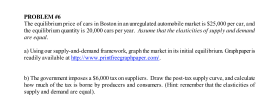 PROBLEM #6 The equilibrium price of cars in Boston in an unregulated automobile market is $25,000 per car, and the equilibrium quantity is 20,000 cars per year. Assume that the elasticities of supply and demand are equal. a) Using our supply-and-demand framework, graph the market in its initial equilibrium. Graphpaper is readily available at http://www.printfreegraphpaper.com/. b) The government imposes a $6,000 tax on suppliers. Draw the post-tax supply curve, and calculate how much of the tax is borne by producers...
Suppose market demand for bread is given by the equation QD = 12-P while the market...
 Suppose market demand for bread is given by the equation QD = 12-P while the market supply equation is Qs = 2P. a. Calculate the equilibrium price and quantity, consumer surplus, and producer surplus in the market for tires. Graph your results. b. Suppose the government imposes a tax on tire producers of $3 per tire. i. What price will the buyer pay? What is the burden to consumers? What amount per unit will the seller receive? What is the...
A higher tax rate is more likely to increase tax revenue if the price elasticity of...
A higher tax rate is more likely to increase tax revenue if the price elasticity of demand is _____ and the price elasticity of supply is _____. Select one: a. low; high b. low; low c. high; low d. high; high If the government imposes a $5 excise tax on leather shoes and the price of leather shoes increases by $2: Select one: a. the quantity of shoes sold will increase. b. producers are paying more of the tax than...
Question 3: Suppose that the demand equation: P- 10-Q and supply equation: P Q a. Calculate...
 Question 3: Suppose that the demand equation: P- 10-Q and supply equation: P Q a. Calculate the equilibrium price and quantity b. Calculate the consumer surplus, producer surplus and total surplus at equilibriunm Suppose the government imposes a tax of $2 for each unit bought. Derive the new equilibrium price that consumers pay, the price that firms receive, and quantity c. d. Calculate the deadweight loss of this tax. e. In a diagram, show the equilibrium in part a and...
Problem 1. Suppose the market demand is given by D(P) = 10 – 2p and the...
 Problem 1. Suppose the market demand is given by D(P) = 10 – 2p and the market supply is given by S(p) = 3p - 5. 1. Draw the supply and demand curves. Determine the equilibrium price p* and the equilibrium output x*. Determine CS, PS, and TS. 2. Explain why TS is maximized at the equilibrium price p*. 3. Suppose government imposed a $0.5 quantity tax. Determine the equilibrium price and the equilibrium output after the tax. Also, determine...
the supply and demand curves of bananas are given by the following P=10+2Q P= 50-2Q a)...
the supply and demand curves of bananas are given by the following P=10+2Q P= 50-2Q a) what is the equilibrium price and quantity? what is the pass through fraction of a tax burden to consumers? c) what is the price after a tax of £10 is imposed on every unit sold? d) how much of the £10 is born by the producer
 5. TAXES/SUBSIDIES, AND OTHER GOVERNMENT REGULATIONS 1. Consider the demand and supply for bubbly water in a market represented by the following equations: QD = 15 - 10P QS = 40P - 50 where Q is millions of bottles per year and P measures dollars per bottle. The equilibrium price of bubbly water is $1.30 per bottle and 2 million bottles are sold each year. (a) Calculate the price elasticity of demand and the price elasticity of supply at the...
 The demand and supply conditions of market for beer are given by the following equations: Qd = 72 - P and Qs = -18 + P a) Find the initial equilibrium price and quantity. b) Calculate the consumer surplus and producer surplus for the equilibrium. c) Suppose that government impose a price floor at P=66 to control the consumption of beer. Is this policy effective? What are price and quantity consumed after this intervention of government? d) Going back to...
 PROBLEM #6 The equilibrium price of cars in Boston in an unregulated automobile market is $25,000 per car, and the equilibrium quantity is 20,000 cars per year. Assume that the elasticities of supply and demand are equal. a) Using our supply-and-demand framework, graph the market in its initial equilibrium. Graphpaper is readily available at http://www.printfreegraphpaper.com/. b) The government imposes a $6,000 tax on suppliers. Draw the post-tax supply curve, and calculate how much of the tax is borne by producers...
 Suppose market demand for bread is given by the equation QD = 12-P while the market supply equation is Qs = 2P. a. Calculate the equilibrium price and quantity, consumer surplus, and producer surplus in the market for tires. Graph your results. b. Suppose the government imposes a tax on tire producers of $3 per tire. i. What price will the buyer pay? What is the burden to consumers? What amount per unit will the seller receive? What is the...
 Question 3: Suppose that the demand equation: P- 10-Q and supply equation: P Q a. Calculate the equilibrium price and quantity b. Calculate the consumer surplus, producer surplus and total surplus at equilibriunm Suppose the government imposes a tax of $2 for each unit bought. Derive the new equilibrium price that consumers pay, the price that firms receive, and quantity c. d. Calculate the deadweight loss of this tax. e. In a diagram, show the equilibrium in part a and...
 Problem 1. Suppose the market demand is given by D(P) = 10 – 2p and the market supply is given by S(p) = 3p - 5. 1. Draw the supply and demand curves. Determine the equilibrium price p* and the equilibrium output x*. Determine CS, PS, and TS. 2. Explain why TS is maximized at the equilibrium price p*. 3. Suppose government imposed a $0.5 quantity tax. Determine the equilibrium price and the equilibrium output after the tax. Also, determine...
Most questions answered within 3 hours.
-
Where is the error in this code sequence?
String s1 = "Hello";
String s2 = "ello";...
asked 10 months ago -
Financial data for Joel de Paris, Inc., for last year
follow:
Joel de Paris, Inc.
Balance...
asked 10 months ago -
Consider this reaction:
Al2(SO4)3 (aq)+ BaCl3
(aq) Al2Cl6 (aq)- +
3BaSO4(s) . What is the...
asked 10 months ago -
Suppose that Savneet is considering increasing her
recent random sample from 20 car rentals to 40...
asked 10 months ago -
Trucks arrive at an unloading terminal at an average rate of 120
per hour.
Trucks arrive...
asked 10 months ago -
Why are methanol and ethanol completely soluble in water while
octanol is not very little soluble....
asked 10 months ago -
A facilities manager at a university reads in a research report
that the mean amount of...
asked 10 months ago -
When the CuSO4 is rehydrated by adding water to the anhydrous
compound, is this an endothermic...
asked 10 months ago -
A ray of sunlight is passing from diamond into crown glass; the
angle of incidence is...
asked 10 months ago -
A block of mass 0.249 kg is placed on top of a light, vertical
spring of...
asked 10 months ago -
how do the kidneys compensate in the presences of acidosis
a) trigger hyperventilate
b) reserve acid...
asked 10 months ago -
Question 501 pts
The rental rate of capital to the firm increases. Which of the
following...
asked 10 months ago