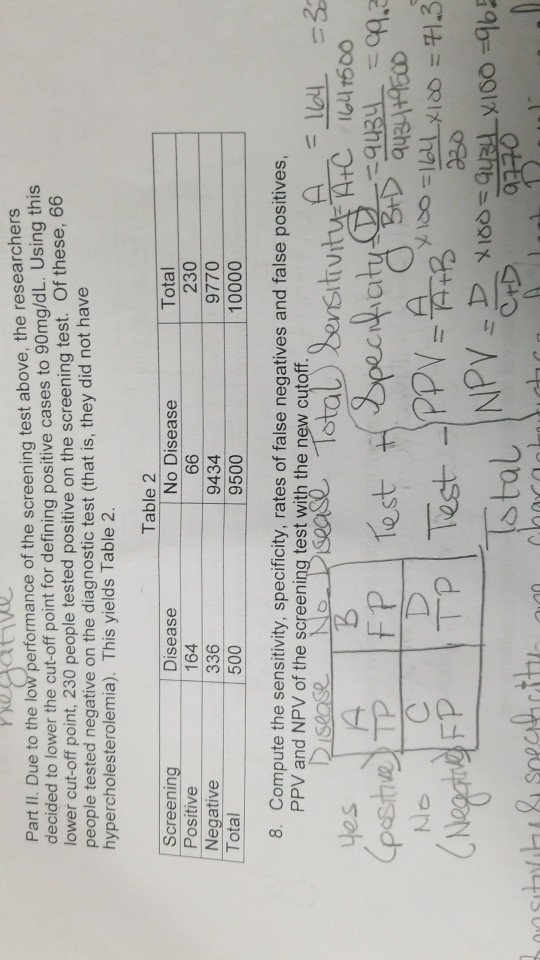

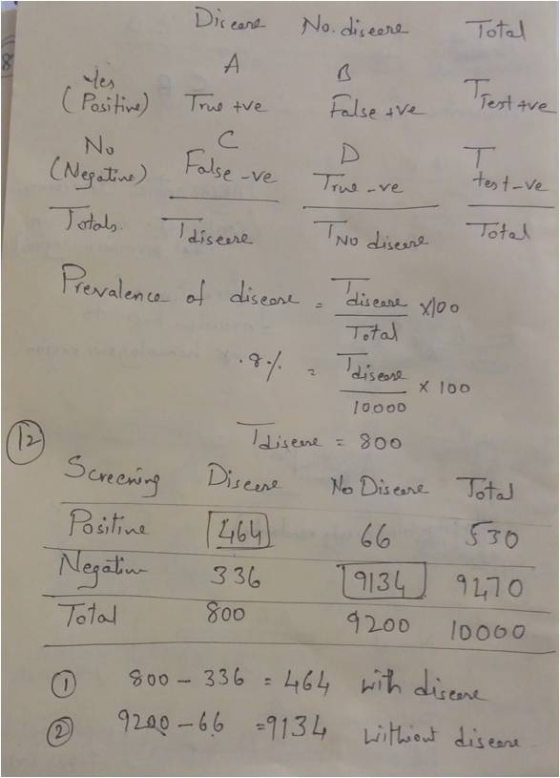
Using the information from Part 2 and question 8 (the first picture). Can you answer numbers 12-14?
Homework Answers

Add Answer to:
Using the information from Part 2 and question 8 (the
first picture). Can you answer numbers...
Epidemiology question 3. ng the screening cut-off point affect sensitivity. specificity, PPV and NPV of the...
 Epidemiology question
3. ng the screening cut-off point affect sensitivity. specificity, PPV and NPV of the test? Why? are the respective "costs" ring the screening cut-off point affect the number of false positives and false negatives associated with false positives and false negativesi ? What 5. sensitivity, PPV and NPV of the test? How would you expect raising the cut-off point to 220mg of blood glucose per 100ml to affect the specificity was repeated using the 130mg of blood glucose...
Epidemiology question
3. ng the screening cut-off point affect sensitivity. specificity, PPV and NPV of the test? Why? are the respective "costs" ring the screening cut-off point affect the number of false positives and false negatives associated with false positives and false negativesi ? What 5. sensitivity, PPV and NPV of the test? How would you expect raising the cut-off point to 220mg of blood glucose per 100ml to affect the specificity was repeated using the 130mg of blood glucose...
QUESTION 20 Disease Positive Disease Negative Tested Positive Tested Negative 25 523 Screening Test Results for Gre...
 QUESTION 20 Disease Positive Disease Negative Tested Positive Tested Negative 25 523 Screening Test Results for Greyscale Disease 1) What is the specificity? (percentage rounded to 2 decimal places) 2) What is the sensitivity? (percentage rounded to 2 decimal places) 3) How many false positives are there? 4) How many false negatives are there?
10) Please calculate the Sensitivity and Specificity from the 2 by 2 (Screening Test A). (2...
 10) Please calculate the Sensitivity and Specificity from the 2 by 2 (Screening Test A). (2 points) Test + Test- Diseased 100 10 Not Diseased 20 80 Sensitivity Specificity How many false positives are there? (1 point) 12) Please Calculate the Sensitivity and Specificity of Screening Test B (2 points) Not D Test Positive 34 Test Negative 13 If I wanted to limit the number of false positives, which of the two screening tests would be preferred? A or B?...
10) Please calculate the Sensitivity and Specificity from the 2 by 2 (Screening Test A). (2 points) Test + Test- Disea...
 10) Please calculate the Sensitivity and Specificity from the 2 by 2 (Screening Test A). (2 points) Test + Test- Diseased 100 10 Not Diseased 20 80 Sensitivity Specificity How many false positives are there? (1 point) 12) Please Calculate the Sensitivity and Specificity of Screening Test B (2 points) Not D Test Positive 34 Test Negative 13 If I wanted to limit the number of false positives, which of the two screening tests would be preferred? A or B?...
Scenario 1: The prevalence (a + c in the table below) of previously undetected diabetes in...
Scenario 1: The prevalence (a + c in the table below) of previously undetected diabetes in a population to be screened is approximately 1.5% and it is assumed that 10,000 persons will be screened. The screening test will measure blood serum sugar content. A value of 180 mg/dl or higher is considered positive. The sensitivity (a) and the specificity (d) associated with this screening are 22.9% and 99.8% respectively. Questions 1-9: set up a two by two table with the...
validity of a test HELP answer ALL you can !! ... imagine you are a physician...
 validity of a test
HELP
answer ALL you can !!
... imagine you are a physician discussing the results of a screening test with a patient. AC 1) If the test was positive, how likely is it that he really has the disease? [How worried should he be?] 2) If the test was negative, how likely is it that he really does NOT have it? (How reassured should he be?] 1) What does 1) represent? 0 1 Represents that the...
validity of a test
HELP
answer ALL you can !!
... imagine you are a physician discussing the results of a screening test with a patient. AC 1) If the test was positive, how likely is it that he really has the disease? [How worried should he be?] 2) If the test was negative, how likely is it that he really does NOT have it? (How reassured should he be?] 1) What does 1) represent? 0 1 Represents that the...
Questions 1, 2, 3, 4, 5, 6, 7, 8 are based on the following information: An...
Questions 1, 2, 3, 4, 5, 6, 7, 8 are based on the following information: An epidemiological study (hypothetical) in humans in an infected country showed the following results: 1176 humans from a village were tested for dengue using an ELISA test, 168 tested positive. Out of 168 tested positives, 100 were misclassified as positive. Similarly, 408 were also misclassified as negative by the test. Question 1. Calculate the prevalence based on the ELISA result. 14.3% b. 10% ...
Questions 1, 2, 3, 4, 5, 6, 7, 8 are based on the following information: An...
Questions 1, 2, 3, 4, 5, 6, 7, 8 are based on the following information: An epidemiological study (hypothetical) in humans in an infected country showed the following results: 1176 humans from a village were tested for dengue using an ELISA test, 168 tested positive. Out of 168 tested positives, 100 were misclassified as positive. Similarly, 408 were also misclassified as negative by the test. Question 1. Calculate the prevalence based on the ELISA result. a. 14.3% b. 10% c....
pls answer all 5:12 .. LED < Back 465 practice 2-1.docx 17 imagine you are a...
 pls answer all
5:12 .. LED < Back 465 practice 2-1.docx 17 imagine you are a physician discussing the results of a screening test with a patient. 1) If the test was positive how likely is it that he really has the disease? (How worried should he be? 2) If the test was negative how likely is it that he really does NOT have it? How reassured should he be? 1) What does 1) represent? a) Express this measure mathematically...
pls answer all
5:12 .. LED < Back 465 practice 2-1.docx 17 imagine you are a physician discussing the results of a screening test with a patient. 1) If the test was positive how likely is it that he really has the disease? (How worried should he be? 2) If the test was negative how likely is it that he really does NOT have it? How reassured should he be? 1) What does 1) represent? a) Express this measure mathematically...
please answer the question 6 using the given information. Thank you 5. A screening test for...
 please answer the question 6 using the given
information. Thank you
5. A screening test for diabetes, where a blood glucose of 180 mg/dl is considered positive, has a known sensitivity of 22.5% and a known specificity of 99.7%. The prevalence of diabetes in Town X is 2% and Town Y is 1.5% 6. Based on Q 5, assuming there are 10000 people living in Town Y, how many people will test positive and be referred for additional testing? a....
please answer the question 6 using the given
information. Thank you
5. A screening test for diabetes, where a blood glucose of 180 mg/dl is considered positive, has a known sensitivity of 22.5% and a known specificity of 99.7%. The prevalence of diabetes in Town X is 2% and Town Y is 1.5% 6. Based on Q 5, assuming there are 10000 people living in Town Y, how many people will test positive and be referred for additional testing? a....
 Epidemiology question
3. ng the screening cut-off point affect sensitivity. specificity, PPV and NPV of the test? Why? are the respective "costs" ring the screening cut-off point affect the number of false positives and false negatives associated with false positives and false negativesi ? What 5. sensitivity, PPV and NPV of the test? How would you expect raising the cut-off point to 220mg of blood glucose per 100ml to affect the specificity was repeated using the 130mg of blood glucose...
Epidemiology question
3. ng the screening cut-off point affect sensitivity. specificity, PPV and NPV of the test? Why? are the respective "costs" ring the screening cut-off point affect the number of false positives and false negatives associated with false positives and false negativesi ? What 5. sensitivity, PPV and NPV of the test? How would you expect raising the cut-off point to 220mg of blood glucose per 100ml to affect the specificity was repeated using the 130mg of blood glucose...
 QUESTION 20 Disease Positive Disease Negative Tested Positive Tested Negative 25 523 Screening Test Results for Greyscale Disease 1) What is the specificity? (percentage rounded to 2 decimal places) 2) What is the sensitivity? (percentage rounded to 2 decimal places) 3) How many false positives are there? 4) How many false negatives are there?
 10) Please calculate the Sensitivity and Specificity from the 2 by 2 (Screening Test A). (2 points) Test + Test- Diseased 100 10 Not Diseased 20 80 Sensitivity Specificity How many false positives are there? (1 point) 12) Please Calculate the Sensitivity and Specificity of Screening Test B (2 points) Not D Test Positive 34 Test Negative 13 If I wanted to limit the number of false positives, which of the two screening tests would be preferred? A or B?...
 10) Please calculate the Sensitivity and Specificity from the 2 by 2 (Screening Test A). (2 points) Test + Test- Diseased 100 10 Not Diseased 20 80 Sensitivity Specificity How many false positives are there? (1 point) 12) Please Calculate the Sensitivity and Specificity of Screening Test B (2 points) Not D Test Positive 34 Test Negative 13 If I wanted to limit the number of false positives, which of the two screening tests would be preferred? A or B?...
 validity of a test
HELP
answer ALL you can !!
... imagine you are a physician discussing the results of a screening test with a patient. AC 1) If the test was positive, how likely is it that he really has the disease? [How worried should he be?] 2) If the test was negative, how likely is it that he really does NOT have it? (How reassured should he be?] 1) What does 1) represent? 0 1 Represents that the...
validity of a test
HELP
answer ALL you can !!
... imagine you are a physician discussing the results of a screening test with a patient. AC 1) If the test was positive, how likely is it that he really has the disease? [How worried should he be?] 2) If the test was negative, how likely is it that he really does NOT have it? (How reassured should he be?] 1) What does 1) represent? 0 1 Represents that the...
 pls answer all
5:12 .. LED < Back 465 practice 2-1.docx 17 imagine you are a physician discussing the results of a screening test with a patient. 1) If the test was positive how likely is it that he really has the disease? (How worried should he be? 2) If the test was negative how likely is it that he really does NOT have it? How reassured should he be? 1) What does 1) represent? a) Express this measure mathematically...
pls answer all
5:12 .. LED < Back 465 practice 2-1.docx 17 imagine you are a physician discussing the results of a screening test with a patient. 1) If the test was positive how likely is it that he really has the disease? (How worried should he be? 2) If the test was negative how likely is it that he really does NOT have it? How reassured should he be? 1) What does 1) represent? a) Express this measure mathematically...
 please answer the question 6 using the given
information. Thank you
5. A screening test for diabetes, where a blood glucose of 180 mg/dl is considered positive, has a known sensitivity of 22.5% and a known specificity of 99.7%. The prevalence of diabetes in Town X is 2% and Town Y is 1.5% 6. Based on Q 5, assuming there are 10000 people living in Town Y, how many people will test positive and be referred for additional testing? a....
please answer the question 6 using the given
information. Thank you
5. A screening test for diabetes, where a blood glucose of 180 mg/dl is considered positive, has a known sensitivity of 22.5% and a known specificity of 99.7%. The prevalence of diabetes in Town X is 2% and Town Y is 1.5% 6. Based on Q 5, assuming there are 10000 people living in Town Y, how many people will test positive and be referred for additional testing? a....
Most questions answered within 3 hours.
-
Where is the error in this code sequence?
String s1 = "Hello";
String s2 = "ello";...
asked 10 months ago -
Financial data for Joel de Paris, Inc., for last year
follow:
Joel de Paris, Inc.
Balance...
asked 10 months ago -
Consider this reaction:
Al2(SO4)3 (aq)+ BaCl3
(aq) Al2Cl6 (aq)- +
3BaSO4(s) . What is the...
asked 10 months ago -
Suppose that Savneet is considering increasing her
recent random sample from 20 car rentals to 40...
asked 10 months ago -
Trucks arrive at an unloading terminal at an average rate of 120
per hour.
Trucks arrive...
asked 10 months ago -
Why are methanol and ethanol completely soluble in water while
octanol is not very little soluble....
asked 10 months ago -
A facilities manager at a university reads in a research report
that the mean amount of...
asked 10 months ago -
When the CuSO4 is rehydrated by adding water to the anhydrous
compound, is this an endothermic...
asked 10 months ago -
A ray of sunlight is passing from diamond into crown glass; the
angle of incidence is...
asked 10 months ago -
A block of mass 0.249 kg is placed on top of a light, vertical
spring of...
asked 10 months ago -
how do the kidneys compensate in the presences of acidosis
a) trigger hyperventilate
b) reserve acid...
asked 10 months ago -
Question 501 pts
The rental rate of capital to the firm increases. Which of the
following...
asked 10 months ago