cell biology Which of the following is an active transport mechanism? a Facilitated diffusion of potassium...
cell biology
Which of the following is an active transport mechanism?
| a Facilitated diffusion of potassium ions across the membrane through an open potassium channel |
| b | Movement of water into a cell |
| c Sodium ions moving out of an animal cell bathed in physiological saline |
| d | Movement of CO2 out of a cell |
| e | None of the above |
Homework Answers
c Sodium ions moving out of an animal cell bathed in physiological saline
Active transport is the mechanism which needs energy as it move substances against a concentration gradient and Sodium ions moving out of an animal cell bathed in physiological saline needs the energy from ATP hydrolysis.
Add Answer to:
cell biology
Which of the following is an active transport mechanism?
a Facilitated diffusion of potassium...
How does facilitated diffusion differ from simple diffusion? Facilitated diffusion requires ATP Facilitated diffusion requires a...
How does facilitated diffusion differ from simple diffusion? Facilitated diffusion requires ATP Facilitated diffusion requires a solute-specific protein carrier Facilitated diffusion transports solute against its’ concentration gradient Which of the following is TRUE about primary active cell membrane transport? It is a form of transport that requires a protein “pump” It is a form of transport that transports ions and/or solute against their concentration gradient It is a transport mechanism that requires energy released from the splitting of ATP by...
Classify the phrases based on whether they describe or give an example of facilitated diffusion, active...
 Classify the phrases based on whether they describe or give an example of facilitated diffusion, active transport, or both. Facilitated diffusion Active transport Both Answer Bank movement to area of lower concentration movement across a membrane movement assisted by proteins glucose transport into muscle cell sodium ion transport out of cell requires energy
A correct distinction between facilitated diffusion and active transport of a substance across a biological membrane...
A correct distinction between facilitated diffusion and active transport of a substance across a biological membrane is that . . . A. active transport requires conformational changes in the transport protein associated with the transport process, and facillitated diffusion does not. B. active transport requires integral membrane protein to carry out the transport, and facillitated diffusion does not. C. facilitated diffusion depends on an existing energy gradient acting on the transported substance, while active transport makes such a gradient. D....
Please summarize this chapter typed clearly. Diffusion Is a passive process of transport. A single substance...
 Please summarize this chapter
typed clearly.
Diffusion Is a passive process of transport. A single substance tends to move from an area of high concentration to an area of low concentration until the concentration is equal across a space. Facilitated transport Facilitated diffusion is the process of spontaneous passive transport of molecules or ions across a biological membrane via specific transmembrane integral proteins. Channels The integral proteins involved in facilitated transport are collectively referred to as transport proteins, and they...
Please summarize this chapter
typed clearly.
Diffusion Is a passive process of transport. A single substance tends to move from an area of high concentration to an area of low concentration until the concentration is equal across a space. Facilitated transport Facilitated diffusion is the process of spontaneous passive transport of molecules or ions across a biological membrane via specific transmembrane integral proteins. Channels The integral proteins involved in facilitated transport are collectively referred to as transport proteins, and they...
ane Transport - Facilitated Diffusion Side with higher concentration of molecules Transport protein Plasma membrane Facilitated...
 ane Transport - Facilitated Diffusion Side with higher concentration of molecules Transport protein Plasma membrane Facilitated diffusion causes a net movement of molecules down their concentration gradient. mework : Membrane Transport - Active Transport Side with higher concentration of square molecules Transport protein Energy input from the cell Plasma membrane Side with lower concentration of square molecules
33) Which of the following is most likely true of a protein that cotransports glucose and...
 33) Which of the following is most likely true of a protein that cotransports glucose and sodium ions into the intestinal cells of an animal? A) Sodium and glucose bind to the same site on the cotransporter. B) Transport of glucose against its concentration gradient provides energy for uptake of sodium ions against the electrochemical gradient. C) Sodium ions can be transported whether or not glucose is present outside the cell, but glucose transport requires cotransport of sodium ions. D)...
How are facilitated diffusion and diffusion similar? Both processes involve the movement of solute from an...
 How are facilitated diffusion and diffusion similar?
Both processes involve the movement of solute from an area of
low concentration to an area of high concentration.
Both processes involve the movement of solute from an area of
high concentration to an area of low concentration.
In both kinds of movement across a cell membrane, proteins do
not play a role in assisting the passage of compounds and ions
through a membrane.
In both kinds of movement across a cell membrane,...
How are facilitated diffusion and diffusion similar?
Both processes involve the movement of solute from an area of
low concentration to an area of high concentration.
Both processes involve the movement of solute from an area of
high concentration to an area of low concentration.
In both kinds of movement across a cell membrane, proteins do
not play a role in assisting the passage of compounds and ions
through a membrane.
In both kinds of movement across a cell membrane,...
Match the following species to their mode of transport across membranes:- Fatty acids [Choose ] Active...
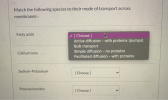 Match the following species to their mode of transport across membranes:- Fatty acids [Choose ] Active diffusion - with proteins (pumps) Bulk transport Simple diffusion - no proteins Facilitated diffusion - with proteins Calcium ions Sodium-Potassium [Choose) Polysaccharides [Choose ]
Oxygen and carbon dioxide enter and exit cell membranes by a) active transport b) facilitated diffusion...
Oxygen and carbon dioxide enter and exit cell membranes by a) active transport b) facilitated diffusion c) passive diffusion d) antiport
Which of the following would not be facilitated diffusion? A. An amino acid exits the cell...
Which of the following would not be facilitated diffusion? A. An amino acid exits the cell through an integral protein. B. A chloride ion (Cl-) unlocks a protein channel, and passes through. C. A large glucose molecule enters the cell through a pore protein. D. A water molecule passes through a semi-permeable membrane.
 Classify the phrases based on whether they describe or give an example of facilitated diffusion, active transport, or both. Facilitated diffusion Active transport Both Answer Bank movement to area of lower concentration movement across a membrane movement assisted by proteins glucose transport into muscle cell sodium ion transport out of cell requires energy
 Please summarize this chapter
typed clearly.
Diffusion Is a passive process of transport. A single substance tends to move from an area of high concentration to an area of low concentration until the concentration is equal across a space. Facilitated transport Facilitated diffusion is the process of spontaneous passive transport of molecules or ions across a biological membrane via specific transmembrane integral proteins. Channels The integral proteins involved in facilitated transport are collectively referred to as transport proteins, and they...
Please summarize this chapter
typed clearly.
Diffusion Is a passive process of transport. A single substance tends to move from an area of high concentration to an area of low concentration until the concentration is equal across a space. Facilitated transport Facilitated diffusion is the process of spontaneous passive transport of molecules or ions across a biological membrane via specific transmembrane integral proteins. Channels The integral proteins involved in facilitated transport are collectively referred to as transport proteins, and they...
 ane Transport - Facilitated Diffusion Side with higher concentration of molecules Transport protein Plasma membrane Facilitated diffusion causes a net movement of molecules down their concentration gradient. mework : Membrane Transport - Active Transport Side with higher concentration of square molecules Transport protein Energy input from the cell Plasma membrane Side with lower concentration of square molecules
 33) Which of the following is most likely true of a protein that cotransports glucose and sodium ions into the intestinal cells of an animal? A) Sodium and glucose bind to the same site on the cotransporter. B) Transport of glucose against its concentration gradient provides energy for uptake of sodium ions against the electrochemical gradient. C) Sodium ions can be transported whether or not glucose is present outside the cell, but glucose transport requires cotransport of sodium ions. D)...
 How are facilitated diffusion and diffusion similar?
Both processes involve the movement of solute from an area of
low concentration to an area of high concentration.
Both processes involve the movement of solute from an area of
high concentration to an area of low concentration.
In both kinds of movement across a cell membrane, proteins do
not play a role in assisting the passage of compounds and ions
through a membrane.
In both kinds of movement across a cell membrane,...
How are facilitated diffusion and diffusion similar?
Both processes involve the movement of solute from an area of
low concentration to an area of high concentration.
Both processes involve the movement of solute from an area of
high concentration to an area of low concentration.
In both kinds of movement across a cell membrane, proteins do
not play a role in assisting the passage of compounds and ions
through a membrane.
In both kinds of movement across a cell membrane,...
 Match the following species to their mode of transport across membranes:- Fatty acids [Choose ] Active diffusion - with proteins (pumps) Bulk transport Simple diffusion - no proteins Facilitated diffusion - with proteins Calcium ions Sodium-Potassium [Choose) Polysaccharides [Choose ]
Most questions answered within 3 hours.
-
Where is the error in this code sequence?
String s1 = "Hello";
String s2 = "ello";...
asked 11 months ago -
Financial data for Joel de Paris, Inc., for last year
follow:
Joel de Paris, Inc.
Balance...
asked 11 months ago -
Consider this reaction:
Al2(SO4)3 (aq)+ BaCl3
(aq) Al2Cl6 (aq)- +
3BaSO4(s) . What is the...
asked 11 months ago -
Suppose that Savneet is considering increasing her
recent random sample from 20 car rentals to 40...
asked 11 months ago -
Trucks arrive at an unloading terminal at an average rate of 120
per hour.
Trucks arrive...
asked 11 months ago -
Why are methanol and ethanol completely soluble in water while
octanol is not very little soluble....
asked 11 months ago -
A facilities manager at a university reads in a research report
that the mean amount of...
asked 11 months ago -
When the CuSO4 is rehydrated by adding water to the anhydrous
compound, is this an endothermic...
asked 11 months ago -
A ray of sunlight is passing from diamond into crown glass; the
angle of incidence is...
asked 11 months ago -
A block of mass 0.249 kg is placed on top of a light, vertical
spring of...
asked 11 months ago -
how do the kidneys compensate in the presences of acidosis
a) trigger hyperventilate
b) reserve acid...
asked 11 months ago -
Question 501 pts
The rental rate of capital to the firm increases. Which of the
following...
asked 11 months ago