 The answer was provided by my
Dynamics professor.
The answer was provided by my
Dynamics professor.
Homework Answers
Add Answer to:
The answer was provided by my
Dynamics professor.
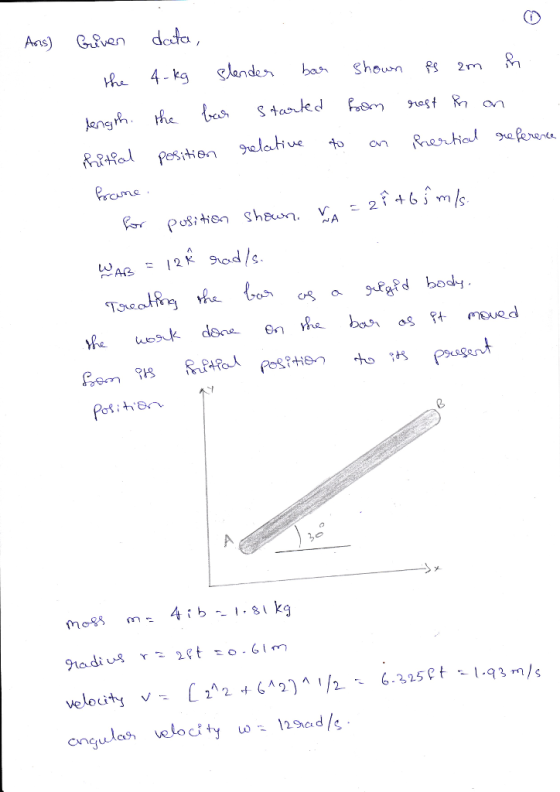
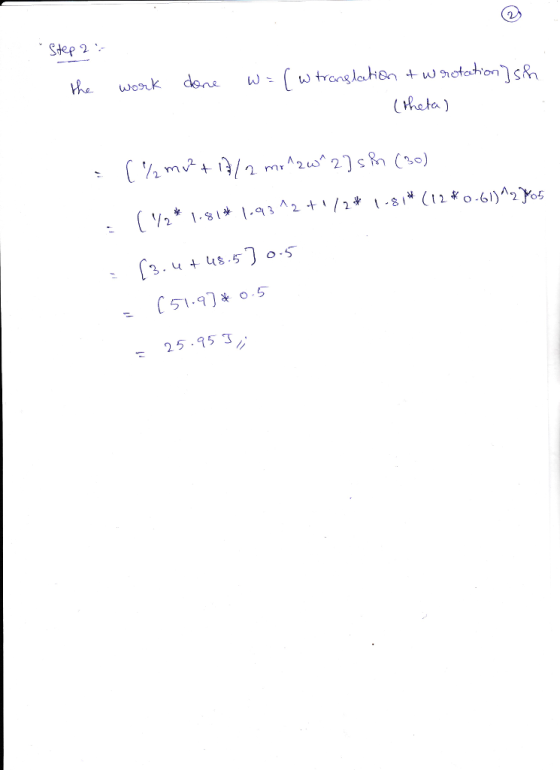
The 4 kg slender bar shown is 2...
The 15-kg slender bar OA is released from rest in the vertical position and compresses the...
The 15-kg slender bar OA is released from rest in the vertical position and compresses thespring of stiffness k = 20 kN/m as the horizontal position is passed. Determine the propersetting of the spring, by specifying the distance h, that will result in the bar having an angularvelocity ω = 4 rad/s as it crosses the horizontal position. What is the effect of x on thedynamics of the problem?
The spring is uncompressed when the uniform slender bar is in the vertical position shown. Determine...
 The spring is uncompressed when the uniform slender bar is in the vertical position shown. Determine the initial angular acceleration a of the bar when it is released from rest in a position where the bar has been rotated clockwise 33° from the position shown. Neglect any sag of the spring, whose mass is negligible. The angular acceleration is positive if counterclockwise and negative if clockwise. The mass m of the bar is 18 kg, the length / is 305...
A rigid bar in the shape of a T has a mass of 10 kg. The T-shaped body of mass m is composed of two identical slender b...
 A rigid bar in the shape of a T has a mass of 10 kg. The T-shaped body of mass m is composed of two identical slender bars welded together. End A is constrained to move in the slotted frictionless groove guided by the light frictionless roller as shown in Figure 3. The lower end of the T is released from rest in the vertical plane in the position shown, and the dimension /= 1 m. (i) Determine the location...
dynamics Fundamental Problem 18.3 The uniform 38 kg slender rod is at rest in the position...
 dynamics
Fundamental Problem 18.3 The uniform 38 kg slender rod is at rest in the position shown when P = 600 N is applied. (Figure 1) Part A Determine the angular velocity of the rod when the rod reaches the vertical position. Express your answer to three significant figures and include the appropriate units. MÅ ? rad W2 = 3.192 S Figure 1 of 1 Submit Previous Answers Request Answer * Incorrect; Try Again; 13 attempts remaining Provide Feedback 5...
dynamics
Fundamental Problem 18.3 The uniform 38 kg slender rod is at rest in the position shown when P = 600 N is applied. (Figure 1) Part A Determine the angular velocity of the rod when the rod reaches the vertical position. Express your answer to three significant figures and include the appropriate units. MÅ ? rad W2 = 3.192 S Figure 1 of 1 Submit Previous Answers Request Answer * Incorrect; Try Again; 13 attempts remaining Provide Feedback 5...
dynamics < 2 of 8 Review Part A If the uniform 40-kg slender rod starts from...
 dynamics
< 2 of 8 Review Part A If the uniform 40-kg slender rod starts from rest at the position shown, determine its angular velocity after it has rotated 4 revolutions. The forces remain perpendicular to the rod.(Figure 1) Express your answer to three significant figures and include the appropriate units. | НА 4 ? WE Value Units Submit Request Answer 30 N 0.5 mſ0.5 m 0.5 m -1.5 m 20 N.m o 20 N
dynamics
< 2 of 8 Review Part A If the uniform 40-kg slender rod starts from rest at the position shown, determine its angular velocity after it has rotated 4 revolutions. The forces remain perpendicular to the rod.(Figure 1) Express your answer to three significant figures and include the appropriate units. | НА 4 ? WE Value Units Submit Request Answer 30 N 0.5 mſ0.5 m 0.5 m -1.5 m 20 N.m o 20 N
01. Answer both parts of this question. Part-1 2D Rigid Body Dynamics The machine shown in...
 01. Answer both parts of this question. Part-1 2D Rigid Body Dynamics The machine shown in Figure Q1a comprises an arm AB attached to a rotating joint at point A, which can also be elevated by a hydraulic ram. The arm has mass 100 kg and moment of inertia IG = 10 kgm about mass centre G. A fixed x-y frame is shown with its origin at point A. At the instant shown, the arm is in the horizontal position...
The slender 12-kg bar has a clockwise angular velocity of ω = 2 rad/s when it is in the position shown Suppose that L = 2.2 m
 The slender 12-kg bar has a clockwise angular velocity of ω = 2 rad/s when it is in the position shown Suppose that L = 2.2 m. (Figure 1) Part A Determine its angular acceleration, measured clockwise. Part B Determine the magnitude of the normal reaction of the smooth surface A at this instant. Part C Determine the magnitude of the normal reaction of the smooth surface B at this instant.
The slender 12-kg bar has a clockwise angular velocity of ω = 2 rad/s when it is in the position shown Suppose that L =3 m
 The slender 12-kg bar has a clockwise angular velocity of ω = 2 rad/s when it is in the position shown Suppose that L =3 m. (Figure 1) Part A Determine its angular acceleration, measured clockwise. Part B Determine the magnitude of the normal reaction of the smooth surface A at this instant. Part C Determine the magnitude of the normal reaction of the smooth surface B at this instant.
Pin P is attached to the wheel shown and slides in a slot cut in bar...
 Pin P is attached to the wheel shown and slides in a slot cut in bar BD. The wheel rolls to the right without slipping with a constant angular velocity of 22 rad/s 0 140 min 200 mm Problem 15.154.a- Plane motion, velocity of a particle with respect to a rotating reference frame Knowing that x= 480 mm at θ = o", determine the angular velocity of the bar and the relative velocity of pin P with respect to the...
The 10 kg uniform slender bar is pinned at A to the collar, which has an upward acceleration a = 4 m/s along the vertical shaft.
 The 10 kg uniform slender bar is pinned at A to the collar, which has an upward acceleration a = 4 m/s along the vertical shaft. If the bar has an angular velocity ω = 3 rad/s as it swings past the horizontal position, determine the magnitude of the reaction at A for this instant.Ans: 43.8 N
 The spring is uncompressed when the uniform slender bar is in the vertical position shown. Determine the initial angular acceleration a of the bar when it is released from rest in a position where the bar has been rotated clockwise 33° from the position shown. Neglect any sag of the spring, whose mass is negligible. The angular acceleration is positive if counterclockwise and negative if clockwise. The mass m of the bar is 18 kg, the length / is 305...
 A rigid bar in the shape of a T has a mass of 10 kg. The T-shaped body of mass m is composed of two identical slender bars welded together. End A is constrained to move in the slotted frictionless groove guided by the light frictionless roller as shown in Figure 3. The lower end of the T is released from rest in the vertical plane in the position shown, and the dimension /= 1 m. (i) Determine the location...
 dynamics
Fundamental Problem 18.3 The uniform 38 kg slender rod is at rest in the position shown when P = 600 N is applied. (Figure 1) Part A Determine the angular velocity of the rod when the rod reaches the vertical position. Express your answer to three significant figures and include the appropriate units. MÅ ? rad W2 = 3.192 S Figure 1 of 1 Submit Previous Answers Request Answer * Incorrect; Try Again; 13 attempts remaining Provide Feedback 5...
dynamics
Fundamental Problem 18.3 The uniform 38 kg slender rod is at rest in the position shown when P = 600 N is applied. (Figure 1) Part A Determine the angular velocity of the rod when the rod reaches the vertical position. Express your answer to three significant figures and include the appropriate units. MÅ ? rad W2 = 3.192 S Figure 1 of 1 Submit Previous Answers Request Answer * Incorrect; Try Again; 13 attempts remaining Provide Feedback 5...
 dynamics
< 2 of 8 Review Part A If the uniform 40-kg slender rod starts from rest at the position shown, determine its angular velocity after it has rotated 4 revolutions. The forces remain perpendicular to the rod.(Figure 1) Express your answer to three significant figures and include the appropriate units. | НА 4 ? WE Value Units Submit Request Answer 30 N 0.5 mſ0.5 m 0.5 m -1.5 m 20 N.m o 20 N
dynamics
< 2 of 8 Review Part A If the uniform 40-kg slender rod starts from rest at the position shown, determine its angular velocity after it has rotated 4 revolutions. The forces remain perpendicular to the rod.(Figure 1) Express your answer to three significant figures and include the appropriate units. | НА 4 ? WE Value Units Submit Request Answer 30 N 0.5 mſ0.5 m 0.5 m -1.5 m 20 N.m o 20 N
 01. Answer both parts of this question. Part-1 2D Rigid Body Dynamics The machine shown in Figure Q1a comprises an arm AB attached to a rotating joint at point A, which can also be elevated by a hydraulic ram. The arm has mass 100 kg and moment of inertia IG = 10 kgm about mass centre G. A fixed x-y frame is shown with its origin at point A. At the instant shown, the arm is in the horizontal position...
 Pin P is attached to the wheel shown and slides in a slot cut in bar BD. The wheel rolls to the right without slipping with a constant angular velocity of 22 rad/s 0 140 min 200 mm Problem 15.154.a- Plane motion, velocity of a particle with respect to a rotating reference frame Knowing that x= 480 mm at θ = o", determine the angular velocity of the bar and the relative velocity of pin P with respect to the...
Most questions answered within 3 hours.
-
Where is the error in this code sequence?
String s1 = "Hello";
String s2 = "ello";...
asked 11 months ago -
Financial data for Joel de Paris, Inc., for last year
follow:
Joel de Paris, Inc.
Balance...
asked 11 months ago -
Consider this reaction:
Al2(SO4)3 (aq)+ BaCl3
(aq) Al2Cl6 (aq)- +
3BaSO4(s) . What is the...
asked 11 months ago -
Suppose that Savneet is considering increasing her
recent random sample from 20 car rentals to 40...
asked 11 months ago -
Trucks arrive at an unloading terminal at an average rate of 120
per hour.
Trucks arrive...
asked 11 months ago -
Why are methanol and ethanol completely soluble in water while
octanol is not very little soluble....
asked 11 months ago -
A facilities manager at a university reads in a research report
that the mean amount of...
asked 11 months ago -
When the CuSO4 is rehydrated by adding water to the anhydrous
compound, is this an endothermic...
asked 11 months ago -
A ray of sunlight is passing from diamond into crown glass; the
angle of incidence is...
asked 11 months ago -
A block of mass 0.249 kg is placed on top of a light, vertical
spring of...
asked 11 months ago -
how do the kidneys compensate in the presences of acidosis
a) trigger hyperventilate
b) reserve acid...
asked 11 months ago -
Question 501 pts
The rental rate of capital to the firm increases. Which of the
following...
asked 11 months ago