Fibonacci: case. Write a VHDL description for a circuit that accepts a four-bit input and outputs...
Fibonacci: case. Write a VHDL description for a circuit that accepts a four-bit input and outputs true if the input is a Fibonacci number (0, 1, 2, 3, 5, 8, or 13). Your implementation must be done via a case statement.
Homework Answers
ANSWER(main module along with test bench)
/*
* Do not change Module name
*/
module mod(in1,out);
input[3:0] in1;
output reg out;
always@(in1)
begin
case(in1)
0,1,2,3,5,8,13: out<=1;
default: out<=0;
endcase
end
endmodule
module tb;
reg[3:0] rin1;
wire wout;
mod m1(rin1,wout);
initial
begin
rin1=4'd0;
#4 $display("output=%b when input 0",wout);
rin1=4'd1;
#4 $display("output=%b when input 1",wout);
rin1=4'd2;
#4 $display("output=%b when input 2",wout);
rin1=4'd3;
#4 $display("output=%b when input 3",wout);
rin1=4'd5;
#4 $display("output=%b when input 5",wout);
rin1=4'd8;
#4 $display("output=%b when input 8",wout);
rin1=4'd13;
#4 $display("output=%b when input 13",wout);
rin1=4'd12;
#4 $display("output=%b when input 12",wout);
end
endmodule
OUTPUT:
![module mod(ini, out); input[3:0] inn; output reg out; output=1 when input o output=1 when input 1 output=1 when input 2 outpu](http://img.homeworklib.com/questions/2b3d9fe0-3594-11eb-9671-fb7daeb713a7.png?x-oss-process=image/resize,w_560)
Add Answer to:
Fibonacci: case. Write a VHDL description for a circuit that
accepts a four-bit input and outputs...
Design a combinational circuit design that given a four-bit number as the input outputs an 8-bit...
Design a combinational circuit design that given a four-bit number as the input outputs an 8-bit number that represents the nth Fibonacci number in the sequence. For instance, if the input is 0001, the output should be the second number in the Fibonacci sequence. The Fibonacci series looks like the following: 0, 1, 1, 2, 3, 5, 8, 13, and so on. The first two numbers in the sequence are always 0 and 1. However, after that, you must add...
Q4) Write a VHDL module that implements a combinational circuit that indicates the number of days in a given month. Notes: The month input is a single port (4-bit number). 'The Leap_Year port...
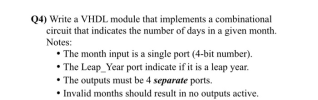 Q4) Write a VHDL module that implements a combinational circuit that indicates the number of days in a given month. Notes: The month input is a single port (4-bit number). 'The Leap_Year port indicate if it is a leap year. The outputs must be 4 separate ports. Invalid months should result in no outputs active.
Q4) Write a VHDL module that implements a combinational circuit that indicates the number of days in a given month. Notes: The month input is...
Q4) Write a VHDL module that implements a combinational circuit that indicates the number of days in a given month. Notes: The month input is a single port (4-bit number). 'The Leap_Year port indicate if it is a leap year. The outputs must be 4 separate ports. Invalid months should result in no outputs active.
Q4) Write a VHDL module that implements a combinational circuit that indicates the number of days in a given month. Notes: The month input is...
Design a combinational circuit that accepts a 3-bit binary number input x
Design a combinational circuit that accepts a 3-bit binary number input x and generates a 6-bit binary number output equal to the xth Fibonacci number F(x) = F(x-1) +F(x-2) where F(0) = 2 and F(1) = 3.The book we are using in class is this: http://www.cramster.com/logic-and-computer-design-fundamentals-4th-solutions-3631 and we are on chapter 3.
4. Design a 4-bit Adder / Subtractor. Follow the steps given below. (a) Write the VHDL...
 4. Design a 4-bit Adder / Subtractor. Follow the steps given below. (a) Write the VHDL code for a 1-bit Full Adder. The VHDL code must include an entity and an architecture. (b) Draw the circuit diagram for a 4-bit Adder / Subtractor. The circuit diagram may include the following logic elements: 1-bit Full Adders (shown as a block with inputs and outputs) Any 2-input logic gates Multiplexers Do not draw the logic circuit for the 1-bit Full Adder.
Write a VHDL module that implements a combinational dircuit that indicates the number of days in a given month. Notes: Q4) .. The month input is a single port (4-bit number The Leap Year port indicat...
 Write a VHDL module that implements a combinational dircuit that indicates the number of days in a given month. Notes: Q4) .. The month input is a single port (4-bit number The Leap Year port indicate if it is a leap yeat . The outputs must be 4 separate ports .Invalid months shouid result in no outputs active. (5 marks) di 1緋 VHDL code paste here using fixed-uidth gth Fonr e consolas Et must be formanted and indented correstty otherwise...
Exercises: 1. Write the VHDL statements to describe a 4-bit comparator. Use the appropriate relational operators....
 Exercises: 1. Write the VHDL statements to describe a 4-bit comparator. Use the appropriate relational operators. Use input ports A and B, described above, as the inputs to the 4-bit comparator. Assume that three output ports, EQ, GT, and LT, have been declared in the Entity statement. Use them as the outputs from the comparator 2. Identify the package (or packages) that must be included in your VHDL code in order to use the relational operators with signals of type...
It should have no inputs and four input wires consolidated by a splitter into one 4-bit...
It should have no inputs and four input wires consolidated by a splitter into one 4-bit output pin. The outputs should be thought of as four digits of a binary number. Your circuit should initially output the number 0 (four 0s in a row). Your circuit should cycle through the first six nonnegative multiples of three (0, 3, 6, ... 12, 15, 0, 3, ...). Each clock cycle, your circuit should output the next number in this sequence. part 2...
6. Write a VHDL code to implement the circuit function described below. The circuit is to display the last four dig...
 6. Write a VHDL code to implement the circuit function described below. The circuit is to display the last four digits of your student ID number on a 7-segment display, one digit at a time, triggered by the falling edge of the clock signal DIR: Direction of the display sequence, '1'forward, '0'- reverse. CLK: clock pulse for the display sequence. RST: reset the display counter Student ID-8860729 Vdd ABC|DEFG DIR CLK RST For example, if your ID number is 1234567,...
Write a VHDL code to implement the circuit function described below. 6. The circuit is to display the last four digits...
 Write a VHDL code to implement the circuit function described below. 6. The circuit is to display the last four digits of your student ID number on a 7-segment display, one digit at a time, triggered by the falling edge of the clock signal. DIR: Direction of the display sequence, '1 CLK: clock pulse for the display sequence RST: reset the display counter. forward, '0' - reverse. Student ID: 8480594 Vdd ABCDE F G DIR CLK RST For example, if...
Write a VHDL code to implement the circuit function described below. 6. The circuit is to display the last four digits...
 Write a VHDL code to implement the circuit function described below. 6. The circuit is to display the last four digits of your student ID number on a 7-segment display, one digit at a time, triggered by the falling edge of the clock signal. DIR: Direction of the display sequence, '1 CLK: clock pulse for the display sequence RST: reset the display counter. forward, '0' - reverse. Student ID: 8243416 Vdd ABCDE F G DIR CLK RST For example, if...
 Q4) Write a VHDL module that implements a combinational circuit that indicates the number of days in a given month. Notes: The month input is a single port (4-bit number). 'The Leap_Year port indicate if it is a leap year. The outputs must be 4 separate ports. Invalid months should result in no outputs active.
Q4) Write a VHDL module that implements a combinational circuit that indicates the number of days in a given month. Notes: The month input is...
Q4) Write a VHDL module that implements a combinational circuit that indicates the number of days in a given month. Notes: The month input is a single port (4-bit number). 'The Leap_Year port indicate if it is a leap year. The outputs must be 4 separate ports. Invalid months should result in no outputs active.
Q4) Write a VHDL module that implements a combinational circuit that indicates the number of days in a given month. Notes: The month input is...
 4. Design a 4-bit Adder / Subtractor. Follow the steps given below. (a) Write the VHDL code for a 1-bit Full Adder. The VHDL code must include an entity and an architecture. (b) Draw the circuit diagram for a 4-bit Adder / Subtractor. The circuit diagram may include the following logic elements: 1-bit Full Adders (shown as a block with inputs and outputs) Any 2-input logic gates Multiplexers Do not draw the logic circuit for the 1-bit Full Adder.
 Write a VHDL module that implements a combinational dircuit that indicates the number of days in a given month. Notes: Q4) .. The month input is a single port (4-bit number The Leap Year port indicate if it is a leap yeat . The outputs must be 4 separate ports .Invalid months shouid result in no outputs active. (5 marks) di 1緋 VHDL code paste here using fixed-uidth gth Fonr e consolas Et must be formanted and indented correstty otherwise...
 Exercises: 1. Write the VHDL statements to describe a 4-bit comparator. Use the appropriate relational operators. Use input ports A and B, described above, as the inputs to the 4-bit comparator. Assume that three output ports, EQ, GT, and LT, have been declared in the Entity statement. Use them as the outputs from the comparator 2. Identify the package (or packages) that must be included in your VHDL code in order to use the relational operators with signals of type...
 6. Write a VHDL code to implement the circuit function described below. The circuit is to display the last four digits of your student ID number on a 7-segment display, one digit at a time, triggered by the falling edge of the clock signal DIR: Direction of the display sequence, '1'forward, '0'- reverse. CLK: clock pulse for the display sequence. RST: reset the display counter Student ID-8860729 Vdd ABC|DEFG DIR CLK RST For example, if your ID number is 1234567,...
 Write a VHDL code to implement the circuit function described below. 6. The circuit is to display the last four digits of your student ID number on a 7-segment display, one digit at a time, triggered by the falling edge of the clock signal. DIR: Direction of the display sequence, '1 CLK: clock pulse for the display sequence RST: reset the display counter. forward, '0' - reverse. Student ID: 8480594 Vdd ABCDE F G DIR CLK RST For example, if...
 Write a VHDL code to implement the circuit function described below. 6. The circuit is to display the last four digits of your student ID number on a 7-segment display, one digit at a time, triggered by the falling edge of the clock signal. DIR: Direction of the display sequence, '1 CLK: clock pulse for the display sequence RST: reset the display counter. forward, '0' - reverse. Student ID: 8243416 Vdd ABCDE F G DIR CLK RST For example, if...
Most questions answered within 3 hours.
-
Where is the error in this code sequence?
String s1 = "Hello";
String s2 = "ello";...
asked 11 months ago -
Financial data for Joel de Paris, Inc., for last year
follow:
Joel de Paris, Inc.
Balance...
asked 11 months ago -
Consider this reaction:
Al2(SO4)3 (aq)+ BaCl3
(aq) Al2Cl6 (aq)- +
3BaSO4(s) . What is the...
asked 11 months ago -
Suppose that Savneet is considering increasing her
recent random sample from 20 car rentals to 40...
asked 11 months ago -
Trucks arrive at an unloading terminal at an average rate of 120
per hour.
Trucks arrive...
asked 11 months ago -
Why are methanol and ethanol completely soluble in water while
octanol is not very little soluble....
asked 11 months ago -
A facilities manager at a university reads in a research report
that the mean amount of...
asked 11 months ago -
When the CuSO4 is rehydrated by adding water to the anhydrous
compound, is this an endothermic...
asked 11 months ago -
A ray of sunlight is passing from diamond into crown glass; the
angle of incidence is...
asked 11 months ago -
A block of mass 0.249 kg is placed on top of a light, vertical
spring of...
asked 11 months ago -
how do the kidneys compensate in the presences of acidosis
a) trigger hyperventilate
b) reserve acid...
asked 11 months ago -
Question 501 pts
The rental rate of capital to the firm increases. Which of the
following...
asked 11 months ago