A rod, in the form of a cylinder of length L and circular cross-section of radius...
A rod, in the form of a cylinder of length L and circular cross-section of radius r, has a resistance R. What is the new value of the resistance R if the length is doubled (2L) and the radius is doubled (2r)?
Homework Answers
Solution) Length , L1 = L
L2 = 2L
Radius , r1 = r
r2 = 2r
Resistance , R1 = R
R2 = ?
We have
Resistance , R = ((rho)(L))/(A)
A = (pi)(r^2)
rho is resistivity
So resistance is directly proportional to Length and inversely proportional to square of radius
(R2/R1) = (L2/L1)(r1/r2)^2
(R2/R1) = (2L/L)(r/2r)^2
(R2/R1) = (1/2)
R2 = (R1/2)
R2 = (R/2)
Add Answer to:
A rod, in the form of a cylinder of length L and circular
cross-section of radius...
QUESTION 3 A rod, of length L and square cross section of side a, has a...
 QUESTION 3 A rod, of length L and square cross section of side a, has a resistance R. What is the new value of the resistance R' if the length is doubled (21) and the cross section side is halved (a/2)? OR'-2R OR 4 R' = R 2 RER
Can you send me the right answer? QUESTION 3 A rod, of length L and square...
 Can you send me the right answer?
QUESTION 3 A rod, of length L and square cross section of side a, has a resistance R. What is the new value of the resistance R' if the length is doubled (2L) and the cross section side is halved (a/2)? a R' R 4 R'=R R' = 2R R R' QUESTION 3 A rod, of length L and square cross section of side a, has a resistance R. What is the new...
Can you send me the right answer?
QUESTION 3 A rod, of length L and square cross section of side a, has a resistance R. What is the new value of the resistance R' if the length is doubled (2L) and the cross section side is halved (a/2)? a R' R 4 R'=R R' = 2R R R' QUESTION 3 A rod, of length L and square cross section of side a, has a resistance R. What is the new...
Column AB is a circular cross section with a radius of r, and the length L...
Column AB is a circular cross section with a radius of r, and the length L is very long compared to r. One end A of the column AB is fixed and receives a compressive load P acting on the center of B. At this time, what is the minimum radius r of the circular cross section to prevent buckling on the column AB? (However, the elastic modulus of the column AB is E.)
Two machine parts are connected by a cylindrical rod of length L, thermal conductivity k, and...
Two machine parts are connected by a cylindrical rod of length L, thermal conductivity k, and circular cross sectional radius R. If this rod is replaced by another one of the same length, but with thermal conductivity 2k and a square cross section with side length 2R, by what factor does the rate of heat conduction increase?
A wire of length L and radius r has a resistance R. If the length and...
 A wire of length L and radius r has a resistance R. If the length and radius of this wire are doubled, the new resistance: remains the same. doubles. quadrables. drops to 1/2 its original value. drops to 1/4 its original value.
4. Consider a circular rod of NiTi (Nitinol with radius R and length L. The stress...
 4. Consider a circular rod of NiTi (Nitinol with radius R and length L. The stress state in the rod is given by a. What are the stresses at (i) z - 0, (ii) z - L, (ii) r- R b. Is this an "equilibrium" stress state? c. What common loading term describes this deformation x state?
One copper wire has a cross sectional area of A and resistance R and length L....
One copper wire has a cross sectional area of A and resistance R and length L. A second copper wire has a length L and cross-sectional area 2A. What is the resistance of the second wire in terms of R? R/2 R 2R 4R Some other value
b) Consider the following cross section of a cylinder of radius BC = 2R and height...
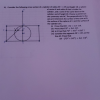 b) Consider the following cross section of a cylinder of radius BC = 2R and height 2R, a sphere of center K and radius R that is inside the cylinder, and a cone of the same base as the cylinder and of height 2R. Choose a point Don the symmetry axis AC. The perpendicular to the axis at D intersects the surface of the cone at G, the surface of the sphere at F, and the surface of the cylinder...
The resistance R of a wire of length l and uniform area of cross-section A is...
 The resistance R of a wire of length l and uniform area of cross-section A is given by R = rhol/A, where rho is the resistivity of the wire. You melt the wire and recast it to have a new length l' = 10l (keeping the volume V = Al of the wire constant). What is the new resistance of the wire, if the original resistance of the wire was 100.0 Ohm.
Consider a long cylinder of circular cross-section with radius R, as shown in Fig. 3. The cross section is subjected to torque T on its ends. As you can see from the special case of a = b in the solution for the warping function of an elliptical cross-sec
Consider a long cylinder of circular cross-section with radius R, as shown in Fig. 3. The cross section is subjected to torque T on its ends. As you can see from the special case of a = b in the solution for the warping function of an elliptical cross-section under torsion, the warping function or out-of-plane displacement of a circular cross-section vanishes.(a) What is the maximum shear stress in the cross-section and where does it occur?(b) What is the shear stress, σθz, as a function of radius, r? (Hint:...
 QUESTION 3 A rod, of length L and square cross section of side a, has a resistance R. What is the new value of the resistance R' if the length is doubled (21) and the cross section side is halved (a/2)? OR'-2R OR 4 R' = R 2 RER
 Can you send me the right answer?
QUESTION 3 A rod, of length L and square cross section of side a, has a resistance R. What is the new value of the resistance R' if the length is doubled (2L) and the cross section side is halved (a/2)? a R' R 4 R'=R R' = 2R R R' QUESTION 3 A rod, of length L and square cross section of side a, has a resistance R. What is the new...
Can you send me the right answer?
QUESTION 3 A rod, of length L and square cross section of side a, has a resistance R. What is the new value of the resistance R' if the length is doubled (2L) and the cross section side is halved (a/2)? a R' R 4 R'=R R' = 2R R R' QUESTION 3 A rod, of length L and square cross section of side a, has a resistance R. What is the new...
 A wire of length L and radius r has a resistance R. If the length and radius of this wire are doubled, the new resistance: remains the same. doubles. quadrables. drops to 1/2 its original value. drops to 1/4 its original value.
 4. Consider a circular rod of NiTi (Nitinol with radius R and length L. The stress state in the rod is given by a. What are the stresses at (i) z - 0, (ii) z - L, (ii) r- R b. Is this an "equilibrium" stress state? c. What common loading term describes this deformation x state?
 b) Consider the following cross section of a cylinder of radius BC = 2R and height 2R, a sphere of center K and radius R that is inside the cylinder, and a cone of the same base as the cylinder and of height 2R. Choose a point Don the symmetry axis AC. The perpendicular to the axis at D intersects the surface of the cone at G, the surface of the sphere at F, and the surface of the cylinder...
 The resistance R of a wire of length l and uniform area of cross-section A is given by R = rhol/A, where rho is the resistivity of the wire. You melt the wire and recast it to have a new length l' = 10l (keeping the volume V = Al of the wire constant). What is the new resistance of the wire, if the original resistance of the wire was 100.0 Ohm.
Most questions answered within 3 hours.
-
Where is the error in this code sequence?
String s1 = "Hello";
String s2 = "ello";...
asked 11 months ago -
Financial data for Joel de Paris, Inc., for last year
follow:
Joel de Paris, Inc.
Balance...
asked 11 months ago -
Consider this reaction:
Al2(SO4)3 (aq)+ BaCl3
(aq) Al2Cl6 (aq)- +
3BaSO4(s) . What is the...
asked 11 months ago -
Suppose that Savneet is considering increasing her
recent random sample from 20 car rentals to 40...
asked 11 months ago -
Trucks arrive at an unloading terminal at an average rate of 120
per hour.
Trucks arrive...
asked 11 months ago -
Why are methanol and ethanol completely soluble in water while
octanol is not very little soluble....
asked 11 months ago -
A facilities manager at a university reads in a research report
that the mean amount of...
asked 11 months ago -
When the CuSO4 is rehydrated by adding water to the anhydrous
compound, is this an endothermic...
asked 11 months ago -
A ray of sunlight is passing from diamond into crown glass; the
angle of incidence is...
asked 11 months ago -
A block of mass 0.249 kg is placed on top of a light, vertical
spring of...
asked 11 months ago -
how do the kidneys compensate in the presences of acidosis
a) trigger hyperventilate
b) reserve acid...
asked 11 months ago -
Question 501 pts
The rental rate of capital to the firm increases. Which of the
following...
asked 11 months ago