

Homework Answers
Add Answer to:
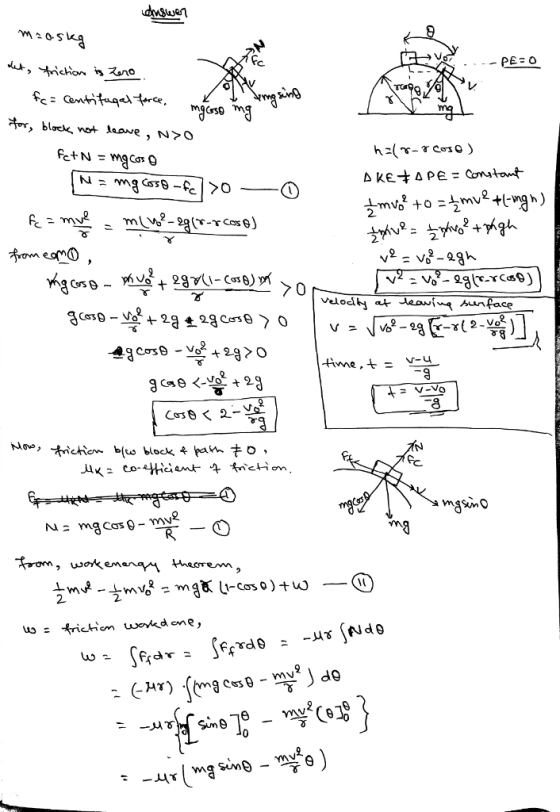
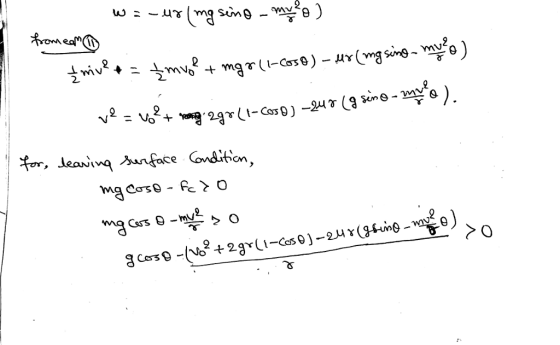
Description Evaluate the position, velocity and the time at which the 0.5 kg block leaves the...
Question 3. A block A, having a mass of 20-kg, is released from rest and slides...
 Question 3. A block A, having a mass of 20-kg, is released from rest and slides down an incline with coeffici an incline with coefficient of static d kinetic friction of 0.25 and 0.10, respectively. When it reaches the bottom of the ramp, it slides ally onto the surface of a 10-kg cart for which the coefficient of static and kinetic friction between Question 3. A block A, having a mass of 20-kg, is released from rest and slides down...
Problem 2 A 0.5-kg block is pressed a distance d against a horizontal spring of constant...
 Problem 2 A 0.5-kg block is pressed a distance d against a horizontal spring of constant 800 N/m. The block sits on a frictionless horizontal surface When the block is released from rest, it slides along the surface, its speed is 1.6 m/s when it leaves the spring (a) Calculate distance d. 4 cm Suppose that the sliding block (speed 1.6 m/s) crosses a rough section of the surface. The leugth of the section is 1m. The block has a...
5. A particle of mass m slides without friction and starting from rest down a block...
 5. A particle of mass m slides without friction and starting from rest down a block of mass M in which the surface is shaped into a quadrant of a circle of radius R. The block also slides without friction on a table top. Choose two suitable generalized coordinates a) Using the Lagrange-multiplier formalism, find the equations of motion of the mass and the block and the reaction force of the block on the mass (ie. the constraint force b)...
eleration along the surface. 0.85 m/s l the crate. 29 N Problem 2 A 0.5-kg block...
 eleration along the surface. 0.85 m/s l the crate. 29 N Problem 2 A 0.5-kg block is pressed a distance d against ahorizontal spring of constant 800 N/m. The block sits on a frictionless horizontal surface When the block is released from rest, it slides along the surface, its speed is 1.6 m/s when it leaves the spring a) Calculate distance d. 4 cm Suppose that the sliding block (speed 1.6 m/s) crosses a rough section of the surface. The...
PLEASE PROVIDE ACCURATE STEP-BY-STEP SOLUTIONS. Question ll The initial velocity of the block in position A...
 PLEASE PROVIDE ACCURATE STEP-BY-STEP SOLUTIONS.
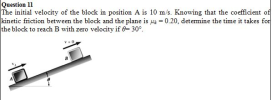
Question ll The initial velocity of the block in position A is 10 m/s. Knowing that the coefficient of kinetic friction between the block and the plane is 쌔-0.20, determine the time it takes for the block to reach B with zero velocity if θ= 30°
PLEASE PROVIDE ACCURATE STEP-BY-STEP SOLUTIONS.
Question ll The initial velocity of the block in position A is 10 m/s. Knowing that the coefficient of kinetic friction between the block and the plane is 쌔-0.20, determine the time it takes for the block to reach B with zero velocity if θ= 30°
A block of mass 1.80 kg is accelerated across a rough surface by a light cord...
 A block of mass 1.80 kg is accelerated across a rough surface by
a light cord passing over a small pulley as shown in the figure
below. The tension T in the cord is maintained at 10.0 N, and the
pulley is 0.110 m above the top of the block. The coefficient of
kinetic friction is 0.310.
(a) Determine the acceleration of the block when x = .400 m.
(b) Describe the general behavior of the acceleration as the
block...
A block of mass 1.80 kg is accelerated across a rough surface by
a light cord passing over a small pulley as shown in the figure
below. The tension T in the cord is maintained at 10.0 N, and the
pulley is 0.110 m above the top of the block. The coefficient of
kinetic friction is 0.310.
(a) Determine the acceleration of the block when x = .400 m.
(b) Describe the general behavior of the acceleration as the
block...
A block of mass 0.528 kg slides with uniform velocity of 3.60 m/s on a horizontal...
A block of mass 0.528 kg slides with uniform velocity of 3.60 m/s on a horizontal frictionless surface. At some point, it strikes a horizontal spring in equilibrium. If the spring constant is k = 26.1 N/m, by how much will the spring be compressed by the time the block comes to rest? b. What is the amount of compression if the surface is rough under the spring, with coefficient of kinetic friction µk = 0.411?
6. A 2.0 kg block slides to the right across a horizontal surface.
6. A 2.0 kg block slides to the right across a horizontal surface. Let's define a coordinate system where the +x-direction is to the right. At x=0, the block's velocity is +5.0 m / s (to the right). The magnitude of the kinetic friction force between the block and surface is 10N.a. Draw a force diagram of the block. Which forces expert zero work on the block? Explain why.c. What is the work that the kinetic friction force exerts on...
A constant-density cylinder of mass 0.5 kg and radius 4 cm can rotate freely about an...
 A constant-density cylinder of mass 0.5 kg and radius 4 cm can rotate freely about an axis through its center. It has thread wound around an attached axle of radius 0.5 cm that also runs through its center (Fig. as shown) The thread is attached to a mass of 1 kg, which slides down an inclined plane of angle ф-300 with an acceleration of 0.1 m/s. a) Draw a free body diagram of the system by PROBLEM 4: (12pts) R....
Circular motion, vertical surface with kinetic friction: A small block of mass 2.0 kg slides on...
 Circular motion, vertical surface with kinetic friction: A small block of mass 2.0 kg slides on a horizontal frictionless surface as it travels around the inside of a hoop of radius R 0.50 m. A view from above is shown. The coefficient of friction between the block and the hoop wall is 0.20. Therefore, the block is slowing down. a) Draw a free body diagram for the block in the position shown (you do not need to include forces perpendicular...
 Question 3. A block A, having a mass of 20-kg, is released from rest and slides down an incline with coeffici an incline with coefficient of static d kinetic friction of 0.25 and 0.10, respectively. When it reaches the bottom of the ramp, it slides ally onto the surface of a 10-kg cart for which the coefficient of static and kinetic friction between Question 3. A block A, having a mass of 20-kg, is released from rest and slides down...
 Problem 2 A 0.5-kg block is pressed a distance d against a horizontal spring of constant 800 N/m. The block sits on a frictionless horizontal surface When the block is released from rest, it slides along the surface, its speed is 1.6 m/s when it leaves the spring (a) Calculate distance d. 4 cm Suppose that the sliding block (speed 1.6 m/s) crosses a rough section of the surface. The leugth of the section is 1m. The block has a...
 5. A particle of mass m slides without friction and starting from rest down a block of mass M in which the surface is shaped into a quadrant of a circle of radius R. The block also slides without friction on a table top. Choose two suitable generalized coordinates a) Using the Lagrange-multiplier formalism, find the equations of motion of the mass and the block and the reaction force of the block on the mass (ie. the constraint force b)...
 eleration along the surface. 0.85 m/s l the crate. 29 N Problem 2 A 0.5-kg block is pressed a distance d against ahorizontal spring of constant 800 N/m. The block sits on a frictionless horizontal surface When the block is released from rest, it slides along the surface, its speed is 1.6 m/s when it leaves the spring a) Calculate distance d. 4 cm Suppose that the sliding block (speed 1.6 m/s) crosses a rough section of the surface. The...
 PLEASE PROVIDE ACCURATE STEP-BY-STEP SOLUTIONS.
Question ll The initial velocity of the block in position A is 10 m/s. Knowing that the coefficient of kinetic friction between the block and the plane is 쌔-0.20, determine the time it takes for the block to reach B with zero velocity if θ= 30°
PLEASE PROVIDE ACCURATE STEP-BY-STEP SOLUTIONS.
Question ll The initial velocity of the block in position A is 10 m/s. Knowing that the coefficient of kinetic friction between the block and the plane is 쌔-0.20, determine the time it takes for the block to reach B with zero velocity if θ= 30°
 A block of mass 1.80 kg is accelerated across a rough surface by
a light cord passing over a small pulley as shown in the figure
below. The tension T in the cord is maintained at 10.0 N, and the
pulley is 0.110 m above the top of the block. The coefficient of
kinetic friction is 0.310.
(a) Determine the acceleration of the block when x = .400 m.
(b) Describe the general behavior of the acceleration as the
block...
A block of mass 1.80 kg is accelerated across a rough surface by
a light cord passing over a small pulley as shown in the figure
below. The tension T in the cord is maintained at 10.0 N, and the
pulley is 0.110 m above the top of the block. The coefficient of
kinetic friction is 0.310.
(a) Determine the acceleration of the block when x = .400 m.
(b) Describe the general behavior of the acceleration as the
block...
 A constant-density cylinder of mass 0.5 kg and radius 4 cm can rotate freely about an axis through its center. It has thread wound around an attached axle of radius 0.5 cm that also runs through its center (Fig. as shown) The thread is attached to a mass of 1 kg, which slides down an inclined plane of angle ф-300 with an acceleration of 0.1 m/s. a) Draw a free body diagram of the system by PROBLEM 4: (12pts) R....
 Circular motion, vertical surface with kinetic friction: A small block of mass 2.0 kg slides on a horizontal frictionless surface as it travels around the inside of a hoop of radius R 0.50 m. A view from above is shown. The coefficient of friction between the block and the hoop wall is 0.20. Therefore, the block is slowing down. a) Draw a free body diagram for the block in the position shown (you do not need to include forces perpendicular...
Most questions answered within 3 hours.
-
Where is the error in this code sequence?
String s1 = "Hello";
String s2 = "ello";...
asked 1 year ago -
Financial data for Joel de Paris, Inc., for last year
follow:
Joel de Paris, Inc.
Balance...
asked 1 year ago -
Consider this reaction:
Al2(SO4)3 (aq)+ BaCl3
(aq) Al2Cl6 (aq)- +
3BaSO4(s) . What is the...
asked 1 year ago -
Suppose that Savneet is considering increasing her
recent random sample from 20 car rentals to 40...
asked 1 year ago -
Trucks arrive at an unloading terminal at an average rate of 120
per hour.
Trucks arrive...
asked 1 year ago -
Why are methanol and ethanol completely soluble in water while
octanol is not very little soluble....
asked 1 year ago -
A facilities manager at a university reads in a research report
that the mean amount of...
asked 1 year ago -
When the CuSO4 is rehydrated by adding water to the anhydrous
compound, is this an endothermic...
asked 1 year ago -
A ray of sunlight is passing from diamond into crown glass; the
angle of incidence is...
asked 1 year ago -
A block of mass 0.249 kg is placed on top of a light, vertical
spring of...
asked 1 year ago -
how do the kidneys compensate in the presences of acidosis
a) trigger hyperventilate
b) reserve acid...
asked 1 year ago -
Question 501 pts
The rental rate of capital to the firm increases. Which of the
following...
asked 1 year ago