Specify the running time of each of the following algorithms. You must fully explain your answer for each of the question!
Homework Answers
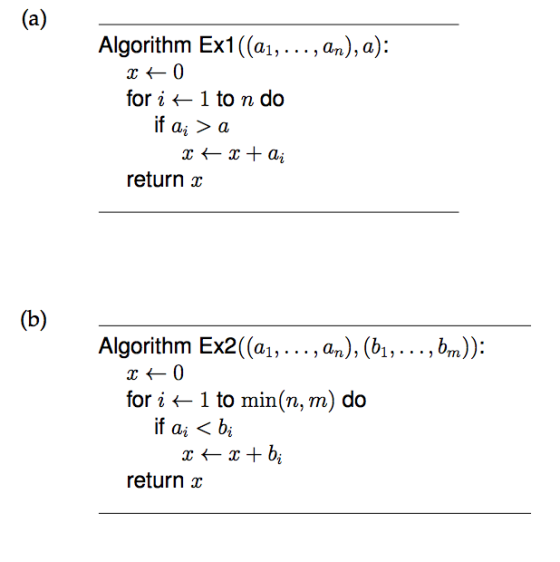
a) O(n)
Explanation : We can see that for loop will run
from 1 to n so it will run n+1 times. One time extra because when i
will be n+1 so condition will fail. Statements inside for loop will
run for n time. So time complexity of algorithm is O(n)
b) O(min(n,m))
Explanation : We can see that for loop will run
from 1 to min ( n, m) so it will run min(n,m)+1 times. One time
extra because when i will be n+1 or m+1 so condition will fail.
Statements inside for loop will run for min(n,m) time. So time
complexity of algorithm is O(min(n,m))
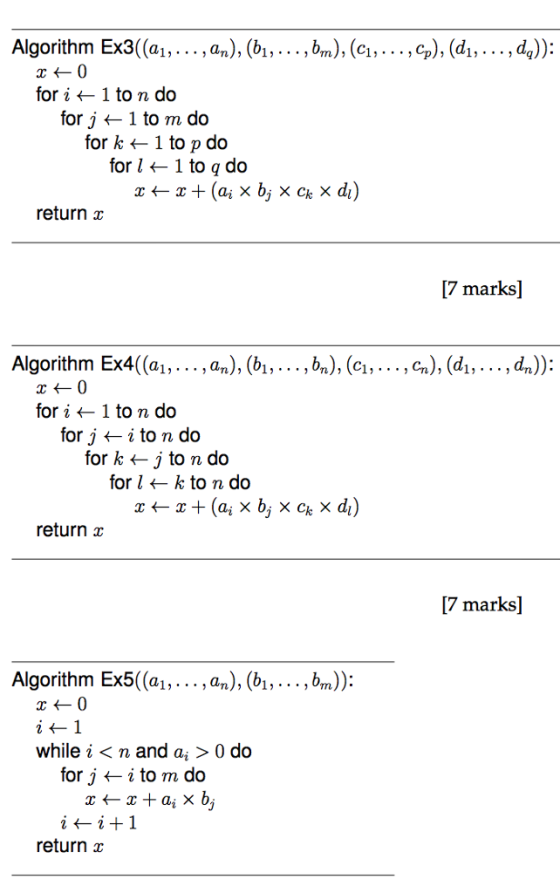
c) O(mnpq)
Explanation : 4 nested loop, One inside the other
. Each loop will run for its range time and a,ong iwth its range
because of outer loop. Hence the time complexity is O(mnpq)
d) O(n4)
Explanation : 4 nested loop, One inside the other
. Outer loop will run for n time, the first inner loop will run for
n time itself and n times because of outer loop so its
n2 . Similarly 2nd inner loop will run for n3
time, and the inner most loop will run for n4
time. Hence the time complexity is O(n4 )
(e)O(nm)
Explanation While loop will run for n time, and
inner loop loop will run for m time itself and n time because of
outer loop so its nm time. hence the time complexity is
O(nm)
Thanks, let me know if there is any concern. PLEASE RATE if you
think its helpful
Add Answer to:
Specify the running time of each of the following algorithms.
You must fully explain your answer...
Analyze the running time of the following algorithms asymptotically. (a) Algorithm for-loop(n): P = 1 for...
 Analyze the running time of the following algorithms asymptotically. (a) Algorithm for-loop(n): P = 1 for i = 1 to 5n^2 do p = p times i return p (b) Algorithm for-loop(n): s = 0 for i = 1 to n do for j = I to n do s = s + i return s (c) Algorithm WhileLoop(n): x = 0; j = 2; while (j = n){x = x+ 1; j =j times 2;}
Write a recurrence relation describing the worst case running time of each of the following algorithms,...
 Write a recurrence relation describing the worst case running time of each of the following algorithms, and determine the asymptotic complexity of the function defined by the recurrence relation. Justify your solution by using substitution or a recursion tree. You may NOT use the Master Theorem. Simplify your answers, expressing them in a form such as O(nk) or (nklog n) whenever possible. If the algorithm takes exponential time, then just give an exponential lower bound using the 2 notation. function...
Determine whether each of the following algorithms is fully correct, and prove that your answer is...
 Determine whether each of the following algorithms is fully
correct, and prove that your answer is correct.
Determine whether each of the following algorithms is fully correct, and prove that your answer is correct. 4 5 (a) [10 points) A(2) IN :TER,r> 1 1 r'= 2 p=0 3 while r'> 1 do p=p+1 r' = 2/2 6 return p OUT: p = log2 (b) [10 points) B(2) IN : r ER, 1 > 1 1 while r > 1 do...
Determine whether each of the following algorithms is fully
correct, and prove that your answer is correct.
Determine whether each of the following algorithms is fully correct, and prove that your answer is correct. 4 5 (a) [10 points) A(2) IN :TER,r> 1 1 r'= 2 p=0 3 while r'> 1 do p=p+1 r' = 2/2 6 return p OUT: p = log2 (b) [10 points) B(2) IN : r ER, 1 > 1 1 while r > 1 do...
For each of the following problems write a recurrence relation describing the running time of eac...
 For each of the following problems write a recurrence relation
describing the running time of each of the following algorithms and
determine the asymptotic complexity of the function defined by the
recurrence relation. Justify your solution using substitution and
carefully computing lower and upper bounds for the sums. Simplify
and express your answer as Θ(n k ) or Θ(n k (log n)) wherever
possible. If the algorithm takes exponential time, then just give
exponential lower bounds.
5. func5 (A,n) /*...
For each of the following problems write a recurrence relation
describing the running time of each of the following algorithms and
determine the asymptotic complexity of the function defined by the
recurrence relation. Justify your solution using substitution and
carefully computing lower and upper bounds for the sums. Simplify
and express your answer as Θ(n k ) or Θ(n k (log n)) wherever
possible. If the algorithm takes exponential time, then just give
exponential lower bounds.
5. func5 (A,n) /*...
Write a recurrence relation describing the worst-case running time of each of the following algor...
 Write a recurrence relation describing the worst-case
running time of each of the following algorithms and determine the
asymptotic complexity of the function defined by the recurrence
relation. Justify your solution by using substitution or a
recursion tree. You may NOT use the Master Theorem.
上午1:46 3月21日周四 令52%. " 5. endfor 6. return (r); function func4(A, n) *Aarray of n integers */ 1. if n s 20 then return (A[n]); 4. while (i < n/2) do 7. endwhile 8. x...
Write a recurrence relation describing the worst-case
running time of each of the following algorithms and determine the
asymptotic complexity of the function defined by the recurrence
relation. Justify your solution by using substitution or a
recursion tree. You may NOT use the Master Theorem.
上午1:46 3月21日周四 令52%. " 5. endfor 6. return (r); function func4(A, n) *Aarray of n integers */ 1. if n s 20 then return (A[n]); 4. while (i < n/2) do 7. endwhile 8. x...
In this lab we are going to complete a profile of two sorting algorithms by running...
In this lab we are going to complete a profile of two sorting algorithms by running some tests to collect empirical data. 1. First we need to be able to generate some random integers. You can do this by including the following library : #include Now first run the following to generate a seed : srand (time(NULL)) You can then generate a random number using the function rand() 2. We will use two sort algorithms - Selection Sort and Bubble...
1. Analyze the running time of the following algorithm and write it using ( notation. You...
 1. Analyze the running time of the following algorithm and write it using ( notation. You must show detailed calculation/derivation of your running time along with table to get marks. int sum = 0; for (int i=n; i)=1; i=i/2) { for (int j=1; j<=i; j*=2) { sum+=i*j; } }
Following algorithm belongs to Dijsktra's Shortest path algorithm: PLEASE SHOW THE RUNNING TIME OF THE EACH...
Following algorithm belongs to Dijsktra's Shortest path algorithm: PLEASE SHOW THE RUNNING TIME OF THE EACH LINE OF THE ALGORITHM AND DETERMINE THE RUNNING TIME OF THE ALGORITHM BY SUMMING UP THEM while current_node != end: visited.add(current_node) destinations = graph.edges[current_node] weight_to_current_node = shortest_paths[current_node][1] for next_node in destinations: weight = graph.weights[(current_node, next_node)] + weight_to_current_node if next_node not in shortest_paths: shortest_paths[next_node] = (current_node, weight) else: current_shortest_weight = shortest_paths[next_node][1] if current_shortest_weight > weight: shortest_paths[next_node] = (current_node, weight) next_destinations = {node: shortest_paths[node] for node...
Consider recursive divide-and-conquer algorithms with the following descriptions. For each, determine the running time in Big-Theta notation. If necessary, you may assume that the regularity conditio...
 Consider recursive divide-and-conquer algorithms with the following descriptions. For each, determine the running time in Big-Theta notation. If necessary, you may assume that the regularity condition holds. You do not need to prove your result. You may use the Master Theorem (n3) work per Performs 8 recursive calls on problems half the size of the input and performs recursive call.
Consider recursive divide-and-conquer algorithms with the following descriptions. For each, determine the running time in Big-Theta notation. If necessary, you...
Consider recursive divide-and-conquer algorithms with the following descriptions. For each, determine the running time in Big-Theta notation. If necessary, you may assume that the regularity condition holds. You do not need to prove your result. You may use the Master Theorem (n3) work per Performs 8 recursive calls on problems half the size of the input and performs recursive call.
Consider recursive divide-and-conquer algorithms with the following descriptions. For each, determine the running time in Big-Theta notation. If necessary, you...
Data Structures and Algorithms For each of the following program fragments, give an analysis of the...
Data Structures and Algorithms For each of the following program fragments, give an analysis of the running time using Big-Oh notation. Do not give formulas, but analyze every line to calculate the running time, e.g. sum = 0 is equal to 1 unit time ... b. sum = 0; for( i = 0; i < n; i++) for( j = 0; j < i*i; j++) for( k = 0; k < j; k++) sum++; c. sum =...
 Analyze the running time of the following algorithms asymptotically. (a) Algorithm for-loop(n): P = 1 for i = 1 to 5n^2 do p = p times i return p (b) Algorithm for-loop(n): s = 0 for i = 1 to n do for j = I to n do s = s + i return s (c) Algorithm WhileLoop(n): x = 0; j = 2; while (j = n){x = x+ 1; j =j times 2;}
 Write a recurrence relation describing the worst case running time of each of the following algorithms, and determine the asymptotic complexity of the function defined by the recurrence relation. Justify your solution by using substitution or a recursion tree. You may NOT use the Master Theorem. Simplify your answers, expressing them in a form such as O(nk) or (nklog n) whenever possible. If the algorithm takes exponential time, then just give an exponential lower bound using the 2 notation. function...
 Determine whether each of the following algorithms is fully
correct, and prove that your answer is correct.
Determine whether each of the following algorithms is fully correct, and prove that your answer is correct. 4 5 (a) [10 points) A(2) IN :TER,r> 1 1 r'= 2 p=0 3 while r'> 1 do p=p+1 r' = 2/2 6 return p OUT: p = log2 (b) [10 points) B(2) IN : r ER, 1 > 1 1 while r > 1 do...
Determine whether each of the following algorithms is fully
correct, and prove that your answer is correct.
Determine whether each of the following algorithms is fully correct, and prove that your answer is correct. 4 5 (a) [10 points) A(2) IN :TER,r> 1 1 r'= 2 p=0 3 while r'> 1 do p=p+1 r' = 2/2 6 return p OUT: p = log2 (b) [10 points) B(2) IN : r ER, 1 > 1 1 while r > 1 do...
 For each of the following problems write a recurrence relation
describing the running time of each of the following algorithms and
determine the asymptotic complexity of the function defined by the
recurrence relation. Justify your solution using substitution and
carefully computing lower and upper bounds for the sums. Simplify
and express your answer as Θ(n k ) or Θ(n k (log n)) wherever
possible. If the algorithm takes exponential time, then just give
exponential lower bounds.
5. func5 (A,n) /*...
For each of the following problems write a recurrence relation
describing the running time of each of the following algorithms and
determine the asymptotic complexity of the function defined by the
recurrence relation. Justify your solution using substitution and
carefully computing lower and upper bounds for the sums. Simplify
and express your answer as Θ(n k ) or Θ(n k (log n)) wherever
possible. If the algorithm takes exponential time, then just give
exponential lower bounds.
5. func5 (A,n) /*...
 Write a recurrence relation describing the worst-case
running time of each of the following algorithms and determine the
asymptotic complexity of the function defined by the recurrence
relation. Justify your solution by using substitution or a
recursion tree. You may NOT use the Master Theorem.
上午1:46 3月21日周四 令52%. " 5. endfor 6. return (r); function func4(A, n) *Aarray of n integers */ 1. if n s 20 then return (A[n]); 4. while (i < n/2) do 7. endwhile 8. x...
Write a recurrence relation describing the worst-case
running time of each of the following algorithms and determine the
asymptotic complexity of the function defined by the recurrence
relation. Justify your solution by using substitution or a
recursion tree. You may NOT use the Master Theorem.
上午1:46 3月21日周四 令52%. " 5. endfor 6. return (r); function func4(A, n) *Aarray of n integers */ 1. if n s 20 then return (A[n]); 4. while (i < n/2) do 7. endwhile 8. x...
 1. Analyze the running time of the following algorithm and write it using ( notation. You must show detailed calculation/derivation of your running time along with table to get marks. int sum = 0; for (int i=n; i)=1; i=i/2) { for (int j=1; j<=i; j*=2) { sum+=i*j; } }
 Consider recursive divide-and-conquer algorithms with the following descriptions. For each, determine the running time in Big-Theta notation. If necessary, you may assume that the regularity condition holds. You do not need to prove your result. You may use the Master Theorem (n3) work per Performs 8 recursive calls on problems half the size of the input and performs recursive call.
Consider recursive divide-and-conquer algorithms with the following descriptions. For each, determine the running time in Big-Theta notation. If necessary, you...
Consider recursive divide-and-conquer algorithms with the following descriptions. For each, determine the running time in Big-Theta notation. If necessary, you may assume that the regularity condition holds. You do not need to prove your result. You may use the Master Theorem (n3) work per Performs 8 recursive calls on problems half the size of the input and performs recursive call.
Consider recursive divide-and-conquer algorithms with the following descriptions. For each, determine the running time in Big-Theta notation. If necessary, you...
Most questions answered within 3 hours.
-
Where is the error in this code sequence?
String s1 = "Hello";
String s2 = "ello";...
asked 11 months ago -
Financial data for Joel de Paris, Inc., for last year
follow:
Joel de Paris, Inc.
Balance...
asked 11 months ago -
Consider this reaction:
Al2(SO4)3 (aq)+ BaCl3
(aq) Al2Cl6 (aq)- +
3BaSO4(s) . What is the...
asked 11 months ago -
Suppose that Savneet is considering increasing her
recent random sample from 20 car rentals to 40...
asked 11 months ago -
Trucks arrive at an unloading terminal at an average rate of 120
per hour.
Trucks arrive...
asked 11 months ago -
Why are methanol and ethanol completely soluble in water while
octanol is not very little soluble....
asked 11 months ago -
A facilities manager at a university reads in a research report
that the mean amount of...
asked 11 months ago -
When the CuSO4 is rehydrated by adding water to the anhydrous
compound, is this an endothermic...
asked 11 months ago -
A ray of sunlight is passing from diamond into crown glass; the
angle of incidence is...
asked 11 months ago -
A block of mass 0.249 kg is placed on top of a light, vertical
spring of...
asked 11 months ago -
how do the kidneys compensate in the presences of acidosis
a) trigger hyperventilate
b) reserve acid...
asked 11 months ago -
Question 501 pts
The rental rate of capital to the firm increases. Which of the
following...
asked 11 months ago