
Homework Answers
Request Answer!
We need at least 10 more requests to produce the answer.
0 / 10 have requested this problem solution
The more requests, the faster the answer.
Add Answer to:
Draw Conclusions 1. What must be true about the sum of the voltage lost across each...
(a) What is the current flowing through each resistor in a circuit consisting of a 48.0-V...
(a) What is the current flowing through each resistor in a circuit consisting of a 48.0-V battery and a 24.0 Ω resistor connected in series with a 96.0 Ω resistor? (b) What is the voltage drop across each resistor? (c) What is the power dissipated in each resistor? (d) If the two resistors were connected in parallel rather than series, what would be the current flow through each resistor? (e) What would be the voltage drop across each resistor for...
QUESTION 3 and the lifting speed As the resistance before the motor decreased the motor voltage QUESTION 4 Consider a circuit with a resistor in series with a motor, like observed in Activity 2 of th...
 QUESTION 3 and the lifting speed As the resistance before the motor decreased the motor voltage QUESTION 4 Consider a circuit with a resistor in series with a motor, like observed in Activity 2 of the Week 10 Practical, when the load on the motor increases the voltage across the motor and the current through the motor Under this higher load the lifting speed and the motor torque QUESTION5 If the power supply is set to 5 V and a...
QUESTION 3 and the lifting speed As the resistance before the motor decreased the motor voltage...
 QUESTION 3 and the lifting speed As the resistance before the motor decreased the motor voltage QUESTION 4 Consider a circuit with a resistor in series with a motor, like observed in Activity 2 of the Week 10 Practical, when the load on the motor increases the voltage across the motor and the current through the motor Under this higher load the lifting speed and the motor torque QUESTION5 If the power supply is set to 5 V and a...
8. Suppose the voltage output of a battery is 10.0V in a series circuit, and the...
 8. Suppose the voltage output of a battery is 10.0V in a series circuit, and the resistances are Ri=4.0012, R2=5.0092, and R3=6.002. a. Draw a diagram of the circuit, and determine the total resistance, the current through each resistor, the voltage drop across each resistor, and the power dissipated by each resistor and the source. 9. Suppose the voltage output of a battery is 10.0V in a parallel circuit, and the resistances are Ri=4.0012, R=5.0002, and R3=6.092. b. Draw a...
connected in series across a standard h rm4 con si era loa a 50 aF capacitor...
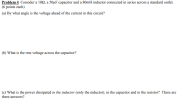 connected in series across a standard h rm4 con si era loa a 50 aF capacitor and . 80 mii ductor (6 points each) outlet (a) By what angle is the voltage ahead of the current in this circuit? (b) What is the rms voltage across the capacitor? (c) What is the power dissipated in the inductor (only the inductor), in the capacitor and in the resistor? There are three answers?
true of false 1.Polarity is defined based on the conventional current through a resistive element. 3....
true of false 1.Polarity is defined based on the conventional current through a resistive element. 3. If there are two resistors in a parallel circuit, total resistance can be calculated by the product divided by the sum. 3. When a 10kohm resistor, a 1kohm resistor, and a 100ohm resistor are connected in series, the current through each resistor is the same, and the voltage across each resistor is the same .
6. (2 pts) In the table below, compare the light intensities before the switch is closed...
 6. (2 pts) In the table below, compare the light intensities before the switch is closed to the intensities after the switch is closed. Please refer to question III on the next page for additional questions about this circuit. III) 1 (3 pts) The following questions are specific to circuit #6. Using the following definitions: ɛ is the emf of the battery. Assume it is an ideal battery. R is the resistance of each lightbulb (resistor + LED). Assume that...
Consider the following circuit, with given constants ?-40V, R-200, L-4mH, C,-5?F and C,-5?F, where the switch...
 Consider the following circuit, with given constants ?-40V, R-200, L-4mH, C,-5?F and C,-5?F, where the switch S has been closed for long enough so that the circuit has reached a steady state, at which point the switch is opened. CI (a) Use Kirchoff's Law to obtain a differential equation for the circuit, expressed only in terms of the charge q in the circuit and other given constants, and write down the initial conditions (current and voltage across each element) at...
A 5.0 Ω resistor is connected in a circuit so that there is 12 V across...
A 5.0 Ω resistor is connected in a circuit so that there is 12 V across it. (i) What current flows through the resistor? (ii) If the voltage is doubled to 24 V, how would this affect the current? (iii) What power is being dissipated by the resistor when the 12 V is applied across the ends? (i) Describe the three types of nuclear radiations β or β+ particles and γ rays, including the penetrating power of each. b The...
2. (2000) Electromagnetics (DC Circuit) Problem a. Calculate the voltages across all resistors and the currents through all the resistors and voltage sources in the following circuit using Kirchhoff&...
 2. (2000) Electromagnetics (DC Circuit) Problem a. Calculate the voltages across all resistors and the currents through all the resistors and voltage sources in the following circuit using Kirchhoff's junction rule (nodal analysis). Show the directions initially assumed for the junction (node) currents. Use the minimum number of junctions (nodes) necessary to accomplish this b. Calculate the power dissipation in each resistor and the sum (or total) of these individual power dissipation values c. Calculate the power associated with each...
 QUESTION 3 and the lifting speed As the resistance before the motor decreased the motor voltage QUESTION 4 Consider a circuit with a resistor in series with a motor, like observed in Activity 2 of the Week 10 Practical, when the load on the motor increases the voltage across the motor and the current through the motor Under this higher load the lifting speed and the motor torque QUESTION5 If the power supply is set to 5 V and a...
 QUESTION 3 and the lifting speed As the resistance before the motor decreased the motor voltage QUESTION 4 Consider a circuit with a resistor in series with a motor, like observed in Activity 2 of the Week 10 Practical, when the load on the motor increases the voltage across the motor and the current through the motor Under this higher load the lifting speed and the motor torque QUESTION5 If the power supply is set to 5 V and a...
 8. Suppose the voltage output of a battery is 10.0V in a series circuit, and the resistances are Ri=4.0012, R2=5.0092, and R3=6.002. a. Draw a diagram of the circuit, and determine the total resistance, the current through each resistor, the voltage drop across each resistor, and the power dissipated by each resistor and the source. 9. Suppose the voltage output of a battery is 10.0V in a parallel circuit, and the resistances are Ri=4.0012, R=5.0002, and R3=6.092. b. Draw a...
 connected in series across a standard h rm4 con si era loa a 50 aF capacitor and . 80 mii ductor (6 points each) outlet (a) By what angle is the voltage ahead of the current in this circuit? (b) What is the rms voltage across the capacitor? (c) What is the power dissipated in the inductor (only the inductor), in the capacitor and in the resistor? There are three answers?
 6. (2 pts) In the table below, compare the light intensities before the switch is closed to the intensities after the switch is closed. Please refer to question III on the next page for additional questions about this circuit. III) 1 (3 pts) The following questions are specific to circuit #6. Using the following definitions: ɛ is the emf of the battery. Assume it is an ideal battery. R is the resistance of each lightbulb (resistor + LED). Assume that...
 Consider the following circuit, with given constants ?-40V, R-200, L-4mH, C,-5?F and C,-5?F, where the switch S has been closed for long enough so that the circuit has reached a steady state, at which point the switch is opened. CI (a) Use Kirchoff's Law to obtain a differential equation for the circuit, expressed only in terms of the charge q in the circuit and other given constants, and write down the initial conditions (current and voltage across each element) at...
 2. (2000) Electromagnetics (DC Circuit) Problem a. Calculate the voltages across all resistors and the currents through all the resistors and voltage sources in the following circuit using Kirchhoff's junction rule (nodal analysis). Show the directions initially assumed for the junction (node) currents. Use the minimum number of junctions (nodes) necessary to accomplish this b. Calculate the power dissipation in each resistor and the sum (or total) of these individual power dissipation values c. Calculate the power associated with each...
Most questions answered within 3 hours.
-
Where is the error in this code sequence?
String s1 = "Hello";
String s2 = "ello";...
asked 11 months ago -
Financial data for Joel de Paris, Inc., for last year
follow:
Joel de Paris, Inc.
Balance...
asked 11 months ago -
Consider this reaction:
Al2(SO4)3 (aq)+ BaCl3
(aq) Al2Cl6 (aq)- +
3BaSO4(s) . What is the...
asked 11 months ago -
Suppose that Savneet is considering increasing her
recent random sample from 20 car rentals to 40...
asked 11 months ago -
Trucks arrive at an unloading terminal at an average rate of 120
per hour.
Trucks arrive...
asked 11 months ago -
Why are methanol and ethanol completely soluble in water while
octanol is not very little soluble....
asked 11 months ago -
A facilities manager at a university reads in a research report
that the mean amount of...
asked 11 months ago -
When the CuSO4 is rehydrated by adding water to the anhydrous
compound, is this an endothermic...
asked 11 months ago -
A ray of sunlight is passing from diamond into crown glass; the
angle of incidence is...
asked 11 months ago -
A block of mass 0.249 kg is placed on top of a light, vertical
spring of...
asked 11 months ago -
how do the kidneys compensate in the presences of acidosis
a) trigger hyperventilate
b) reserve acid...
asked 11 months ago -
Question 501 pts
The rental rate of capital to the firm increases. Which of the
following...
asked 11 months ago