
Homework Answers

![le k, Xト o . 457 Norr k,ト 6.45 x1.32 TA1 o 04 819 [a] 느 0.0482](http://img.homeworklib.com/questions/c11d0cb0-3779-11eb-8437-999024832537.png?x-oss-process=image/resize,w_560)
Add Answer to:
At a certain temperature, the half-life of the first order decomposition of phenol (shown below) is...
At a certain temperature, the half-life of the first order decomposition of 2,4-cyclohexadienone (shown below) is...
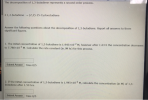
 At a certain temperature, the half-life of the first order decomposition of 2,4-cyclohexadienone (shown below) is 2.11 hr 2,4-cyclohexadienone phenol Answer the following questions about the decomposition of 2,4-cyclohexadienone and report all answers to three significant figures. 1. If the initial concentration of 2,4-cyclohexadienone is 8.04×10⁻² M, calculate the time (in hr) required for the concentration of 2,4-cyclohexadienone to decrease to 38.4 % of the initial concentration. Submit Answer Tries o/s 2. If the initial concentration of 2,4-cyclohexadienone is 8.04×10⁻²...
The decomposition of dioxygen represents a second order process. 2 dioxygen → ozone + O Answer...
 The decomposition of dioxygen represents a second order process. 2 dioxygen → ozone + O Answer the following questions about the decomposition of dioxygen. Report all answers to three significant figures. 1. The initial concentration of dioxygen is 7.310x10⁻¹ M, however after 3.36 h the concentration decreases to 4.898x10⁻¹ M. Calculate the rate constant (in /M hr) for this process. Submit Answer Tries 0/13 2. If the initial concentration of dioxygen is 7.310x10⁻² M, calculate the concentration (in M) of...
The decomposition of nitrosyl chloride represents a second order process. 2 nitrosyl chloride ? dichlorine +...
The decomposition of nitrosyl chloride represents a second order process. 2 nitrosyl chloride ? dichlorine + 2 nitrogen monoxide Answer the following questions about the decomposition of nitrosyl chloride. Report all answers to three significant figures. 1. The initial concentration of nitrosyl chloride is 3.244×10⁻³ M, however after 3.39 h the concentration decreases to 2.011×10⁻³ M. Calculate the rate constant (in /M hr) for this process. Tries 0/3 2. If the initial concentration of nitrosyl chloride is 3.244×10⁻³ M, calculate...
The decomposition of nitrosyl chloride represents a second order process. 2 nitrosyl chloride → dichlorine +...
The decomposition of nitrosyl chloride represents a second order process. 2 nitrosyl chloride → dichlorine + 2 nitrogen monoxide Answer the following questions about the decomposition of nitrosyl chloride. Report all answers to three significant figures. 1. The initial concentration of nitrosyl chloride is 5.271×10⁻³ M, however after 1.27 h the concentration decreases to 3.110×10⁻³ M. Calculate the rate constant (in /M hr) for this process. Tries 0/3 2. If the initial concentration of nitrosyl chloride is 5.271×10⁻³ M, calculate...
The decomposition of 1,3-butadiene represents a second order process. 2 1,3-butadiene - (2,2)-15-Cyclooctadiene Answer the following...
 The decomposition of 1,3-butadiene represents a second order process. 2 1,3-butadiene - (2,2)-15-Cyclooctadiene Answer the following questions about the decomposition of 1,3-butadiene. Report all answers to three significant figures. 1. The initial concentration of 1,3-butadiene is 1.945x10⁻² M, however after 1.63 h the concentration decreases to 7.780x10- M. Calculate the rate constant (in /M hr) for this process. Submit Answer Tries 0/5 2. If the initial concentration of 1,3-butadiene is 1.945x10M, calculate the concentration (in M) of 1,3- butadiene after...
The decomposition of SO,Cl, is first order in SO, Cl, and has a rate constant of...
 The decomposition of SO,Cl, is first order in SO, Cl, and has a rate constant of 1.38x10 - at a certain temperature Part A What is the half-life for this reaction? 1 | ΑΣφ και ? $ Submit Het we Part How long wil it take for the concentration of SO,Cl to decrease to 25% of its initial concentration? Express your answer using two significant figures. VE ΑΣφ ? Submit Beavest A The decomposition of SO,Cl is first order in...
The decomposition of SO2Cl2 is first order in SO, Cl, and has a rate constant of...
 The decomposition of SO2Cl2 is first order in SO, Cl, and has a rate constant of 1.38x10⁻⁴ 5-1 at a certain temperature. Part A What is the half-life for this reaction? ΟΙ ΑΣφ ? 11/2= Submit Request Answer Part B How long will it take for the concentration of SO, Cl, to decrease to 25% of its initial concentration? Express your answer using two significant figures. ΟΙ ΑΣΦ ? Part C If the initial concentration of SO, Cl, is 1.00...
The decomposition of A to B is a first-order reaction with a half-life of 29.9 min:...
The decomposition of A to B is a first-order reaction with a half-life of 29.9 min: A → 2B If the initial concentration of A is 0.463 M, how long will it take for the concentration of A to decrease by 21.3 %? 10.3 min 11.4 min 9.58 min 66.7 min 8.84 min
The first-order decomposition of hydrogen peroxide has a half-life of 10.7 h at 20°C. a. What...
The first-order decomposition of hydrogen peroxide has a half-life of 10.7 h at 20°C. a. What is the rate constant (expressed in hr−1) for this reaction? _____________ Write answer to three significant figures and NO UNITS in answer. b. If you started with a solution that was 7.5 × 10⁻³ M H2O2, what would be the concentration of H2O2 after 3.3 h? __________
The half-life for the first order decomposition of A is 200.0 sec. How much time must...
 The half-life for the first order decomposition of A is 200.0 sec. How much time must elapse for the concentration of A to decrease to (a) one-half: (b) one-sixteenth: (c) one-ninth of its initial concentration?
 At a certain temperature, the half-life of the first order decomposition of 2,4-cyclohexadienone (shown below) is 2.11 hr 2,4-cyclohexadienone phenol Answer the following questions about the decomposition of 2,4-cyclohexadienone and report all answers to three significant figures. 1. If the initial concentration of 2,4-cyclohexadienone is 8.04×10⁻² M, calculate the time (in hr) required for the concentration of 2,4-cyclohexadienone to decrease to 38.4 % of the initial concentration. Submit Answer Tries o/s 2. If the initial concentration of 2,4-cyclohexadienone is 8.04×10⁻²...
 The decomposition of dioxygen represents a second order process. 2 dioxygen → ozone + O Answer the following questions about the decomposition of dioxygen. Report all answers to three significant figures. 1. The initial concentration of dioxygen is 7.310x10⁻¹ M, however after 3.36 h the concentration decreases to 4.898x10⁻¹ M. Calculate the rate constant (in /M hr) for this process. Submit Answer Tries 0/13 2. If the initial concentration of dioxygen is 7.310x10⁻² M, calculate the concentration (in M) of...
 The decomposition of 1,3-butadiene represents a second order process. 2 1,3-butadiene - (2,2)-15-Cyclooctadiene Answer the following questions about the decomposition of 1,3-butadiene. Report all answers to three significant figures. 1. The initial concentration of 1,3-butadiene is 1.945x10⁻² M, however after 1.63 h the concentration decreases to 7.780x10- M. Calculate the rate constant (in /M hr) for this process. Submit Answer Tries 0/5 2. If the initial concentration of 1,3-butadiene is 1.945x10M, calculate the concentration (in M) of 1,3- butadiene after...
 The decomposition of SO,Cl, is first order in SO, Cl, and has a rate constant of 1.38x10 - at a certain temperature Part A What is the half-life for this reaction? 1 | ΑΣφ και ? $ Submit Het we Part How long wil it take for the concentration of SO,Cl to decrease to 25% of its initial concentration? Express your answer using two significant figures. VE ΑΣφ ? Submit Beavest A The decomposition of SO,Cl is first order in...
 The decomposition of SO2Cl2 is first order in SO, Cl, and has a rate constant of 1.38x10⁻⁴ 5-1 at a certain temperature. Part A What is the half-life for this reaction? ΟΙ ΑΣφ ? 11/2= Submit Request Answer Part B How long will it take for the concentration of SO, Cl, to decrease to 25% of its initial concentration? Express your answer using two significant figures. ΟΙ ΑΣΦ ? Part C If the initial concentration of SO, Cl, is 1.00...
 The half-life for the first order decomposition of A is 200.0 sec. How much time must elapse for the concentration of A to decrease to (a) one-half: (b) one-sixteenth: (c) one-ninth of its initial concentration?
Most questions answered within 3 hours.
-
Where is the error in this code sequence?
String s1 = "Hello";
String s2 = "ello";...
asked 11 months ago -
Financial data for Joel de Paris, Inc., for last year
follow:
Joel de Paris, Inc.
Balance...
asked 11 months ago -
Consider this reaction:
Al2(SO4)3 (aq)+ BaCl3
(aq) Al2Cl6 (aq)- +
3BaSO4(s) . What is the...
asked 11 months ago -
Suppose that Savneet is considering increasing her
recent random sample from 20 car rentals to 40...
asked 11 months ago -
Trucks arrive at an unloading terminal at an average rate of 120
per hour.
Trucks arrive...
asked 11 months ago -
Why are methanol and ethanol completely soluble in water while
octanol is not very little soluble....
asked 11 months ago -
A facilities manager at a university reads in a research report
that the mean amount of...
asked 11 months ago -
When the CuSO4 is rehydrated by adding water to the anhydrous
compound, is this an endothermic...
asked 11 months ago -
A ray of sunlight is passing from diamond into crown glass; the
angle of incidence is...
asked 11 months ago -
A block of mass 0.249 kg is placed on top of a light, vertical
spring of...
asked 11 months ago -
how do the kidneys compensate in the presences of acidosis
a) trigger hyperventilate
b) reserve acid...
asked 11 months ago -
Question 501 pts
The rental rate of capital to the firm increases. Which of the
following...
asked 11 months ago