
Homework Answers

Add Answer to:
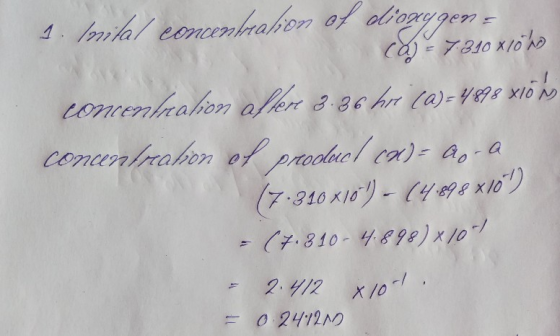
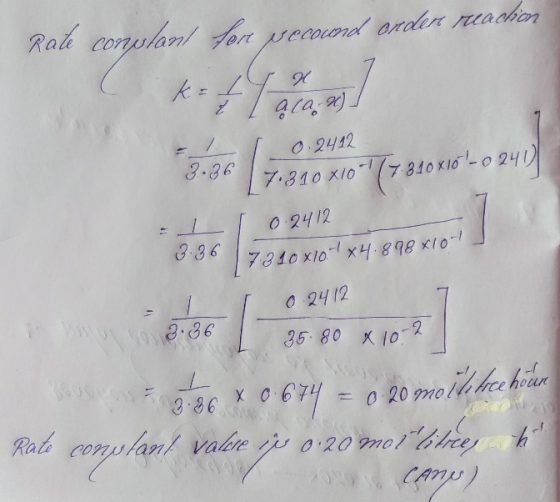
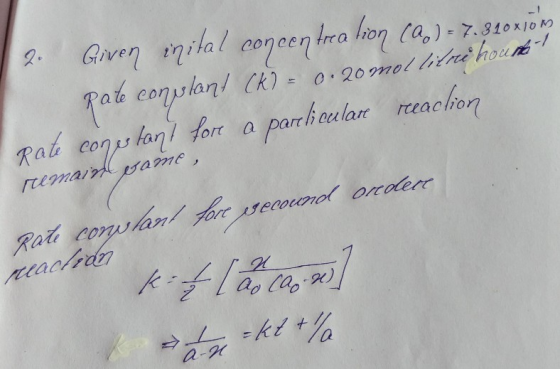
The decomposition of dioxygen represents a second order process. 2 dioxygen → ozone + O Answer...
The decomposition of 1,3-butadiene represents a second order process. 2 1,3-butadiene - (2,2)-15-Cyclooctadiene Answer the following...
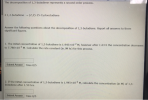 The decomposition of 1,3-butadiene represents a second order process. 2 1,3-butadiene - (2,2)-15-Cyclooctadiene Answer the following questions about the decomposition of 1,3-butadiene. Report all answers to three significant figures. 1. The initial concentration of 1,3-butadiene is 1.945x10⁻² M, however after 1.63 h the concentration decreases to 7.780x10- M. Calculate the rate constant (in /M hr) for this process. Submit Answer Tries 0/5 2. If the initial concentration of 1,3-butadiene is 1.945x10M, calculate the concentration (in M) of 1,3- butadiene after...
The decomposition of nitrosyl chloride represents a second order process. 2 nitrosyl chloride ? dichlorine +...
The decomposition of nitrosyl chloride represents a second order process. 2 nitrosyl chloride ? dichlorine + 2 nitrogen monoxide Answer the following questions about the decomposition of nitrosyl chloride. Report all answers to three significant figures. 1. The initial concentration of nitrosyl chloride is 3.244×10⁻³ M, however after 3.39 h the concentration decreases to 2.011×10⁻³ M. Calculate the rate constant (in /M hr) for this process. Tries 0/3 2. If the initial concentration of nitrosyl chloride is 3.244×10⁻³ M, calculate...
The decomposition of nitrosyl chloride represents a second order process. 2 nitrosyl chloride → dichlorine +...
The decomposition of nitrosyl chloride represents a second order process. 2 nitrosyl chloride → dichlorine + 2 nitrogen monoxide Answer the following questions about the decomposition of nitrosyl chloride. Report all answers to three significant figures. 1. The initial concentration of nitrosyl chloride is 5.271×10⁻³ M, however after 1.27 h the concentration decreases to 3.110×10⁻³ M. Calculate the rate constant (in /M hr) for this process. Tries 0/3 2. If the initial concentration of nitrosyl chloride is 5.271×10⁻³ M, calculate...
At a certain temperature, the half-life of the first order decomposition of phenol (shown below) is...
 At a certain temperature, the half-life of the first order decomposition of phenol (shown below) is 1.54 hr phenol cyclopentadiene carbon monoxide Answer the following questions about the decornposition of phenol and report all answers to three significant figures. 1. If the initial concentration of phenol is 8.73×10 2 M, calculate the time in hr required for the concentration o phenol to decrease to 50.3 % of the initial concentration. Submit Answer Tries 0/3 2. Tf the initial concentration of...
At a certain temperature, the half-life of the first order decomposition of 2,4-cyclohexadienone (shown below) is...
 At a certain temperature, the half-life of the first order decomposition of 2,4-cyclohexadienone (shown below) is 2.11 hr 2,4-cyclohexadienone phenol Answer the following questions about the decomposition of 2,4-cyclohexadienone and report all answers to three significant figures. 1. If the initial concentration of 2,4-cyclohexadienone is 8.04×10⁻² M, calculate the time (in hr) required for the concentration of 2,4-cyclohexadienone to decrease to 38.4 % of the initial concentration. Submit Answer Tries o/s 2. If the initial concentration of 2,4-cyclohexadienone is 8.04×10⁻²...
The decomposition of XY is second order in XY and has a rate constant of 7.06×10⁻³...
The decomposition of XY is second order in XY and has a rate constant of 7.06×10⁻³ M−1⋅s−1 at a certain temperature. PART A If the initial concentration of XY is 0.160 M , how long will it take for the concentration to decrease to 6.80×10⁻² M ? Express your answer using two significant figures. PART B If the initial concentration of XY is 0.050 M, what is the concentration of XY after 45.0 s ? Express your answer using two...
The decomposition of XY is second order in XY and has a rate constant of 7.04×10⁻³...
The decomposition of XY is second order in XY and has a rate constant of 7.04×10⁻³ M−1⋅s−1 at a certain temperature. Part A: What is the half-life for this reaction at an initial concentration of 0.100 M? Express your answer using three significant figures. Part B: How long will it take for the concentration of XY to decrease to 12.5% of its initial concentration when the initial concentration is 0.100 M? Express your answer using three significant figures. Part C:...
The decomposition of SO,Cl, is first order in SO, Cl, and has a rate constant of...
 The decomposition of SO,Cl, is first order in SO, Cl, and has a rate constant of 1.38x10 - at a certain temperature Part A What is the half-life for this reaction? 1 | ΑΣφ και ? $ Submit Het we Part How long wil it take for the concentration of SO,Cl to decrease to 25% of its initial concentration? Express your answer using two significant figures. VE ΑΣφ ? Submit Beavest A The decomposition of SO,Cl is first order in...
Please answer #7 and #8 only, Thank you! Ozone Decomposition: Ozone formation is faster during the...
 Please answer #7 and #8 only,
Thank you!
Ozone Decomposition: Ozone formation is faster during the day due to the action of sunlight on NO2 molecules. Thus, Os(g) accumulates in the troposphere and its concentration peaks sometime in the afternoon. During the night, ozone reacts with NO(g) according to the following reaction: NO(g) + Os(g) = NO2(g) + Ox(g). This is a single-step process with an activation energy E. = 12.5 kl/mol and a AH..=-199.5 kJ/mol. 5. Build potential energy...
Please answer #7 and #8 only,
Thank you!
Ozone Decomposition: Ozone formation is faster during the day due to the action of sunlight on NO2 molecules. Thus, Os(g) accumulates in the troposphere and its concentration peaks sometime in the afternoon. During the night, ozone reacts with NO(g) according to the following reaction: NO(g) + Os(g) = NO2(g) + Ox(g). This is a single-step process with an activation energy E. = 12.5 kl/mol and a AH..=-199.5 kJ/mol. 5. Build potential energy...
You are studying a second order process for the decomposition of C4H10 and find that it...
You are studying a second order process for the decomposition of C4H10 and find that it has a half-life of 491.14 seconds if you have an initial concentration of 0.219 M. You then set up a new experiment. If the initial concentration of C4H10 is 5.55 M , how many seconds will it take to get to a concentration of 1.48 M? Enter your answer with at least 3 sig figs and don't use scientific notation.
 The decomposition of 1,3-butadiene represents a second order process. 2 1,3-butadiene - (2,2)-15-Cyclooctadiene Answer the following questions about the decomposition of 1,3-butadiene. Report all answers to three significant figures. 1. The initial concentration of 1,3-butadiene is 1.945x10⁻² M, however after 1.63 h the concentration decreases to 7.780x10- M. Calculate the rate constant (in /M hr) for this process. Submit Answer Tries 0/5 2. If the initial concentration of 1,3-butadiene is 1.945x10M, calculate the concentration (in M) of 1,3- butadiene after...
 At a certain temperature, the half-life of the first order decomposition of phenol (shown below) is 1.54 hr phenol cyclopentadiene carbon monoxide Answer the following questions about the decornposition of phenol and report all answers to three significant figures. 1. If the initial concentration of phenol is 8.73×10 2 M, calculate the time in hr required for the concentration o phenol to decrease to 50.3 % of the initial concentration. Submit Answer Tries 0/3 2. Tf the initial concentration of...
 At a certain temperature, the half-life of the first order decomposition of 2,4-cyclohexadienone (shown below) is 2.11 hr 2,4-cyclohexadienone phenol Answer the following questions about the decomposition of 2,4-cyclohexadienone and report all answers to three significant figures. 1. If the initial concentration of 2,4-cyclohexadienone is 8.04×10⁻² M, calculate the time (in hr) required for the concentration of 2,4-cyclohexadienone to decrease to 38.4 % of the initial concentration. Submit Answer Tries o/s 2. If the initial concentration of 2,4-cyclohexadienone is 8.04×10⁻²...
 The decomposition of SO,Cl, is first order in SO, Cl, and has a rate constant of 1.38x10 - at a certain temperature Part A What is the half-life for this reaction? 1 | ΑΣφ και ? $ Submit Het we Part How long wil it take for the concentration of SO,Cl to decrease to 25% of its initial concentration? Express your answer using two significant figures. VE ΑΣφ ? Submit Beavest A The decomposition of SO,Cl is first order in...
 Please answer #7 and #8 only,
Thank you!
Ozone Decomposition: Ozone formation is faster during the day due to the action of sunlight on NO2 molecules. Thus, Os(g) accumulates in the troposphere and its concentration peaks sometime in the afternoon. During the night, ozone reacts with NO(g) according to the following reaction: NO(g) + Os(g) = NO2(g) + Ox(g). This is a single-step process with an activation energy E. = 12.5 kl/mol and a AH..=-199.5 kJ/mol. 5. Build potential energy...
Please answer #7 and #8 only,
Thank you!
Ozone Decomposition: Ozone formation is faster during the day due to the action of sunlight on NO2 molecules. Thus, Os(g) accumulates in the troposphere and its concentration peaks sometime in the afternoon. During the night, ozone reacts with NO(g) according to the following reaction: NO(g) + Os(g) = NO2(g) + Ox(g). This is a single-step process with an activation energy E. = 12.5 kl/mol and a AH..=-199.5 kJ/mol. 5. Build potential energy...
Most questions answered within 3 hours.
-
Where is the error in this code sequence?
String s1 = "Hello";
String s2 = "ello";...
asked 10 months ago -
Financial data for Joel de Paris, Inc., for last year
follow:
Joel de Paris, Inc.
Balance...
asked 10 months ago -
Consider this reaction:
Al2(SO4)3 (aq)+ BaCl3
(aq) Al2Cl6 (aq)- +
3BaSO4(s) . What is the...
asked 10 months ago -
Suppose that Savneet is considering increasing her
recent random sample from 20 car rentals to 40...
asked 10 months ago -
Trucks arrive at an unloading terminal at an average rate of 120
per hour.
Trucks arrive...
asked 10 months ago -
Why are methanol and ethanol completely soluble in water while
octanol is not very little soluble....
asked 10 months ago -
A facilities manager at a university reads in a research report
that the mean amount of...
asked 10 months ago -
When the CuSO4 is rehydrated by adding water to the anhydrous
compound, is this an endothermic...
asked 10 months ago -
A ray of sunlight is passing from diamond into crown glass; the
angle of incidence is...
asked 10 months ago -
A block of mass 0.249 kg is placed on top of a light, vertical
spring of...
asked 10 months ago -
how do the kidneys compensate in the presences of acidosis
a) trigger hyperventilate
b) reserve acid...
asked 10 months ago -
Question 501 pts
The rental rate of capital to the firm increases. Which of the
following...
asked 10 months ago