The table below shows the daily costs of Cathy's Corn Stand. Cathy sells her corn cobs...
The table below shows the daily costs of Cathy's Corn Stand. Cathy sells her corn cobs in a perfectly competitive market.
Cathy's Corn Stand's Production Costs
| Quantity (corn cobs) | AVC (dollars) | ATC (dollars) | MC (dollars) |
| 10.00 | $2.50 | $5.00 | $2.50 |
| 20.00 | 2.25 | 3.50 | 2.00 |
| 30.00 | 2.00 | 2.83 | 1.50 |
| 40.00 | 1.81 | 2.44 | 1.25 |
| 50.00 | 1.70 | 2.20 | 1.25 |
| 60.00 | 1.67 | 2.08 | 1.50 |
| 70.00 | 1.68 | 2.04 | 1.75 |
| 80.00 | 1.75 | 2.06 | 2.25 |
| 90.00 | 1.86 | 2.14 | 2.75 |
a. Draw Cathy's marginal cost (MC) curve.
Instructions: Use the tool provided 'MC' to plot the curve point by point (8 points total).
Instructions: In part b, enter your answer as a whole number. In part c, round your answer to two decimal places. If you are entering any negative numbers be sure to include a negative sign (-) in front of those numbers.
b. If the market price of corn is $1.75 per corn cob, in the short run how much corn should Cathy produce each day to maximize profits?
corn cobs per day
c. What are Cathy's profits/losses per day if she produces the profit-maximizing quantity of corn in the short run (losses are expressed as a negative number)?
$
d. In the short run, assuming nothing else changes, Cathy should:
-
produce the same quantity of corn per day.
-
produce a lower quantity of corn per day.
-
shut down, because the market price is above the AVC.
-
produce a greater quantity of corn per day.
e. If the short-run price of corn falls to $1.25 per corn cob, Cathy should:
-
produce a lower quantity of corn per day.
-
produce the same quantity of corn per day.
-
shut down, because the market price is below the AVC.
-
produce a greater quantity of corn per day.
Homework Answers
a.
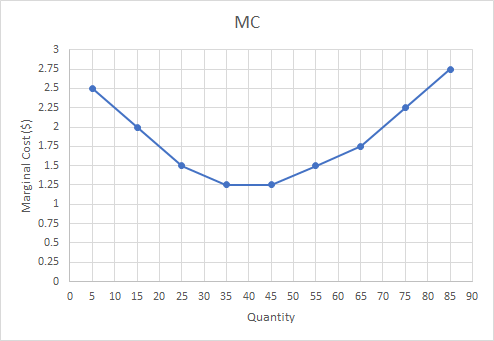
b. Profit-maximizing condition:
MC = Price = $1.75 when the quantity = 70 units
Cathy should produce 70 corn cobs per day
c. When the quantity = 70 corn cobs per day
ATC = $2.04
Price = $1,75
Profit/Loss = Total Revenue - Total Cost = Price * Quantity - ATC * Quantity = $1.75 * 70 - $2.04 * 70 = -$20.30 (loss)
d. As the price is greater than the AVC, Cathy is recovering her variable costs and hence should continue to produce the same quantity(70 corn cobs per day) in the short-run
Ans: produce the same quantity of corn per day.
e. If the price falls to $1.25 per corn cob, it is below the minimum AVC. As Cathy cannot recover the variable costs at this price, production should be shut down.
Ans: shut down, because the market price is below the AVC.
Add Answer to:
The table below shows the daily costs of Cathy's Corn Stand.
Cathy sells her corn cobs...
The table below shows the daily costs of Cathy's Corn Stand. Cathy sells her corn cobs...
 The table below shows the daily costs of Cathy's Corn Stand. Cathy sells her corn cobs in a perfectly competitive market. Cathy's Corn Stand's Production Costs Quantity (corn cobs) AVC (dollars) 10.00 $2.50 20.00 2.25 30.00 2.00 40.00 1.81 50.00 1.70 60.00 1.67 70.00 1.68 80.00 1.75 90.00 ATC (dollars) $5.00 3.50 2.83 2.44 2.20 2.08 2.04 2.06 2.14 MC (dollars $2.50 2.00 1.50 1.25 1.25 1.50 1.75 2.25 2.75 a. Draw Cathy's marginal cost (MC) curve. Instructions: Use the...
The table below shows the daily costs of Cathy's Corn Stand. Cathy sells her corn cobs...
 The table below shows the daily costs of Cathy's Corn Stand. Cathy sells her corn cobs in a perfectly competitive market. MC (dollars) $2.50 5.00 Cathy's Corn Stand's Production Costs Quantity (corn cobs) AVC (dollars) 8.0 $5.00 0 11. 4 .55 13.0 4.62 14.8 4.75 16.3 4.91 17.7 5.10 18.9 5.29 5.51 ATC (dollars) $12.50 10.00 9.23 8.81 8. 59 8.50 8.47 8.52 6 .45 7.41 9.52 Instructions: In part a, round your answer to one decimal place. In part...
17 The table below shows the daily costs of Corny's Corn Cobs. Corny's sells corn by...
 17 The table below shows the daily costs of Corny's Corn Cobs. Corny's sells corn by the dozen in a perfectly competitive market. The market price of a dozen ears of corn is $2.20 per dozen. Tмс Quantity (Dozens of Ears) ($) 1.6 3.40 Corny's Corn Cobs AVC ATC ($) ($) 1.90 4.40 1.70 1.60 2.80 1.50 2.50 1.50 2.30 1.60 2.30 1.70 2.30 1.80 2.40 1.30 1.10 1.30 1.50 2.20 2.20 2.60 a. In the short run, to maximize...
The table below shows All's monthly costs of producing wheat. Suppose the current market price of...
 The table below shows All's monthly costs of producing wheat. Suppose the current market price of wheat is $84.70 per bushel. ATC (dollars) MC (dollars) All's Wheat Production Costs Quantity AVC (bushels) (dollars) 0 - 500 $19.70 1,000 16.70 1,500 14.70 2,000 19.70 2.500 24.70 3,000 29.70 3,500 34.70 4,000 39.70 4,500 44.70 5,000 49.70 $44.70 29.70 28.03 29.70 32.70 36.37 40.41 44.70 49.14 53.70 4.70 14.70 22.70 34.70 44.70 54.70 64.70 74.70 84.70 94.70 Instructions: Round your answers to...
5. Profit maximization and shutting down in the short run Suppose that the market for black...
 5. Profit maximization and shutting down in the short run Suppose that the market for black leather purses is a competitive market. The following graph shows the daily cost curves of a firm operating in this market. PRICE (Dollars per purse) + MC AVC 0 10 90 100 20 30 40 50 60 70 80 QUANTITY (Thousands of purses) For each price in the following table, calculate the firm's optimal quantity of units to produce, and determine the profit or...
The data in the table below are the monthly average variable costs (AVC), average total costs (ATC), and marginal costs (MC) for Alpacky, a typical alpaca wool-manufacturing firm in Peru
3) Perfect Competition (5 points) The data in the table below are the monthly average variable costs (AVC), average total costs (ATC), and marginal costs (MC) for Alpacky, a typical alpaca wool-manufacturing firm in Peru. The alpaca wool industry is competitive.For each market price given below, give the profit-maximizing output level and state whether Alpacky's profits are positive, negative, or zero. Also state whether Alpacky should produce or shut down in the short run. a. If the market price is $22... i. what...
Consider the competitive market for dress shirts. The following graph shows the marginal cost (MC), average...
 Consider the competitive market for dress shirts. The following
graph shows the marginal cost (MC), average total cost (ATC), and
average variable cost (AVC) curves for a typical firm in the
industry.
On the following graph, use the orange points (square
symbol) to plot points along the portion of the
firm's short-run supply curve that corresponds to
prices where there is positive output. (Note: You
are given more points to plot than you need.)
At the current short-run market price,...
Consider the competitive market for dress shirts. The following
graph shows the marginal cost (MC), average total cost (ATC), and
average variable cost (AVC) curves for a typical firm in the
industry.
On the following graph, use the orange points (square
symbol) to plot points along the portion of the
firm's short-run supply curve that corresponds to
prices where there is positive output. (Note: You
are given more points to plot than you need.)
At the current short-run market price,...
The following graph shows the daily cost curves of a firm operating in a perfectly competitive...
 The following graph shows the daily cost curves of a firm operating in a perfectly competitive market. Suppose the market price for the good is $80 per unit Use the blue rectangle (circle symbols) to shade the area representing the firm's profit or loss at the market price of $80 per unit if the firm chooses to produce the profit-maximizing quantity of output Profit or Loss PRICE AND COST (Dollars) QUANTITY (Thousands of units) At the market price of $80...
12. Suppose Market A (left) represents the market for corn in the short run and Market...
 12. Suppose Market A (left) represents the market for corn in the short run and Market B represents the market for corn (right) in the long run. Large scale negative publicity about the health effects of high fructose corn syrup would have a larger effect on the price of corn in which market? Assume that the effect of negative publicity is the same in both the short and the long run. X 50 50 40 40 MC 30 30 20...
COSTS (Dollars) 8 a88 + EmoK(LH14 6. Deriving the short-run supply curve Consider the competitive market...
 COSTS (Dollars) 8 a88 + EmoK(LH14 6. Deriving the short-run supply curve Consider the competitive market for sports jackets. The following graph shows the marginal cost (MC), average total cost (ATC), and average variable cost (AVC) curves for a typical firm in the industry 100 90 70 60 ATC 50 40 30 20 AVC For each price in the following table, use the graph to determine the number of jackets this firm would produce in order to maximize its profit....
 The table below shows the daily costs of Cathy's Corn Stand. Cathy sells her corn cobs in a perfectly competitive market. Cathy's Corn Stand's Production Costs Quantity (corn cobs) AVC (dollars) 10.00 $2.50 20.00 2.25 30.00 2.00 40.00 1.81 50.00 1.70 60.00 1.67 70.00 1.68 80.00 1.75 90.00 ATC (dollars) $5.00 3.50 2.83 2.44 2.20 2.08 2.04 2.06 2.14 MC (dollars $2.50 2.00 1.50 1.25 1.25 1.50 1.75 2.25 2.75 a. Draw Cathy's marginal cost (MC) curve. Instructions: Use the...
 The table below shows the daily costs of Cathy's Corn Stand. Cathy sells her corn cobs in a perfectly competitive market. MC (dollars) $2.50 5.00 Cathy's Corn Stand's Production Costs Quantity (corn cobs) AVC (dollars) 8.0 $5.00 0 11. 4 .55 13.0 4.62 14.8 4.75 16.3 4.91 17.7 5.10 18.9 5.29 5.51 ATC (dollars) $12.50 10.00 9.23 8.81 8. 59 8.50 8.47 8.52 6 .45 7.41 9.52 Instructions: In part a, round your answer to one decimal place. In part...
 17 The table below shows the daily costs of Corny's Corn Cobs. Corny's sells corn by the dozen in a perfectly competitive market. The market price of a dozen ears of corn is $2.20 per dozen. Tмс Quantity (Dozens of Ears) ($) 1.6 3.40 Corny's Corn Cobs AVC ATC ($) ($) 1.90 4.40 1.70 1.60 2.80 1.50 2.50 1.50 2.30 1.60 2.30 1.70 2.30 1.80 2.40 1.30 1.10 1.30 1.50 2.20 2.20 2.60 a. In the short run, to maximize...
 The table below shows All's monthly costs of producing wheat. Suppose the current market price of wheat is $84.70 per bushel. ATC (dollars) MC (dollars) All's Wheat Production Costs Quantity AVC (bushels) (dollars) 0 - 500 $19.70 1,000 16.70 1,500 14.70 2,000 19.70 2.500 24.70 3,000 29.70 3,500 34.70 4,000 39.70 4,500 44.70 5,000 49.70 $44.70 29.70 28.03 29.70 32.70 36.37 40.41 44.70 49.14 53.70 4.70 14.70 22.70 34.70 44.70 54.70 64.70 74.70 84.70 94.70 Instructions: Round your answers to...
 5. Profit maximization and shutting down in the short run Suppose that the market for black leather purses is a competitive market. The following graph shows the daily cost curves of a firm operating in this market. PRICE (Dollars per purse) + MC AVC 0 10 90 100 20 30 40 50 60 70 80 QUANTITY (Thousands of purses) For each price in the following table, calculate the firm's optimal quantity of units to produce, and determine the profit or...
 Consider the competitive market for dress shirts. The following
graph shows the marginal cost (MC), average total cost (ATC), and
average variable cost (AVC) curves for a typical firm in the
industry.
On the following graph, use the orange points (square
symbol) to plot points along the portion of the
firm's short-run supply curve that corresponds to
prices where there is positive output. (Note: You
are given more points to plot than you need.)
At the current short-run market price,...
Consider the competitive market for dress shirts. The following
graph shows the marginal cost (MC), average total cost (ATC), and
average variable cost (AVC) curves for a typical firm in the
industry.
On the following graph, use the orange points (square
symbol) to plot points along the portion of the
firm's short-run supply curve that corresponds to
prices where there is positive output. (Note: You
are given more points to plot than you need.)
At the current short-run market price,...
 The following graph shows the daily cost curves of a firm operating in a perfectly competitive market. Suppose the market price for the good is $80 per unit Use the blue rectangle (circle symbols) to shade the area representing the firm's profit or loss at the market price of $80 per unit if the firm chooses to produce the profit-maximizing quantity of output Profit or Loss PRICE AND COST (Dollars) QUANTITY (Thousands of units) At the market price of $80...
 12. Suppose Market A (left) represents the market for corn in the short run and Market B represents the market for corn (right) in the long run. Large scale negative publicity about the health effects of high fructose corn syrup would have a larger effect on the price of corn in which market? Assume that the effect of negative publicity is the same in both the short and the long run. X 50 50 40 40 MC 30 30 20...
 COSTS (Dollars) 8 a88 + EmoK(LH14 6. Deriving the short-run supply curve Consider the competitive market for sports jackets. The following graph shows the marginal cost (MC), average total cost (ATC), and average variable cost (AVC) curves for a typical firm in the industry 100 90 70 60 ATC 50 40 30 20 AVC For each price in the following table, use the graph to determine the number of jackets this firm would produce in order to maximize its profit....
Most questions answered within 3 hours.
-
Where is the error in this code sequence?
String s1 = "Hello";
String s2 = "ello";...
asked 11 months ago -
Financial data for Joel de Paris, Inc., for last year
follow:
Joel de Paris, Inc.
Balance...
asked 11 months ago -
Consider this reaction:
Al2(SO4)3 (aq)+ BaCl3
(aq) Al2Cl6 (aq)- +
3BaSO4(s) . What is the...
asked 11 months ago -
Suppose that Savneet is considering increasing her
recent random sample from 20 car rentals to 40...
asked 11 months ago -
Trucks arrive at an unloading terminal at an average rate of 120
per hour.
Trucks arrive...
asked 11 months ago -
Why are methanol and ethanol completely soluble in water while
octanol is not very little soluble....
asked 11 months ago -
A facilities manager at a university reads in a research report
that the mean amount of...
asked 11 months ago -
When the CuSO4 is rehydrated by adding water to the anhydrous
compound, is this an endothermic...
asked 11 months ago -
A ray of sunlight is passing from diamond into crown glass; the
angle of incidence is...
asked 11 months ago -
A block of mass 0.249 kg is placed on top of a light, vertical
spring of...
asked 11 months ago -
how do the kidneys compensate in the presences of acidosis
a) trigger hyperventilate
b) reserve acid...
asked 11 months ago -
Question 501 pts
The rental rate of capital to the firm increases. Which of the
following...
asked 11 months ago