Potential Energy and Force A mass m=3.00kg moving along the x-axis is acted on only by...
Potential Energy and Force
A mass m=3.00kg moving along the x-axis is acted on only by a single conservative force. The force has a potential energy function given by U(x)=(1.00J/m3)x3−(9.00J/m2)x2+(15.0J/m)x. It will be useful to graph this function on your calculator or computer.
Part A
Find the force on the mass as a function of x. (Leave the units out of the coefficients in your expression, and make sure all coefficients have three significant figures).
|
|
||||
| F(x) = | N |
SubmitMy AnswersGive Up
Part B
For this force, there are two equilibrium positions. Solve for them, and list them in increasing order below.
|
|
||||
| xeq = | m |
SubmitHintsMy AnswersGive UpReview Part
Part C
Assume you are told that one of the turning points of the mass is at x=6.00m. Solve for the total energy of the system. (Recall that a turning point is defined as a position at which the object stops and turns around).
|
|
||||
| E = | J |
SubmitMy AnswersGive Up
Part D
Determine if the mass will ever reach the first equilibrium point.
Determine if the mass will ever reach the first equilibrium point.
| There is not enough information to decide. | |
| The mass will reach the first equilibrium point. | |
| The mass will not reach the first equilibrium point. |
SubmitHintsMy AnswersGive UpReview Part
Part E
Solve for the speed of the mass when it is at the second equilibrium position.
|
|
||||
| veq,2 = | m/s |
Homework Answers
The potential energy


At equilibrium position


Clearly two equlibrium points are

a turning point is defined as a position at which the object stops and turns around
velocity of the object as well as the kinetic energy is zero at turning point
Therefore the total energy is the potential energy at that turning point and that is given by

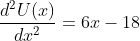
at  the second
derivative is negative, means this is a maxima
the second
derivative is negative, means this is a maxima
at  the second
derivative is positive, means this is a minima
the second
derivative is positive, means this is a minima
For stable equilibrium the body will tend to be in a minima.
at 
at 
For total energy  , if the
potential energy is
, if the
potential energy is  then
the kinetic energy has to be
then
the kinetic energy has to be  which is not possible as negative kinetic energy is
absurd.
which is not possible as negative kinetic energy is
absurd.
So The mass will not reach the first equilibrium point.
This potential energy will be converted to kinetic energy at equilibrium point
Therefore at second equilibrium position
For total energy , if the
potential energy is  then
the kinetic energy has to be
then
the kinetic energy has to be  which is acceptable

Add Answer to:
Potential Energy and Force
A mass m=3.00kg moving along the x-axis is acted on
only by...
A particle of mass m and energy E moving along the x axis is subjected to a potential energy function U(x).
 \((25\) marks) A particle of mass \(m\) and energy \(E\) moving along the \(x\) axis is subjected to a potential energy function \(U(x) .\) (a) Suppose \(\psi_{1}(x)\) and \(\psi_{2}(\mathrm{x})\) are two wave functions of the system with the same energy \(E .\) Derive an expression to relate \(\psi_{1}(x), \psi_{2}(x)\), and their derivatives. (b) By requiring the wave functions to vanish at infinity, show that \(\psi_{1}(x)\) and \(\psi_{2}(x)\) can at most differ by a multiplicative constant. Hence, what conclusion can you...
QUESTION6 (2+3+2+3 10 Marks) A particle can only move along the x-axis. There is only one...
 QUESTION6 (2+3+2+3 10 Marks) A particle can only move along the x-axis. There is only one force acting on the particle along the x- axis and the force is conservative where the corresponding potential energy is given by U(x) = ar ifx = 0 or x > 0 where a= 2.0 J/m. The total mechanical energy of the particle is 20 J (a) Are there any equilibrium points? Explain your answer briefly (b) Determine the turning points or point for...
A particle of mass m moves in one dimension along the positive x axis. It is...
 A particle of mass m moves in one dimension along the positive x axis. It is acted on by a constant force directed toward the origin with magnitude B, and an inverse-square law repulsive force with magnitude A/x^2. Find the potential energy function, U(x). Sketch the energy diagram for the system when the maximum kinetic energy is K_0 = 1/2 mv_0^2 Find the equilibrium position, x_0.
A particle of mass m = 2.70 kg moving along the x axis from x =...
A particle of mass m = 2.70 kg moving along the x axis from x = 0 to x = 10.6 m experiences a net conservative force in an isolated system given by F = 5x − 4, where F is in newtons and x is in meters. (a) What is the work done on the particle by the force F? J (b) What is the change in the potential energy of the system during this motion? J (c) If...
A 4.2 kg particle moving along the x-axis is acted upon by the force whose functional...
 A 4.2 kg particle moving along the x-axis is acted upon
by the force whose functional form appears below. The velocity of
the particle at x = 0 is v = 6.6 m/s.
(a) Find the particle's speed (in m/s) at x = 2.0
m.
____ m/s
(b) Find the particle's speed (in m/s) at x = 5.0
m.
____ m/s
(c) Find the particle's speed (in m/s) at x = 10.0
m.
____ m/s
(d) Does the particle turn...
A 4.2 kg particle moving along the x-axis is acted upon
by the force whose functional form appears below. The velocity of
the particle at x = 0 is v = 6.6 m/s.
(a) Find the particle's speed (in m/s) at x = 2.0
m.
____ m/s
(b) Find the particle's speed (in m/s) at x = 5.0
m.
____ m/s
(c) Find the particle's speed (in m/s) at x = 10.0
m.
____ m/s
(d) Does the particle turn...
24&25 please The figure below shows the potential energy function U (r)for a particle moving along...
 24&25 please
The figure below shows the potential energy function U (r)for a particle moving along an axis labeled by the coordinate r. Values for energy and distance are in joules (j) millimeters (mm), respectively. The total energy of this particle is E = -4 J. Initially, the particle is at r = 1 mm and moving to the right (direction of increasing r) Which of the following statements best describes the subsequent motion of this particle? a. The particle...
24&25 please
The figure below shows the potential energy function U (r)for a particle moving along an axis labeled by the coordinate r. Values for energy and distance are in joules (j) millimeters (mm), respectively. The total energy of this particle is E = -4 J. Initially, the particle is at r = 1 mm and moving to the right (direction of increasing r) Which of the following statements best describes the subsequent motion of this particle? a. The particle...
A particle of mass 5 kg is subject to a conservative force whose potential energy (in...
 A particle of mass 5 kg is subject to a conservative force whose potential energy (in joules) as a function of position (in meters) is given by the equation U(x) =-100x5e-1x [where x > 0] (a) Determine the position xo where the particle experiences stable equilibrium (b) Find the potential energy Uo of the particle at the position x 2106 The particle is displaced slightly from position x = xo and released (c) Determine the effective value of the spring...
2. A particle of mass m is moving in a plane under a force whose potential energy is given by V(r...
 2. A particle of mass m is moving in a plane under a force whose potential energy is given by V(r) -kin r + cr + gr cos θ with k,c,g positive constants. (a) Write down the force in polar coordinates. (b) Find the positions of equilibrium (1) if c>g and (2) if c<g. (c) By considering the direction of the force near these points, determine whether the equilibrium is stable or not
2. A particle of mass m is...
2. A particle of mass m is moving in a plane under a force whose potential energy is given by V(r) -kin r + cr + gr cos θ with k,c,g positive constants. (a) Write down the force in polar coordinates. (b) Find the positions of equilibrium (1) if c>g and (2) if c<g. (c) By considering the direction of the force near these points, determine whether the equilibrium is stable or not
2. A particle of mass m is...
Q.3) (7 Marks An object of mass m is being acted upon by a force F(x)...
 Q.3) (7 Marks An object of mass m is being acted upon by a force F(x) = Fosin (cx), where F. = 2 N and c = 0.5 rad/m are constants (a) Prove that this force is conservative. (b) Find the potential energy function V(x) (c) Make a graph of the potential energy V(x) as a functions of x in the interval [x = -a m,x = + m) d) Us previous graph to discuss the motion of the particle...
4. A particle of mass m 2 kg moves under the potential energy function U(x.y.z)- (kx...
 4. A particle of mass m 2 kg moves under the potential energy function U(x.y.z)- (kx + 2 k2y2 +3 k3z3) where k 1N. a. Suppose the particle has speed vo3 m/s when it passes through the origin. What will its speed be if and when it passes through the point (1,1.1)? b. Suppose the particle's speed vo at the origin is not known and that the point (1,1,1) is a turning point of the motion (a point where v0)....
 QUESTION6 (2+3+2+3 10 Marks) A particle can only move along the x-axis. There is only one force acting on the particle along the x- axis and the force is conservative where the corresponding potential energy is given by U(x) = ar ifx = 0 or x > 0 where a= 2.0 J/m. The total mechanical energy of the particle is 20 J (a) Are there any equilibrium points? Explain your answer briefly (b) Determine the turning points or point for...
 A particle of mass m moves in one dimension along the positive x axis. It is acted on by a constant force directed toward the origin with magnitude B, and an inverse-square law repulsive force with magnitude A/x^2. Find the potential energy function, U(x). Sketch the energy diagram for the system when the maximum kinetic energy is K_0 = 1/2 mv_0^2 Find the equilibrium position, x_0.
 A 4.2 kg particle moving along the x-axis is acted upon
by the force whose functional form appears below. The velocity of
the particle at x = 0 is v = 6.6 m/s.
(a) Find the particle's speed (in m/s) at x = 2.0
m.
____ m/s
(b) Find the particle's speed (in m/s) at x = 5.0
m.
____ m/s
(c) Find the particle's speed (in m/s) at x = 10.0
m.
____ m/s
(d) Does the particle turn...
A 4.2 kg particle moving along the x-axis is acted upon
by the force whose functional form appears below. The velocity of
the particle at x = 0 is v = 6.6 m/s.
(a) Find the particle's speed (in m/s) at x = 2.0
m.
____ m/s
(b) Find the particle's speed (in m/s) at x = 5.0
m.
____ m/s
(c) Find the particle's speed (in m/s) at x = 10.0
m.
____ m/s
(d) Does the particle turn...
 24&25 please
The figure below shows the potential energy function U (r)for a particle moving along an axis labeled by the coordinate r. Values for energy and distance are in joules (j) millimeters (mm), respectively. The total energy of this particle is E = -4 J. Initially, the particle is at r = 1 mm and moving to the right (direction of increasing r) Which of the following statements best describes the subsequent motion of this particle? a. The particle...
24&25 please
The figure below shows the potential energy function U (r)for a particle moving along an axis labeled by the coordinate r. Values for energy and distance are in joules (j) millimeters (mm), respectively. The total energy of this particle is E = -4 J. Initially, the particle is at r = 1 mm and moving to the right (direction of increasing r) Which of the following statements best describes the subsequent motion of this particle? a. The particle...
 A particle of mass 5 kg is subject to a conservative force whose potential energy (in joules) as a function of position (in meters) is given by the equation U(x) =-100x5e-1x [where x > 0] (a) Determine the position xo where the particle experiences stable equilibrium (b) Find the potential energy Uo of the particle at the position x 2106 The particle is displaced slightly from position x = xo and released (c) Determine the effective value of the spring...
 2. A particle of mass m is moving in a plane under a force whose potential energy is given by V(r) -kin r + cr + gr cos θ with k,c,g positive constants. (a) Write down the force in polar coordinates. (b) Find the positions of equilibrium (1) if c>g and (2) if c<g. (c) By considering the direction of the force near these points, determine whether the equilibrium is stable or not
2. A particle of mass m is...
2. A particle of mass m is moving in a plane under a force whose potential energy is given by V(r) -kin r + cr + gr cos θ with k,c,g positive constants. (a) Write down the force in polar coordinates. (b) Find the positions of equilibrium (1) if c>g and (2) if c<g. (c) By considering the direction of the force near these points, determine whether the equilibrium is stable or not
2. A particle of mass m is...
 Q.3) (7 Marks An object of mass m is being acted upon by a force F(x) = Fosin (cx), where F. = 2 N and c = 0.5 rad/m are constants (a) Prove that this force is conservative. (b) Find the potential energy function V(x) (c) Make a graph of the potential energy V(x) as a functions of x in the interval [x = -a m,x = + m) d) Us previous graph to discuss the motion of the particle...
 4. A particle of mass m 2 kg moves under the potential energy function U(x.y.z)- (kx + 2 k2y2 +3 k3z3) where k 1N. a. Suppose the particle has speed vo3 m/s when it passes through the origin. What will its speed be if and when it passes through the point (1,1.1)? b. Suppose the particle's speed vo at the origin is not known and that the point (1,1,1) is a turning point of the motion (a point where v0)....
Most questions answered within 3 hours.
-
Where is the error in this code sequence?
String s1 = "Hello";
String s2 = "ello";...
asked 10 months ago -
Financial data for Joel de Paris, Inc., for last year
follow:
Joel de Paris, Inc.
Balance...
asked 10 months ago -
Consider this reaction:
Al2(SO4)3 (aq)+ BaCl3
(aq) Al2Cl6 (aq)- +
3BaSO4(s) . What is the...
asked 10 months ago -
Suppose that Savneet is considering increasing her
recent random sample from 20 car rentals to 40...
asked 10 months ago -
Trucks arrive at an unloading terminal at an average rate of 120
per hour.
Trucks arrive...
asked 10 months ago -
Why are methanol and ethanol completely soluble in water while
octanol is not very little soluble....
asked 10 months ago -
A facilities manager at a university reads in a research report
that the mean amount of...
asked 10 months ago -
When the CuSO4 is rehydrated by adding water to the anhydrous
compound, is this an endothermic...
asked 10 months ago -
A ray of sunlight is passing from diamond into crown glass; the
angle of incidence is...
asked 10 months ago -
A block of mass 0.249 kg is placed on top of a light, vertical
spring of...
asked 10 months ago -
how do the kidneys compensate in the presences of acidosis
a) trigger hyperventilate
b) reserve acid...
asked 10 months ago -
Question 501 pts
The rental rate of capital to the firm increases. Which of the
following...
asked 10 months ago