
Homework Answers

Add Answer to:
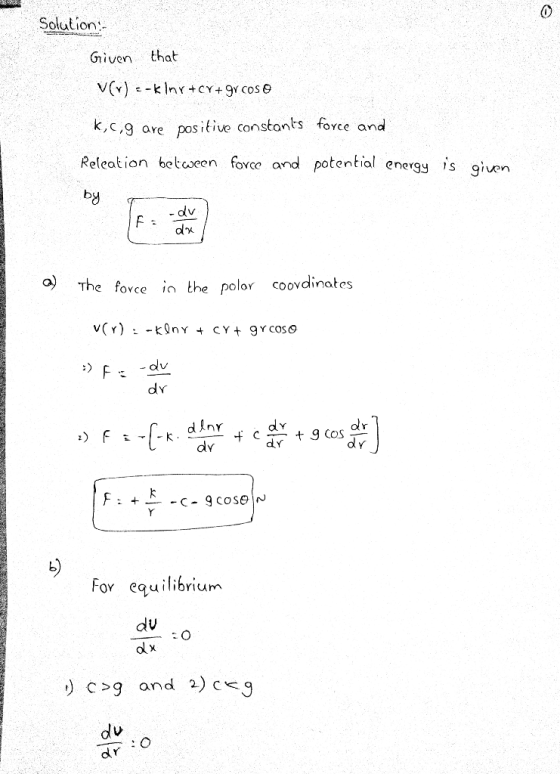
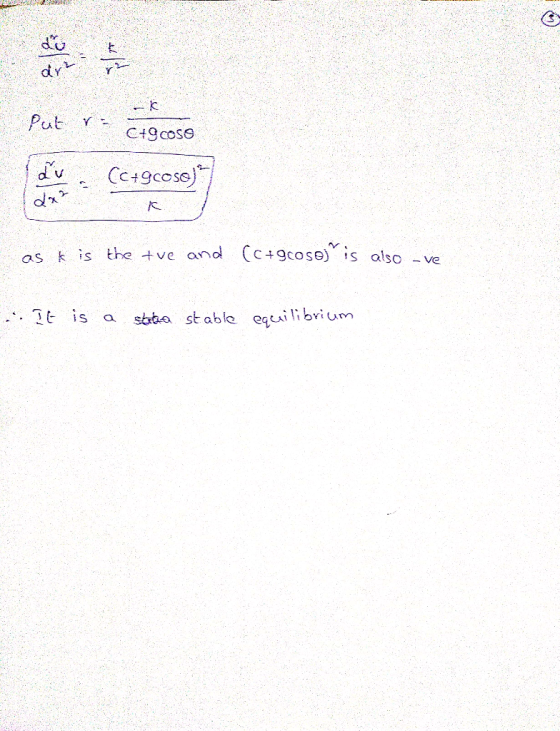
2. A particle of mass m is moving in a plane under a force whose potential energy is given by V(r...
achieves its closest approach A particle of mass m moving in the Kepler potential V -k/...
 achieves its closest approach A particle of mass m moving in the Kepler potential V -k/ to the force center, r-ro, at 0, where r, p denote polar coordinates in the plane of motion of the particle. At φ = π/3, its distance from the force center is r = 5r0/4. Determine the eccentricity e of the orbit, the angular momentum, the energy, and the ratio of speeds v(p /3)/(p 0). Hint: If you're not completely confident in your knowledge...
#1 A particle of mass, m, moves in a field whose potential energy in spherical coordinates...
 #1 A particle of mass, m, moves in a field whose potential energy in spherical coordinates has a 2 , where r and are the standard variables of spherical coordinates and k is a positive constant. Find Hamiltonian and Hamilton's equations of motion for this particle. form of V --k cose
1. A particle of unit mass moves along a trajectory , 2r) θ E (03), and θ E ( a coal, -a cose r(8...
 Acceleration in polar coordinates is required
1. A particle of unit mass moves along a trajectory , 2r) θ E (03), and θ E ( a coal, -a cose r(8)--, expressed in plane polar coordinates. The angle 6(t) changes with time according to the equation θ wt. Here a, are positive constants independent of time. (a) [10 marks) Compute the transverse acceleration of the particle (b) [10 marks) Find the force acting on a particle and express it in terms...
Acceleration in polar coordinates is required
1. A particle of unit mass moves along a trajectory , 2r) θ E (03), and θ E ( a coal, -a cose r(8)--, expressed in plane polar coordinates. The angle 6(t) changes with time according to the equation θ wt. Here a, are positive constants independent of time. (a) [10 marks) Compute the transverse acceleration of the particle (b) [10 marks) Find the force acting on a particle and express it in terms...
3. (i) Find the kinetic energy of a particle of mass m with position given by...
 3. (i) Find the kinetic energy of a particle of mass m with position given by the coordinates (s, u, v), related to the ordinary Cartesian coordinates by y z = 2s + 3 + u = 2u + v = 0+03 (ii) Find the kinetic energy of a particle of mass m whose position is given in cylindrical coordinates = = r cos r sine y (iii) Find the kinetic energy of a particle of mass m with position...
Consider a particle of mass m moving in a one-dimensional potential of the form V. for...
 Consider a particle of mass m moving in a one-dimensional potential of the form V. for 0<x<b, V(a) = 0 for Islal<e, for 1212, with V., b and c positive constants and c>b. a Explain why the wave function of the particle can be assumed to be cither an even function or an odd function of a. b For the case that the energy E of the particle is in the range 0<ESV., find the (unnormalized) even cigenfunctions and give...
A particle is constrained to move along the positive x-axis under the influence of a force...
 A particle is constrained to move along the positive x-axis under the influence of a force whose potential energy is U(x) = U_0(2 cos x/a - x/a) where U_0 and a are positive constants. Plot U versus x. A simple hand sketch is fine. Find the equilibrium point(s). For each equilibrium point, determine whether the equilibrium is stable or unstable.
A particle is moving to the right with initial kinetic energy To, subject to a force...
 A particle is moving to the right with initial kinetic energy To, subject to a force F(z)k function U(x) for this force ; (b) the kinetic energy and (c) the total energy of the particle as a function of its position; (d) find the turning points of the motion and the condition the total energy of the particle must satisfy if its motion is to exhibit turning points. (e) Sketch the potential, kinetic and total energy function (you can use...
The Lagrangian for a particle of mass m moving in a vertical plane and experiencing the constant ...
 The Lagrangian for a particle of mass m moving in a vertical plane and experiencing the constant gravitational force mg is 2 Find the Hamiltonian and so the Hamilton-Jacobi equation Using the separable ansatz s- S(a)+Sy(v)-at ciple function i constants a and ay . Taking the separation constants a and ay as the new momenta find the new constant coordinates ßz and ßy. Find the particle's trajectory as a function of the constants Oz, αψ β, and β . Find...
P chem ll The kinetic energy T of a particle moving in three dimensions is given...
 P chem ll
The kinetic energy T of a particle moving in three dimensions is given by im where i- dx / dt...etc and p is the magnitude of the linear momentum. Verify that this is true and show that in polar coordinates Where 9 -d9 / dt...etc. dx ах x =-= sin θ cosor + r cos θ cos φθ-r sin θ sin φφ. Similarly get y .from y = r sin θ sino dt and z from z-r...
P chem ll
The kinetic energy T of a particle moving in three dimensions is given by im where i- dx / dt...etc and p is the magnitude of the linear momentum. Verify that this is true and show that in polar coordinates Where 9 -d9 / dt...etc. dx ах x =-= sin θ cosor + r cos θ cos φθ-r sin θ sin φφ. Similarly get y .from y = r sin θ sino dt and z from z-r...
A For a particle with mass m moving under a one dimensional potential V(x), one solution...
 A For a particle with mass m moving under a one dimensional potential V(x), one solution to the Schrödinger equation for the region 0<x< oo is x) =2 (a>0), where A is the normalization constant. The energy of the particle in the given state is 0, Show that this function is a solution, and find the corresponding potential V(x)?
 achieves its closest approach A particle of mass m moving in the Kepler potential V -k/ to the force center, r-ro, at 0, where r, p denote polar coordinates in the plane of motion of the particle. At φ = π/3, its distance from the force center is r = 5r0/4. Determine the eccentricity e of the orbit, the angular momentum, the energy, and the ratio of speeds v(p /3)/(p 0). Hint: If you're not completely confident in your knowledge...
 #1 A particle of mass, m, moves in a field whose potential energy in spherical coordinates has a 2 , where r and are the standard variables of spherical coordinates and k is a positive constant. Find Hamiltonian and Hamilton's equations of motion for this particle. form of V --k cose
 Acceleration in polar coordinates is required
1. A particle of unit mass moves along a trajectory , 2r) θ E (03), and θ E ( a coal, -a cose r(8)--, expressed in plane polar coordinates. The angle 6(t) changes with time according to the equation θ wt. Here a, are positive constants independent of time. (a) [10 marks) Compute the transverse acceleration of the particle (b) [10 marks) Find the force acting on a particle and express it in terms...
Acceleration in polar coordinates is required
1. A particle of unit mass moves along a trajectory , 2r) θ E (03), and θ E ( a coal, -a cose r(8)--, expressed in plane polar coordinates. The angle 6(t) changes with time according to the equation θ wt. Here a, are positive constants independent of time. (a) [10 marks) Compute the transverse acceleration of the particle (b) [10 marks) Find the force acting on a particle and express it in terms...
 3. (i) Find the kinetic energy of a particle of mass m with position given by the coordinates (s, u, v), related to the ordinary Cartesian coordinates by y z = 2s + 3 + u = 2u + v = 0+03 (ii) Find the kinetic energy of a particle of mass m whose position is given in cylindrical coordinates = = r cos r sine y (iii) Find the kinetic energy of a particle of mass m with position...
 Consider a particle of mass m moving in a one-dimensional potential of the form V. for 0<x<b, V(a) = 0 for Islal<e, for 1212, with V., b and c positive constants and c>b. a Explain why the wave function of the particle can be assumed to be cither an even function or an odd function of a. b For the case that the energy E of the particle is in the range 0<ESV., find the (unnormalized) even cigenfunctions and give...
 A particle is constrained to move along the positive x-axis under the influence of a force whose potential energy is U(x) = U_0(2 cos x/a - x/a) where U_0 and a are positive constants. Plot U versus x. A simple hand sketch is fine. Find the equilibrium point(s). For each equilibrium point, determine whether the equilibrium is stable or unstable.
 A particle is moving to the right with initial kinetic energy To, subject to a force F(z)k function U(x) for this force ; (b) the kinetic energy and (c) the total energy of the particle as a function of its position; (d) find the turning points of the motion and the condition the total energy of the particle must satisfy if its motion is to exhibit turning points. (e) Sketch the potential, kinetic and total energy function (you can use...
 The Lagrangian for a particle of mass m moving in a vertical plane and experiencing the constant gravitational force mg is 2 Find the Hamiltonian and so the Hamilton-Jacobi equation Using the separable ansatz s- S(a)+Sy(v)-at ciple function i constants a and ay . Taking the separation constants a and ay as the new momenta find the new constant coordinates ßz and ßy. Find the particle's trajectory as a function of the constants Oz, αψ β, and β . Find...
 P chem ll
The kinetic energy T of a particle moving in three dimensions is given by im where i- dx / dt...etc and p is the magnitude of the linear momentum. Verify that this is true and show that in polar coordinates Where 9 -d9 / dt...etc. dx ах x =-= sin θ cosor + r cos θ cos φθ-r sin θ sin φφ. Similarly get y .from y = r sin θ sino dt and z from z-r...
P chem ll
The kinetic energy T of a particle moving in three dimensions is given by im where i- dx / dt...etc and p is the magnitude of the linear momentum. Verify that this is true and show that in polar coordinates Where 9 -d9 / dt...etc. dx ах x =-= sin θ cosor + r cos θ cos φθ-r sin θ sin φφ. Similarly get y .from y = r sin θ sino dt and z from z-r...
 A For a particle with mass m moving under a one dimensional potential V(x), one solution to the Schrödinger equation for the region 0<x< oo is x) =2 (a>0), where A is the normalization constant. The energy of the particle in the given state is 0, Show that this function is a solution, and find the corresponding potential V(x)?
Most questions answered within 3 hours.
-
Where is the error in this code sequence?
String s1 = "Hello";
String s2 = "ello";...
asked 11 months ago -
Financial data for Joel de Paris, Inc., for last year
follow:
Joel de Paris, Inc.
Balance...
asked 11 months ago -
Consider this reaction:
Al2(SO4)3 (aq)+ BaCl3
(aq) Al2Cl6 (aq)- +
3BaSO4(s) . What is the...
asked 11 months ago -
Suppose that Savneet is considering increasing her
recent random sample from 20 car rentals to 40...
asked 11 months ago -
Trucks arrive at an unloading terminal at an average rate of 120
per hour.
Trucks arrive...
asked 11 months ago -
Why are methanol and ethanol completely soluble in water while
octanol is not very little soluble....
asked 11 months ago -
A facilities manager at a university reads in a research report
that the mean amount of...
asked 11 months ago -
When the CuSO4 is rehydrated by adding water to the anhydrous
compound, is this an endothermic...
asked 11 months ago -
A ray of sunlight is passing from diamond into crown glass; the
angle of incidence is...
asked 11 months ago -
A block of mass 0.249 kg is placed on top of a light, vertical
spring of...
asked 11 months ago -
how do the kidneys compensate in the presences of acidosis
a) trigger hyperventilate
b) reserve acid...
asked 11 months ago -
Question 501 pts
The rental rate of capital to the firm increases. Which of the
following...
asked 11 months ago