
Homework Answers

Add Answer to:
Consider a particle of mass m moving in a one-dimensional potential of the form V. for...
A For a particle with mass m moving under a one dimensional potential V(x), one solution...
 A For a particle with mass m moving under a one dimensional potential V(x), one solution to the Schrödinger equation for the region 0<x< oo is x) =2 (a>0), where A is the normalization constant. The energy of the particle in the given state is 0, Show that this function is a solution, and find the corresponding potential V(x)?
At time t = 0, a mass-m particle in a one-dimensional potential well is in a...
 At time t = 0, a mass-m particle in a one-dimensional potential well is in a state given by the normalised wave function (x, 0) =3/2eAl2| | -ao x << 0, realU>0. Find the potential energy V = the energy eigenvalue E. Fix zero energy according to the convention V(x) » 0 for ao. Is there a delta function singularity at x0? V (x) for which this is an energy eigenstate and determine [6]
At time t = 0, a...
At time t = 0, a mass-m particle in a one-dimensional potential well is in a state given by the normalised wave function (x, 0) =3/2eAl2| | -ao x << 0, realU>0. Find the potential energy V = the energy eigenvalue E. Fix zero energy according to the convention V(x) » 0 for ao. Is there a delta function singularity at x0? V (x) for which this is an energy eigenstate and determine [6]
At time t = 0, a...
Please answer all parts: Consider a particle in a one-dimensional box, where the potential the potential...
 Please answer all parts:
Consider a particle in a one-dimensional box, where the potential the potential V(x) = 0 for 0 < x <a and V(x) = 20 outside the box. On the system acts a perturbation Ĥ' of the form: 2a ad αδα 3 Approximation: Although the Hilbert space for this problem has infinite dimensions, you are allowed (and advised) to limit your calculations to a subspace of the lowest six states (n = 6), for the questions of...
Please answer all parts:
Consider a particle in a one-dimensional box, where the potential the potential V(x) = 0 for 0 < x <a and V(x) = 20 outside the box. On the system acts a perturbation Ĥ' of the form: 2a ad αδα 3 Approximation: Although the Hilbert space for this problem has infinite dimensions, you are allowed (and advised) to limit your calculations to a subspace of the lowest six states (n = 6), for the questions of...
Please do this problem about quantum mechanic harmonic oscillator and show all your steps thank you. Q1. Consider a particle of mass m moving in a one-dimensional harmonic oscillator potential. 1....
 Please do this problem about quantum mechanic harmonic
oscillator and show all your steps thank you.
Q1. Consider a particle of mass m moving in a one-dimensional harmonic oscillator potential. 1. Calculate the product of uncertainties in position and momentum for the particle in 2. Compare the result of (a) with the uncertainty product when the particle is in its the fifth excited state, ie. (OxơP)5. lowest energy state.
Q1. Consider a particle of mass m moving in a one-dimensional...
Please do this problem about quantum mechanic harmonic
oscillator and show all your steps thank you.
Q1. Consider a particle of mass m moving in a one-dimensional harmonic oscillator potential. 1. Calculate the product of uncertainties in position and momentum for the particle in 2. Compare the result of (a) with the uncertainty product when the particle is in its the fifth excited state, ie. (OxơP)5. lowest energy state.
Q1. Consider a particle of mass m moving in a one-dimensional...
A one-dimensional particle of mass m is confined within the region 0 < x < a...
 A one-dimensional particle of mass m is confined within the region 0 < x < a and wave function V(x, t) = sin(TI)e-iwt. a Given the wave function 1(x, t) above, show that V is independent of t. b Calculate the probability of finding the particle in the interval a 5 x 54
Instead of assuming that a one-dimensional particle has no energy (v(x)=0), consider the case of a...
 Instead of assuming that a one-dimensional
particle has no energy (v(x)=0), consider the case of a
one-dimensional particle which has finite, but constant, energy
V(x)= V sub zero.. Show that the ID particle in a box wave
functions. n(x)= A sin ((pi n x)/a). Also solve the Schrödinger
equation for this potential, and determine the energies En
Problem 2: Particle in a Box with Non-Zero Energy (2 points) Instead of assuming that a one-dimensional particle has no energy (V(x) =...
Instead of assuming that a one-dimensional
particle has no energy (v(x)=0), consider the case of a
one-dimensional particle which has finite, but constant, energy
V(x)= V sub zero.. Show that the ID particle in a box wave
functions. n(x)= A sin ((pi n x)/a). Also solve the Schrödinger
equation for this potential, and determine the energies En
Problem 2: Particle in a Box with Non-Zero Energy (2 points) Instead of assuming that a one-dimensional particle has no energy (V(x) =...
Consider a particle of mass in a 10 finite potential well of height V. the domain...
 Consider a particle of mass in a 10 finite potential well of height V. the domain – a < x < a. a) Show that solutions for – a < x < a take the form on (x) = A cos(knx) for odd n, and on (x) = A sin(knx) for even n. . Show a) Match the boundary conditions at x = a to prove that cos(ka) = Bk where k is the wave vector for -a < x...
5. One-Dimensional Potential Energy (20 points) A particle of mass m oscillates in a potential well...
 5. One-Dimensional Potential Energy (20 points) A particle of mass m oscillates in a potential well created by a one-dimensional force where a and b are known positive constants. Assume the particle is trapped in the well on the positive side of the y-axis. a) Find and expression for the potential energy U(x) for this force. (10 points) NOTE: There will be one undetermined constant. b) Set Umin, the minimum value for this potential energy function, equal to zero. Solve...
Need help with this question A particle of mass m is in the one-dimensional potential a....
 Need help with this question
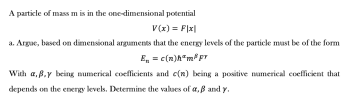
A particle of mass m is in the one-dimensional potential a. Argue, based on dimensional arguments dhat the enersy levelust be of the form With α, β, γ being numerical coefficients and c(n) being a positive numerical coefficient that depends on the energy levels. Determine the values of a, β and γ.
Need help with this question
A particle of mass m is in the one-dimensional potential a. Argue, based on dimensional arguments dhat the enersy levelust be of the form With α, β, γ being numerical coefficients and c(n) being a positive numerical coefficient that depends on the energy levels. Determine the values of a, β and γ.
2. A particle of mass m is moving in a plane under a force whose potential energy is given by V(r...
 2. A particle of mass m is moving in a plane under a force whose potential energy is given by V(r) -kin r + cr + gr cos θ with k,c,g positive constants. (a) Write down the force in polar coordinates. (b) Find the positions of equilibrium (1) if c>g and (2) if c<g. (c) By considering the direction of the force near these points, determine whether the equilibrium is stable or not
2. A particle of mass m is...
2. A particle of mass m is moving in a plane under a force whose potential energy is given by V(r) -kin r + cr + gr cos θ with k,c,g positive constants. (a) Write down the force in polar coordinates. (b) Find the positions of equilibrium (1) if c>g and (2) if c<g. (c) By considering the direction of the force near these points, determine whether the equilibrium is stable or not
2. A particle of mass m is...
 A For a particle with mass m moving under a one dimensional potential V(x), one solution to the Schrödinger equation for the region 0<x< oo is x) =2 (a>0), where A is the normalization constant. The energy of the particle in the given state is 0, Show that this function is a solution, and find the corresponding potential V(x)?
 At time t = 0, a mass-m particle in a one-dimensional potential well is in a state given by the normalised wave function (x, 0) =3/2eAl2| | -ao x << 0, realU>0. Find the potential energy V = the energy eigenvalue E. Fix zero energy according to the convention V(x) » 0 for ao. Is there a delta function singularity at x0? V (x) for which this is an energy eigenstate and determine [6]
At time t = 0, a...
At time t = 0, a mass-m particle in a one-dimensional potential well is in a state given by the normalised wave function (x, 0) =3/2eAl2| | -ao x << 0, realU>0. Find the potential energy V = the energy eigenvalue E. Fix zero energy according to the convention V(x) » 0 for ao. Is there a delta function singularity at x0? V (x) for which this is an energy eigenstate and determine [6]
At time t = 0, a...
 Please answer all parts:
Consider a particle in a one-dimensional box, where the potential the potential V(x) = 0 for 0 < x <a and V(x) = 20 outside the box. On the system acts a perturbation Ĥ' of the form: 2a ad αδα 3 Approximation: Although the Hilbert space for this problem has infinite dimensions, you are allowed (and advised) to limit your calculations to a subspace of the lowest six states (n = 6), for the questions of...
Please answer all parts:
Consider a particle in a one-dimensional box, where the potential the potential V(x) = 0 for 0 < x <a and V(x) = 20 outside the box. On the system acts a perturbation Ĥ' of the form: 2a ad αδα 3 Approximation: Although the Hilbert space for this problem has infinite dimensions, you are allowed (and advised) to limit your calculations to a subspace of the lowest six states (n = 6), for the questions of...
 Please do this problem about quantum mechanic harmonic
oscillator and show all your steps thank you.
Q1. Consider a particle of mass m moving in a one-dimensional harmonic oscillator potential. 1. Calculate the product of uncertainties in position and momentum for the particle in 2. Compare the result of (a) with the uncertainty product when the particle is in its the fifth excited state, ie. (OxơP)5. lowest energy state.
Q1. Consider a particle of mass m moving in a one-dimensional...
Please do this problem about quantum mechanic harmonic
oscillator and show all your steps thank you.
Q1. Consider a particle of mass m moving in a one-dimensional harmonic oscillator potential. 1. Calculate the product of uncertainties in position and momentum for the particle in 2. Compare the result of (a) with the uncertainty product when the particle is in its the fifth excited state, ie. (OxơP)5. lowest energy state.
Q1. Consider a particle of mass m moving in a one-dimensional...
 A one-dimensional particle of mass m is confined within the region 0 < x < a and wave function V(x, t) = sin(TI)e-iwt. a Given the wave function 1(x, t) above, show that V is independent of t. b Calculate the probability of finding the particle in the interval a 5 x 54
 Instead of assuming that a one-dimensional
particle has no energy (v(x)=0), consider the case of a
one-dimensional particle which has finite, but constant, energy
V(x)= V sub zero.. Show that the ID particle in a box wave
functions. n(x)= A sin ((pi n x)/a). Also solve the Schrödinger
equation for this potential, and determine the energies En
Problem 2: Particle in a Box with Non-Zero Energy (2 points) Instead of assuming that a one-dimensional particle has no energy (V(x) =...
Instead of assuming that a one-dimensional
particle has no energy (v(x)=0), consider the case of a
one-dimensional particle which has finite, but constant, energy
V(x)= V sub zero.. Show that the ID particle in a box wave
functions. n(x)= A sin ((pi n x)/a). Also solve the Schrödinger
equation for this potential, and determine the energies En
Problem 2: Particle in a Box with Non-Zero Energy (2 points) Instead of assuming that a one-dimensional particle has no energy (V(x) =...
 Consider a particle of mass in a 10 finite potential well of height V. the domain – a < x < a. a) Show that solutions for – a < x < a take the form on (x) = A cos(knx) for odd n, and on (x) = A sin(knx) for even n. . Show a) Match the boundary conditions at x = a to prove that cos(ka) = Bk where k is the wave vector for -a < x...
 5. One-Dimensional Potential Energy (20 points) A particle of mass m oscillates in a potential well created by a one-dimensional force where a and b are known positive constants. Assume the particle is trapped in the well on the positive side of the y-axis. a) Find and expression for the potential energy U(x) for this force. (10 points) NOTE: There will be one undetermined constant. b) Set Umin, the minimum value for this potential energy function, equal to zero. Solve...
 Need help with this question
A particle of mass m is in the one-dimensional potential a. Argue, based on dimensional arguments dhat the enersy levelust be of the form With α, β, γ being numerical coefficients and c(n) being a positive numerical coefficient that depends on the energy levels. Determine the values of a, β and γ.
Need help with this question
A particle of mass m is in the one-dimensional potential a. Argue, based on dimensional arguments dhat the enersy levelust be of the form With α, β, γ being numerical coefficients and c(n) being a positive numerical coefficient that depends on the energy levels. Determine the values of a, β and γ.
 2. A particle of mass m is moving in a plane under a force whose potential energy is given by V(r) -kin r + cr + gr cos θ with k,c,g positive constants. (a) Write down the force in polar coordinates. (b) Find the positions of equilibrium (1) if c>g and (2) if c<g. (c) By considering the direction of the force near these points, determine whether the equilibrium is stable or not
2. A particle of mass m is...
2. A particle of mass m is moving in a plane under a force whose potential energy is given by V(r) -kin r + cr + gr cos θ with k,c,g positive constants. (a) Write down the force in polar coordinates. (b) Find the positions of equilibrium (1) if c>g and (2) if c<g. (c) By considering the direction of the force near these points, determine whether the equilibrium is stable or not
2. A particle of mass m is...
Most questions answered within 3 hours.
-
Where is the error in this code sequence?
String s1 = "Hello";
String s2 = "ello";...
asked 11 months ago -
Financial data for Joel de Paris, Inc., for last year
follow:
Joel de Paris, Inc.
Balance...
asked 11 months ago -
Consider this reaction:
Al2(SO4)3 (aq)+ BaCl3
(aq) Al2Cl6 (aq)- +
3BaSO4(s) . What is the...
asked 11 months ago -
Suppose that Savneet is considering increasing her
recent random sample from 20 car rentals to 40...
asked 11 months ago -
Trucks arrive at an unloading terminal at an average rate of 120
per hour.
Trucks arrive...
asked 11 months ago -
Why are methanol and ethanol completely soluble in water while
octanol is not very little soluble....
asked 11 months ago -
A facilities manager at a university reads in a research report
that the mean amount of...
asked 11 months ago -
When the CuSO4 is rehydrated by adding water to the anhydrous
compound, is this an endothermic...
asked 11 months ago -
A ray of sunlight is passing from diamond into crown glass; the
angle of incidence is...
asked 11 months ago -
A block of mass 0.249 kg is placed on top of a light, vertical
spring of...
asked 11 months ago -
how do the kidneys compensate in the presences of acidosis
a) trigger hyperventilate
b) reserve acid...
asked 11 months ago -
Question 501 pts
The rental rate of capital to the firm increases. Which of the
following...
asked 11 months ago