
Homework Answers
Add Answer to:
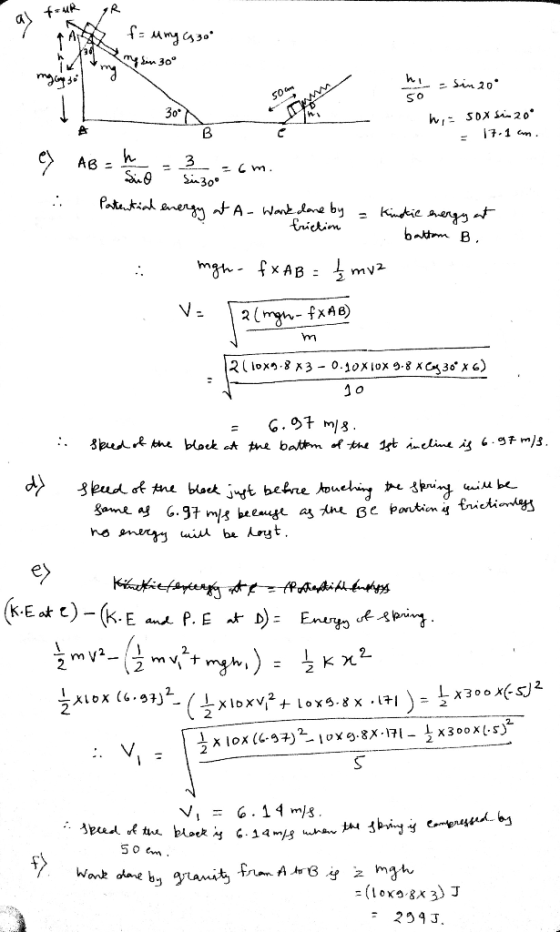
3m Susand a) A block with a mass of 10.0 kg is AS released from rest...
In the figure, a block of mass m = 11 kg is released from rest on...
In the figure, a block of mass m = 11 kg is released from rest on a frictionless incline of angle θ = 26°. Below the block is a spring that can be compressed 3.4 cm by a force of 320 N. The block momentarily stops when it compresses the spring by 5.3 cm. (a) How far does the block move down the incline from its rest position to this stopping point? (b) What is the speed of the block...
. A 2.00kg block is moved from point A (at rest) a distance of 2.00 m...
 . A 2.00kg block is moved from point A (at rest) a distance of 2.00 m to point B under the action of a variable force F(x) 10x + 6x2. Once in point B it is moving down 1.00 m through an 60.00 inclined frictionless surface until hit a spring (point C) as shown in figure. (The coefficient of kinetic friction between the block and the surface between A and B is 0.3 and the spring constant equal to 400...
In the figure below, block-2 of mass M = 1 Kg is at rest on a...
 In the figure below, block-2 of mass M = 1 Kg is at rest on a frictionless surface and touching the end of an un-stretched spring whose spring constant is 200 N/m. The other end of the spring is fixed to a wall. Block-1 of mass 2 Kg, travelling at speed v_1 = 4 m/s, collides with block-2 and the two blocks stick together. When the blocks momentarily stop, by what distance is the spring compressed?
Question 5 In the figure, a block of mass m = 3.50 kg slides from rest...
 Question 5 In the figure, a block of mass m = 3.50 kg slides from rest a distance d down a frictionless incline at angle 9 = 27.0° where it runs into a spring of spring constant 470 N/m. When the block momentarily stops, it has compressed the spring by 20.0 cm. What are (a) distance d and (b) the distance between the point of the first block-spring contact and the point where the block's speed is greatest? A (a)...
A 19.0-kg block is released from rest on a frictionless 35.0 incline. Below the block is...
A 19.0-kg block is released from rest on a frictionless 35.0 incline. Below the block is a spring that can be compressed 3.60 cm by a force of 270 N. After the block is released, the block slides down the frictionless ramp and compresses the spring by 5.50 cm. How fast is the block traveling the moment it reaches the spring?
M -/2 points HRW6 8.P.021 In Fig. 8-34, a 12 kg block is released from rest on an incline angled at e 30. Below the blo...
 M -/2 points HRW6 8.P.021 In Fig. 8-34, a 12 kg block is released from rest on an incline angled at e 30. Below the block is a spring that can be compressed 2.0 cm by a force of 270 N The block momentarily stops when it compresses the spring by 6.4 cm. 12 kg Figure 8-34 (a) How far has the block moved down the incline to this stopping point? m (b) What is the speed of the block...
Please solve quation no. 8.4 A kg block slides on a frictionless curved track The spring...
 Please solve quation no. 8.4
A kg block slides on a frictionless curved track The spring mounted at the right end of the track has a spring constant of 1250 N/m What speed must the block have at point A so that its speed at point B is 2 m/s? When the block runs into the spring, how much will the spring be compressed as it brings the block to a stop? A 10 kg block slides on a frictionless...
Please solve quation no. 8.4
A kg block slides on a frictionless curved track The spring mounted at the right end of the track has a spring constant of 1250 N/m What speed must the block have at point A so that its speed at point B is 2 m/s? When the block runs into the spring, how much will the spring be compressed as it brings the block to a stop? A 10 kg block slides on a frictionless...
Chapter 09, Problem 058 In the figure, block 2 (mass 1.40 kg) is at rest on...
 Chapter 09, Problem 058 In the figure, block 2 (mass 1.40 kg) is at rest on a frictionless surface and touching the end of an unstretched spring of spring constant 109 N/m. The other end of the spring is foxed to a wall. Block 1 (mass 1.20 kg), traveling at speed v1 - 4.10 m/s, collides with block 2, and the two blocks stick together. When the blocks momentarily stop, by what distance is the spring compressed? Number Units
A small 0.40-kg box is launched from rest by a horizontal spring as shown in the...
 A small 0.40-kg box is launched from rest by a horizontal spring as shown in the figure below. The block slides on a track down a hill and comes to rest at a distance d from the base of the hill. The coefficient of kinetic friction between the box and the track is 0.37 along the entire track. The spring has a spring constant of 35.0 N/m and is compressed 30.0 cm with the box attached. The block remains on...
A block of mass m = 3.5 kg is on an inclined plane with a coefficient...
 A block of mass m = 3.5 kg is
on an inclined plane with a coefficient of friction
μ1 = 0.31, at an
initial height h = 0.53 m above
the ground. The plane is inclined at an angle θ =
54°. The block is then compressed against
a spring a distance Δx = 0.11 m
from its equilibrium point (the spring has a spring constant of
k1 = 39 N/m) and
released. At the bottom of the inclined plane...
A block of mass m = 3.5 kg is
on an inclined plane with a coefficient of friction
μ1 = 0.31, at an
initial height h = 0.53 m above
the ground. The plane is inclined at an angle θ =
54°. The block is then compressed against
a spring a distance Δx = 0.11 m
from its equilibrium point (the spring has a spring constant of
k1 = 39 N/m) and
released. At the bottom of the inclined plane...
 . A 2.00kg block is moved from point A (at rest) a distance of 2.00 m to point B under the action of a variable force F(x) 10x + 6x2. Once in point B it is moving down 1.00 m through an 60.00 inclined frictionless surface until hit a spring (point C) as shown in figure. (The coefficient of kinetic friction between the block and the surface between A and B is 0.3 and the spring constant equal to 400...
 In the figure below, block-2 of mass M = 1 Kg is at rest on a frictionless surface and touching the end of an un-stretched spring whose spring constant is 200 N/m. The other end of the spring is fixed to a wall. Block-1 of mass 2 Kg, travelling at speed v_1 = 4 m/s, collides with block-2 and the two blocks stick together. When the blocks momentarily stop, by what distance is the spring compressed?
 Question 5 In the figure, a block of mass m = 3.50 kg slides from rest a distance d down a frictionless incline at angle 9 = 27.0° where it runs into a spring of spring constant 470 N/m. When the block momentarily stops, it has compressed the spring by 20.0 cm. What are (a) distance d and (b) the distance between the point of the first block-spring contact and the point where the block's speed is greatest? A (a)...
 M -/2 points HRW6 8.P.021 In Fig. 8-34, a 12 kg block is released from rest on an incline angled at e 30. Below the block is a spring that can be compressed 2.0 cm by a force of 270 N The block momentarily stops when it compresses the spring by 6.4 cm. 12 kg Figure 8-34 (a) How far has the block moved down the incline to this stopping point? m (b) What is the speed of the block...
 Please solve quation no. 8.4
A kg block slides on a frictionless curved track The spring mounted at the right end of the track has a spring constant of 1250 N/m What speed must the block have at point A so that its speed at point B is 2 m/s? When the block runs into the spring, how much will the spring be compressed as it brings the block to a stop? A 10 kg block slides on a frictionless...
Please solve quation no. 8.4
A kg block slides on a frictionless curved track The spring mounted at the right end of the track has a spring constant of 1250 N/m What speed must the block have at point A so that its speed at point B is 2 m/s? When the block runs into the spring, how much will the spring be compressed as it brings the block to a stop? A 10 kg block slides on a frictionless...
 Chapter 09, Problem 058 In the figure, block 2 (mass 1.40 kg) is at rest on a frictionless surface and touching the end of an unstretched spring of spring constant 109 N/m. The other end of the spring is foxed to a wall. Block 1 (mass 1.20 kg), traveling at speed v1 - 4.10 m/s, collides with block 2, and the two blocks stick together. When the blocks momentarily stop, by what distance is the spring compressed? Number Units
 A small 0.40-kg box is launched from rest by a horizontal spring as shown in the figure below. The block slides on a track down a hill and comes to rest at a distance d from the base of the hill. The coefficient of kinetic friction between the box and the track is 0.37 along the entire track. The spring has a spring constant of 35.0 N/m and is compressed 30.0 cm with the box attached. The block remains on...
 A block of mass m = 3.5 kg is
on an inclined plane with a coefficient of friction
μ1 = 0.31, at an
initial height h = 0.53 m above
the ground. The plane is inclined at an angle θ =
54°. The block is then compressed against
a spring a distance Δx = 0.11 m
from its equilibrium point (the spring has a spring constant of
k1 = 39 N/m) and
released. At the bottom of the inclined plane...
A block of mass m = 3.5 kg is
on an inclined plane with a coefficient of friction
μ1 = 0.31, at an
initial height h = 0.53 m above
the ground. The plane is inclined at an angle θ =
54°. The block is then compressed against
a spring a distance Δx = 0.11 m
from its equilibrium point (the spring has a spring constant of
k1 = 39 N/m) and
released. At the bottom of the inclined plane...
Most questions answered within 3 hours.
-
Where is the error in this code sequence?
String s1 = "Hello";
String s2 = "ello";...
asked 11 months ago -
Financial data for Joel de Paris, Inc., for last year
follow:
Joel de Paris, Inc.
Balance...
asked 11 months ago -
Consider this reaction:
Al2(SO4)3 (aq)+ BaCl3
(aq) Al2Cl6 (aq)- +
3BaSO4(s) . What is the...
asked 11 months ago -
Suppose that Savneet is considering increasing her
recent random sample from 20 car rentals to 40...
asked 11 months ago -
Trucks arrive at an unloading terminal at an average rate of 120
per hour.
Trucks arrive...
asked 11 months ago -
Why are methanol and ethanol completely soluble in water while
octanol is not very little soluble....
asked 11 months ago -
A facilities manager at a university reads in a research report
that the mean amount of...
asked 11 months ago -
When the CuSO4 is rehydrated by adding water to the anhydrous
compound, is this an endothermic...
asked 11 months ago -
A ray of sunlight is passing from diamond into crown glass; the
angle of incidence is...
asked 11 months ago -
A block of mass 0.249 kg is placed on top of a light, vertical
spring of...
asked 11 months ago -
how do the kidneys compensate in the presences of acidosis
a) trigger hyperventilate
b) reserve acid...
asked 11 months ago -
Question 501 pts
The rental rate of capital to the firm increases. Which of the
following...
asked 11 months ago