
Homework Answers
Answer)
I have enclosed answers in rectangular boxes for your convenience.
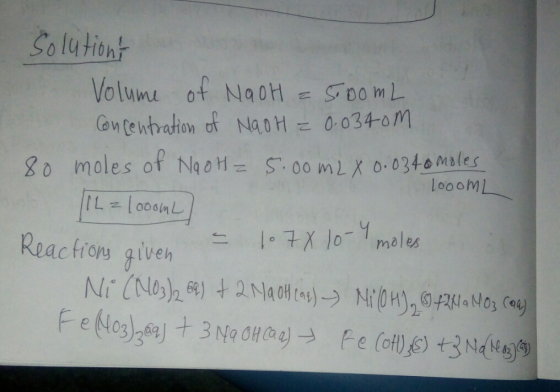

 .. If you have any doubts
please feel free to ask
.. If you have any doubts
please feel free to ask
If you found it useful please give a like...
Add Answer to:
For the reactions shown below, we added 5.00 mL of 0.0340 M NaOH to a test...
25.0 mL of 0.100 M NiSO4 solution is added to 50.0-mL of a 0.080 M NaOH...
25.0 mL of 0.100 M NiSO4 solution is added to 50.0-mL of a 0.080 M NaOH solution. NiSO4(aq) + 2 NaOH(aq) -> Ni(OH)2(s) + Na2SO4(aq) a. What is the limiting reagent? b. What is the mass of precipitate formed? c. After the reaction is complete, calculate the concentration of the reactant remaining in solution. ( NiSO4 = 158.8 g/mol | NaOH = 40.0 g/mol | Ni(OH)2 = 92.7 g/mol )
A 25.0 mL volume of 0.0200 M Fe(NO3)3 is mixed with 50.0 mL of 0.00200 M...
A 25.0 mL volume of 0.0200 M Fe(NO3)3 is mixed with 50.0 mL of 0.00200 M NaSCN and 25.0 mL of 0.100 HNO3. The blood-red FeSCN2+ ion forms and the equilibrium is established: Fe3+(aq) + SCN-(aq) <---> FeSCN2+(aq) The equilibrium concentration of FeSCN2+ ([FeSCN2+]) was measured spectrophotometrically and found to be 7.0 x 10⁻⁴ mol/L. To calculate the equilibrium constant (Kc) for thr equilibrium system, proceed through the following steps: A. Moles of Fe3+, initial B. Moles of SCN-, initial...
0.125M 8) What mass of iron (III) hydroxide precipitate can be pr Fe(NO3)3 with 125 ml 0.150 M NaOH? (45 pts) The n...
 0.125M 8) What mass of iron (III) hydroxide precipitate can be pr Fe(NO3)3 with 125 ml 0.150 M NaOH? (45 pts) The net ionic reactions Fe3+ 3 OH 3 0.150 M be produced by reacting 75.0 ml of 0.105 M Fe(OH)34)
The metathesis reaction between iron (III) nitrate and sodium sulfide is shown below 2 Fe(NO3)3(aq) +...
The metathesis reaction between iron (III) nitrate and sodium sulfide is shown below 2 Fe(NO3)3(aq) + 3 Na2S (aq) ➝ 6 NaNO3(aq) + Fe2S3(s) How many grams of solid iron (III) sulfide can be produced by the reaction of 250.0 ml of 0.400 M iron (III) nitrate solution with 350.0 ml of 0.250 M sodium sulfide solution? Determine the final concentration of each ion in solution at the end of the precipitation reaction. Na+ NO3– Fe+3 S–2
QUESTION 1 43.2 mL of aqueous 0.255 M Pb(NO3)2 is mixed with 36.1 mL of 0.415...
QUESTION 1 43.2 mL of aqueous 0.255 M Pb(NO3)2 is mixed with 36.1 mL of 0.415 M NaCl. The equation for the precipitate reaction is: Pb(NO3)2 (aq) + 2 NaCl (aq) --> PbCl2 (s) + 2 NaNO3 (aq) How many moles of PbCl2 are formed? (with correct sig figs) QUESTION 2 What volume (in mL!!!) of 1.28 M HCl is required to react with 3.33 g of zinc (65.41 g/mol) according to the following reaction? Zn(s) + 2 HCl (aq)...
15. The mixing of which pair of reactants will result in a precipitation reaction? CsI(aq)...
15. The mixing of which pair of reactants will result in a precipitation reaction? CsI(aq) + NaOH(aq) HCl(aq) + Ca(OH)2(aq) K2SO4(aq) + Hg2(NO3)2(aq) NaNO3(aq) + NH4Cl(aq) 16. Which of the following is a precipitation reaction? Zn(s) + 2 AgNO3(aq) 2 Ag(s) + Zn(NO3)2(aq) NaCl(aq) + LiI(aq) NaI(aq) + LiCl(aq) 2 KI(aq) + Hg2(NO3)2(aq) Hg2I2(s) + 2 KNO3(aq) HI(aq) + NaOH(aq) NaI(aq) + H2O(l) None of these are precipitation reactions. 17. Which...
4. How many mls of 0.25 M NaOH would be required to titrate 35.0 mL of...
 4. How many mls of 0.25 M NaOH would be required to titrate 35.0 mL of 0.20 M HCI 5. A primary standard is a reagent that is extremely pure, stable, has no waters of hydration, and typically has a high molecular weight. One such stable standard, even though its formula weight is not high, is sulfamic acid, NH2SOOH (formula weight 97.09 g/mol). How many grams of this salt will be required to titrate 50.0 mL of 0.15 M NaOH...
the questions, please. thank you. Report Sheet Reactions in Aqueous Solutions: Metathesis Reactions and Net Tonle...
 the
questions, please.
thank you.
Report Sheet Reactions in Aqueous Solutions: Metathesis Reactions and Net Tonle Equations 2. Crystal shape_ Needles 3. Identity of crystals 4. Temperature of filtrate 52°C 5. Crystal shape of second batch 6. Identity of second batch of crystals 7. Crystal shape of third batch 8. Identity of third batch of crystals QUESTIONS Y. Which of the following reactions are metathesis reactions? (a) 2KCIO, — 2KCI +302 (b) Cu(NO3)2 + Zn — Cu + Zn(NO)2 (c)...
the
questions, please.
thank you.
Report Sheet Reactions in Aqueous Solutions: Metathesis Reactions and Net Tonle Equations 2. Crystal shape_ Needles 3. Identity of crystals 4. Temperature of filtrate 52°C 5. Crystal shape of second batch 6. Identity of second batch of crystals 7. Crystal shape of third batch 8. Identity of third batch of crystals QUESTIONS Y. Which of the following reactions are metathesis reactions? (a) 2KCIO, — 2KCI +302 (b) Cu(NO3)2 + Zn — Cu + Zn(NO)2 (c)...
1.) An aqueous solution containing 5.66 g of lead(II) nitrate is added to an aqueous solution...
1.) An aqueous solution containing 5.66 g of lead(II) nitrate is added to an aqueous solution containing 6.30 g of potassium chloride. Enter the balanced chemical equation for this reaction. Be sure to include all physical states. balanced chemical equation What is the limiting reactant? The percent yield for the reaction is 79.2 % . How many grams of precipitate is recovered? precipitate recovered: How many grams of the excess reactant remain? excess reactant remaining: 2.) Chlorine gas can be...
if you can't answer all ,please don't answer 1) of the reactions below, which one is...
 if you can't answer all ,please don't answer
1) of the reactions below, which one is a decomposition reaction? A) Ca(NO3)2 + Na2S -- CdS +2NaNO3 B) NH4Cl- NH3 + HCI C) 2Mg + 02 - 2MgO D) 2N2 + 3H2 → 2NH3 E) 2CH4 + 402 - 2002 + 4H20 miches of - x 1? 2 2) Calculate the percentage by mass of ammonia in cisplatin, PtCl2/NH3 12. A) 12.53 B) 5.68 C) 18.09 D) 11.35 E) 4.67 3)...
if you can't answer all ,please don't answer
1) of the reactions below, which one is a decomposition reaction? A) Ca(NO3)2 + Na2S -- CdS +2NaNO3 B) NH4Cl- NH3 + HCI C) 2Mg + 02 - 2MgO D) 2N2 + 3H2 → 2NH3 E) 2CH4 + 402 - 2002 + 4H20 miches of - x 1? 2 2) Calculate the percentage by mass of ammonia in cisplatin, PtCl2/NH3 12. A) 12.53 B) 5.68 C) 18.09 D) 11.35 E) 4.67 3)...
 0.125M 8) What mass of iron (III) hydroxide precipitate can be pr Fe(NO3)3 with 125 ml 0.150 M NaOH? (45 pts) The net ionic reactions Fe3+ 3 OH 3 0.150 M be produced by reacting 75.0 ml of 0.105 M Fe(OH)34)
 4. How many mls of 0.25 M NaOH would be required to titrate 35.0 mL of 0.20 M HCI 5. A primary standard is a reagent that is extremely pure, stable, has no waters of hydration, and typically has a high molecular weight. One such stable standard, even though its formula weight is not high, is sulfamic acid, NH2SOOH (formula weight 97.09 g/mol). How many grams of this salt will be required to titrate 50.0 mL of 0.15 M NaOH...
 the
questions, please.
thank you.
Report Sheet Reactions in Aqueous Solutions: Metathesis Reactions and Net Tonle Equations 2. Crystal shape_ Needles 3. Identity of crystals 4. Temperature of filtrate 52°C 5. Crystal shape of second batch 6. Identity of second batch of crystals 7. Crystal shape of third batch 8. Identity of third batch of crystals QUESTIONS Y. Which of the following reactions are metathesis reactions? (a) 2KCIO, — 2KCI +302 (b) Cu(NO3)2 + Zn — Cu + Zn(NO)2 (c)...
the
questions, please.
thank you.
Report Sheet Reactions in Aqueous Solutions: Metathesis Reactions and Net Tonle Equations 2. Crystal shape_ Needles 3. Identity of crystals 4. Temperature of filtrate 52°C 5. Crystal shape of second batch 6. Identity of second batch of crystals 7. Crystal shape of third batch 8. Identity of third batch of crystals QUESTIONS Y. Which of the following reactions are metathesis reactions? (a) 2KCIO, — 2KCI +302 (b) Cu(NO3)2 + Zn — Cu + Zn(NO)2 (c)...
 if you can't answer all ,please don't answer
1) of the reactions below, which one is a decomposition reaction? A) Ca(NO3)2 + Na2S -- CdS +2NaNO3 B) NH4Cl- NH3 + HCI C) 2Mg + 02 - 2MgO D) 2N2 + 3H2 → 2NH3 E) 2CH4 + 402 - 2002 + 4H20 miches of - x 1? 2 2) Calculate the percentage by mass of ammonia in cisplatin, PtCl2/NH3 12. A) 12.53 B) 5.68 C) 18.09 D) 11.35 E) 4.67 3)...
if you can't answer all ,please don't answer
1) of the reactions below, which one is a decomposition reaction? A) Ca(NO3)2 + Na2S -- CdS +2NaNO3 B) NH4Cl- NH3 + HCI C) 2Mg + 02 - 2MgO D) 2N2 + 3H2 → 2NH3 E) 2CH4 + 402 - 2002 + 4H20 miches of - x 1? 2 2) Calculate the percentage by mass of ammonia in cisplatin, PtCl2/NH3 12. A) 12.53 B) 5.68 C) 18.09 D) 11.35 E) 4.67 3)...
Most questions answered within 3 hours.
-
Where is the error in this code sequence?
String s1 = "Hello";
String s2 = "ello";...
asked 10 months ago -
Financial data for Joel de Paris, Inc., for last year
follow:
Joel de Paris, Inc.
Balance...
asked 10 months ago -
Consider this reaction:
Al2(SO4)3 (aq)+ BaCl3
(aq) Al2Cl6 (aq)- +
3BaSO4(s) . What is the...
asked 10 months ago -
Suppose that Savneet is considering increasing her
recent random sample from 20 car rentals to 40...
asked 10 months ago -
Trucks arrive at an unloading terminal at an average rate of 120
per hour.
Trucks arrive...
asked 10 months ago -
Why are methanol and ethanol completely soluble in water while
octanol is not very little soluble....
asked 10 months ago -
A facilities manager at a university reads in a research report
that the mean amount of...
asked 10 months ago -
When the CuSO4 is rehydrated by adding water to the anhydrous
compound, is this an endothermic...
asked 10 months ago -
A ray of sunlight is passing from diamond into crown glass; the
angle of incidence is...
asked 10 months ago -
A block of mass 0.249 kg is placed on top of a light, vertical
spring of...
asked 10 months ago -
how do the kidneys compensate in the presences of acidosis
a) trigger hyperventilate
b) reserve acid...
asked 10 months ago -
Question 501 pts
The rental rate of capital to the firm increases. Which of the
following...
asked 10 months ago