Road map: A, B, and C are cyclic alkyl halides with a molecular formula of C6H11Br....
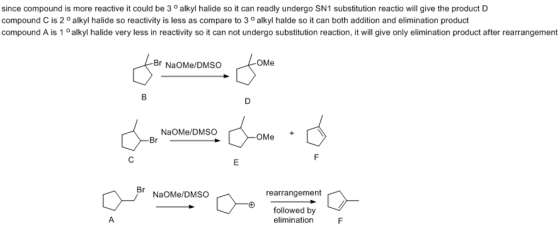
Road map: A, B, and C are cyclic alkyl halides with a molecular formula of C6H11Br. Compound B reacts with Na+ - OCH3 in DMSO at room temperature to give the corresponding ether D. Compound C reacts with Na+ - OCH3 in DMSO to give a different ether E and cyclic trisubstituted alkene F. Compound B reacts much faster with Na+ -OCH3 in DMSO than compound C. Compound A does not give an ether when reacted with Na+ -OCH3 in DMSO but instead gives trisubstituted alkene F as the major product. Give the structures of compounds A-F Please explain this. I don't just want the answers. Thanks
Homework Answers
Add Answer to:
Road map: A, B, and C are cyclic alkyl halides with a molecular
formula of C6H11Br....
solve the road mab with explanation 16. ROAD MAP: Compounds A, B, and Care constitutional isomers. Treatment...
 solve the road mab
with explanation
16. ROAD MAP: Compounds A, B, and Care constitutional isomers. Treatment of A or B with potassium tert-butoxide gives the same alkene D. If the base is changed to a less sterically hindered base such as sodium ethoxide, A and C give the same alkene E as the major product. Treatment of C (spectroscopic data given on next page) with potassium tert-butoxide gives yet another alkene F as a minor product. Compound B reacts...
solve the road mab
with explanation
16. ROAD MAP: Compounds A, B, and Care constitutional isomers. Treatment of A or B with potassium tert-butoxide gives the same alkene D. If the base is changed to a less sterically hindered base such as sodium ethoxide, A and C give the same alkene E as the major product. Treatment of C (spectroscopic data given on next page) with potassium tert-butoxide gives yet another alkene F as a minor product. Compound B reacts...
12 ROAD MAP: Compound A has the chemical formula CHn. Treatment of A with H,SO, and...
 12 ROAD MAP: Compound A has the chemical formula CHn. Treatment of A with H,SO, and HO produces sertiary alcohol B. However, when A undergoes hvdroboration with 9-BBN followed by oxidation secondary alcohol C is formed. When Compound A is reacted with HCl alkyl halide D is produced. When D is reacted with water at room temperature alcohol B is produced. When Compound D is reacted with sodium methoxide in TH at room temperature, no reaction occurs. Upon treatment of...
Compound A (C6H11Br), when reacted with magnesium, provides a carbon nucleophile, called compound B. Compound B...
 Compound A (C6H11Br), when reacted with magnesium, provides a
carbon nucleophile, called compound B. Compound B is then reacted
with 2-propanone followed by an acidic workup to give compound C
(C9H18O). When compound C reacts with H2SO4 an internal alkene is
formed, known as compound D (C9H16). What are the structures for
compounds A-D? Show your logic and reasoning.
2-Propanone
Compound A (C6H11Br), when reacted with magnesium, provides a
carbon nucleophile, called compound B. Compound B is then reacted
with 2-propanone followed by an acidic workup to give compound C
(C9H18O). When compound C reacts with H2SO4 an internal alkene is
formed, known as compound D (C9H16). What are the structures for
compounds A-D? Show your logic and reasoning.
2-Propanone
ROAD MAP. Compound A has the chemical formula CHio. Treatment of A with HS0, and H:0...
 ROAD MAP. Compound A has the chemical formula CHio. Treatment of A with HS0, and H:0 produces ohol B However, when A undergoes hydroboration with 9-BBN followed by oxidation, secondary alcohol C with chemical formula CsHi20 is formed (H NMR provided below). If either Compound A or Compound B is alkyl halide D. When Compound D is reacted with sodium in THF at room temperature, no reaction occurs. Upon treatment of compound C with sodium hydride pound 12.. alc followed...
Compound A (C6H11Br) when reacted with magnesium provides a carbon nucleophile, called compound B. Compound B...
 Compound A (C6H11Br) when reacted with magnesium provides a carbon nucleophile, called compound B. Compound B is then reacted with 2-propanone followed by an acidic work-up to give compound C (CH180). When compound C reacts with H2SO4 an internal alkene is formed, known as compound D (C9H16). What are the structures for compounds A-D? Show your logic and reasoning to gain full credit. i 2-Propanone
Three isomeric ketones, compounds A, B, and C, with the molecular formula C_7H_14O are converted into...
 Three isomeric ketones, compounds A, B, and C, with the molecular formula C_7H_14O are converted into heptane by Clemmensen reduction. Upon Baeyer-Villiger oxidation, compound A gives a single product; compound B gives two different products with very different yields; compound C gives two different products in virtually a 1:1 ratio. Deduce and draw A, B, and C in the labeled boxes below. Incorrect. The ketone you have drawn as compound B does fit the molecular formula and produces heptanes upon...
26. (4 pts) Listed below is information on an alkene X with molecular formula C H12:...
 26. (4 pts) Listed below is information on an alkene X with molecular formula C H12: a Compound X adds HBr to give a single alkyl halide Y with molecular formula C-H3Br b. Compound X undergoes catalytic hydrogenation to give 1,1-dimethylcyclopentane Provide the structures of X and Y. Write the equations to show the chemistry outlined in parts (a) and (b).
(10 pts total) Give the structures for compounds/reagents A through K in the following road- map...
 (10 pts total) Give the structures for compounds/reagents A through K in the following road- map 6-methylhept-1-yne SOCI G (CH3),Culi (1) CH,MgBr in ether (2) H30* (1) B (CH3)CH(CH), MgBr — (2) H30 Na Cr20 H2SO4 KCN HCN (1) K (2) H307 (1) J (2) H30+ OH H0+ H тон
I have difficult times with road map questions please help! (10 pts total) Give the structures...
 I have difficult times with road map questions please help!
(10 pts total) Give the structures for compounds/reagents A through K in the following road- map. 6-methylhept-1-yne SOC!2 F (CH)2CuLi (1) CH3MgBr in ether (2) H20* G (1) B (CH3) CH(CH2)3MgBr Na2Cr2O7 C (2) H20* H2SO4 KCN HCN (1) K (2) H30* (1) J (2) H3O* H ОН Но* I OH
I have difficult times with road map questions please help!
(10 pts total) Give the structures for compounds/reagents A through K in the following road- map. 6-methylhept-1-yne SOC!2 F (CH)2CuLi (1) CH3MgBr in ether (2) H20* G (1) B (CH3) CH(CH2)3MgBr Na2Cr2O7 C (2) H20* H2SO4 KCN HCN (1) K (2) H30* (1) J (2) H3O* H ОН Но* I OH
An alkane (A) with the formula CgH14 reacts with chlorine to yield three compounds with the...
 An alkane (A) with the formula CgH14 reacts with chlorine to yield three compounds with the formula CgH13Cl: B, C, and D. Of these only C and D undergo dehydrohalogenation with sodium ethoxide in ethanol to produce an alkene. Moreover, C and D yield the same alkene E (C6H12). Hydrogenation of E produces A. Treating E with HCl produces a compound (F) that is an isomer of B, C, and D. Treating F with magnesium in dry ether followed by...
 solve the road mab
with explanation
16. ROAD MAP: Compounds A, B, and Care constitutional isomers. Treatment of A or B with potassium tert-butoxide gives the same alkene D. If the base is changed to a less sterically hindered base such as sodium ethoxide, A and C give the same alkene E as the major product. Treatment of C (spectroscopic data given on next page) with potassium tert-butoxide gives yet another alkene F as a minor product. Compound B reacts...
solve the road mab
with explanation
16. ROAD MAP: Compounds A, B, and Care constitutional isomers. Treatment of A or B with potassium tert-butoxide gives the same alkene D. If the base is changed to a less sterically hindered base such as sodium ethoxide, A and C give the same alkene E as the major product. Treatment of C (spectroscopic data given on next page) with potassium tert-butoxide gives yet another alkene F as a minor product. Compound B reacts...
 12 ROAD MAP: Compound A has the chemical formula CHn. Treatment of A with H,SO, and HO produces sertiary alcohol B. However, when A undergoes hvdroboration with 9-BBN followed by oxidation secondary alcohol C is formed. When Compound A is reacted with HCl alkyl halide D is produced. When D is reacted with water at room temperature alcohol B is produced. When Compound D is reacted with sodium methoxide in TH at room temperature, no reaction occurs. Upon treatment of...
 Compound A (C6H11Br), when reacted with magnesium, provides a
carbon nucleophile, called compound B. Compound B is then reacted
with 2-propanone followed by an acidic workup to give compound C
(C9H18O). When compound C reacts with H2SO4 an internal alkene is
formed, known as compound D (C9H16). What are the structures for
compounds A-D? Show your logic and reasoning.
2-Propanone
Compound A (C6H11Br), when reacted with magnesium, provides a
carbon nucleophile, called compound B. Compound B is then reacted
with 2-propanone followed by an acidic workup to give compound C
(C9H18O). When compound C reacts with H2SO4 an internal alkene is
formed, known as compound D (C9H16). What are the structures for
compounds A-D? Show your logic and reasoning.
2-Propanone
 ROAD MAP. Compound A has the chemical formula CHio. Treatment of A with HS0, and H:0 produces ohol B However, when A undergoes hydroboration with 9-BBN followed by oxidation, secondary alcohol C with chemical formula CsHi20 is formed (H NMR provided below). If either Compound A or Compound B is alkyl halide D. When Compound D is reacted with sodium in THF at room temperature, no reaction occurs. Upon treatment of compound C with sodium hydride pound 12.. alc followed...
 Compound A (C6H11Br) when reacted with magnesium provides a carbon nucleophile, called compound B. Compound B is then reacted with 2-propanone followed by an acidic work-up to give compound C (CH180). When compound C reacts with H2SO4 an internal alkene is formed, known as compound D (C9H16). What are the structures for compounds A-D? Show your logic and reasoning to gain full credit. i 2-Propanone
 Three isomeric ketones, compounds A, B, and C, with the molecular formula C_7H_14O are converted into heptane by Clemmensen reduction. Upon Baeyer-Villiger oxidation, compound A gives a single product; compound B gives two different products with very different yields; compound C gives two different products in virtually a 1:1 ratio. Deduce and draw A, B, and C in the labeled boxes below. Incorrect. The ketone you have drawn as compound B does fit the molecular formula and produces heptanes upon...
 26. (4 pts) Listed below is information on an alkene X with molecular formula C H12: a Compound X adds HBr to give a single alkyl halide Y with molecular formula C-H3Br b. Compound X undergoes catalytic hydrogenation to give 1,1-dimethylcyclopentane Provide the structures of X and Y. Write the equations to show the chemistry outlined in parts (a) and (b).
 (10 pts total) Give the structures for compounds/reagents A through K in the following road- map 6-methylhept-1-yne SOCI G (CH3),Culi (1) CH,MgBr in ether (2) H30* (1) B (CH3)CH(CH), MgBr — (2) H30 Na Cr20 H2SO4 KCN HCN (1) K (2) H307 (1) J (2) H30+ OH H0+ H тон
 I have difficult times with road map questions please help!
(10 pts total) Give the structures for compounds/reagents A through K in the following road- map. 6-methylhept-1-yne SOC!2 F (CH)2CuLi (1) CH3MgBr in ether (2) H20* G (1) B (CH3) CH(CH2)3MgBr Na2Cr2O7 C (2) H20* H2SO4 KCN HCN (1) K (2) H30* (1) J (2) H3O* H ОН Но* I OH
I have difficult times with road map questions please help!
(10 pts total) Give the structures for compounds/reagents A through K in the following road- map. 6-methylhept-1-yne SOC!2 F (CH)2CuLi (1) CH3MgBr in ether (2) H20* G (1) B (CH3) CH(CH2)3MgBr Na2Cr2O7 C (2) H20* H2SO4 KCN HCN (1) K (2) H30* (1) J (2) H3O* H ОН Но* I OH
 An alkane (A) with the formula CgH14 reacts with chlorine to yield three compounds with the formula CgH13Cl: B, C, and D. Of these only C and D undergo dehydrohalogenation with sodium ethoxide in ethanol to produce an alkene. Moreover, C and D yield the same alkene E (C6H12). Hydrogenation of E produces A. Treating E with HCl produces a compound (F) that is an isomer of B, C, and D. Treating F with magnesium in dry ether followed by...
Most questions answered within 3 hours.
-
Where is the error in this code sequence?
String s1 = "Hello";
String s2 = "ello";...
asked 10 months ago -
Financial data for Joel de Paris, Inc., for last year
follow:
Joel de Paris, Inc.
Balance...
asked 10 months ago -
Consider this reaction:
Al2(SO4)3 (aq)+ BaCl3
(aq) Al2Cl6 (aq)- +
3BaSO4(s) . What is the...
asked 10 months ago -
Suppose that Savneet is considering increasing her
recent random sample from 20 car rentals to 40...
asked 10 months ago -
Trucks arrive at an unloading terminal at an average rate of 120
per hour.
Trucks arrive...
asked 10 months ago -
Why are methanol and ethanol completely soluble in water while
octanol is not very little soluble....
asked 10 months ago -
A facilities manager at a university reads in a research report
that the mean amount of...
asked 10 months ago -
When the CuSO4 is rehydrated by adding water to the anhydrous
compound, is this an endothermic...
asked 10 months ago -
A ray of sunlight is passing from diamond into crown glass; the
angle of incidence is...
asked 10 months ago -
A block of mass 0.249 kg is placed on top of a light, vertical
spring of...
asked 10 months ago -
how do the kidneys compensate in the presences of acidosis
a) trigger hyperventilate
b) reserve acid...
asked 10 months ago -
Question 501 pts
The rental rate of capital to the firm increases. Which of the
following...
asked 10 months ago