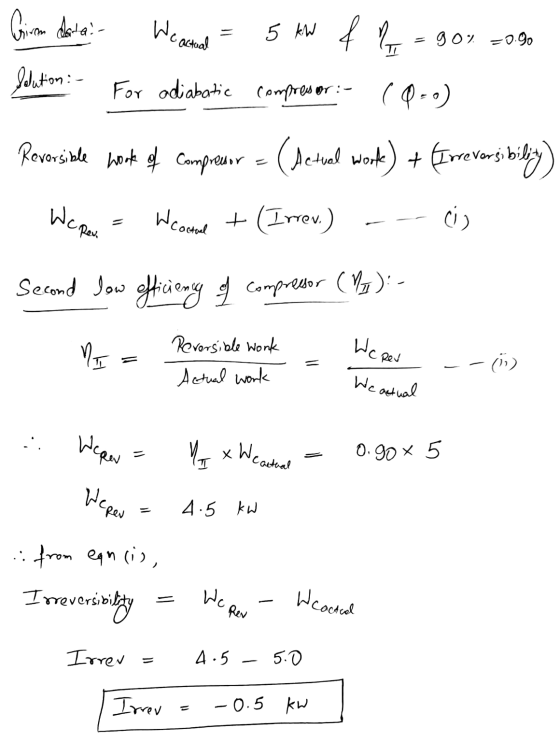
The actual work of an adiabatic compressor is 5 kW. If the second law efficiency of...
Homework Answers
In this Problem, first Calculate the reversible work for compressor from the formula of second law efficiency of compressor and then Calculate the irreversibility of compressor from the equation of reversible work for compressor as below:-
Add Answer to:
The
actual work of an adiabatic compressor is 5 kW. If the second law
efficiency of...
1 MPa Isentropic Efficiency of a Compressor Refrigerant-134a enters an adiabatic compressor as a saturated vapor...
 1 MPa Isentropic Efficiency of a Compressor Refrigerant-134a enters an adiabatic compressor as a saturated vapor at 100kPa at a rate of 0.7 m/min and exits at 1-MPa pressure. The isentropic efficiency of the compressor is 87%. R-134a Compressor Isentropic Compressor Work hs-h 100 kPa sat. vapor Actual Compressor Work Determine the refrigerant properties at the inlet and outlet for an isentropic process. Actual 2s entropic procEss Inlet state Determine the actual isentropic enthalpy from the efficiency. (Ans: 289.71 J/kg)...
Air enters an adiabatic compressor at 17 Cand 90 KPa with a mass flow rate of...
 Air enters an adiabatic compressor at 17 Cand 90 KPa with a mass flow rate of 0.2 Kg/s and exits at 400 KPa. The compressor has an isentropic effeciency of 88 % assuming constant specific heats at room temperature determine: A) The power input to the compressor B) The total rate of exergy destroyed during the process C) The second law efficiency of the compressor D) Draw the actual and isentropic process on T-5 diagram
The refrigerant R134a flows through an adiabatic compressor in stationary operation. The volume at the inlet...
The refrigerant R134a flows through an adiabatic compressor in stationary operation. The volume at the inlet is 500 liters / min. At the inlet, the refrigerant is at 0 ° C and 200kPa. At the outlet, the pressure is 1MPa. The compressor has an isentropic efficiency of 85%. The environment of the compressor is at 25 ° C and 100kPa. a) Calculate the specific enthalpy at the compressor outlet (in kJ / kg). Draw a Ts diagram of the process...
An adiabatic compressor with an isentropic efficiency of 73% is used in a refrigeration unit to...
An adiabatic compressor with an isentropic efficiency of 73% is used in a refrigeration unit to compress saturated R-134a vapor at 10° C to 1000 kPa Determine the required power of the compressor to compress 0.84 kg/s.
6. Refrigerant-134a enters an adiabatic compressor as saturated vapor at 100 kPa at a rate of...
 6. Refrigerant-134a enters an adiabatic compressor as saturated vapor at 100 kPa at a rate of 0.7 m3/min and exits at 1 MPa pressure. If the isentropic efficiency of the compressor is 87%, determine (a) the temperature of the refrigerant at the exit of the compressor, (b) the power input (in kW), and (c) the rate of entropy generation during this process.
Please solve and show work for each part thanks s total) An adiabatic air compressor is...
 Please solve and show work for each part thanks
s total) An adiabatic air compressor is powered by a direct-coupled (35 pts total) adiab atic steam turbine. This same turbine also simultaneously drivesa nerator (see next page). Steam enters the turbine at 12.5 MPa and 500 degrees C at a rate of 50 kg/sec, and exits at 10kPa with a quality of 0.92. Air enters the compressor at 98 kPa and 295 K at a rate of 17 kg/sec and...
Please solve and show work for each part thanks
s total) An adiabatic air compressor is powered by a direct-coupled (35 pts total) adiab atic steam turbine. This same turbine also simultaneously drivesa nerator (see next page). Steam enters the turbine at 12.5 MPa and 500 degrees C at a rate of 50 kg/sec, and exits at 10kPa with a quality of 0.92. Air enters the compressor at 98 kPa and 295 K at a rate of 17 kg/sec and...
An adiabatic air compressor compresses 100 L/S of air at 120 kPa and 20°C to 1000...
An adiabatic air compressor compresses 100 L/S of air at 120 kPa and 20°C to 1000 kPa and 300°C. Determine (a) the work required by the compressor, in kJ/kg, and (b) the power required to drive the air compressor, in kW.
The power input to the compressor of an ammonia vapor compression plant is 8.2 kW. The...
The power input to the compressor of an ammonia vapor compression plant is 8.2 kW. The mechanical efficiency is 85%. The ammonia is dry saturated vapor at -5oC at inlet to the compressor. After compression, the vapor is at 1000 kPa. The compressor has an isentropic efficiency of 90%. The condenser produces saturated liquid. Calculate the coefficient of performance for the refrigerator and for the heat pump for this plant.
(30 points) A compressor uses 2200 kW of work to compress 2.50 kg/s of steam from...
 (30 points) A compressor uses 2200 kW of work to compress 2.50 kg/s of steam from an initial state of 1.00 bar and 150.0°C to a final pressure of 15.0 bar. Determine the compressor efficiency.
Question 6 Air at the inlet of an ideal (reversible-adiabatic) compressor is at 100 kPa and...
 Question 6 Air at the inlet of an ideal (reversible-adiabatic) compressor is at 100 kPa and 2685o. The compressor exit pressure is at 620.4 kPa. Determine the compressor power (kw Calculate the power based on variable specific heats (i.e.,use the ideal gas table for air). Selected Answer Incorrect [None Given] Rgl_e 尻(T) W, m(m-h.) Correct Answer: Correct -47.41% Question 7 Nitrogen gas expands in an adiabatic nozzle from 800 kPa 600x, to a final pressure of 98.26 kPa. Calculate the...
 1 MPa Isentropic Efficiency of a Compressor Refrigerant-134a enters an adiabatic compressor as a saturated vapor at 100kPa at a rate of 0.7 m/min and exits at 1-MPa pressure. The isentropic efficiency of the compressor is 87%. R-134a Compressor Isentropic Compressor Work hs-h 100 kPa sat. vapor Actual Compressor Work Determine the refrigerant properties at the inlet and outlet for an isentropic process. Actual 2s entropic procEss Inlet state Determine the actual isentropic enthalpy from the efficiency. (Ans: 289.71 J/kg)...
 Air enters an adiabatic compressor at 17 Cand 90 KPa with a mass flow rate of 0.2 Kg/s and exits at 400 KPa. The compressor has an isentropic effeciency of 88 % assuming constant specific heats at room temperature determine: A) The power input to the compressor B) The total rate of exergy destroyed during the process C) The second law efficiency of the compressor D) Draw the actual and isentropic process on T-5 diagram
 6. Refrigerant-134a enters an adiabatic compressor as saturated vapor at 100 kPa at a rate of 0.7 m3/min and exits at 1 MPa pressure. If the isentropic efficiency of the compressor is 87%, determine (a) the temperature of the refrigerant at the exit of the compressor, (b) the power input (in kW), and (c) the rate of entropy generation during this process.
 Please solve and show work for each part thanks
s total) An adiabatic air compressor is powered by a direct-coupled (35 pts total) adiab atic steam turbine. This same turbine also simultaneously drivesa nerator (see next page). Steam enters the turbine at 12.5 MPa and 500 degrees C at a rate of 50 kg/sec, and exits at 10kPa with a quality of 0.92. Air enters the compressor at 98 kPa and 295 K at a rate of 17 kg/sec and...
Please solve and show work for each part thanks
s total) An adiabatic air compressor is powered by a direct-coupled (35 pts total) adiab atic steam turbine. This same turbine also simultaneously drivesa nerator (see next page). Steam enters the turbine at 12.5 MPa and 500 degrees C at a rate of 50 kg/sec, and exits at 10kPa with a quality of 0.92. Air enters the compressor at 98 kPa and 295 K at a rate of 17 kg/sec and...
 (30 points) A compressor uses 2200 kW of work to compress 2.50 kg/s of steam from an initial state of 1.00 bar and 150.0°C to a final pressure of 15.0 bar. Determine the compressor efficiency.
 Question 6 Air at the inlet of an ideal (reversible-adiabatic) compressor is at 100 kPa and 2685o. The compressor exit pressure is at 620.4 kPa. Determine the compressor power (kw Calculate the power based on variable specific heats (i.e.,use the ideal gas table for air). Selected Answer Incorrect [None Given] Rgl_e 尻(T) W, m(m-h.) Correct Answer: Correct -47.41% Question 7 Nitrogen gas expands in an adiabatic nozzle from 800 kPa 600x, to a final pressure of 98.26 kPa. Calculate the...
Most questions answered within 3 hours.
-
Where is the error in this code sequence?
String s1 = "Hello";
String s2 = "ello";...
asked 11 months ago -
Financial data for Joel de Paris, Inc., for last year
follow:
Joel de Paris, Inc.
Balance...
asked 11 months ago -
Consider this reaction:
Al2(SO4)3 (aq)+ BaCl3
(aq) Al2Cl6 (aq)- +
3BaSO4(s) . What is the...
asked 11 months ago -
Suppose that Savneet is considering increasing her
recent random sample from 20 car rentals to 40...
asked 11 months ago -
Trucks arrive at an unloading terminal at an average rate of 120
per hour.
Trucks arrive...
asked 11 months ago -
Why are methanol and ethanol completely soluble in water while
octanol is not very little soluble....
asked 11 months ago -
A facilities manager at a university reads in a research report
that the mean amount of...
asked 11 months ago -
When the CuSO4 is rehydrated by adding water to the anhydrous
compound, is this an endothermic...
asked 11 months ago -
A ray of sunlight is passing from diamond into crown glass; the
angle of incidence is...
asked 11 months ago -
A block of mass 0.249 kg is placed on top of a light, vertical
spring of...
asked 11 months ago -
how do the kidneys compensate in the presences of acidosis
a) trigger hyperventilate
b) reserve acid...
asked 11 months ago -
Question 501 pts
The rental rate of capital to the firm increases. Which of the
following...
asked 11 months ago