Show that (r ∨ p) ∧ [(∼ r ∨ (p ∧ q)) ∧ (r ∨ q)]...
Show that (r ∨ p) ∧ [(∼ r ∨ (p ∧ q)) ∧ (r ∨ q)] ≡ p ∧ q.
Homework Answers
![VCP A (oup) [ coor repago) A corąz] = forp) 1 cenoupon cor vq)) a covqı] ..De moyen = (TYP) - Lv3 vt) (co va) ACT về))) - Nia](http://img.homeworklib.com/questions/48bef960-3910-11eb-8937-b5beaea80b60.png?x-oss-process=image/resize,w_560)
Show that: (b) (p → q) → r and p →(q → r) are not logically equivalent.
6. Maximum score 3 ( 1 per part).Show that:(b) (p → q) → r and p →(q → r) are not logically equivalent.(c) p ↔ q and ¬ p ↔ ¬ q are logically equivalent.
Question: Show that the propositions (p ∨ q) ∧ (¬p ∨ r) and (p ∧ r)...
Question: Show that the propositions (p ∨ q) ∧ (¬p ∨ r) and (p ∧ r) ⊕ (¬p ∧ q) are logically equivalent.
show, using natural deduction p V q, p -> r, q -> r proves r
show, using natural deduction p V q, p -> r, q -> r proves r
p implies r q implies r conclusion (p or q ) implies r show they sre...
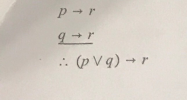 p implies r
q implies r
conclusion (p or q ) implies r
show they sre logical equivalent
(pVa)
(pVa)
p implies r
q implies r
conclusion (p or q ) implies r
show they sre logical equivalent
(pVa)
(pVa)
Show that ~p -> (q -> r ) and q -> (p v r) are logically equivalent using laws
Show that ~p -> (q -> r) and q-> (p v r) are logically equivalent
WITHOUT constructing TT Show whether or not p-, q ^ (q-r)-p-, r is logically equivalent to
 WITHOUT constructing TT Show whether or not p-, q ^ (q-r)-p-, r is logically equivalent to
2. (a) Show that (PVQ) + R is not logically equivalent to (P + R) V(Q...
 2. (a) Show that (PVQ) + R is not logically equivalent to (P + R) V(Q + R) using a truth table. (b) Is (PAQ) → R logically equivalent to (P + R) A( Q R )? If so, use a truth table to establish this. If not, show that it is false.
Problem 3.11 Show using a chain of logical equivalences that (p → r)A(q → r) pv q) → Show transcribed image text
 Problem 3.11 Show using a chain of logical equivalences that (p → r)A(q → r) pv q) →
How do you show the following propositions are logically equivalent? (a) [(p → q) → r]...
How do you show the following propositions are logically equivalent? (a) [(p → q) → r] ⊕ (p ∧ q ∧ r) and (p ∨ r) ⊕ (p ∧ q) (b) ¬∃x {P(x) → ∃y [Q(x, y) ⊕ R(x, y)] } and (∀x P(x)) ∧ [∀x ∀y(Q(x, y) ↔ R(x, y))] (c) Does [(p → q) ∧ (q → r)] → r implies (p → r) → r?
How many of the disjunctions p∨¬q, ¬p∨q, q ∨r, q ∨¬ r, and ¬q ∨¬ r...
How many of the disjunctions p∨¬q, ¬p∨q, q ∨r, q ∨¬ r, and ¬q ∨¬ r can be made simultaneously true by an assignment of truth values to p, q, and r? Please explain how to find that? thinking process!
 p implies r
q implies r
conclusion (p or q ) implies r
show they sre logical equivalent
(pVa)
(pVa)
p implies r
q implies r
conclusion (p or q ) implies r
show they sre logical equivalent
(pVa)
(pVa)
 WITHOUT constructing TT Show whether or not p-, q ^ (q-r)-p-, r is logically equivalent to
 2. (a) Show that (PVQ) + R is not logically equivalent to (P + R) V(Q + R) using a truth table. (b) Is (PAQ) → R logically equivalent to (P + R) A( Q R )? If so, use a truth table to establish this. If not, show that it is false.
 Problem 3.11 Show using a chain of logical equivalences that (p → r)A(q → r) pv q) →
Most questions answered within 3 hours.
-
Where is the error in this code sequence?
String s1 = "Hello";
String s2 = "ello";...
asked 10 months ago -
Financial data for Joel de Paris, Inc., for last year
follow:
Joel de Paris, Inc.
Balance...
asked 10 months ago -
Consider this reaction:
Al2(SO4)3 (aq)+ BaCl3
(aq) Al2Cl6 (aq)- +
3BaSO4(s) . What is the...
asked 10 months ago -
Suppose that Savneet is considering increasing her
recent random sample from 20 car rentals to 40...
asked 10 months ago -
Trucks arrive at an unloading terminal at an average rate of 120
per hour.
Trucks arrive...
asked 10 months ago -
Why are methanol and ethanol completely soluble in water while
octanol is not very little soluble....
asked 10 months ago -
A facilities manager at a university reads in a research report
that the mean amount of...
asked 10 months ago -
When the CuSO4 is rehydrated by adding water to the anhydrous
compound, is this an endothermic...
asked 10 months ago -
A ray of sunlight is passing from diamond into crown glass; the
angle of incidence is...
asked 10 months ago -
A block of mass 0.249 kg is placed on top of a light, vertical
spring of...
asked 10 months ago -
how do the kidneys compensate in the presences of acidosis
a) trigger hyperventilate
b) reserve acid...
asked 10 months ago -
Question 501 pts
The rental rate of capital to the firm increases. Which of the
following...
asked 10 months ago