1) Describe typical preparations for carbonyl complexes
1) Describe typical preparations for carbonyl complexes
Homework Answers
Carbonyl complexes are easily prepared in the labs using CO and metal in the presence of a reducing agent.
Fe + 5CO (at 200 atm and 200C) --> Fe(CO)5 (In sunglight) --> Fe2(CO)9
Another way of producing Carbonyl complexes is by reaction of metal halids with CO
WCl6 + 6CO + 2Et3Al --> W(CO)6
write three different preparations of 1,1-diphenylethanol from three different carbonyl compounds and grignard reagents
write three different preparations of 1,1-diphenylethanol from three different carbonyl compounds and grignard reagents
The complexes shown below are catalysts for the water splitting process. It has been found that t...
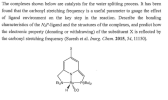 The complexes shown below are catalysts for the water splitting process. It has been found that the carbonyl stretching frequency is a useful parameter to gauge the effect of ligand environment on the key step in the reaction. Describe the bonding characteristics of the N2P-ligand and the structures of the complexes, and predict how the electronic property (donating or withdrawing) of the substituent X is reflected by the carbonyl stretching frequency (Suresh et al. Inorg. Chem. 2015, 54, 11150). Et2NRuP(tBu)2...
please answer.. Q. Arrange the given carbonyl complexes in the increasing order of CO stretching frequencies...
 please answer..
Q. Arrange the given carbonyl complexes in the increasing order of CO stretching frequencies and justify your answer 1. Cr(CO), [V(CO),1 [Ti(CO),12- Cr(CO), [Cr(CO), [Cr(CO),]+ оме Мо. CO Occo co CO CO co
please answer..
Q. Arrange the given carbonyl complexes in the increasing order of CO stretching frequencies and justify your answer 1. Cr(CO), [V(CO),1 [Ti(CO),12- Cr(CO), [Cr(CO), [Cr(CO),]+ оме Мо. CO Occo co CO CO co
The use of the name “metallocenes” to describe complexes with the general formula (C5H5)2M is derived...
The use of the name “metallocenes” to describe complexes with the general formula (C5H5)2M is derived from the word “ferrocene”, which in turn was given to the iron containing compound (C5H5)2Fe because its cyclopentadienyl rings exhibited aromatic behavior typical of benzene. Given its name, what type of reactivity (or lack thereof) would be expected for ferrocene?
Part I: Describe the procedure for creating wet mount preparations of these cells. Explain the similarities...
 Part I: Describe the procedure for creating wet mount preparations of these cells. Explain the similarities and differences between how each of these cells look under the microscope.
Chapter 30 Cardiopulmonary Procedures G. Additional ECG Testing Describe the preparations for an exercise stress test....
 Chapter 30 Cardiopulmonary Procedures G. Additional ECG Testing Describe the preparations for an exercise stress test. 2 Describe a Holter monitor test. 3. Describe patient education required for the Holter monitor test. 4. Describe the cardiac event recorder and discuss how the patient uses the recorder.
Chapter 30 Cardiopulmonary Procedures G. Additional ECG Testing Describe the preparations for an exercise stress test....
 Chapter 30 Cardiopulmonary Procedures G. Additional ECG Testing Describe the preparations for an exercise stress test. 2 Describe a Holter monitor test. 3. Describe patient education required for the Holter monitor test. 4. Describe the cardiac event recorder and discuss how the patient uses the recorder.
Choose one of the nine principal categories of topical skin preparations (medications) and describe it in...
Choose one of the nine principal categories of topical skin preparations (medications) and describe it in detail. Include its primary use and mechanism of action (what it does within the body), at least one specific medication (include generic and trade name) within that classification, and some side effects and/or contraindications related to this drug
Describe and draw the thylakoid membrane with all the complexes required for the light reactions.
Describe and draw the thylakoid membrane with all the complexes required for the light reactions.
In the laboratory preparation of chromium complexes such as [Cr(en)3](ClO4)3, the typical starting material is CrCl3·6H2O....
In the laboratory preparation of chromium complexes such as [Cr(en)3](ClO4)3, the typical starting material is CrCl3·6H2O. When combined with excess en (ethylenediamine) in an appropriate solvent, the reaction proceeds unacceptably slowly, however the addition of a small, catalytic piece of Zn rapidly accelerates the reaction, such that it is complete within an hour. Discuss this reaction in terms of the role of the Zn as a catalyst and the relative labilities of the oxidation state(s) of chromium involved.
 The complexes shown below are catalysts for the water splitting process. It has been found that the carbonyl stretching frequency is a useful parameter to gauge the effect of ligand environment on the key step in the reaction. Describe the bonding characteristics of the N2P-ligand and the structures of the complexes, and predict how the electronic property (donating or withdrawing) of the substituent X is reflected by the carbonyl stretching frequency (Suresh et al. Inorg. Chem. 2015, 54, 11150). Et2NRuP(tBu)2...
 please answer..
Q. Arrange the given carbonyl complexes in the increasing order of CO stretching frequencies and justify your answer 1. Cr(CO), [V(CO),1 [Ti(CO),12- Cr(CO), [Cr(CO), [Cr(CO),]+ оме Мо. CO Occo co CO CO co
please answer..
Q. Arrange the given carbonyl complexes in the increasing order of CO stretching frequencies and justify your answer 1. Cr(CO), [V(CO),1 [Ti(CO),12- Cr(CO), [Cr(CO), [Cr(CO),]+ оме Мо. CO Occo co CO CO co
 Part I: Describe the procedure for creating wet mount preparations of these cells. Explain the similarities and differences between how each of these cells look under the microscope.
 Chapter 30 Cardiopulmonary Procedures G. Additional ECG Testing Describe the preparations for an exercise stress test. 2 Describe a Holter monitor test. 3. Describe patient education required for the Holter monitor test. 4. Describe the cardiac event recorder and discuss how the patient uses the recorder.
 Chapter 30 Cardiopulmonary Procedures G. Additional ECG Testing Describe the preparations for an exercise stress test. 2 Describe a Holter monitor test. 3. Describe patient education required for the Holter monitor test. 4. Describe the cardiac event recorder and discuss how the patient uses the recorder.
Most questions answered within 3 hours.
-
Where is the error in this code sequence?
String s1 = "Hello";
String s2 = "ello";...
asked 10 months ago -
Financial data for Joel de Paris, Inc., for last year
follow:
Joel de Paris, Inc.
Balance...
asked 10 months ago -
Consider this reaction:
Al2(SO4)3 (aq)+ BaCl3
(aq) Al2Cl6 (aq)- +
3BaSO4(s) . What is the...
asked 10 months ago -
Suppose that Savneet is considering increasing her
recent random sample from 20 car rentals to 40...
asked 10 months ago -
Trucks arrive at an unloading terminal at an average rate of 120
per hour.
Trucks arrive...
asked 10 months ago -
Why are methanol and ethanol completely soluble in water while
octanol is not very little soluble....
asked 10 months ago -
A facilities manager at a university reads in a research report
that the mean amount of...
asked 10 months ago -
When the CuSO4 is rehydrated by adding water to the anhydrous
compound, is this an endothermic...
asked 10 months ago -
A ray of sunlight is passing from diamond into crown glass; the
angle of incidence is...
asked 10 months ago -
A block of mass 0.249 kg is placed on top of a light, vertical
spring of...
asked 10 months ago -
how do the kidneys compensate in the presences of acidosis
a) trigger hyperventilate
b) reserve acid...
asked 10 months ago -
Question 501 pts
The rental rate of capital to the firm increases. Which of the
following...
asked 10 months ago