CS Discrete Structures 2 Question 3
Homework Answers
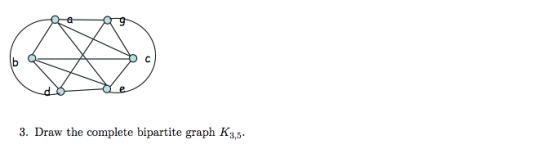
Question 3: Draw the complete bipartite graph K3,5.
A graph is called complete bipartite graph if it holds the following two properties.
First: it is a graph whose vertices can be partitioned into two subsets V1 and V2 in a way so that endpoints of each edge remain in different subset. Second: every vertex of the first subset is connected to every vertex of the second subset.
Following image is a complete bipartite graph K3,5 ; where two subset of vertices are V1 = a,b,c and V2 = d,e,f,g,h

/*If this helps you, please let me know by giving a positive thumbs up. In case you have any queries, do let me know. I will revert back to you. Thank you!!*/
Add Answer to:
CS Discrete Structures 2 Question 3
kb 3. Draw the complete bipartite graph K3,j5
QUESTION 2 True or False? Let Km,n be a complete bipartite graph with at least 3...
 QUESTION 2 True or False? Let Km,n be a complete bipartite graph with at least 3 vertices. Then Km,n has a Hamilton cycle if m=n. True False
Discrete Structures 1 3 2 7. Draw an undirected multi-graph represented by the adjacency matrix 3...
 Discrete Structures
1 3 2 7. Draw an undirected multi-graph represented by the adjacency matrix 3 04
Discrete Structures
1 3 2 7. Draw an undirected multi-graph represented by the adjacency matrix 3 04
Network Structures 3. Given a bipartite affiliation graph that shows the membership of people in different...
Network Structures 3. Given a bipartite affiliation graph that shows the membership of people in different social foci, the corresponding projected graph has just people as the nodes, with two nodes connected when they have a focus in common. Give an example of two different affiliation networks - on the same set of people, but with different numbers of foci – so that the projected graphs from these two different affiliation networks are the same.
Discrete math 1. Consider the graph on all two-element subsets of (a. b, c.d,e), in which...
 Discrete math
1. Consider the graph on all two-element subsets of (a. b, c.d,e), in which two subsets are neighbors if they have a common element. Give a hamiltonian cycle in this graph. 2. Draw the line graph of Ksa. What is its chromatic munber? 3. Show that if G and H are two bipartite graphs, then the Cartesian product GxH is also bipartite.
Discrete math
1. Consider the graph on all two-element subsets of (a. b, c.d,e), in which two subsets are neighbors if they have a common element. Give a hamiltonian cycle in this graph. 2. Draw the line graph of Ksa. What is its chromatic munber? 3. Show that if G and H are two bipartite graphs, then the Cartesian product GxH is also bipartite.
Problem 8. (2+4+4 points each) A bipartite graph G = (V. E) is a graph whose...
 Problem 8. (2+4+4 points each) A bipartite graph G = (V. E) is a graph whose vertices can be partitioned into two (disjoint) sets V1 and V2, such that every edge joins a vertex in V1 with a vertex in V2. This means no edges are within V1 or V2 (or symbolically: Vu, v E V1. {u, u} &E and Vu, v E V2.{u,v} &E). 8(a) Show that the complete graph K, is a bipartite graph. 8(b) Prove that no...
math 270A quiz 10 discrete structures Name: Spring 2020 Math 270A Quiz 10 (MFCS 5.1-6.1) Directions:...
 math 270A quiz 10 discrete structures
Name: Spring 2020 Math 270A Quiz 10 (MFCS 5.1-6.1) Directions: Please complete each question to the best of your ability. Show work to get full credit. Partially correct work will receive partial credit. Lastly please box your answer. 1. (2 points) Are the following graphs isomorphic? Explain why or why not. 2. (3 points) Find a minimum weight spanning tree of the graph below (either highlight the edges that make up the MST, or...
math 270A quiz 10 discrete structures
Name: Spring 2020 Math 270A Quiz 10 (MFCS 5.1-6.1) Directions: Please complete each question to the best of your ability. Show work to get full credit. Partially correct work will receive partial credit. Lastly please box your answer. 1. (2 points) Are the following graphs isomorphic? Explain why or why not. 2. (3 points) Find a minimum weight spanning tree of the graph below (either highlight the edges that make up the MST, or...
Discrete Math: Please help with all parts of question 5. I have included problem 3 to...
 Discrete Math: Please help with all parts of question
5. I have included problem 3 to help answer part (a) but
I only need help with question 5!
5.
3.
(a) (4 points) Prove that a graph is bipartite if and only if there is a 2-coloring (see problem 3) of its vertices. (b) (4 points) Prove that if a graph is a tree with at least two vertices, then there is a 2-coloring of its vertices. (Hint: Here are...
Discrete Math: Please help with all parts of question
5. I have included problem 3 to help answer part (a) but
I only need help with question 5!
5.
3.
(a) (4 points) Prove that a graph is bipartite if and only if there is a 2-coloring (see problem 3) of its vertices. (b) (4 points) Prove that if a graph is a tree with at least two vertices, then there is a 2-coloring of its vertices. (Hint: Here are...
Bipartite graph is a graph, which vertices can be partitioned into 2 parts - so that...
 Bipartite graph is a graph, which vertices can be partitioned into 2 parts - so that all edges connect only vertices from different parts. For example, this is a bipartite graph where one part has 3 vertices (a,b,c), and the other part - 4 vertices (d.e.f.g). Note there are NO edges in-between vertices coming from the same part. a b d f e g Give the order in which nodes are traversed with BFS. After listing a node, add its...
Discrete Math Create a graph with 4 vertices of degrees 2, 2, 3, 3 or explain why no such graph exists. If the graph exists, draw the graph, label the vertices and edges. To answer the question in th...
 Discrete Math
Create a graph with 4 vertices of degrees 2, 2, 3, 3 or explain why no such graph exists. If the graph exists, draw the graph, label the vertices and edges. To answer the question in the box below, write the vertex set, the edge set, and the edge-endpoint function as shown on page 627 of the text. You can copy (Ctrl-C) and paste(Ctrl-V) the table to use in your answer if you like. Vertex set- Edge set...
Discrete Math
Create a graph with 4 vertices of degrees 2, 2, 3, 3 or explain why no such graph exists. If the graph exists, draw the graph, label the vertices and edges. To answer the question in the box below, write the vertex set, the edge set, and the edge-endpoint function as shown on page 627 of the text. You can copy (Ctrl-C) and paste(Ctrl-V) the table to use in your answer if you like. Vertex set- Edge set...
(3) Prove that for a bipartite graph G on n vertices, we have a(G)- n/2 if and only if G has a pe...
 Please answer the question and write
legibly
(3) Prove that for a bipartite graph G on n vertices, we have a(G)- n/2 if and only if G has a perfect matching. (Recall that α(G) is the maximum size among the independent subsets of G.)
(3) Prove that for a bipartite graph G on n vertices, we have a(G)- n/2 if and only if G has a perfect matching. (Recall that α(G) is the maximum size among the independent subsets of...
Please answer the question and write
legibly
(3) Prove that for a bipartite graph G on n vertices, we have a(G)- n/2 if and only if G has a perfect matching. (Recall that α(G) is the maximum size among the independent subsets of G.)
(3) Prove that for a bipartite graph G on n vertices, we have a(G)- n/2 if and only if G has a perfect matching. (Recall that α(G) is the maximum size among the independent subsets of...
 QUESTION 2 True or False? Let Km,n be a complete bipartite graph with at least 3 vertices. Then Km,n has a Hamilton cycle if m=n. True False
 Discrete Structures
1 3 2 7. Draw an undirected multi-graph represented by the adjacency matrix 3 04
Discrete Structures
1 3 2 7. Draw an undirected multi-graph represented by the adjacency matrix 3 04
 Discrete math
1. Consider the graph on all two-element subsets of (a. b, c.d,e), in which two subsets are neighbors if they have a common element. Give a hamiltonian cycle in this graph. 2. Draw the line graph of Ksa. What is its chromatic munber? 3. Show that if G and H are two bipartite graphs, then the Cartesian product GxH is also bipartite.
Discrete math
1. Consider the graph on all two-element subsets of (a. b, c.d,e), in which two subsets are neighbors if they have a common element. Give a hamiltonian cycle in this graph. 2. Draw the line graph of Ksa. What is its chromatic munber? 3. Show that if G and H are two bipartite graphs, then the Cartesian product GxH is also bipartite.
 Problem 8. (2+4+4 points each) A bipartite graph G = (V. E) is a graph whose vertices can be partitioned into two (disjoint) sets V1 and V2, such that every edge joins a vertex in V1 with a vertex in V2. This means no edges are within V1 or V2 (or symbolically: Vu, v E V1. {u, u} &E and Vu, v E V2.{u,v} &E). 8(a) Show that the complete graph K, is a bipartite graph. 8(b) Prove that no...
 math 270A quiz 10 discrete structures
Name: Spring 2020 Math 270A Quiz 10 (MFCS 5.1-6.1) Directions: Please complete each question to the best of your ability. Show work to get full credit. Partially correct work will receive partial credit. Lastly please box your answer. 1. (2 points) Are the following graphs isomorphic? Explain why or why not. 2. (3 points) Find a minimum weight spanning tree of the graph below (either highlight the edges that make up the MST, or...
math 270A quiz 10 discrete structures
Name: Spring 2020 Math 270A Quiz 10 (MFCS 5.1-6.1) Directions: Please complete each question to the best of your ability. Show work to get full credit. Partially correct work will receive partial credit. Lastly please box your answer. 1. (2 points) Are the following graphs isomorphic? Explain why or why not. 2. (3 points) Find a minimum weight spanning tree of the graph below (either highlight the edges that make up the MST, or...
 Discrete Math: Please help with all parts of question
5. I have included problem 3 to help answer part (a) but
I only need help with question 5!
5.
3.
(a) (4 points) Prove that a graph is bipartite if and only if there is a 2-coloring (see problem 3) of its vertices. (b) (4 points) Prove that if a graph is a tree with at least two vertices, then there is a 2-coloring of its vertices. (Hint: Here are...
Discrete Math: Please help with all parts of question
5. I have included problem 3 to help answer part (a) but
I only need help with question 5!
5.
3.
(a) (4 points) Prove that a graph is bipartite if and only if there is a 2-coloring (see problem 3) of its vertices. (b) (4 points) Prove that if a graph is a tree with at least two vertices, then there is a 2-coloring of its vertices. (Hint: Here are...
 Bipartite graph is a graph, which vertices can be partitioned into 2 parts - so that all edges connect only vertices from different parts. For example, this is a bipartite graph where one part has 3 vertices (a,b,c), and the other part - 4 vertices (d.e.f.g). Note there are NO edges in-between vertices coming from the same part. a b d f e g Give the order in which nodes are traversed with BFS. After listing a node, add its...
 Discrete Math
Create a graph with 4 vertices of degrees 2, 2, 3, 3 or explain why no such graph exists. If the graph exists, draw the graph, label the vertices and edges. To answer the question in the box below, write the vertex set, the edge set, and the edge-endpoint function as shown on page 627 of the text. You can copy (Ctrl-C) and paste(Ctrl-V) the table to use in your answer if you like. Vertex set- Edge set...
Discrete Math
Create a graph with 4 vertices of degrees 2, 2, 3, 3 or explain why no such graph exists. If the graph exists, draw the graph, label the vertices and edges. To answer the question in the box below, write the vertex set, the edge set, and the edge-endpoint function as shown on page 627 of the text. You can copy (Ctrl-C) and paste(Ctrl-V) the table to use in your answer if you like. Vertex set- Edge set...
 Please answer the question and write
legibly
(3) Prove that for a bipartite graph G on n vertices, we have a(G)- n/2 if and only if G has a perfect matching. (Recall that α(G) is the maximum size among the independent subsets of G.)
(3) Prove that for a bipartite graph G on n vertices, we have a(G)- n/2 if and only if G has a perfect matching. (Recall that α(G) is the maximum size among the independent subsets of...
Please answer the question and write
legibly
(3) Prove that for a bipartite graph G on n vertices, we have a(G)- n/2 if and only if G has a perfect matching. (Recall that α(G) is the maximum size among the independent subsets of G.)
(3) Prove that for a bipartite graph G on n vertices, we have a(G)- n/2 if and only if G has a perfect matching. (Recall that α(G) is the maximum size among the independent subsets of...
Most questions answered within 3 hours.
-
Where is the error in this code sequence?
String s1 = "Hello";
String s2 = "ello";...
asked 10 months ago -
Financial data for Joel de Paris, Inc., for last year
follow:
Joel de Paris, Inc.
Balance...
asked 10 months ago -
Consider this reaction:
Al2(SO4)3 (aq)+ BaCl3
(aq) Al2Cl6 (aq)- +
3BaSO4(s) . What is the...
asked 10 months ago -
Suppose that Savneet is considering increasing her
recent random sample from 20 car rentals to 40...
asked 10 months ago -
Trucks arrive at an unloading terminal at an average rate of 120
per hour.
Trucks arrive...
asked 10 months ago -
Why are methanol and ethanol completely soluble in water while
octanol is not very little soluble....
asked 10 months ago -
A facilities manager at a university reads in a research report
that the mean amount of...
asked 10 months ago -
When the CuSO4 is rehydrated by adding water to the anhydrous
compound, is this an endothermic...
asked 10 months ago -
A ray of sunlight is passing from diamond into crown glass; the
angle of incidence is...
asked 10 months ago -
A block of mass 0.249 kg is placed on top of a light, vertical
spring of...
asked 10 months ago -
how do the kidneys compensate in the presences of acidosis
a) trigger hyperventilate
b) reserve acid...
asked 10 months ago -
Question 501 pts
The rental rate of capital to the firm increases. Which of the
following...
asked 10 months ago