
Homework Answers
Add Answer to:
In the picture
Consider a parallel plate capacitor with plates of area A and With separation...
A parallel plate capacitor has a charge Q, plates of area A and separation d, where...
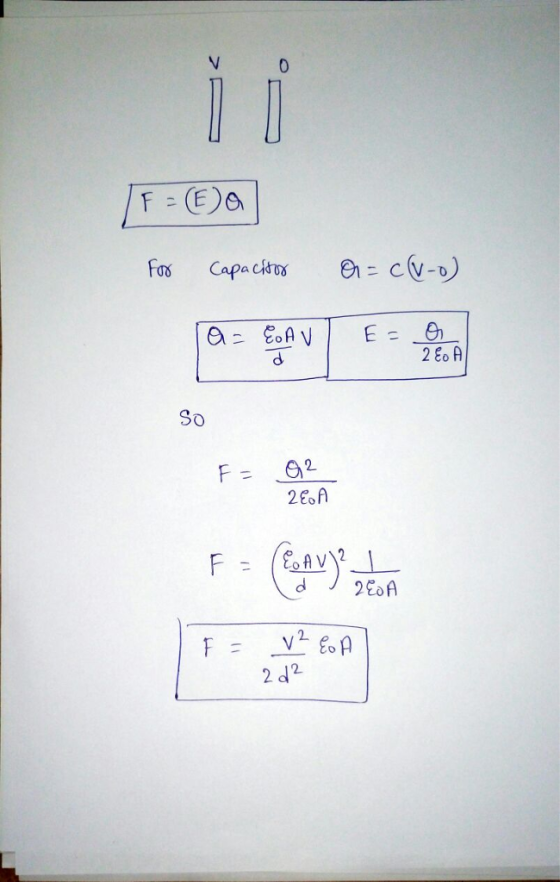
A parallel plate capacitor has a charge Q, plates of area A and separation d, where , so that we can disregard the fringe field. Show that the magnitude of the force exerted on each plate by the other is F = Q2/(2e0A).You may use (with care!) the expression F = QE, or consider the change in potential energy of the capacitor as you change the separation of the plates. Or you may do both.
A parallel plate capacitor is constructed with plate area of 0.80 m2 and a plate separation...
A parallel plate capacitor is constructed with plate area of 0.80 m2 and a plate separation of 0.10 mm. When it is charged to a potential difference of 12 V, the charge stored on it is = micro C. A parallel plate capacitor is constructed with plate area of 0.40 m2 and a plate separation of 0.10 mm. When it is charged to a potential difference of 12 V, the charge stored on it is= micro C. A parallel-plate capacitor...
A parallel plate capacitor is constructed with plate area of 0.40 m2 and a plate separation...
A parallel plate capacitor is constructed with plate area of 0.40 m2 and a plate separation of 0.10 mm. How much charge is stored on it when it is charged to a potential difference of 12 V? A parallel-plate capacitor is filled with air, and the plates are separated by 0.050 mm. If the capacitance is 17.3 pF, what is the plate area? A parallel plate capacitor is constructed with plate area of 0.0010 m2 and a plate separation of...
5. The two metal plates having an area A and a separation d from parallel-plate capacitor. The upper plate is...
 5. The two metal plates having an area A and a separation d from parallel-plate capacitor. The upper plate is held at a potential of Va and the lower plate is grounded. Determine: a) The potential distribution b) The electric field intensity e) The charge distribution on each plate d) The capacitance of the parallel plate capacitor z0 A charged particle of mass 2 kg and 1 C starts at the origin with velocity 3a, m/s and travels in a...
Q. 1 A parallel-plate capacitor has plates with an area of 1.1×10⁻² m2 and a separation...
Q. 1 A parallel-plate capacitor has plates with an area of 1.1×10⁻² m2 and a separation of 0.80 mm . The space between the plates is filled with a dielectric whose dielectric constant is 1.9. A. What is the potential difference between the plates when the charge on the capacitor plates is 4.1 μC ? B. Will your answer to part A increase, decrease, or stay the same if the dielectric constant is increased? Q 2. Point charges 3.7...
The figure shows a parallel-plate capacitor of plate area A and plate separation d. A potential differenceV0 is applied between the plates.
 The figure shows a parallel-plate capacitor of plate area A and plate separation d. A potential differenceV0 is applied between the plates. While the
battery remains connected, a dielectric slab of thickness b and dielectric constant κ is placed between the plates
as shown. Assume A = 130 cm2, d = 1.94
cm, V0 = 72.6 V, b = 0.735 cm, and κ =
3.15. Calculate (a) the capacitance,(b) the charge on the capacitor plates,(c) the electric field in the gap, and(d)...
The figure shows a parallel-plate capacitor of plate area A and plate separation d. A potential differenceV0 is applied between the plates. While the
battery remains connected, a dielectric slab of thickness b and dielectric constant κ is placed between the plates
as shown. Assume A = 130 cm2, d = 1.94
cm, V0 = 72.6 V, b = 0.735 cm, and κ =
3.15. Calculate (a) the capacitance,(b) the charge on the capacitor plates,(c) the electric field in the gap, and(d)...
2. Consider a capacitor created when two identical conducting plates are placed parallel and close to...
 2. Consider a capacitor created when two identical conducting plates are placed parallel and close to each in other in vacuum The surface area for each plate is e.0400 m2. The two plates are separated by a distance of e.00200 m. When an electric potential difference of 5e.e v is established between the two plates, what is the magnitude of the electrostatic force between the charged plates? Is the force attractive or repulsive? 3. What mass on the Earth surface...
A parallel plate capacitor has plates of area 0.96 m2 and a separation of 1.37 mm....
 A parallel plate capacitor has plates of area 0.96 m2 and a separation of 1.37 mm. The potential difference between the plates is 3.38 kV. Find the magnitude of the charge (in micro-Coulomb) on each plate
A parallel plate capacitor has plates of area 0.96 m2 and a separation of 1.37 mm....
 A parallel plate capacitor has plates of area 0.96 m2 and a separation of 1.37 mm. The potential difference between the plates is 3.38 kV. Find the magnitude of the charge (in micro-Coulomb) on each plate
A parallel-plate capacitor (Homework #2) A parallel-plate capacitor is made by a pair of plates with...
 A parallel-plate capacitor (Homework #2) A parallel-plate capacitor is made by a pair of plates with area A and separation d. At first, the plates are charged up to +Q and -O respectively, and then a battery is disconnected. Express all the answers for a) through f) only by Q, d, A and 5 +Q 2d -Q Area A a) What is the electric field E inside of the capacitor? b) What is the potential difference V between the plates?...
 5. The two metal plates having an area A and a separation d from parallel-plate capacitor. The upper plate is held at a potential of Va and the lower plate is grounded. Determine: a) The potential distribution b) The electric field intensity e) The charge distribution on each plate d) The capacitance of the parallel plate capacitor z0 A charged particle of mass 2 kg and 1 C starts at the origin with velocity 3a, m/s and travels in a...
 2. Consider a capacitor created when two identical conducting plates are placed parallel and close to each in other in vacuum The surface area for each plate is e.0400 m2. The two plates are separated by a distance of e.00200 m. When an electric potential difference of 5e.e v is established between the two plates, what is the magnitude of the electrostatic force between the charged plates? Is the force attractive or repulsive? 3. What mass on the Earth surface...
 A parallel plate capacitor has plates of area 0.96 m2 and a separation of 1.37 mm. The potential difference between the plates is 3.38 kV. Find the magnitude of the charge (in micro-Coulomb) on each plate
 A parallel plate capacitor has plates of area 0.96 m2 and a separation of 1.37 mm. The potential difference between the plates is 3.38 kV. Find the magnitude of the charge (in micro-Coulomb) on each plate
 A parallel-plate capacitor (Homework #2) A parallel-plate capacitor is made by a pair of plates with area A and separation d. At first, the plates are charged up to +Q and -O respectively, and then a battery is disconnected. Express all the answers for a) through f) only by Q, d, A and 5 +Q 2d -Q Area A a) What is the electric field E inside of the capacitor? b) What is the potential difference V between the plates?...
Most questions answered within 3 hours.
-
Where is the error in this code sequence?
String s1 = "Hello";
String s2 = "ello";...
asked 10 months ago -
Financial data for Joel de Paris, Inc., for last year
follow:
Joel de Paris, Inc.
Balance...
asked 10 months ago -
Consider this reaction:
Al2(SO4)3 (aq)+ BaCl3
(aq) Al2Cl6 (aq)- +
3BaSO4(s) . What is the...
asked 10 months ago -
Suppose that Savneet is considering increasing her
recent random sample from 20 car rentals to 40...
asked 10 months ago -
Trucks arrive at an unloading terminal at an average rate of 120
per hour.
Trucks arrive...
asked 10 months ago -
Why are methanol and ethanol completely soluble in water while
octanol is not very little soluble....
asked 10 months ago -
A facilities manager at a university reads in a research report
that the mean amount of...
asked 10 months ago -
When the CuSO4 is rehydrated by adding water to the anhydrous
compound, is this an endothermic...
asked 10 months ago -
A ray of sunlight is passing from diamond into crown glass; the
angle of incidence is...
asked 10 months ago -
A block of mass 0.249 kg is placed on top of a light, vertical
spring of...
asked 10 months ago -
how do the kidneys compensate in the presences of acidosis
a) trigger hyperventilate
b) reserve acid...
asked 10 months ago -
Question 501 pts
The rental rate of capital to the firm increases. Which of the
following...
asked 10 months ago