What part of this question did I get wrong? Thank you so much!!

Homework Answers

Add Answer to:
What part of this question did I get wrong? Thank you so
much!!
The reaction shown...
This is an example from our textbook. The substrate turned into a tertiary carbocation and then...
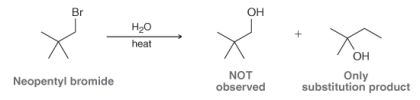 This is an example from our textbook.
The substrate turned into a tertiary carbocation and then
underwent a nucleophilic attack from water and formed an SN1
product. But my text has the following table for reaction
predictions:
In this situation, water is a weak base/weak nucleophile and the
substrate is tertiary so you would expect a mix of SN1 and E1
products per the table. But the example says that SN1 product is
the only product. Should the example have...
This is an example from our textbook.
The substrate turned into a tertiary carbocation and then
underwent a nucleophilic attack from water and formed an SN1
product. But my text has the following table for reaction
predictions:
In this situation, water is a weak base/weak nucleophile and the
substrate is tertiary so you would expect a mix of SN1 and E1
products per the table. But the example says that SN1 product is
the only product. Should the example have...
For the Diels-Alder reaction I need to know what each of these components are please help:...
For the Diels-Alder reaction I need to know what each of these components are please help: for example I need to know if the substrate is primary tertiary, etc. If the nucleophile/base is strong or weak? if the solvent is polar aprotic, ect? if the temp is low high or in between and if the leaving group is good, bad ect? and what type of reaction is this? I think it is E2 but not sure. I don't understand how...
Predict the major product(s) expected given the reagents shown below. Answer the following questions and use...
 Predict the major product(s) expected given the reagents shown below. Answer the following questions and use the answer so identify the likely mechanists pathway(s) (e.g., E2 or E1eB) Be sure to include the answers to the questions! What is the electrophile for this reaction? (Mark it with an*) Is the electrophilie carbon primary, secondary, tertiary, Is the leaving group excellent okay, or poor? (eg Good LG) Is the considered to be strong or weak? (e.g Strong Nu) Can the nueleophile...
Substitution Problems I. In each of the problems below, label the alkyl halide as primary, secondary, or tertiary. Labe...
 Substitution Problems I. In each of the problems below, label the alkyl halide as primary, secondary, or tertiary. Label the nucleophile as strong or weak. Decide whether an SN2 or an Sy1 reaction occurs. After, show the mechanism and product or products. Indicate stereochemistry where appropriate. a. Reaction of 1-bromopropane and sodium methoxide in methanol CH3 Na CH,Oн Br b. Reaction of 2-bromopropane in ethanol CH3CH2OH Br c. Reaction of (R) 3-chloro-3-methyl heptane in acetic acid Ci Cн CH,COOH но...
need help with the boxed bullet point. writing the chemical reaction scheme for the experiment. Synthesis of an A...
 need help with the boxed bullet point. writing the chemical
reaction scheme for the experiment.
Synthesis of an Alkyl Halide: A Nucleophilic Substitution Reaction, Part I Pre-lab Assignment for Synthesis of an Alkyl Halide: A Nucleophilic Substitution Reaction, Part 1 1. From The Organic Chem Lab Survival Manual ( edition) by Zubrick • Review pages 201-204: Standard Reflux. • Review pages 127-140: Extraction • Review pages 164-189: Distillation, Simple Distillation. The Distillation Example, and The Distillation Mistake. 2. Read this...
need help with the boxed bullet point. writing the chemical
reaction scheme for the experiment.
Synthesis of an Alkyl Halide: A Nucleophilic Substitution Reaction, Part I Pre-lab Assignment for Synthesis of an Alkyl Halide: A Nucleophilic Substitution Reaction, Part 1 1. From The Organic Chem Lab Survival Manual ( edition) by Zubrick • Review pages 201-204: Standard Reflux. • Review pages 127-140: Extraction • Review pages 164-189: Distillation, Simple Distillation. The Distillation Example, and The Distillation Mistake. 2. Read this...
Please show all work! Thank you so much 4. (0.5pt) When a single compound contains both a nucleophile and a leav...
 Please show all work! Thank you so much
4. (0.5pt) When a single compound contains both a nucleophile and a leaving group, an intramolecular reaction may occur. With this in mind, draw the product of the following reaction. OHS но CH1002 Br Br Bro 5. (7pts) Draw a stepwise, detailed mechanism for the following reaction. N. ci CH3NH2 (excess) CH3NH3
Please show all work! Thank you so much
4. (0.5pt) When a single compound contains both a nucleophile and a leaving group, an intramolecular reaction may occur. With this in mind, draw the product of the following reaction. OHS но CH1002 Br Br Bro 5. (7pts) Draw a stepwise, detailed mechanism for the following reaction. N. ci CH3NH2 (excess) CH3NH3
Substitution Problems I. In each of the problems below, label the alkyl halide as primary, secondary,...
 Substitution Problems I. In each of the problems below, label the alkyl halide as primary, secondary, or tertiary, Label the nucleophile as strong or weak. Decide whether an S2 or an Sol reaction occurs. Alter, show the mechanism and product or products. Indicate stereochemistry where appropriate. a. Reaction of 1-bromopropane and sodium methoxide in methanol + Na CH₂ CH OH b. Reaction of 2-bromopropane in ethanol Br + CH.CH, OH - c. Reaction of (R) 3-chloro-3-methylheptane in acetic acid CH3...
The two reactants shown below are combined to bring about a nucleophilic substitution reaction. F +...
 The two reactants shown below are combined to bring about a nucleophilic substitution reaction. F + Nal IT g. HI h. Nat i. none f. HF Which letter designates the electrophilic carbon at which substitution occurs? (If no reaction occurs enter the letter corresponding to "none.") Which letter corresponds to the leaving group? Which letter designates the nucleophile? Submit Answer Try Another Version 1 item attempt remaining
if i could explanations and help with these! thank you so much! 4. What is(are) the...
 if i could explanations and help with these! thank you so
much!
4. What is(are) the major organic product(s) obtained from the following substitution reaction? - Ho 1 OH 2 OH a. b. c. d. only 1 only 2 only 1 and 2 1, 2 and 3 Which of the following statements is not true regarding S 2 reactions? a. A carbocation intermediate is formed. b. The mechanism has only one step. c. Aprotic solvents are good choices for Syl...
if i could explanations and help with these! thank you so
much!
4. What is(are) the major organic product(s) obtained from the following substitution reaction? - Ho 1 OH 2 OH a. b. c. d. only 1 only 2 only 1 and 2 1, 2 and 3 Which of the following statements is not true regarding S 2 reactions? a. A carbocation intermediate is formed. b. The mechanism has only one step. c. Aprotic solvents are good choices for Syl...
I need help. -87.8 and 87.8 is wrong. Please and thank you so much. Calculate delta...
 I need help. -87.8 and 87.8 is
wrong. Please and thank you so much.
Calculate delta H degree for the reaction. Enter your answer in the provided box. CH_3OH + HI rightarrow CH_3I + H_2O kJ/mol
I need help. -87.8 and 87.8 is
wrong. Please and thank you so much.
Calculate delta H degree for the reaction. Enter your answer in the provided box. CH_3OH + HI rightarrow CH_3I + H_2O kJ/mol
 This is an example from our textbook.
The substrate turned into a tertiary carbocation and then
underwent a nucleophilic attack from water and formed an SN1
product. But my text has the following table for reaction
predictions:
In this situation, water is a weak base/weak nucleophile and the
substrate is tertiary so you would expect a mix of SN1 and E1
products per the table. But the example says that SN1 product is
the only product. Should the example have...
This is an example from our textbook.
The substrate turned into a tertiary carbocation and then
underwent a nucleophilic attack from water and formed an SN1
product. But my text has the following table for reaction
predictions:
In this situation, water is a weak base/weak nucleophile and the
substrate is tertiary so you would expect a mix of SN1 and E1
products per the table. But the example says that SN1 product is
the only product. Should the example have...
 Predict the major product(s) expected given the reagents shown below. Answer the following questions and use the answer so identify the likely mechanists pathway(s) (e.g., E2 or E1eB) Be sure to include the answers to the questions! What is the electrophile for this reaction? (Mark it with an*) Is the electrophilie carbon primary, secondary, tertiary, Is the leaving group excellent okay, or poor? (eg Good LG) Is the considered to be strong or weak? (e.g Strong Nu) Can the nueleophile...
 Substitution Problems I. In each of the problems below, label the alkyl halide as primary, secondary, or tertiary. Label the nucleophile as strong or weak. Decide whether an SN2 or an Sy1 reaction occurs. After, show the mechanism and product or products. Indicate stereochemistry where appropriate. a. Reaction of 1-bromopropane and sodium methoxide in methanol CH3 Na CH,Oн Br b. Reaction of 2-bromopropane in ethanol CH3CH2OH Br c. Reaction of (R) 3-chloro-3-methyl heptane in acetic acid Ci Cн CH,COOH но...
 need help with the boxed bullet point. writing the chemical
reaction scheme for the experiment.
Synthesis of an Alkyl Halide: A Nucleophilic Substitution Reaction, Part I Pre-lab Assignment for Synthesis of an Alkyl Halide: A Nucleophilic Substitution Reaction, Part 1 1. From The Organic Chem Lab Survival Manual ( edition) by Zubrick • Review pages 201-204: Standard Reflux. • Review pages 127-140: Extraction • Review pages 164-189: Distillation, Simple Distillation. The Distillation Example, and The Distillation Mistake. 2. Read this...
need help with the boxed bullet point. writing the chemical
reaction scheme for the experiment.
Synthesis of an Alkyl Halide: A Nucleophilic Substitution Reaction, Part I Pre-lab Assignment for Synthesis of an Alkyl Halide: A Nucleophilic Substitution Reaction, Part 1 1. From The Organic Chem Lab Survival Manual ( edition) by Zubrick • Review pages 201-204: Standard Reflux. • Review pages 127-140: Extraction • Review pages 164-189: Distillation, Simple Distillation. The Distillation Example, and The Distillation Mistake. 2. Read this...
 Please show all work! Thank you so much
4. (0.5pt) When a single compound contains both a nucleophile and a leaving group, an intramolecular reaction may occur. With this in mind, draw the product of the following reaction. OHS но CH1002 Br Br Bro 5. (7pts) Draw a stepwise, detailed mechanism for the following reaction. N. ci CH3NH2 (excess) CH3NH3
Please show all work! Thank you so much
4. (0.5pt) When a single compound contains both a nucleophile and a leaving group, an intramolecular reaction may occur. With this in mind, draw the product of the following reaction. OHS но CH1002 Br Br Bro 5. (7pts) Draw a stepwise, detailed mechanism for the following reaction. N. ci CH3NH2 (excess) CH3NH3
 Substitution Problems I. In each of the problems below, label the alkyl halide as primary, secondary, or tertiary, Label the nucleophile as strong or weak. Decide whether an S2 or an Sol reaction occurs. Alter, show the mechanism and product or products. Indicate stereochemistry where appropriate. a. Reaction of 1-bromopropane and sodium methoxide in methanol + Na CH₂ CH OH b. Reaction of 2-bromopropane in ethanol Br + CH.CH, OH - c. Reaction of (R) 3-chloro-3-methylheptane in acetic acid CH3...
 The two reactants shown below are combined to bring about a nucleophilic substitution reaction. F + Nal IT g. HI h. Nat i. none f. HF Which letter designates the electrophilic carbon at which substitution occurs? (If no reaction occurs enter the letter corresponding to "none.") Which letter corresponds to the leaving group? Which letter designates the nucleophile? Submit Answer Try Another Version 1 item attempt remaining
 if i could explanations and help with these! thank you so
much!
4. What is(are) the major organic product(s) obtained from the following substitution reaction? - Ho 1 OH 2 OH a. b. c. d. only 1 only 2 only 1 and 2 1, 2 and 3 Which of the following statements is not true regarding S 2 reactions? a. A carbocation intermediate is formed. b. The mechanism has only one step. c. Aprotic solvents are good choices for Syl...
if i could explanations and help with these! thank you so
much!
4. What is(are) the major organic product(s) obtained from the following substitution reaction? - Ho 1 OH 2 OH a. b. c. d. only 1 only 2 only 1 and 2 1, 2 and 3 Which of the following statements is not true regarding S 2 reactions? a. A carbocation intermediate is formed. b. The mechanism has only one step. c. Aprotic solvents are good choices for Syl...
 I need help. -87.8 and 87.8 is
wrong. Please and thank you so much.
Calculate delta H degree for the reaction. Enter your answer in the provided box. CH_3OH + HI rightarrow CH_3I + H_2O kJ/mol
I need help. -87.8 and 87.8 is
wrong. Please and thank you so much.
Calculate delta H degree for the reaction. Enter your answer in the provided box. CH_3OH + HI rightarrow CH_3I + H_2O kJ/mol
Most questions answered within 3 hours.
-
Where is the error in this code sequence?
String s1 = "Hello";
String s2 = "ello";...
asked 10 months ago -
Financial data for Joel de Paris, Inc., for last year
follow:
Joel de Paris, Inc.
Balance...
asked 10 months ago -
Consider this reaction:
Al2(SO4)3 (aq)+ BaCl3
(aq) Al2Cl6 (aq)- +
3BaSO4(s) . What is the...
asked 10 months ago -
Suppose that Savneet is considering increasing her
recent random sample from 20 car rentals to 40...
asked 10 months ago -
Trucks arrive at an unloading terminal at an average rate of 120
per hour.
Trucks arrive...
asked 10 months ago -
Why are methanol and ethanol completely soluble in water while
octanol is not very little soluble....
asked 10 months ago -
A facilities manager at a university reads in a research report
that the mean amount of...
asked 10 months ago -
When the CuSO4 is rehydrated by adding water to the anhydrous
compound, is this an endothermic...
asked 10 months ago -
A ray of sunlight is passing from diamond into crown glass; the
angle of incidence is...
asked 10 months ago -
A block of mass 0.249 kg is placed on top of a light, vertical
spring of...
asked 10 months ago -
how do the kidneys compensate in the presences of acidosis
a) trigger hyperventilate
b) reserve acid...
asked 10 months ago -
Question 501 pts
The rental rate of capital to the firm increases. Which of the
following...
asked 10 months ago