
Homework Answers
Request Answer!
We need at least 10 more requests to produce the answer.
0 / 10 have requested this problem solution
The more requests, the faster the answer.
Add Answer to:
8. Why acetylation/succinylation reactions are common in anabolic pathway? Explain why acetylation/succinylation is needed for each...
Germination of a bacterial spore requires both anabolic and catabolic chemical reactions to occur." Explain what...
Germination of a bacterial spore requires both anabolic and catabolic chemical reactions to occur." Explain what is meant by this statement, providing an example of an anabolic reaction needed for sporulation and an example of a catabolic reaction needed for sporulation.
7. (True/false) Because glycolysis produces pyruvate, glycolysis is an anabolic pathway, • True • False 8....
 7. (True/false) Because glycolysis produces pyruvate, glycolysis is an anabolic pathway, • True • False 8. Which metabolism is better equipped to support chemotaxis? • Aerobic respiration • Anaerobic respiration • Aerobic chemolithotrophic metabolisms • Gycolysis alone • Tricarboxylic acid cycle alone 9. Comparing a Saccharomyces cerevisiae yeast cell to a Staphylococcus aureus bacterial cell, which one would have the higher S/V ratio? • Staphylococcus aureus • Saccharomyces cerevisiae 10. (True/false) Metabolic pathways represent a predictable linear set of reactions...
please explain why for each answer in table 4.Keduced organic compounds tend to contain stored energy...
 please explain why for each answer in table
4.Keduced organic compounds tend to contain stored energy in C-H bonds. As a general rule, the greater the number of C-H bonds, the greater the amount of potential energy stored in the molecule. Answer cach question in the chart as it relates to the two reactions shown at the top. Be sure to explain the reasoning behind your answers. ogniwolle talo Reaction 1: CH, +20, H,O+CO, (methane) Reaction 2: 600, +6H, O...
please explain why for each answer in table
4.Keduced organic compounds tend to contain stored energy in C-H bonds. As a general rule, the greater the number of C-H bonds, the greater the amount of potential energy stored in the molecule. Answer cach question in the chart as it relates to the two reactions shown at the top. Be sure to explain the reasoning behind your answers. ogniwolle talo Reaction 1: CH, +20, H,O+CO, (methane) Reaction 2: 600, +6H, O...
5. In class, we discussed the following reactions and how they differ in their regioselectivity. Provide...
 5. In class, we discussed the following reactions and how they differ in their regioselectivity. Provide the product for each reaction and discuss why the regioselectivity is observed in each case. Draw diagrams to explain your answer.[8 points) 1) BH3. THE 2) H2O2, OH H₂O H2SO4
6. (True/false) Because glycolysis produces pyruvate, glycolysis is an anabolic pathway. • True False 7. Which...
 6. (True/false) Because glycolysis produces pyruvate, glycolysis is an anabolic pathway. • True False 7. Which metabolism is better equipped to support chemotaxis? • Aerobic respiration • Anaerobic respiration • Aerobic chemolitbatrophic metabolisms Gxcalysis alone • Tricarboxylic acid cycle alone 8. Comparing a Saccharomyces cerevisiae yeast cell to a Staphylococcus aureus bacterial cell, which one would have the higher S/V ratio? • Staphylococcus aureus • Saccharomyces cerevisiae 9. (True/false) Metabolic pathways represent a predictable linear set of reactions in the...
For each of the reactions or products given choose the metabolic pathway or pathways where that...
For each of the reactions or products given choose the metabolic pathway or pathways where that reaction occurs or the product is made. The topic for this problem is aerobic respiration. Some responses may be used more than once while others may not be used at all. FAD is reduced to FADH2 Redox reactions occur the choices are: 1) Glycolysis 2) Pyruvate Dehydrogenase 3) Krebs Cycle 4) Electron Transport Chain 5) Both Glycolysis and Pyruvate Dehydrogenase 6) Both Glycolysis and...
v For each of the following reactions, explain why they are spontaneous or non spontaneous based...
 v For each of the following reactions, explain why they are spontaneous or non spontaneous based on the change in entropy of the reaction 2N20 (0) -> O2 (8) --> 2N2 (8) Decrease in the number of mole and phase change from gas to aqueous solutic A both decrease entropy N2 (g)+ 3H2(g) -> 2NH3 (8) B Decrease in the number of mole decreases entropy + CaCO3 (8) -> CaO (5) + CO2 (g) Increase in the number of mole...
1) Compare and contrast SN1, SN2, E1, and E2 reactions! (similarities abd differences. Requirements for each...
 1) Compare and contrast SN1, SN2, E1, and E2 reactions!
(similarities abd differences. Requirements for each to
work.)
2) Why is SN2 is in direct competition with E2 while SN1 is
direct competition with E1 reaction.
3) Rate expression of each
4) which reactions are concerted? Which are atep wise?
5) which are sterospecific and what stereospecificity of each
are?
6) how do the variables below (A-D) influence reaction
pathway?
Compare and contrast SNI, SN2, El and E2 reactions. What...
1) Compare and contrast SN1, SN2, E1, and E2 reactions!
(similarities abd differences. Requirements for each to
work.)
2) Why is SN2 is in direct competition with E2 while SN1 is
direct competition with E1 reaction.
3) Rate expression of each
4) which reactions are concerted? Which are atep wise?
5) which are sterospecific and what stereospecificity of each
are?
6) how do the variables below (A-D) influence reaction
pathway?
Compare and contrast SNI, SN2, El and E2 reactions. What...
SHORT ANSWER AND DISCUSSION. 4. Calculate the degrees of unsaturation for each of the following molecular formulas...
 SHORT ANSWER AND DISCUSSION. 4. Calculate the degrees of unsaturation for each of the following molecular formulas and draw a structure is consistent. Show your work! [8 points] CHgCl2 CH, NO 5. In class, we discussed the following reactions and how they differ in their regioselectivity. Provide the product for each reaction and discuss why the regiosclectivity is observed in each case. Draw diagrams to explain your answer. [8 points). 1) BH3. THE 2) H2O2, OH H2O H2SO4
Please explain the answer completely. 2. (8 points) Indicate whether each of these reactions requires heat...
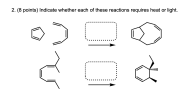 Please explain the answer completely.
2. (8 points) Indicate whether each of these reactions requires heat or light. ---------
Please explain the answer completely.
2. (8 points) Indicate whether each of these reactions requires heat or light. ---------
 7. (True/false) Because glycolysis produces pyruvate, glycolysis is an anabolic pathway, • True • False 8. Which metabolism is better equipped to support chemotaxis? • Aerobic respiration • Anaerobic respiration • Aerobic chemolithotrophic metabolisms • Gycolysis alone • Tricarboxylic acid cycle alone 9. Comparing a Saccharomyces cerevisiae yeast cell to a Staphylococcus aureus bacterial cell, which one would have the higher S/V ratio? • Staphylococcus aureus • Saccharomyces cerevisiae 10. (True/false) Metabolic pathways represent a predictable linear set of reactions...
 please explain why for each answer in table
4.Keduced organic compounds tend to contain stored energy in C-H bonds. As a general rule, the greater the number of C-H bonds, the greater the amount of potential energy stored in the molecule. Answer cach question in the chart as it relates to the two reactions shown at the top. Be sure to explain the reasoning behind your answers. ogniwolle talo Reaction 1: CH, +20, H,O+CO, (methane) Reaction 2: 600, +6H, O...
please explain why for each answer in table
4.Keduced organic compounds tend to contain stored energy in C-H bonds. As a general rule, the greater the number of C-H bonds, the greater the amount of potential energy stored in the molecule. Answer cach question in the chart as it relates to the two reactions shown at the top. Be sure to explain the reasoning behind your answers. ogniwolle talo Reaction 1: CH, +20, H,O+CO, (methane) Reaction 2: 600, +6H, O...
 5. In class, we discussed the following reactions and how they differ in their regioselectivity. Provide the product for each reaction and discuss why the regioselectivity is observed in each case. Draw diagrams to explain your answer.[8 points) 1) BH3. THE 2) H2O2, OH H₂O H2SO4
 6. (True/false) Because glycolysis produces pyruvate, glycolysis is an anabolic pathway. • True False 7. Which metabolism is better equipped to support chemotaxis? • Aerobic respiration • Anaerobic respiration • Aerobic chemolitbatrophic metabolisms Gxcalysis alone • Tricarboxylic acid cycle alone 8. Comparing a Saccharomyces cerevisiae yeast cell to a Staphylococcus aureus bacterial cell, which one would have the higher S/V ratio? • Staphylococcus aureus • Saccharomyces cerevisiae 9. (True/false) Metabolic pathways represent a predictable linear set of reactions in the...
 v For each of the following reactions, explain why they are spontaneous or non spontaneous based on the change in entropy of the reaction 2N20 (0) -> O2 (8) --> 2N2 (8) Decrease in the number of mole and phase change from gas to aqueous solutic A both decrease entropy N2 (g)+ 3H2(g) -> 2NH3 (8) B Decrease in the number of mole decreases entropy + CaCO3 (8) -> CaO (5) + CO2 (g) Increase in the number of mole...
 1) Compare and contrast SN1, SN2, E1, and E2 reactions!
(similarities abd differences. Requirements for each to
work.)
2) Why is SN2 is in direct competition with E2 while SN1 is
direct competition with E1 reaction.
3) Rate expression of each
4) which reactions are concerted? Which are atep wise?
5) which are sterospecific and what stereospecificity of each
are?
6) how do the variables below (A-D) influence reaction
pathway?
Compare and contrast SNI, SN2, El and E2 reactions. What...
1) Compare and contrast SN1, SN2, E1, and E2 reactions!
(similarities abd differences. Requirements for each to
work.)
2) Why is SN2 is in direct competition with E2 while SN1 is
direct competition with E1 reaction.
3) Rate expression of each
4) which reactions are concerted? Which are atep wise?
5) which are sterospecific and what stereospecificity of each
are?
6) how do the variables below (A-D) influence reaction
pathway?
Compare and contrast SNI, SN2, El and E2 reactions. What...
 SHORT ANSWER AND DISCUSSION. 4. Calculate the degrees of unsaturation for each of the following molecular formulas and draw a structure is consistent. Show your work! [8 points] CHgCl2 CH, NO 5. In class, we discussed the following reactions and how they differ in their regioselectivity. Provide the product for each reaction and discuss why the regiosclectivity is observed in each case. Draw diagrams to explain your answer. [8 points). 1) BH3. THE 2) H2O2, OH H2O H2SO4
 Please explain the answer completely.
2. (8 points) Indicate whether each of these reactions requires heat or light. ---------
Please explain the answer completely.
2. (8 points) Indicate whether each of these reactions requires heat or light. ---------
Most questions answered within 3 hours.
-
Where is the error in this code sequence?
String s1 = "Hello";
String s2 = "ello";...
asked 10 months ago -
Financial data for Joel de Paris, Inc., for last year
follow:
Joel de Paris, Inc.
Balance...
asked 10 months ago -
Consider this reaction:
Al2(SO4)3 (aq)+ BaCl3
(aq) Al2Cl6 (aq)- +
3BaSO4(s) . What is the...
asked 10 months ago -
Suppose that Savneet is considering increasing her
recent random sample from 20 car rentals to 40...
asked 10 months ago -
Trucks arrive at an unloading terminal at an average rate of 120
per hour.
Trucks arrive...
asked 10 months ago -
Why are methanol and ethanol completely soluble in water while
octanol is not very little soluble....
asked 10 months ago -
A facilities manager at a university reads in a research report
that the mean amount of...
asked 10 months ago -
When the CuSO4 is rehydrated by adding water to the anhydrous
compound, is this an endothermic...
asked 10 months ago -
A ray of sunlight is passing from diamond into crown glass; the
angle of incidence is...
asked 10 months ago -
A block of mass 0.249 kg is placed on top of a light, vertical
spring of...
asked 10 months ago -
how do the kidneys compensate in the presences of acidosis
a) trigger hyperventilate
b) reserve acid...
asked 10 months ago -
Question 501 pts
The rental rate of capital to the firm increases. Which of the
following...
asked 10 months ago