
Homework Answers
Add Answer to:
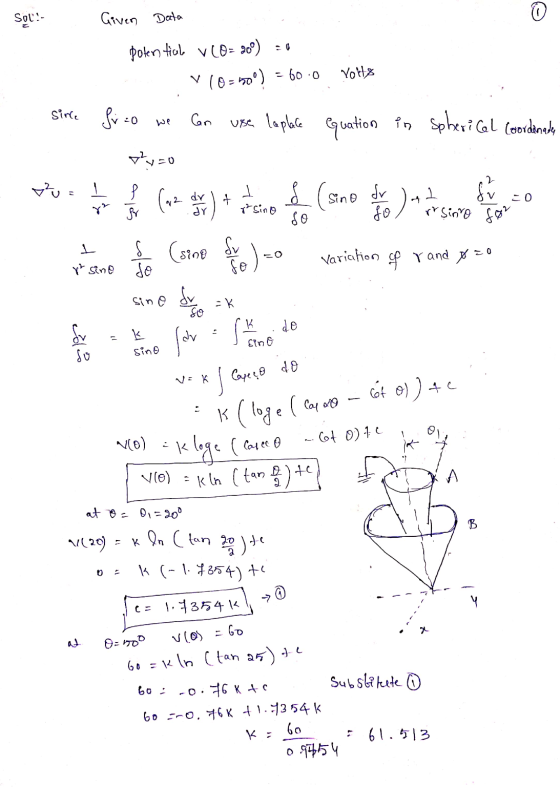
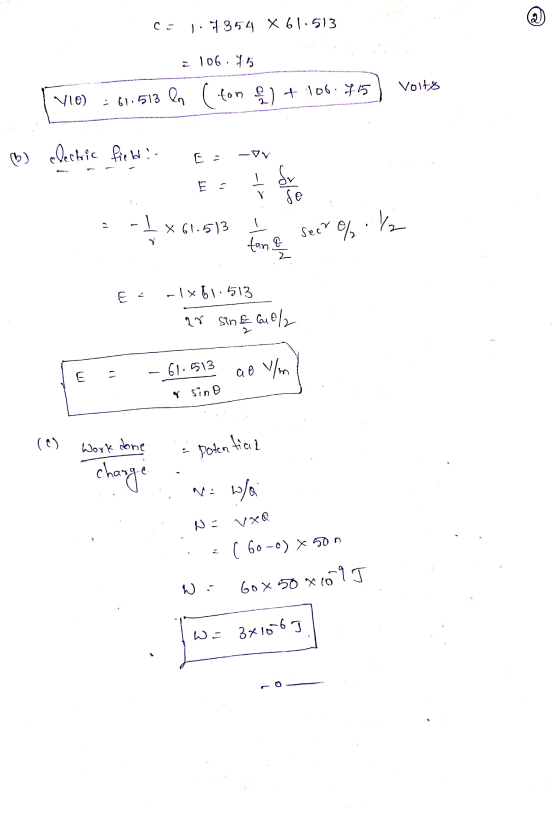
Two conducting cones extending to infinity are placed as shown in the figure. The inner conductor...
[3.3] A conducting shell of outer radius 0.25 m and inner radius 0.21 m contains another...
 [3.3] A conducting shell of outer radius 0.25 m and inner radius 0.21 m contains another conducting shell of outer radius 0.18 m and inner radius 0.12 m; both shells are centered at the origin, where there is a positive point charge, Q12.0 nC. If the electric potential is defined to be V- 0 at infinity, what is the electric potential of each conductor?
Q.3 Consider an infinitely long coaxial structure shown in the figure below. Inner conductor has a...
 Q.3 Consider an infinitely long coaxial structure shown in the figure below. Inner conductor has a radius a and outer conducting shell has a radius b. Thickness of the outer conductor is ignored as it is very small. Between two conductors, there is a magnetic material with permeability () = Mo a Assume that the current I is distributed uniformly over the cross-section of the inner conductor whereas it flows on the surface of the outer conductor. a) Find the...
get the solution 1. A coaxial transmission line has inner and outer conductor radii a and b. Between conductors (a &...
 get
the solution
1. A coaxial transmission line has inner and outer conductor radii a and b. Between conductors (a < ρ < b) lies a conductive medium whose conductivity is σ(p)- /p, where σ0is a constant. The inner conductor is charged to potential V0, and the outer conductor is grounded. (a) Assuming de radial current I per unit length inz, determine the radial current density field J in A/m2. (b) Determine the electric field intensity E in terms of...
get
the solution
1. A coaxial transmission line has inner and outer conductor radii a and b. Between conductors (a < ρ < b) lies a conductive medium whose conductivity is σ(p)- /p, where σ0is a constant. The inner conductor is charged to potential V0, and the outer conductor is grounded. (a) Assuming de radial current I per unit length inz, determine the radial current density field J in A/m2. (b) Determine the electric field intensity E in terms of...
A coaxial cable, as shown in Figure 2, consists of an inner conductor of radius a,...
 A coaxial cable, as shown in Figure 2, consists of an inner conductor of radius a, surrounded by an outer conductor of radius b, along the same axis. The space is filled with dielectric. The cable is connected to a power supply and it is deposited a charge of +Q uniformly along the length of the surface of the inner conductor and a charge - Q uniformly along the length of the inner surface of the outer conductor. No fields...
18. A infinitely long cable consists of a solid cylindrical inner conductor of radius a, surrounded...
 18. A infinitely long cable consists of a solid cylindrical inner conductor of radius a, surrounded by a concentric cylindrical conducting shell of inner radius b and outer radius c. The inner conductor has a non-uniform current density (r) = ar in the z direction shown. a is a positive constant with units A-m'. The outer conductor has a uniform current density: Jr) = -B (in negative z). B has the same unit as a. The conductors carry equal and...
Shown in the figure below are concentric conducting sphere and conducting spherical shell that are connected...
 Shown in the figure below are concentric conducting sphere and conducting spherical shell that are connected by a conducting wire. The geometrical parameters displayed in the figure are given: a=0.63 cm, b=23.94 cm and c=26.6 cm. The system is charged by adding charge qa=3.25 nC to the core and charge ac=11.125 nC to the shell as shown. b с rac qa What is the potential difference V between the center of the spherical core and infinity?: V= V. Find how...
The figure shows an inner metallic sphere (Conductor I) centered inside a spherical cavity located inside...
 The figure shows an inner metallic sphere (Conductor I) centered inside a spherical cavity located inside another metallic sphere (Conductor II). The radii a, band care defined in the figure. Charges Q, and Qu have been placed on Conductors I and II respectively, so that the total charge is Qtot = Q1 + Qui- (a) Find the surface charge densities oa, Ob, and oc (see figure). Explain why your solution works. (b) What is the field outside conductor II? (c)...
consider two thin conducting spherical shells as shown in the figure 9 Consider two thin, conducting,...
 consider two thin conducting spherical shells as shown in the
figure
9 Consider two thin, conducting, spherical shells as shown in the figure. The inner shell has a radius n=15.0 cm and a charge of 10.0 nC. The outer shell has a radius rz=30.0 cm and a charge of 15.0 nC. Find (a) the electric field E and (b) the electric potential V in regions A, B, and C, with V=0 at-o. 0 An air-filled capacitor consists of two parallel...
consider two thin conducting spherical shells as shown in the
figure
9 Consider two thin, conducting, spherical shells as shown in the figure. The inner shell has a radius n=15.0 cm and a charge of 10.0 nC. The outer shell has a radius rz=30.0 cm and a charge of 15.0 nC. Find (a) the electric field E and (b) the electric potential V in regions A, B, and C, with V=0 at-o. 0 An air-filled capacitor consists of two parallel...
Perfect conductor Pe= 4.5x10 C/m? 2.8 2 cm Perfect dielectric Perfect conductor Figure 2. Dielectric separated...
 Perfect conductor Pe= 4.5x10 C/m? 2.8 2 cm Perfect dielectric Perfect conductor Figure 2. Dielectric separated by two perfect conductors. A perfect dielectric is separated by two perfect-conductor plates as in Figure.2. On the surface of the top plate there is a uniform surface charge density of 4.5 x 10+ C/m2 as shown. In the perfect dielectric region the electric field is uniformly distributed. (25) a) Calculate the electric field intensity and discuss if there is a breakdown in the...
Question 2 1. Two perfectly conducting cylinders ra and rb form an inductor of length d, as shown...
 Question 2 1. Two perfectly conducting cylinders ra and rb form an inductor of length d, as shown in the figure below. The total current I flowing on the surface r-α of the inner cylinder is returned through the outer conductor r - b. The medium between the two conductors has magnetic permeability m a) Find the magnetic field intensity H everywhere, disregarding "edge effects" (i.e. assuming that the a, b and hence, it can be considered as infinite) length...
 [3.3] A conducting shell of outer radius 0.25 m and inner radius 0.21 m contains another conducting shell of outer radius 0.18 m and inner radius 0.12 m; both shells are centered at the origin, where there is a positive point charge, Q12.0 nC. If the electric potential is defined to be V- 0 at infinity, what is the electric potential of each conductor?
 Q.3 Consider an infinitely long coaxial structure shown in the figure below. Inner conductor has a radius a and outer conducting shell has a radius b. Thickness of the outer conductor is ignored as it is very small. Between two conductors, there is a magnetic material with permeability () = Mo a Assume that the current I is distributed uniformly over the cross-section of the inner conductor whereas it flows on the surface of the outer conductor. a) Find the...
 get
the solution
1. A coaxial transmission line has inner and outer conductor radii a and b. Between conductors (a < ρ < b) lies a conductive medium whose conductivity is σ(p)- /p, where σ0is a constant. The inner conductor is charged to potential V0, and the outer conductor is grounded. (a) Assuming de radial current I per unit length inz, determine the radial current density field J in A/m2. (b) Determine the electric field intensity E in terms of...
get
the solution
1. A coaxial transmission line has inner and outer conductor radii a and b. Between conductors (a < ρ < b) lies a conductive medium whose conductivity is σ(p)- /p, where σ0is a constant. The inner conductor is charged to potential V0, and the outer conductor is grounded. (a) Assuming de radial current I per unit length inz, determine the radial current density field J in A/m2. (b) Determine the electric field intensity E in terms of...
 A coaxial cable, as shown in Figure 2, consists of an inner conductor of radius a, surrounded by an outer conductor of radius b, along the same axis. The space is filled with dielectric. The cable is connected to a power supply and it is deposited a charge of +Q uniformly along the length of the surface of the inner conductor and a charge - Q uniformly along the length of the inner surface of the outer conductor. No fields...
 18. A infinitely long cable consists of a solid cylindrical inner conductor of radius a, surrounded by a concentric cylindrical conducting shell of inner radius b and outer radius c. The inner conductor has a non-uniform current density (r) = ar in the z direction shown. a is a positive constant with units A-m'. The outer conductor has a uniform current density: Jr) = -B (in negative z). B has the same unit as a. The conductors carry equal and...
 Shown in the figure below are concentric conducting sphere and conducting spherical shell that are connected by a conducting wire. The geometrical parameters displayed in the figure are given: a=0.63 cm, b=23.94 cm and c=26.6 cm. The system is charged by adding charge qa=3.25 nC to the core and charge ac=11.125 nC to the shell as shown. b с rac qa What is the potential difference V between the center of the spherical core and infinity?: V= V. Find how...
 The figure shows an inner metallic sphere (Conductor I) centered inside a spherical cavity located inside another metallic sphere (Conductor II). The radii a, band care defined in the figure. Charges Q, and Qu have been placed on Conductors I and II respectively, so that the total charge is Qtot = Q1 + Qui- (a) Find the surface charge densities oa, Ob, and oc (see figure). Explain why your solution works. (b) What is the field outside conductor II? (c)...
 consider two thin conducting spherical shells as shown in the
figure
9 Consider two thin, conducting, spherical shells as shown in the figure. The inner shell has a radius n=15.0 cm and a charge of 10.0 nC. The outer shell has a radius rz=30.0 cm and a charge of 15.0 nC. Find (a) the electric field E and (b) the electric potential V in regions A, B, and C, with V=0 at-o. 0 An air-filled capacitor consists of two parallel...
consider two thin conducting spherical shells as shown in the
figure
9 Consider two thin, conducting, spherical shells as shown in the figure. The inner shell has a radius n=15.0 cm and a charge of 10.0 nC. The outer shell has a radius rz=30.0 cm and a charge of 15.0 nC. Find (a) the electric field E and (b) the electric potential V in regions A, B, and C, with V=0 at-o. 0 An air-filled capacitor consists of two parallel...
 Perfect conductor Pe= 4.5x10 C/m? 2.8 2 cm Perfect dielectric Perfect conductor Figure 2. Dielectric separated by two perfect conductors. A perfect dielectric is separated by two perfect-conductor plates as in Figure.2. On the surface of the top plate there is a uniform surface charge density of 4.5 x 10+ C/m2 as shown. In the perfect dielectric region the electric field is uniformly distributed. (25) a) Calculate the electric field intensity and discuss if there is a breakdown in the...
 Question 2 1. Two perfectly conducting cylinders ra and rb form an inductor of length d, as shown in the figure below. The total current I flowing on the surface r-α of the inner cylinder is returned through the outer conductor r - b. The medium between the two conductors has magnetic permeability m a) Find the magnetic field intensity H everywhere, disregarding "edge effects" (i.e. assuming that the a, b and hence, it can be considered as infinite) length...
Most questions answered within 3 hours.
-
Where is the error in this code sequence?
String s1 = "Hello";
String s2 = "ello";...
asked 10 months ago -
Financial data for Joel de Paris, Inc., for last year
follow:
Joel de Paris, Inc.
Balance...
asked 10 months ago -
Consider this reaction:
Al2(SO4)3 (aq)+ BaCl3
(aq) Al2Cl6 (aq)- +
3BaSO4(s) . What is the...
asked 10 months ago -
Suppose that Savneet is considering increasing her
recent random sample from 20 car rentals to 40...
asked 10 months ago -
Trucks arrive at an unloading terminal at an average rate of 120
per hour.
Trucks arrive...
asked 10 months ago -
Why are methanol and ethanol completely soluble in water while
octanol is not very little soluble....
asked 10 months ago -
A facilities manager at a university reads in a research report
that the mean amount of...
asked 10 months ago -
When the CuSO4 is rehydrated by adding water to the anhydrous
compound, is this an endothermic...
asked 10 months ago -
A ray of sunlight is passing from diamond into crown glass; the
angle of incidence is...
asked 10 months ago -
A block of mass 0.249 kg is placed on top of a light, vertical
spring of...
asked 10 months ago -
how do the kidneys compensate in the presences of acidosis
a) trigger hyperventilate
b) reserve acid...
asked 10 months ago -
Question 501 pts
The rental rate of capital to the firm increases. Which of the
following...
asked 10 months ago