
Homework Answers
Add Answer to:
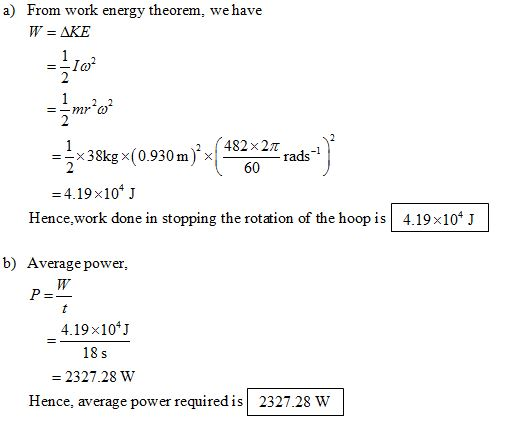
A 38.0 kg wheal, essentially a thin hoop with radius 0.930 m, is rotating at 482...
A 12.0 kg wheel, essentially a thin hoop with radius 0.810 m, is rotating at 104...
A 12.0 kg wheel, essentially a thin hoop with radius 0.810 m, is rotating at 104 rev/min. It must be brought to a stop in 30.0 s. (a) How much work must be done to stop it? (b) What is the required average power? Give absolute values for both parts.
A 28.0 kg wheel, essentially a thin hoop with radius 0.530 m, is rotating at 424...
A 28.0 kg wheel, essentially a thin hoop with radius 0.530 m, is rotating at 424 rev/min. It must be brought to a stop in 25.0 s. (a) How much work must be done to stop it? (b) What is the required average power? Give absolute values for both parts.
A 33.0 kg wheel, essentially a thin hoop with radius 2.30 m, is rotating at 275...
A 33.0 kg wheel, essentially a thin hoop with radius 2.30 m, is rotating at 275 rev/min. It must be brought to a stop in 24.0 s. (a) How much work must be done to stop it? (b) What is the required average power? Give absolute values for both parts.
A 28.0 kg wheel, essentially a thin hoop with radius 1.00 m, is rotating at 320...
A 28.0 kg wheel, essentially a thin hoop with radius 1.00 m, is rotating at 320 rev/min. It must be brought to a stop in 11 s. How much work must be done to stop it? What is the required average power?
A 38.0 kg wheel, essentially a thin hoop with radius 1.30 m, is rotating at 280...
A 38.0 kg wheel, essentially a thin hoop with radius 1.30 m, is rotating at 280 rev/min. It must be brought to a stop in 13 s. How much work must be done to stop it? Why isn't translational kenetic energy accouted for in this question? I only used rotational kenetic energy for my answer and I appeared to get the right answer. Can you please explain or correct me if I'm wrong.
Chapter 10, Problem 061 A 15.0 kg wheel, essentially a thin hoop with radius 2.30 m,...
 Chapter 10, Problem 061 A 15.0 kg wheel, essentially a thin hoop with radius 2.30 m, is rotating at 165 rev/min. It must be brought to a stop in 26,.0 s. (a) How much work must be done to stop t (b) What . It must be is the required average power? Give absolute valuesfor both parts. (a) Number (b) Number l the tolerance is +/-50%-units Units SHOW HINT
A hoop (thin walled hollow cylinder) of mass 2.3 kg, radius 0.37 m, is rotating at...
 A hoop (thin walled hollow cylinder) of mass 2.3 kg, radius 0.37 m, is rotating at 6.39 radians/s about the symmetric axis. Calculate its rotational kinetic energy in Joules to 2 significant figures Answer: I
A thin hoop (I = 1.31 kg m^2) is rotating with an angular velocity of 4.6...
A thin hoop (I = 1.31 kg m^2) is rotating with an angular velocity of 4.6 rad/s. Five identical globs of putty are then attached to the rotating hoop. If the hoop has a radius of 0.52 m and each particle-like piece of putty had a mass of 0.45 kg, what would be the angular velocity of the resulting hoop-putty system? A. 2.8 rad/s B. 3.1 rad/s C. 4.2 rad/s D. 3.6 rad/s
A thin hoop of radius r = 0.82 m and mass M = 7.3 kg rolls...
A thin hoop of radius r = 0.82 m and mass M = 7.3 kg rolls without slipping across a horizontal floor with a velocity v = 1.1 m/s. It then rolls up an incline with an angle of inclination theta = 44 degrees. a) What is the maximum height h reached by the hoop before rolling back down the incline? b) Now, suppose a uniform solid sphere is used instead of a hoop. Use the same values of r,...
A potter's wheel—a thick stone disk of radius 0.500 m and mass 125 kg—is freely rotating...
A potter's wheel—a thick stone disk of radius 0.500 m and mass 125 kg—is freely rotating at 50.0 rev/min. The potter can stop the wheel in 6.00 s by pressing a wet rag against the rim and exerting a radially inward force of 71.0 N. Find the effective coefficient of kinetic friction between the wheel and rag.
 Chapter 10, Problem 061 A 15.0 kg wheel, essentially a thin hoop with radius 2.30 m, is rotating at 165 rev/min. It must be brought to a stop in 26,.0 s. (a) How much work must be done to stop t (b) What . It must be is the required average power? Give absolute valuesfor both parts. (a) Number (b) Number l the tolerance is +/-50%-units Units SHOW HINT
 A hoop (thin walled hollow cylinder) of mass 2.3 kg, radius 0.37 m, is rotating at 6.39 radians/s about the symmetric axis. Calculate its rotational kinetic energy in Joules to 2 significant figures Answer: I
Most questions answered within 3 hours.
-
Where is the error in this code sequence?
String s1 = "Hello";
String s2 = "ello";...
asked 10 months ago -
Financial data for Joel de Paris, Inc., for last year
follow:
Joel de Paris, Inc.
Balance...
asked 10 months ago -
Consider this reaction:
Al2(SO4)3 (aq)+ BaCl3
(aq) Al2Cl6 (aq)- +
3BaSO4(s) . What is the...
asked 10 months ago -
Suppose that Savneet is considering increasing her
recent random sample from 20 car rentals to 40...
asked 10 months ago -
Trucks arrive at an unloading terminal at an average rate of 120
per hour.
Trucks arrive...
asked 10 months ago -
Why are methanol and ethanol completely soluble in water while
octanol is not very little soluble....
asked 10 months ago -
A facilities manager at a university reads in a research report
that the mean amount of...
asked 10 months ago -
When the CuSO4 is rehydrated by adding water to the anhydrous
compound, is this an endothermic...
asked 10 months ago -
A ray of sunlight is passing from diamond into crown glass; the
angle of incidence is...
asked 10 months ago -
A block of mass 0.249 kg is placed on top of a light, vertical
spring of...
asked 10 months ago -
how do the kidneys compensate in the presences of acidosis
a) trigger hyperventilate
b) reserve acid...
asked 10 months ago -
Question 501 pts
The rental rate of capital to the firm increases. Which of the
following...
asked 10 months ago