
Homework Answers
Add Answer to:
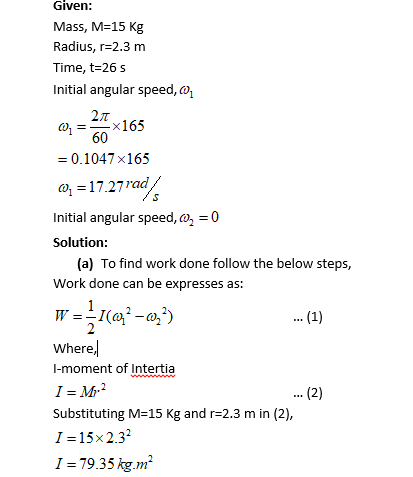
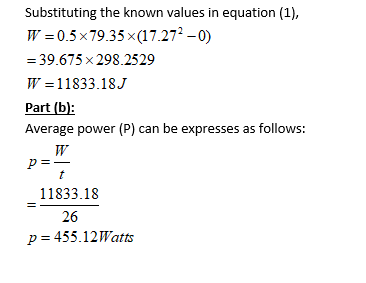
Chapter 10, Problem 061 A 15.0 kg wheel, essentially a thin hoop with radius 2.30 m,...
A 33.0 kg wheel, essentially a thin hoop with radius 2.30 m, is rotating at 275...
A 33.0 kg wheel, essentially a thin hoop with radius 2.30 m, is rotating at 275 rev/min. It must be brought to a stop in 24.0 s. (a) How much work must be done to stop it? (b) What is the required average power? Give absolute values for both parts.
A 12.0 kg wheel, essentially a thin hoop with radius 0.810 m, is rotating at 104...
A 12.0 kg wheel, essentially a thin hoop with radius 0.810 m, is rotating at 104 rev/min. It must be brought to a stop in 30.0 s. (a) How much work must be done to stop it? (b) What is the required average power? Give absolute values for both parts.
A 28.0 kg wheel, essentially a thin hoop with radius 0.530 m, is rotating at 424...
A 28.0 kg wheel, essentially a thin hoop with radius 0.530 m, is rotating at 424 rev/min. It must be brought to a stop in 25.0 s. (a) How much work must be done to stop it? (b) What is the required average power? Give absolute values for both parts.
A 28.0 kg wheel, essentially a thin hoop with radius 1.00 m, is rotating at 320...
A 28.0 kg wheel, essentially a thin hoop with radius 1.00 m, is rotating at 320 rev/min. It must be brought to a stop in 11 s. How much work must be done to stop it? What is the required average power?
A 38.0 kg wheal, essentially a thin hoop with radius 0.930 m, is rotating at 482...
 A 38.0 kg wheal, essentially a thin hoop with radius 0.930 m, is rotating at 482 rev/min. It must be brought to a stop in 18.0 s. How much work must be done stop it? What is the required average power? Give absolute values for both parts.
A 38.0 kg wheel, essentially a thin hoop with radius 1.30 m, is rotating at 280...
A 38.0 kg wheel, essentially a thin hoop with radius 1.30 m, is rotating at 280 rev/min. It must be brought to a stop in 13 s. How much work must be done to stop it? Why isn't translational kenetic energy accouted for in this question? I only used rotational kenetic energy for my answer and I appeared to get the right answer. Can you please explain or correct me if I'm wrong.
Chapter 10, Problem 028 In the figure, wheel A of radius rA 11.0 cm is coupled...
 Chapter 10, Problem 028 In the figure, wheel A of radius rA 11.0 cm is coupled by belt B to wheel C of radius rc for wheel C to reach an angular speed of 140 rev/min, a 6.7 cm. The angular speed of wheel A is increased from rest at a constant rate of 2.58 radira?. Find the time neneded 2 in, assuming the belt does not slip. (Hint: If the belt does not slip, the linear speeds at the...
In the ligure, wheel A of radius A-8.74 cm is coupled by belt 8 to wheel...
 In the ligure, wheel A of radius A-8.74 cm is coupled by belt 8 to wheel of radius - 20.4 cm. The angular speed of wheel A is increased from rest at a constant rate of 2.18 rad/s. Find the time needed for wheel to reach an angular speed of 131 rev/min, assuming the belt does not slip. (Hint: If the belt does not so, the linear speeds at the two rims must be equal Number Units the tolerance is...
Chapter 10, Problem 007 e wheel in the figure has eight equally spaced spokes and a...
 Chapter 10, Problem 007 e wheel in the figure has eight equally spaced spokes and a radius of 28 crn. It is mounted on a fixed axle and is spinning at 5.0 rev/s You want to shoot a 21m the wheel without hitting any of the spokes. Assume that the arrow and the spokes are very thin. What minimum speed must the arrow have? "row shi-n" ad' 써"rough Units Number +/-5%
Chapter 11, Problem 081 A uniform wheel of mass 10.0 kg and radius 0.400 m is...
 Chapter 11, Problem 081 A uniform wheel of mass 10.0 kg and radius 0.400 m is mounted rigidly on an axle through its center (see the figure). The radius of the axle is 0.200 m, and the rotational inertia of the wheel-axle combination about its central axis is 0.600 kg-m2. The wheel is initially at rest at the top of a surface that is inclined at angle 58.4° with the horizontal; the axle rests on the surface while the wheel...
 A 38.0 kg wheal, essentially a thin hoop with radius 0.930 m, is rotating at 482 rev/min. It must be brought to a stop in 18.0 s. How much work must be done stop it? What is the required average power? Give absolute values for both parts.
 Chapter 10, Problem 028 In the figure, wheel A of radius rA 11.0 cm is coupled by belt B to wheel C of radius rc for wheel C to reach an angular speed of 140 rev/min, a 6.7 cm. The angular speed of wheel A is increased from rest at a constant rate of 2.58 radira?. Find the time neneded 2 in, assuming the belt does not slip. (Hint: If the belt does not slip, the linear speeds at the...
 In the ligure, wheel A of radius A-8.74 cm is coupled by belt 8 to wheel of radius - 20.4 cm. The angular speed of wheel A is increased from rest at a constant rate of 2.18 rad/s. Find the time needed for wheel to reach an angular speed of 131 rev/min, assuming the belt does not slip. (Hint: If the belt does not so, the linear speeds at the two rims must be equal Number Units the tolerance is...
 Chapter 10, Problem 007 e wheel in the figure has eight equally spaced spokes and a radius of 28 crn. It is mounted on a fixed axle and is spinning at 5.0 rev/s You want to shoot a 21m the wheel without hitting any of the spokes. Assume that the arrow and the spokes are very thin. What minimum speed must the arrow have? "row shi-n" ad' 써"rough Units Number +/-5%
 Chapter 11, Problem 081 A uniform wheel of mass 10.0 kg and radius 0.400 m is mounted rigidly on an axle through its center (see the figure). The radius of the axle is 0.200 m, and the rotational inertia of the wheel-axle combination about its central axis is 0.600 kg-m2. The wheel is initially at rest at the top of a surface that is inclined at angle 58.4° with the horizontal; the axle rests on the surface while the wheel...
Most questions answered within 3 hours.
-
Where is the error in this code sequence?
String s1 = "Hello";
String s2 = "ello";...
asked 10 months ago -
Financial data for Joel de Paris, Inc., for last year
follow:
Joel de Paris, Inc.
Balance...
asked 10 months ago -
Consider this reaction:
Al2(SO4)3 (aq)+ BaCl3
(aq) Al2Cl6 (aq)- +
3BaSO4(s) . What is the...
asked 10 months ago -
Suppose that Savneet is considering increasing her
recent random sample from 20 car rentals to 40...
asked 10 months ago -
Trucks arrive at an unloading terminal at an average rate of 120
per hour.
Trucks arrive...
asked 10 months ago -
Why are methanol and ethanol completely soluble in water while
octanol is not very little soluble....
asked 10 months ago -
A facilities manager at a university reads in a research report
that the mean amount of...
asked 10 months ago -
When the CuSO4 is rehydrated by adding water to the anhydrous
compound, is this an endothermic...
asked 10 months ago -
A ray of sunlight is passing from diamond into crown glass; the
angle of incidence is...
asked 10 months ago -
A block of mass 0.249 kg is placed on top of a light, vertical
spring of...
asked 10 months ago -
how do the kidneys compensate in the presences of acidosis
a) trigger hyperventilate
b) reserve acid...
asked 10 months ago -
Question 501 pts
The rental rate of capital to the firm increases. Which of the
following...
asked 10 months ago