![em sets: Compute the weakest precondition for the following sequence of assignment statements and their postconditions (3pts]](http://img.homeworklib.com/questions/4d193b80-3db3-11eb-b71e-e7b0f0eefcfd.png?x-oss-process=image/resize,w_560)

Homework Answers

Add Answer to:
how
do you solve this?
em sets: Compute the weakest precondition for the following sequence of...
Compute the weakest precondition for each of the following assignment statements and postconditions: a = 2...
Compute the weakest precondition for each of the following assignment statements and postconditions: a = 2 * (b - 1) - 1 {a > 0} b = (c + 10) / 3 {b > 6} Prove that the following grammar is ambiguous (show 2 trees): <S> → <A> <A> → <A> + <A> | <id> <id> → a | b | c
3. Find the weakest precondition for the following sequence of statements and its post-condition: a-2b +...
 3. Find the weakest precondition for the following sequence of statements and its post-condition: a-2b + 1; b = a - 3; {b > 2)
Compute the weakest precondition for the following sequence of statements, given the stated post condition. Hint:...
Compute the weakest precondition for the following sequence of statements, given the stated post condition. Hint: Start by deciding what variable or variables should be mentioned in the precondition. Recall the rule for sequences: the precondition for a statement in a sequence is equal to the post-condition for the statement that precedes it. Note: Your answer will involve a relationship between a and b. {??} x = 4 * (3 * y – x); y = 2 * x –...
Compute the weakest precondition for the following statements A. if (x == y) x=x*3 else x=x+1...
Compute the weakest precondition for the following statements A. if (x == y) x=x*3 else x=x+1 {x < 0} B. x = 3 * (y + x); y= 3*x ; {y > 6}
2. (8 points) A sequence of statements is listed below: b = (a+4)/2 c=2* b-5 d...
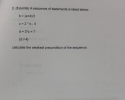 2. (8 points) A sequence of statements is listed below: b = (a+4)/2 c=2* b-5 d = 3*c+ 7 {d>4} calculate the weakest precondition of the sequence.
2. Consider the following grammar: <assign> à <id> = <expr>
2. Consider the following grammar: <assign> à <id> = <expr> <id> à A | B | C <expr> à <id> + <expr> | <id> * <expr> | ( <expr> ) | <id> Show a parse tree and leftmost derivation for the following statements: (a) A = ( A + B ) * C (b) A = A * ( B + C ) 3. [10 Points] Show that the following grammar is...
2. (15 marks) Consider the following program: >> Precondition: x and y E Z. Postcondition: Return...
 2. (15 marks) Consider the following program: >> Precondition: x and y E Z. Postcondition: Return the sum x + y. add(x, y): 1. if x == 0: 2. return y 3. elif x > 0: 4. return add(x - 1, y) + 1 5. else: 6. return add(x + 1, y) - 1 Prove that this program is correct in terms of its specification.
How do you seal sequence 2 (from 5'end) to the 3' end of the sequence 1...
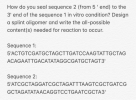 How do you seal sequence 2 (from 5'end) to the 3' end of the sequence 1 in vitro condition? Design a splint oligomer and write the all-possible content(s) needed for reaction to occur. Sequence 1: 5'ACTGTCGATGCTAGCTTGATCCAAGTATTGCTAG ACAGAATTGACATATAGGCGATGCTAGT3 Sequence 2: 5'ATCGCTAGGATCGCTAGATTTAAGTCGCTGATCG GCTAGATATAACAGGTCCTGAATCGCTA3
Please solve with solution. Answer is provided 9. Consider the following four sets of functions: How...
 Please solve with solution. Answer is provided
9. Consider the following four sets of functions: How many sets are linearly dependent? A. 0 B. 1 C. 2 D. 3 E. 4 Correct Answer is C
Please solve with solution. Answer is provided
9. Consider the following four sets of functions: How many sets are linearly dependent? A. 0 B. 1 C. 2 D. 3 E. 4 Correct Answer is C
Let a sequence Xo, X1,X2,... be defined in the following way: X12 1) Compute the first...
 Let a sequence Xo, X1,X2,... be defined in the following way: X12 1) Compute the first 10 terms of this sequence. (2 points) 2) Prove that this sequence is strictly increasing, .e., Vn 20:X >X. (2 points) 3) Prove that Vn 20: Xn S4". What are the base cases? What is the inductive step? (5 points) 4) The above result suggests that this sequence grows in the worst case exponentially, i.e., X 0(4). Consider trying to tighten this bound in...
 3. Find the weakest precondition for the following sequence of statements and its post-condition: a-2b + 1; b = a - 3; {b > 2)
 2. (8 points) A sequence of statements is listed below: b = (a+4)/2 c=2* b-5 d = 3*c+ 7 {d>4} calculate the weakest precondition of the sequence.
 2. (15 marks) Consider the following program: >> Precondition: x and y E Z. Postcondition: Return the sum x + y. add(x, y): 1. if x == 0: 2. return y 3. elif x > 0: 4. return add(x - 1, y) + 1 5. else: 6. return add(x + 1, y) - 1 Prove that this program is correct in terms of its specification.
 How do you seal sequence 2 (from 5'end) to the 3' end of the sequence 1 in vitro condition? Design a splint oligomer and write the all-possible content(s) needed for reaction to occur. Sequence 1: 5'ACTGTCGATGCTAGCTTGATCCAAGTATTGCTAG ACAGAATTGACATATAGGCGATGCTAGT3 Sequence 2: 5'ATCGCTAGGATCGCTAGATTTAAGTCGCTGATCG GCTAGATATAACAGGTCCTGAATCGCTA3
 Please solve with solution. Answer is provided
9. Consider the following four sets of functions: How many sets are linearly dependent? A. 0 B. 1 C. 2 D. 3 E. 4 Correct Answer is C
Please solve with solution. Answer is provided
9. Consider the following four sets of functions: How many sets are linearly dependent? A. 0 B. 1 C. 2 D. 3 E. 4 Correct Answer is C
 Let a sequence Xo, X1,X2,... be defined in the following way: X12 1) Compute the first 10 terms of this sequence. (2 points) 2) Prove that this sequence is strictly increasing, .e., Vn 20:X >X. (2 points) 3) Prove that Vn 20: Xn S4". What are the base cases? What is the inductive step? (5 points) 4) The above result suggests that this sequence grows in the worst case exponentially, i.e., X 0(4). Consider trying to tighten this bound in...
Most questions answered within 3 hours.
-
Where is the error in this code sequence?
String s1 = "Hello";
String s2 = "ello";...
asked 10 months ago -
Financial data for Joel de Paris, Inc., for last year
follow:
Joel de Paris, Inc.
Balance...
asked 10 months ago -
Consider this reaction:
Al2(SO4)3 (aq)+ BaCl3
(aq) Al2Cl6 (aq)- +
3BaSO4(s) . What is the...
asked 10 months ago -
Suppose that Savneet is considering increasing her
recent random sample from 20 car rentals to 40...
asked 10 months ago -
Trucks arrive at an unloading terminal at an average rate of 120
per hour.
Trucks arrive...
asked 10 months ago -
Why are methanol and ethanol completely soluble in water while
octanol is not very little soluble....
asked 10 months ago -
A facilities manager at a university reads in a research report
that the mean amount of...
asked 10 months ago -
When the CuSO4 is rehydrated by adding water to the anhydrous
compound, is this an endothermic...
asked 10 months ago -
A ray of sunlight is passing from diamond into crown glass; the
angle of incidence is...
asked 10 months ago -
A block of mass 0.249 kg is placed on top of a light, vertical
spring of...
asked 10 months ago -
how do the kidneys compensate in the presences of acidosis
a) trigger hyperventilate
b) reserve acid...
asked 10 months ago -
Question 501 pts
The rental rate of capital to the firm increases. Which of the
following...
asked 10 months ago