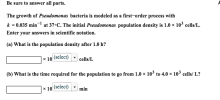
The growth of Pseudomonas bacteria is modeled as a first-order process with k = 0.035 min−1...
The growth of Pseudomonas bacteria is modeled as a
first-order process with k = 0.035 min−1 at
37°C. The initial Pseudomonas population density is 1.0
×103 cells/L. Enter your answers in scientific
notation.
(a) What is the population density after 3.0 h?
_____×10____cells/L
(b) What is the time required for the population to go from 1.0
×103 to 4.0 ×10³ cells/ L?
_____×10____ min
Homework Answers

Add Answer to:
The growth of Pseudomonas bacteria is modeled as a
first-order process with k = 0.035 min−1...
The growth of Pseudomonas bacteria is modeled as a first-order process with k = 0.035 min^-1...
 The growth of Pseudomonas bacteria is modeled as a first-order process with k = 0.035 min^-1 at 37degreeC. The initial Pseudomonas population density is 1.0 times 10^3 cells/L. Enter your answers in scientific notation. What is the population density after 1.0 h? What is the time required for the population to go from 1.0 times 10^3 to 4.0 times 10^3 cells/ L?
The growth rate of a particular bacteria is modeled by the differential equation dP/dt = k P. Suppose a population at...
 The growth rate of a particular bacteria is modeled by the differential equation dP/dt = k P. Suppose a population at of bacteria doubles in size every 11 hours. Initially, there are 200 bacteria cells. If we begin growing the bacteria for our experiment at 7: 00pm on September 4, when is the earliest the necessary 5,000,000 bacteria cells will be ready? a) September 07 at 12: 00pm b) September 07 at 9: 00pm c) September 08 at 8: 00am...
The rate constant k for a certain first-order reaction is 0.60 min–1. What is the initial...
The rate constant k for a certain first-order reaction is 0.60 min–1. What is the initial rate, if the initial concentration of the reactant is 0.10 M?
First order Trendline for Ina R2 = 0.997 Ina 0 -1 -2 10 8 6 2...
 First order Trendline for Ina R2 = 0.997 Ina 0 -1 -2 10 8 6 2 Time (hours) n (A) M Lecure notes Po.3 5 pts each 7. In lecture, real experimental data was presented for the decomposition reaction wherein N2Os decomposed to NO2 and O2 at 30C. Use the data provided to answer the following three questions a) Assume that the order of the reaction with respect to N:Os is either 1 What is the order? Support your contention...
Given a second order process: 2 AB → A2 + B2 with k = 0.095 M-1min-1;...
Given a second order process: 2 AB → A2 + B2 with k = 0.095 M-1min-1; and the initial concentration of AB = 1.054 M, calculate the concentration of A2 after exactly 30.3 min. Enter the result to 3 decimal places and no units.
1-The rate constant of a chemical reaction was measured at several temperature values and a plot...
1-The rate constant of a chemical reaction was measured at several temperature values and a plot of ln k (on the y-axis) was plotted against 1/T (on the x-axis, temperature was measured in Kelvin). If the slope of the plot was -9.21 x 10³ K and the y-intercept was 13.0, what is the activation energy (EA) of the reaction in kJ mol-1? 2-In an enzyme-catalyzed reaction, the rate of the reaction depends on which of the following at very low...
Compounds A and B are unstable and each decomposes by a first-order process. At 398 K,...
 Compounds A and B are unstable and each decomposes by a first-order process. At 398 K, the rate constant for the decomposition of A is 3.6 X 10⁻⁵ s-1. Separate containers of A and B were prepared, with initial concentrations of 0.120 M A and 0.240 M B. After 5 hrs, it was found that the concentration of A was three times the concentration of B wwww What was the concentration of A after 5 hrs? 2) 1) What is...
What is the solution for this first order nonlinear differential equation of this SIR model with...
 What is the solution for this first order nonlinear differential equation of this SIR model with these initial conditions? S(t)=not infected individuals (1) l(t)- Currently Infected (588) R(t)- recovered individuals (0) This will be a nonlinear first order differential equation(ODE) dasi d/dt-sal-kt di/dt a (s-k/a) i dr/dt-ki Total population will be modeled by this equation consistent with the SlR model. d(S+l+R)/dt= -saltsal-kltkl-0 Solution: i stk/aln stK Model the topic using a differential equation. a) Draw any visuals (diagrams) that exemplify...
x'=r (1 - 2 / 2 x where r and K are positive constants, is called...
 x'=r (1 - 2 / 2 x where r and K are positive constants, is called the logistic equation. It is used in a number of scientific disciplines, but primarily (and historically) in population dynamics where z(t) is the size (numbers or density) of individuals in a biological population. For application to population dynamics ä(t) cannot be negative. If the solution (t) vanishes at some time, then we interpret this biologically as population extinction. (a) Draw the phase line portrait...
help me answer quetion 1 please 11 42% & 17:19 4/ Homework 2- ECH160,pdf Quarter 2,...
 help me answer quetion 1 please
11 42% & 17:19 4/ Homework 2- ECH160,pdf Quarter 2, 2018-2019 ECH 160Homework 2 Instructor: N.T Linh, Dept. OR&P, HUMG Assigned on 24 May, 2019 Due on 27 May, 2019 Problem 1 A mouse-mouse hybridoma cell line is used to produce monoclonal antibody. Growth in batch culture is monitored with the following results. Time (day) Cell concentration (cells/ml) x 10 0.0 0.45 0.2 0.52 0.65 0.5 0.81 1.5 1.22 1.77 2.13 3.0 3.55 4.02...
help me answer quetion 1 please
11 42% & 17:19 4/ Homework 2- ECH160,pdf Quarter 2, 2018-2019 ECH 160Homework 2 Instructor: N.T Linh, Dept. OR&P, HUMG Assigned on 24 May, 2019 Due on 27 May, 2019 Problem 1 A mouse-mouse hybridoma cell line is used to produce monoclonal antibody. Growth in batch culture is monitored with the following results. Time (day) Cell concentration (cells/ml) x 10 0.0 0.45 0.2 0.52 0.65 0.5 0.81 1.5 1.22 1.77 2.13 3.0 3.55 4.02...
 The growth of Pseudomonas bacteria is modeled as a first-order process with k = 0.035 min^-1 at 37degreeC. The initial Pseudomonas population density is 1.0 times 10^3 cells/L. Enter your answers in scientific notation. What is the population density after 1.0 h? What is the time required for the population to go from 1.0 times 10^3 to 4.0 times 10^3 cells/ L?
 The growth rate of a particular bacteria is modeled by the differential equation dP/dt = k P. Suppose a population at of bacteria doubles in size every 11 hours. Initially, there are 200 bacteria cells. If we begin growing the bacteria for our experiment at 7: 00pm on September 4, when is the earliest the necessary 5,000,000 bacteria cells will be ready? a) September 07 at 12: 00pm b) September 07 at 9: 00pm c) September 08 at 8: 00am...
 First order Trendline for Ina R2 = 0.997 Ina 0 -1 -2 10 8 6 2 Time (hours) n (A) M Lecure notes Po.3 5 pts each 7. In lecture, real experimental data was presented for the decomposition reaction wherein N2Os decomposed to NO2 and O2 at 30C. Use the data provided to answer the following three questions a) Assume that the order of the reaction with respect to N:Os is either 1 What is the order? Support your contention...
 Compounds A and B are unstable and each decomposes by a first-order process. At 398 K, the rate constant for the decomposition of A is 3.6 X 10⁻⁵ s-1. Separate containers of A and B were prepared, with initial concentrations of 0.120 M A and 0.240 M B. After 5 hrs, it was found that the concentration of A was three times the concentration of B wwww What was the concentration of A after 5 hrs? 2) 1) What is...
 What is the solution for this first order nonlinear differential equation of this SIR model with these initial conditions? S(t)=not infected individuals (1) l(t)- Currently Infected (588) R(t)- recovered individuals (0) This will be a nonlinear first order differential equation(ODE) dasi d/dt-sal-kt di/dt a (s-k/a) i dr/dt-ki Total population will be modeled by this equation consistent with the SlR model. d(S+l+R)/dt= -saltsal-kltkl-0 Solution: i stk/aln stK Model the topic using a differential equation. a) Draw any visuals (diagrams) that exemplify...
 x'=r (1 - 2 / 2 x where r and K are positive constants, is called the logistic equation. It is used in a number of scientific disciplines, but primarily (and historically) in population dynamics where z(t) is the size (numbers or density) of individuals in a biological population. For application to population dynamics ä(t) cannot be negative. If the solution (t) vanishes at some time, then we interpret this biologically as population extinction. (a) Draw the phase line portrait...
 help me answer quetion 1 please
11 42% & 17:19 4/ Homework 2- ECH160,pdf Quarter 2, 2018-2019 ECH 160Homework 2 Instructor: N.T Linh, Dept. OR&P, HUMG Assigned on 24 May, 2019 Due on 27 May, 2019 Problem 1 A mouse-mouse hybridoma cell line is used to produce monoclonal antibody. Growth in batch culture is monitored with the following results. Time (day) Cell concentration (cells/ml) x 10 0.0 0.45 0.2 0.52 0.65 0.5 0.81 1.5 1.22 1.77 2.13 3.0 3.55 4.02...
help me answer quetion 1 please
11 42% & 17:19 4/ Homework 2- ECH160,pdf Quarter 2, 2018-2019 ECH 160Homework 2 Instructor: N.T Linh, Dept. OR&P, HUMG Assigned on 24 May, 2019 Due on 27 May, 2019 Problem 1 A mouse-mouse hybridoma cell line is used to produce monoclonal antibody. Growth in batch culture is monitored with the following results. Time (day) Cell concentration (cells/ml) x 10 0.0 0.45 0.2 0.52 0.65 0.5 0.81 1.5 1.22 1.77 2.13 3.0 3.55 4.02...
Most questions answered within 3 hours.
-
Where is the error in this code sequence?
String s1 = "Hello";
String s2 = "ello";...
asked 11 months ago -
Financial data for Joel de Paris, Inc., for last year
follow:
Joel de Paris, Inc.
Balance...
asked 11 months ago -
Consider this reaction:
Al2(SO4)3 (aq)+ BaCl3
(aq) Al2Cl6 (aq)- +
3BaSO4(s) . What is the...
asked 11 months ago -
Suppose that Savneet is considering increasing her
recent random sample from 20 car rentals to 40...
asked 11 months ago -
Trucks arrive at an unloading terminal at an average rate of 120
per hour.
Trucks arrive...
asked 11 months ago -
Why are methanol and ethanol completely soluble in water while
octanol is not very little soluble....
asked 11 months ago -
A facilities manager at a university reads in a research report
that the mean amount of...
asked 11 months ago -
When the CuSO4 is rehydrated by adding water to the anhydrous
compound, is this an endothermic...
asked 11 months ago -
A ray of sunlight is passing from diamond into crown glass; the
angle of incidence is...
asked 11 months ago -
A block of mass 0.249 kg is placed on top of a light, vertical
spring of...
asked 11 months ago -
how do the kidneys compensate in the presences of acidosis
a) trigger hyperventilate
b) reserve acid...
asked 11 months ago -
Question 501 pts
The rental rate of capital to the firm increases. Which of the
following...
asked 11 months ago