Given a second order process: 2 AB → A2 + B2 with k = 0.095 M-1min-1;...
Given a second order process:
2 AB → A2 + B2
with k = 0.095 M-1min-1; and the initial concentration of AB = 1.054 M, calculate the concentration of A2 after exactly 30.3 min. Enter the result to 3 decimal places and no units.
Homework Answers

Add Answer to:
Given a second order process:
2 AB → A2 + B2
with k = 0.095 M-1min-1;...
The reaction 2A → A2 was experimentally determined to be second order with a rate constant,...
The reaction 2A → A2 was experimentally determined to be second order with a rate constant, k, equal to 0.0265 M–1min–1. If the initial concentration of A was 5.75 M, what was the concentration of A (in M) after 180.0 min?
The reaction 2A → A2 was experimentally determined to be second order with a rate constant,...
The reaction 2A → A2 was experimentally determined to be second order with a rate constant, k, equal to 0.0265 M–1min–1. If the initial concentration of A was 3.00 M, what was the concentration of A (in M) after 180.0 min? M ?
2. Consider the reaction A2+ B2 = 2AB. If the initial concentration of both A2 and...
 2. Consider the reaction A2+ B2 = 2AB. If the initial concentration of both A2 and B2 is 4.0 M. and after 10 minutes the reaction appears to stop. The concentration of [A2) is now 2.0M. a. Draw a graph of [A2) vs. time, over the span of 20 minutes. 09. (M concertuohon 5 15 20 time (min) b. On the same axes draw a graph of [B2] v time, over a span of 20 minutes. c. On the same...
1. A reaction is second order in[A] and second-order in [B]: Rate,=K[A]^2[B]^2. what are the units...
1. A reaction is second order in[A] and second-order in [B]: Rate,=K[A]^2[B]^2. what are the units of k for this reaction? If the concentration of air decreases by a factor of 2 and the concentration of b increases by a factor of 5 what happens to the rate? 2. for the forward reaction 2NO+Cl2=>2NOCl. determine the rate(m/s)for experiment #4 given [NO]°(M)=0.40M and [Cl2]°z(M)=0?20M. Rate? 3.The following data were collected over time for the forward reaction 2NO2=>2NO+O2 ( 1/[NO2]=100 at 0...
1. For a first order k = 9.09x10⁻³ 1/s. If the initial concentration is 7.06 M...
1. For a first order k = 9.09x10⁻³ 1/s. If the initial concentration is 7.06 M calculate the concentration after 35.0 s. 2. How long does it take the initial concentration of 0.778 M reduce to 0.453 M when k for the first order reaction is 2.11x10⁻² 1/min.? 3. The rate constant for a reaction at 25.0 oC is 2.87x10 -2. What is the rate constant at 55.0 oC? E a= 20.5 kJ. 4. The decomposition of a substance is...
The degradation of atrazine can be described by second-order kinetics with k= 5 L∙mg-1min-1 in a...
The degradation of atrazine can be described by second-order kinetics with k= 5 L∙mg-1min-1 in a reactor. Calculate the volume of a PFR and CSTR required to remove atrazine to the MCL if the flow rate is 2 m3/min and C0 is 0.06 mg/L. Assume steady-state. If it costs $1/gal of tank and $4/gal of tank for a CSTR and a PFR, respectively, determine which type of reactor would be cheaper to construct.
Question 3 1 pts The rate constant, k, of the first order reaction A B +C...
 Question 3 1 pts The rate constant, k, of the first order reaction A B +C is k = 8.62 x 10⁻³⁵-1. If the initial concentration of A is 2.74 M, how long will it take for the concentration of A to fall below 0.32 M? Give your answer to one decimal place in MINUTES (do not input the units). For example, if your answer is 8.956 minutes, enter 9.0 Question 4 1 pts The rate constant, k, of the...
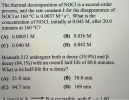
help The thermal decomposition of NOCl is a second-order process, and the rate constant k for...
 help
The thermal decomposition of NOCl is a second-order process, and the rate constant k for the disappearance of NOCI at 160 °C is 0.0037 Msl. What is the concentration of NOCI, initially at 0.043 M, after 20.0 minutes at 160 °C? (A) 0.00051 M (B) 0.036 M (C) 0.040 M (D) 0.042 M Bismuth-212 undergoes both a decay (35.9%) and B decay (64.1%) with an overall half-life of 60.6 minutes. What is its half-life for a decay? (A) 21.8...
help
The thermal decomposition of NOCl is a second-order process, and the rate constant k for the disappearance of NOCI at 160 °C is 0.0037 Msl. What is the concentration of NOCI, initially at 0.043 M, after 20.0 minutes at 160 °C? (A) 0.00051 M (B) 0.036 M (C) 0.040 M (D) 0.042 M Bismuth-212 undergoes both a decay (35.9%) and B decay (64.1%) with an overall half-life of 60.6 minutes. What is its half-life for a decay? (A) 21.8...
The decomposition of nitrosyl chloride represents a second order process. 2 nitrosyl chloride ? dichlorine +...
The decomposition of nitrosyl chloride represents a second order process. 2 nitrosyl chloride ? dichlorine + 2 nitrogen monoxide Answer the following questions about the decomposition of nitrosyl chloride. Report all answers to three significant figures. 1. The initial concentration of nitrosyl chloride is 3.244×10⁻³ M, however after 3.39 h the concentration decreases to 2.011×10⁻³ M. Calculate the rate constant (in /M hr) for this process. Tries 0/3 2. If the initial concentration of nitrosyl chloride is 3.244×10⁻³ M, calculate...
The decomposition of nitrosyl chloride represents a second order process. 2 nitrosyl chloride → dichlorine +...
The decomposition of nitrosyl chloride represents a second order process. 2 nitrosyl chloride → dichlorine + 2 nitrogen monoxide Answer the following questions about the decomposition of nitrosyl chloride. Report all answers to three significant figures. 1. The initial concentration of nitrosyl chloride is 5.271×10⁻³ M, however after 1.27 h the concentration decreases to 3.110×10⁻³ M. Calculate the rate constant (in /M hr) for this process. Tries 0/3 2. If the initial concentration of nitrosyl chloride is 5.271×10⁻³ M, calculate...
 2. Consider the reaction A2+ B2 = 2AB. If the initial concentration of both A2 and B2 is 4.0 M. and after 10 minutes the reaction appears to stop. The concentration of [A2) is now 2.0M. a. Draw a graph of [A2) vs. time, over the span of 20 minutes. 09. (M concertuohon 5 15 20 time (min) b. On the same axes draw a graph of [B2] v time, over a span of 20 minutes. c. On the same...
 Question 3 1 pts The rate constant, k, of the first order reaction A B +C is k = 8.62 x 10⁻³⁵-1. If the initial concentration of A is 2.74 M, how long will it take for the concentration of A to fall below 0.32 M? Give your answer to one decimal place in MINUTES (do not input the units). For example, if your answer is 8.956 minutes, enter 9.0 Question 4 1 pts The rate constant, k, of the...
 help
The thermal decomposition of NOCl is a second-order process, and the rate constant k for the disappearance of NOCI at 160 °C is 0.0037 Msl. What is the concentration of NOCI, initially at 0.043 M, after 20.0 minutes at 160 °C? (A) 0.00051 M (B) 0.036 M (C) 0.040 M (D) 0.042 M Bismuth-212 undergoes both a decay (35.9%) and B decay (64.1%) with an overall half-life of 60.6 minutes. What is its half-life for a decay? (A) 21.8...
help
The thermal decomposition of NOCl is a second-order process, and the rate constant k for the disappearance of NOCI at 160 °C is 0.0037 Msl. What is the concentration of NOCI, initially at 0.043 M, after 20.0 minutes at 160 °C? (A) 0.00051 M (B) 0.036 M (C) 0.040 M (D) 0.042 M Bismuth-212 undergoes both a decay (35.9%) and B decay (64.1%) with an overall half-life of 60.6 minutes. What is its half-life for a decay? (A) 21.8...
Most questions answered within 3 hours.
-
Where is the error in this code sequence?
String s1 = "Hello";
String s2 = "ello";...
asked 10 months ago -
Financial data for Joel de Paris, Inc., for last year
follow:
Joel de Paris, Inc.
Balance...
asked 10 months ago -
Consider this reaction:
Al2(SO4)3 (aq)+ BaCl3
(aq) Al2Cl6 (aq)- +
3BaSO4(s) . What is the...
asked 10 months ago -
Suppose that Savneet is considering increasing her
recent random sample from 20 car rentals to 40...
asked 10 months ago -
Trucks arrive at an unloading terminal at an average rate of 120
per hour.
Trucks arrive...
asked 10 months ago -
Why are methanol and ethanol completely soluble in water while
octanol is not very little soluble....
asked 10 months ago -
A facilities manager at a university reads in a research report
that the mean amount of...
asked 10 months ago -
When the CuSO4 is rehydrated by adding water to the anhydrous
compound, is this an endothermic...
asked 10 months ago -
A ray of sunlight is passing from diamond into crown glass; the
angle of incidence is...
asked 10 months ago -
A block of mass 0.249 kg is placed on top of a light, vertical
spring of...
asked 10 months ago -
how do the kidneys compensate in the presences of acidosis
a) trigger hyperventilate
b) reserve acid...
asked 10 months ago -
Question 501 pts
The rental rate of capital to the firm increases. Which of the
following...
asked 10 months ago