The reaction 2A → A2 was experimentally determined to be second order with a rate constant,...
The reaction 2A → A2 was experimentally determined to be second order with a rate constant, k, equal to 0.0265 M–1min–1. If the initial concentration of A was 3.00 M, what was the concentration of A (in M) after 180.0 min?
M ?
Homework Answers
Given, the balanced second order reaction,
2A  A2
A2
Also given,
Rate constant(k) = 0.0265 M-1 min-1
The initial concentration of A (No) = 3.00 M
Time (t) = 180.0 min
Nt = ? The concentration of A(in M) after time "t".
We know, The second order rate law equation,
1 / [Nt] = kt + 1 / [No]
Substituting the known values in the formula,
1 / [Nt] = 0.0265 M-1 min-1 x 180.0 min. + 1 / 3.00 M
1 / [Nt] = 4.77 + 0.3333
1 / [Nt] = 5.1033
[Nt] = 1 / 5.1033
[Nt] = 0.196 M
Add Answer to:
The reaction 2A → A2 was experimentally determined to
be second order with a rate constant,...
The reaction 2A → A2 was experimentally determined to be second order with a rate constant,...
The reaction 2A → A2 was experimentally determined to be second order with a rate constant, k, equal to 0.0265 M–1min–1. If the initial concentration of A was 5.75 M, what was the concentration of A (in M) after 180.0 min?
The reaction A→BA→B has been experimentally determined to be second order. The initial rate is 0.0100...
The reaction A→BA→B has been experimentally determined to be second order. The initial rate is 0.0100 M/sM/s at an initial concentration of AA of 0.100 MM. Part A What is the initial rate at [A]=0.400M[A]=0.400M? What is the initial rate at ? 0.00250 M/sM/s 0.160 M/sM/s 0.0100 M/sM/s 0.0400 M/s
Given a second order process: 2 AB → A2 + B2 with k = 0.095 M-1min-1;...
Given a second order process: 2 AB → A2 + B2 with k = 0.095 M-1min-1; and the initial concentration of AB = 1.054 M, calculate the concentration of A2 after exactly 30.3 min. Enter the result to 3 decimal places and no units.
A reaction was determined to be second order with respect to a reactant with a rate...
A reaction was determined to be second order with respect to a reactant with a rate constant of 0.695L/mol*s at 300°C. If the initial concentration is 0.0455 M, what is the concentration after 365 seconds?
The reaction 2A → B is second order with a rate constant of 51.0/M · min...
The reaction 2A → B is second order with a rate constant of 51.0/M · min at 24 ° C. (a) Starting with [A]0 = 9.30 ×10⁻³M, how long will it take for [A]t = 2.80 ×10⁻³M? min (b) Calculate the half-life of the reaction. min
3. The thermal decomposition of A, 2A + products is a second-order reaction. Given that the...
 3. The thermal decomposition of A, 2A + products is a second-order reaction. Given that the initial concentration of A is = 2.45 x 10⁻³ M and the intial rate of reaction is 2.05x10⁻⁶ M s-1, calculate the rate constant. Also calculate the rate of reaction after 90% of A has reacted.
QUESTION 7 Consider a second-order reaction: A - Products Rate constant k = 5.0x10⁻³⁵-1. The initial...
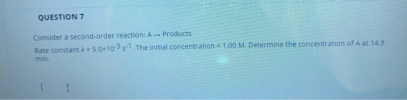 QUESTION 7 Consider a second-order reaction: A - Products Rate constant k = 5.0x10⁻³⁵-1. The initial concentration = 1.00 M. Determine the concentration of A at 14.9 min. I
What happens to the rate of the forward reaction as time passes in the equilibrium region...
 What happens to the rate of the forward reaction as time passes in the equilibrium region of the graph below? Concentration Time Ob. the rate decreases a cannot be determined from the graph Ос. the rate both increases and decreases the rate remains constant O d. the rate increases Concentration of reactant A was measured as a function of time, and the data were plotted as shown below. Which of the following statements is true? 850 Chart Area 800 1/[A]...
1. A reaction is second order in[A] and second-order in [B]: Rate,=K[A]^2[B]^2. what are the units...
1. A reaction is second order in[A] and second-order in [B]: Rate,=K[A]^2[B]^2. what are the units of k for this reaction? If the concentration of air decreases by a factor of 2 and the concentration of b increases by a factor of 5 what happens to the rate? 2. for the forward reaction 2NO+Cl2=>2NOCl. determine the rate(m/s)for experiment #4 given [NO]°(M)=0.40M and [Cl2]°z(M)=0?20M. Rate? 3.The following data were collected over time for the forward reaction 2NO2=>2NO+O2 ( 1/[NO2]=100 at 0...
For a first-order reaction, the half-life is constant. It depends only on the rate constant k...
For a first-order reaction, the half-life is constant. It depends only on the rate constant k and not on the reactant concentration. It is expressed as t1/2=0.693kt1/2=0.693k For a second-order reaction, the half-life depends on the rate constant and the concentration of the reactant and so is expressed as t1/2=1k[A]0 Part A. A certain first-order reaction (A→products) has a rate constant of 3.00×10⁻³ s−1 at 45 ∘C∘C. How many minutes does it take for the concentration of the reactant, [A],...
 3. The thermal decomposition of A, 2A + products is a second-order reaction. Given that the initial concentration of A is = 2.45 x 10⁻³ M and the intial rate of reaction is 2.05x10⁻⁶ M s-1, calculate the rate constant. Also calculate the rate of reaction after 90% of A has reacted.
 QUESTION 7 Consider a second-order reaction: A - Products Rate constant k = 5.0x10⁻³⁵-1. The initial concentration = 1.00 M. Determine the concentration of A at 14.9 min. I
 What happens to the rate of the forward reaction as time passes in the equilibrium region of the graph below? Concentration Time Ob. the rate decreases a cannot be determined from the graph Ос. the rate both increases and decreases the rate remains constant O d. the rate increases Concentration of reactant A was measured as a function of time, and the data were plotted as shown below. Which of the following statements is true? 850 Chart Area 800 1/[A]...
Most questions answered within 3 hours.
-
Where is the error in this code sequence?
String s1 = "Hello";
String s2 = "ello";...
asked 10 months ago -
Financial data for Joel de Paris, Inc., for last year
follow:
Joel de Paris, Inc.
Balance...
asked 10 months ago -
Consider this reaction:
Al2(SO4)3 (aq)+ BaCl3
(aq) Al2Cl6 (aq)- +
3BaSO4(s) . What is the...
asked 10 months ago -
Suppose that Savneet is considering increasing her
recent random sample from 20 car rentals to 40...
asked 10 months ago -
Trucks arrive at an unloading terminal at an average rate of 120
per hour.
Trucks arrive...
asked 10 months ago -
Why are methanol and ethanol completely soluble in water while
octanol is not very little soluble....
asked 10 months ago -
A facilities manager at a university reads in a research report
that the mean amount of...
asked 10 months ago -
When the CuSO4 is rehydrated by adding water to the anhydrous
compound, is this an endothermic...
asked 10 months ago -
A ray of sunlight is passing from diamond into crown glass; the
angle of incidence is...
asked 10 months ago -
A block of mass 0.249 kg is placed on top of a light, vertical
spring of...
asked 10 months ago -
how do the kidneys compensate in the presences of acidosis
a) trigger hyperventilate
b) reserve acid...
asked 10 months ago -
Question 501 pts
The rental rate of capital to the firm increases. Which of the
following...
asked 10 months ago