
Homework Answers
 please see pages in the order
of page no. Marked on each page
please see pages in the order
of page no. Marked on each page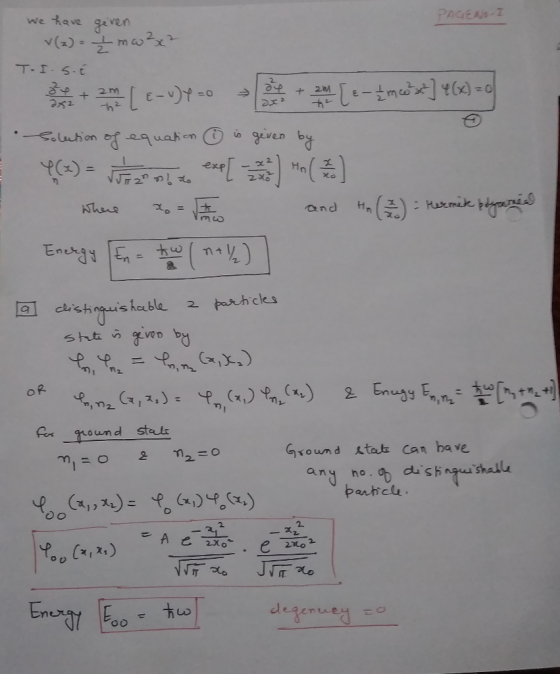
 Note : degeneracy =O means non
degenerate state or 1fold degeneracy
Note : degeneracy =O means non
degenerate state or 1fold degeneracy
please see the page according to page no. Marked on
pages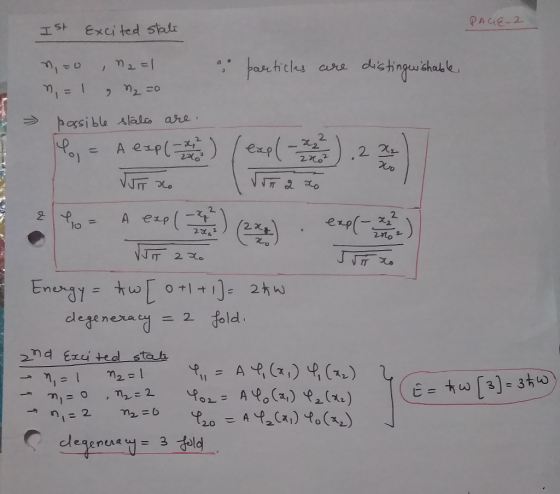
Add Answer to:
2. Two noninteracting particles, each of mass m, are in the 1-D harmonic oscillator potential Describe...
Problem 5.7 Two noninteracting particles (of equal mass) share the same harmonic oscillator potential, one in...
 Problem 5.7 Two noninteracting particles (of equal mass) share the same harmonic oscillator potential, one in the ground state and one in the first excited state. (a) Construct the wave function, y (x1, x2), assuming (1) they are distinguishable, (ii) they are identical bosons, (iii) they are identical fermions. Plot IV (x1,x2)|in each case (use, for instance, Mathematica's Plot3D). (6) Use Equations 5.23 and 5.25 to determine ((x1 - x2) for each case. (C) Express each y (x1, x2) in...
2096) Two noninteracting particles 1 and 2, each of mass m, are in a 1-D infinite...
 2096) Two noninteracting particles 1 and 2, each of mass m, are in a 1-D infinite square well ol width a. If one is in the state V'in and the other in the state (n! /), calculate C(xI-x), assuming (a) (6%) they are distinguishable particles, (b) (7%) Ihey are identical bosons, and (c) (796) Ihey arc identical fermions. 4.
Q1: Consider two particles occupying the ground state 01) and the first excited state (42) of...
 Q1: Consider two particles occupying the ground state 01) and the first excited state (42) of the one dimensional infinite square potential well. Give a proper form of the normalized wave function of the system (11,12) in the following cases: (a) The two particles are distinguishable. (b) The two particles are identical bosons. (c) The two particles are identical fermions
6. (Extra Credit: 6 Points) Consider two noninteracting particles of mass m in an infinite square well of width L. For the case with one particle in the single-particle state In) and the other in...
 6. (Extra Credit: 6 Points) Consider two noninteracting particles of mass m in an infinite square well of width L. For the case with one particle in the single-particle state In) and the other in the state k) (nメk), calculate the expectation value of the squared inter-particle spacing (71-72) , assuming (a) the particles are distinguishable, (b) the particles are identical in a symmetrical spatial state, and (c) the particles are identical in an anti-symmetric spatial state. Use Dirac notation...
tthe-independent Help: The operator expression dimensions is given by H 2m r ar2 [2] A particle of mass m is in a three-dimensional, spherically symmetric harmonic oscillator potential given by V...
 tthe-independent Help: The operator expression dimensions is given by H 2m r ar2 [2] A particle of mass m is in a three-dimensional, spherically symmetric harmonic oscillator potential given by V(r)2r2. The particle is in the I-0 state. Noting that all eigenfunetions must be finite everywhere, find the ground-state radial wave-function R() and the ground-state energy. You do not have to nor oscillator is g (x) = C x exp(-8x2), where C and B are constants) harmonic malize the solution....
Consider a particle subjected to a harmonic oscillator potential of the form x)m. The allowed values...
 Consider a particle subjected to a harmonic oscillator potential of the form x)m. The allowed values of energy for the simple harmonic oscillator is (a) What is the energy corresponding to the ground state (3 points)? (b) What is the energy separation between the ground state and the first excited state (3 points)? (c) The selection rule allows only those transitions for which the quantum number changes by 1. What is the energy of photon necessary to make the transition...
[1 44= 9 marks ] Question 5 Consider two identical particles in 1D which exist in single-particle (normalised) (x), and...
 [1 44= 9 marks ] Question 5 Consider two identical particles in 1D which exist in single-particle (normalised) (x), and are in such close proximity they can be considered as indistinguishable. wave functions /a(x) and (a) Write down the symmetrised two-particle wave function for the case where the particles are bosons (VB) and the case where the particles are fermions (Vp). (b) Show that the expectation value (xjr2)B,F is given by: (T122) в,F — (а:)a (х)ь + dx x y:(")...
1. Imagine that a particle can exist in one of the three states: |0 > , |1 >, |2> . We now consider 2 such part...
1. Imagine that a particle can exist in one of the three states: |0 > , |1 >, |2> . We now consider 2 such particles. How many distinguishable states are possible if the particles are (a) distinguishable (b) indistinguishable, classic (c) bosons (d) fermions. Write down the wave function of the system for all cases.
1. Position representation of the harmonic oscillator wave functions. (a) Using that the position representation of...
 1. Position representation of the harmonic oscillator wave functions. (a) Using that the position representation of the ground state of the harmonic ) _ (쁩)1/4e-mura/an, find 너 1) and (212) (2 points) (b) Verify explicitly that your solution for (r|1) fulfills the position representa- oscillator is (rlo tion of the Schrödinger equation (1 point) (1 point) (c) What are the corresponding energy eigenvalues En?
A rigid rotor has two particles of mass m attached to the ends of a massless...
A rigid rotor has two particles of mass m attached to the ends of a massless rigid rod of length a. The rotor is free to rotate in three dimensions about the center of mass. This is a model for the rotational motion of a homonuclear diatomic molecule, a molecule with two identical nuclei. (An example is 16O2.) (a) By expressing the Hamiltonian in terms of the orbital angular momentum, show that the allowed energies of this rigid rotor are...
 Problem 5.7 Two noninteracting particles (of equal mass) share the same harmonic oscillator potential, one in the ground state and one in the first excited state. (a) Construct the wave function, y (x1, x2), assuming (1) they are distinguishable, (ii) they are identical bosons, (iii) they are identical fermions. Plot IV (x1,x2)|in each case (use, for instance, Mathematica's Plot3D). (6) Use Equations 5.23 and 5.25 to determine ((x1 - x2) for each case. (C) Express each y (x1, x2) in...
 2096) Two noninteracting particles 1 and 2, each of mass m, are in a 1-D infinite square well ol width a. If one is in the state V'in and the other in the state (n! /), calculate C(xI-x), assuming (a) (6%) they are distinguishable particles, (b) (7%) Ihey are identical bosons, and (c) (796) Ihey arc identical fermions. 4.
 Q1: Consider two particles occupying the ground state 01) and the first excited state (42) of the one dimensional infinite square potential well. Give a proper form of the normalized wave function of the system (11,12) in the following cases: (a) The two particles are distinguishable. (b) The two particles are identical bosons. (c) The two particles are identical fermions
 6. (Extra Credit: 6 Points) Consider two noninteracting particles of mass m in an infinite square well of width L. For the case with one particle in the single-particle state In) and the other in the state k) (nメk), calculate the expectation value of the squared inter-particle spacing (71-72) , assuming (a) the particles are distinguishable, (b) the particles are identical in a symmetrical spatial state, and (c) the particles are identical in an anti-symmetric spatial state. Use Dirac notation...
 tthe-independent Help: The operator expression dimensions is given by H 2m r ar2 [2] A particle of mass m is in a three-dimensional, spherically symmetric harmonic oscillator potential given by V(r)2r2. The particle is in the I-0 state. Noting that all eigenfunetions must be finite everywhere, find the ground-state radial wave-function R() and the ground-state energy. You do not have to nor oscillator is g (x) = C x exp(-8x2), where C and B are constants) harmonic malize the solution....
 Consider a particle subjected to a harmonic oscillator potential of the form x)m. The allowed values of energy for the simple harmonic oscillator is (a) What is the energy corresponding to the ground state (3 points)? (b) What is the energy separation between the ground state and the first excited state (3 points)? (c) The selection rule allows only those transitions for which the quantum number changes by 1. What is the energy of photon necessary to make the transition...
 [1 44= 9 marks ] Question 5 Consider two identical particles in 1D which exist in single-particle (normalised) (x), and are in such close proximity they can be considered as indistinguishable. wave functions /a(x) and (a) Write down the symmetrised two-particle wave function for the case where the particles are bosons (VB) and the case where the particles are fermions (Vp). (b) Show that the expectation value (xjr2)B,F is given by: (T122) в,F — (а:)a (х)ь + dx x y:(")...
 1. Position representation of the harmonic oscillator wave functions. (a) Using that the position representation of the ground state of the harmonic ) _ (쁩)1/4e-mura/an, find 너 1) and (212) (2 points) (b) Verify explicitly that your solution for (r|1) fulfills the position representa- oscillator is (rlo tion of the Schrödinger equation (1 point) (1 point) (c) What are the corresponding energy eigenvalues En?
Most questions answered within 3 hours.
-
Where is the error in this code sequence?
String s1 = "Hello";
String s2 = "ello";...
asked 11 months ago -
Financial data for Joel de Paris, Inc., for last year
follow:
Joel de Paris, Inc.
Balance...
asked 11 months ago -
Consider this reaction:
Al2(SO4)3 (aq)+ BaCl3
(aq) Al2Cl6 (aq)- +
3BaSO4(s) . What is the...
asked 11 months ago -
Suppose that Savneet is considering increasing her
recent random sample from 20 car rentals to 40...
asked 11 months ago -
Trucks arrive at an unloading terminal at an average rate of 120
per hour.
Trucks arrive...
asked 11 months ago -
Why are methanol and ethanol completely soluble in water while
octanol is not very little soluble....
asked 11 months ago -
A facilities manager at a university reads in a research report
that the mean amount of...
asked 11 months ago -
When the CuSO4 is rehydrated by adding water to the anhydrous
compound, is this an endothermic...
asked 11 months ago -
A ray of sunlight is passing from diamond into crown glass; the
angle of incidence is...
asked 11 months ago -
A block of mass 0.249 kg is placed on top of a light, vertical
spring of...
asked 11 months ago -
how do the kidneys compensate in the presences of acidosis
a) trigger hyperventilate
b) reserve acid...
asked 11 months ago -
Question 501 pts
The rental rate of capital to the firm increases. Which of the
following...
asked 11 months ago