
Homework Answers
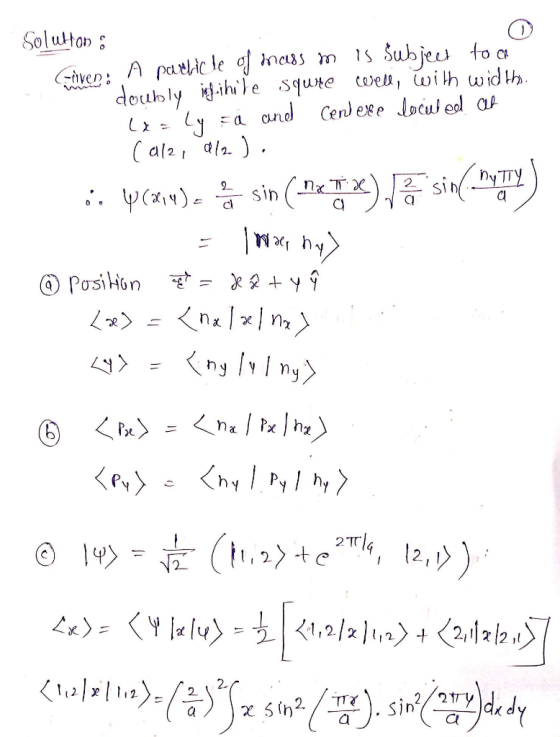
![- a Six sin ( a ). der = á Sve (1-сos (org lite lässing (y =12 - ä [-] similarly 211111211) = :. (o)= (3+) ==> simi lovely so](http://img.homeworklib.com/questions/d4093130-3f7b-11eb-abef-69bd80266201.png?x-oss-process=image/resize,w_560)
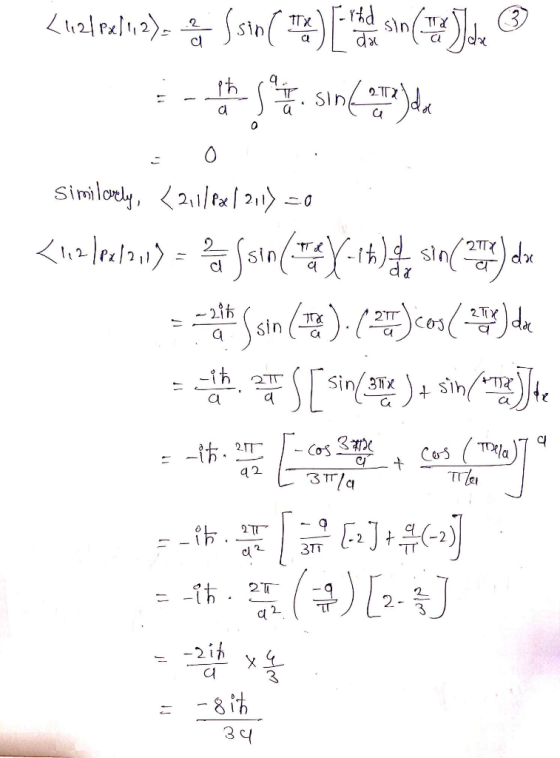
![</0/12) 3{**) \sin ( sury). Cornelio - cha [sin ( sub ) + 510 ( 12 )]dx -16x 89 3T a 2 .(Px) = ₃ [oto- sih celine te inta] 3a](http://img.homeworklib.com/questions/d6619650-3f7b-11eb-963d-2b0eb7f41095.png?x-oss-process=image/resize,w_560)
Add Answer to:
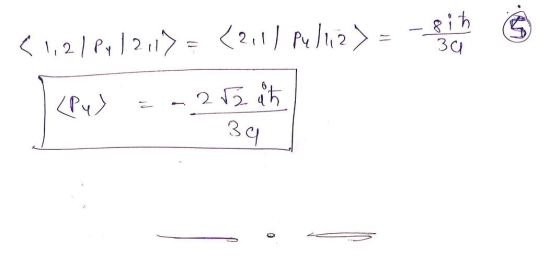
A particle of mass m is subject to a doubly infinite square well, with widths L,...
2. A particle of mass m in the infinite square well of width a at time...
 2. A particle of mass m in the infinite square well of width a at time 1 - 0 has wave function that is an equal weight mixture of the two lowest n= 1,2 energy stationary states: (x,0) - C[4,(x)+42(x)] (a) Normalize the wave function. Hints: 1. Exploit the orthonormality of W, 2. Recall that if a wave function is normalized at t = 0, it stays normalized. (b) Find '(x, t) and (x,1)1at a later time 1>0. Express Y*...
I. Consider a particle in an infinite square well potential with sides at x = ±a. Find the expectation value of the operator given below in any eigenstate of the particle: I. Consider a parti...
 I. Consider a particle in an infinite square well potential with sides at x = ±a. Find the expectation value of the operator given below in any eigenstate of the particle:
I. Consider a particle in an infinite square well potential with sides at x = ±a. Find the expectation value of the operator given below in any eigenstate of the particle:
I. Consider a particle in an infinite square well potential with sides at x = ±a. Find the expectation value of the operator given below in any eigenstate of the particle:
Quantum Mechanics question about an infinite square well. A particle in an infinite square well potential...
 Quantum Mechanics question about an infinite square
well.
A particle in an infinite square well potential has an initial state vector 14() = E1) - %|E2) where E) is the n'th eigenfunctions of the Hamiltonian operator. (a) Find the time evolution of the state vector. (b) Find the expectation value of the position as a function of time.
Quantum Mechanics question about an infinite square
well.
A particle in an infinite square well potential has an initial state vector 14() = E1) - %|E2) where E) is the n'th eigenfunctions of the Hamiltonian operator. (a) Find the time evolution of the state vector. (b) Find the expectation value of the position as a function of time.
please explain all, thanks! 4. (60 pts) A particle in an infinite square well of width...
 please explain all, thanks!
4. (60 pts) A particle in an infinite square well of width L has an initial wave function (x,t = 0) = Ax(L - x)2, OSX SL a) Find y(x, t) fort > 0. You first have to normalize the wave function. Hint: this is best expressed an infinite series: show that the wave function coefficients are on = * 31% (12 – n?)(1-(-1)") → (n = 87315 (12 - nºre?); n odd. b) Which energy...
please explain all, thanks!
4. (60 pts) A particle in an infinite square well of width L has an initial wave function (x,t = 0) = Ax(L - x)2, OSX SL a) Find y(x, t) fort > 0. You first have to normalize the wave function. Hint: this is best expressed an infinite series: show that the wave function coefficients are on = * 31% (12 – n?)(1-(-1)") → (n = 87315 (12 - nºre?); n odd. b) Which energy...
1. A particle in an infinite square well has an initial wave function Alsin sin 4 0 < x < L other...
 help on all a), b), and c) please!!
1. A particle in an infinite square well has an initial wave function Alsin sin 4 0 < x < L otherwise s(x, t = 0) 0 (a) Find A so that the wavefunction is normalized. (b) Find '(z,t). (c) Find the expectation value(E) of the energy of ψ(x,t = 0). You may use the result mx n 2 0
1. A particle in an infinite square well has an initial wave...
help on all a), b), and c) please!!
1. A particle in an infinite square well has an initial wave function Alsin sin 4 0 < x < L otherwise s(x, t = 0) 0 (a) Find A so that the wavefunction is normalized. (b) Find '(z,t). (c) Find the expectation value(E) of the energy of ψ(x,t = 0). You may use the result mx n 2 0
1. A particle in an infinite square well has an initial wave...
2. A particle of mass m in the infinite square well of width a (located at...
 2. A particle of mass m in the infinite square well of width a (located at 0 SSa) has as its initial wave function a mixture of two stationary states: v(x,0)Avi(x) +2s (x). (a) Find the probability density of finding the particle at the center of the well, as a function of time. (b) Find the average momentum of the particle at time t.
A NON stationary state A particle of mass m is in an infinite square well potential of width L, a...
 A NON stationary state A particle of mass m is in an infinite square well potential of width L, as in McIntyre's section 5.4. Suppose we have an initial state vector lv(t -0) results from Mclntrye without re-deriving them, and you may use a computer for your math as long as you include your code in your solution A(3E1) 4iE2)). You may use E. (4 pts) Use a computer to plot this probability density at 4 times: t 0, t2...
6. (Extra Credit: 6 Points) Consider two noninteracting particles of mass m in an infinite square well of width L. For the case with one particle in the single-particle state In) and the other in...
 6. (Extra Credit: 6 Points) Consider two noninteracting particles of mass m in an infinite square well of width L. For the case with one particle in the single-particle state In) and the other in the state k) (nメk), calculate the expectation value of the squared inter-particle spacing (71-72) , assuming (a) the particles are distinguishable, (b) the particles are identical in a symmetrical spatial state, and (c) the particles are identical in an anti-symmetric spatial state. Use Dirac notation...
[12 6. Consid er a particle of mass m moving in an infinitely deep square well...
 [12 6. Consid er a particle of mass m moving in an infinitely deep square well potential of width a, whose wave function at time t 0 is where on Ce) is the normaized wave function of the n-th eigenstate of the Hamitonian of that particle The corresponding eigen-energy of the n-th state is 2ma?n 1,2,3,... (e) Find the average energy of the system (ie. the expectation value () (b) Write down the wave function p(z,t) at a later time...
6. (a) Consider the infinite square well again. Let the width of the well be a...
 6. (a) Consider the infinite square well again. Let the width of the well be a and the particle mass be m. Find an expression for the probability that a particle in the state, vi will be found in the region a/4 <x<3a/4. (b) Repeat part (a) for the nth eigenstate, yn, for arbitrary n. Show that the answer reduces to the classical value of 2 as n 00.
 2. A particle of mass m in the infinite square well of width a at time 1 - 0 has wave function that is an equal weight mixture of the two lowest n= 1,2 energy stationary states: (x,0) - C[4,(x)+42(x)] (a) Normalize the wave function. Hints: 1. Exploit the orthonormality of W, 2. Recall that if a wave function is normalized at t = 0, it stays normalized. (b) Find '(x, t) and (x,1)1at a later time 1>0. Express Y*...
 I. Consider a particle in an infinite square well potential with sides at x = ±a. Find the expectation value of the operator given below in any eigenstate of the particle:
I. Consider a particle in an infinite square well potential with sides at x = ±a. Find the expectation value of the operator given below in any eigenstate of the particle:
I. Consider a particle in an infinite square well potential with sides at x = ±a. Find the expectation value of the operator given below in any eigenstate of the particle:
 Quantum Mechanics question about an infinite square
well.
A particle in an infinite square well potential has an initial state vector 14() = E1) - %|E2) where E) is the n'th eigenfunctions of the Hamiltonian operator. (a) Find the time evolution of the state vector. (b) Find the expectation value of the position as a function of time.
Quantum Mechanics question about an infinite square
well.
A particle in an infinite square well potential has an initial state vector 14() = E1) - %|E2) where E) is the n'th eigenfunctions of the Hamiltonian operator. (a) Find the time evolution of the state vector. (b) Find the expectation value of the position as a function of time.
 please explain all, thanks!
4. (60 pts) A particle in an infinite square well of width L has an initial wave function (x,t = 0) = Ax(L - x)2, OSX SL a) Find y(x, t) fort > 0. You first have to normalize the wave function. Hint: this is best expressed an infinite series: show that the wave function coefficients are on = * 31% (12 – n?)(1-(-1)") → (n = 87315 (12 - nºre?); n odd. b) Which energy...
please explain all, thanks!
4. (60 pts) A particle in an infinite square well of width L has an initial wave function (x,t = 0) = Ax(L - x)2, OSX SL a) Find y(x, t) fort > 0. You first have to normalize the wave function. Hint: this is best expressed an infinite series: show that the wave function coefficients are on = * 31% (12 – n?)(1-(-1)") → (n = 87315 (12 - nºre?); n odd. b) Which energy...
 help on all a), b), and c) please!!
1. A particle in an infinite square well has an initial wave function Alsin sin 4 0 < x < L otherwise s(x, t = 0) 0 (a) Find A so that the wavefunction is normalized. (b) Find '(z,t). (c) Find the expectation value(E) of the energy of ψ(x,t = 0). You may use the result mx n 2 0
1. A particle in an infinite square well has an initial wave...
help on all a), b), and c) please!!
1. A particle in an infinite square well has an initial wave function Alsin sin 4 0 < x < L otherwise s(x, t = 0) 0 (a) Find A so that the wavefunction is normalized. (b) Find '(z,t). (c) Find the expectation value(E) of the energy of ψ(x,t = 0). You may use the result mx n 2 0
1. A particle in an infinite square well has an initial wave...
 2. A particle of mass m in the infinite square well of width a (located at 0 SSa) has as its initial wave function a mixture of two stationary states: v(x,0)Avi(x) +2s (x). (a) Find the probability density of finding the particle at the center of the well, as a function of time. (b) Find the average momentum of the particle at time t.
 A NON stationary state A particle of mass m is in an infinite square well potential of width L, as in McIntyre's section 5.4. Suppose we have an initial state vector lv(t -0) results from Mclntrye without re-deriving them, and you may use a computer for your math as long as you include your code in your solution A(3E1) 4iE2)). You may use E. (4 pts) Use a computer to plot this probability density at 4 times: t 0, t2...
 6. (Extra Credit: 6 Points) Consider two noninteracting particles of mass m in an infinite square well of width L. For the case with one particle in the single-particle state In) and the other in the state k) (nメk), calculate the expectation value of the squared inter-particle spacing (71-72) , assuming (a) the particles are distinguishable, (b) the particles are identical in a symmetrical spatial state, and (c) the particles are identical in an anti-symmetric spatial state. Use Dirac notation...
 [12 6. Consid er a particle of mass m moving in an infinitely deep square well potential of width a, whose wave function at time t 0 is where on Ce) is the normaized wave function of the n-th eigenstate of the Hamitonian of that particle The corresponding eigen-energy of the n-th state is 2ma?n 1,2,3,... (e) Find the average energy of the system (ie. the expectation value () (b) Write down the wave function p(z,t) at a later time...
 6. (a) Consider the infinite square well again. Let the width of the well be a and the particle mass be m. Find an expression for the probability that a particle in the state, vi will be found in the region a/4 <x<3a/4. (b) Repeat part (a) for the nth eigenstate, yn, for arbitrary n. Show that the answer reduces to the classical value of 2 as n 00.
Most questions answered within 3 hours.
-
Where is the error in this code sequence?
String s1 = "Hello";
String s2 = "ello";...
asked 11 months ago -
Financial data for Joel de Paris, Inc., for last year
follow:
Joel de Paris, Inc.
Balance...
asked 11 months ago -
Consider this reaction:
Al2(SO4)3 (aq)+ BaCl3
(aq) Al2Cl6 (aq)- +
3BaSO4(s) . What is the...
asked 11 months ago -
Suppose that Savneet is considering increasing her
recent random sample from 20 car rentals to 40...
asked 11 months ago -
Trucks arrive at an unloading terminal at an average rate of 120
per hour.
Trucks arrive...
asked 11 months ago -
Why are methanol and ethanol completely soluble in water while
octanol is not very little soluble....
asked 11 months ago -
A facilities manager at a university reads in a research report
that the mean amount of...
asked 11 months ago -
When the CuSO4 is rehydrated by adding water to the anhydrous
compound, is this an endothermic...
asked 11 months ago -
A ray of sunlight is passing from diamond into crown glass; the
angle of incidence is...
asked 11 months ago -
A block of mass 0.249 kg is placed on top of a light, vertical
spring of...
asked 11 months ago -
how do the kidneys compensate in the presences of acidosis
a) trigger hyperventilate
b) reserve acid...
asked 11 months ago -
Question 501 pts
The rental rate of capital to the firm increases. Which of the
following...
asked 11 months ago