
Homework Answers
Answer - Path 2 is the correct answer
Explanation
When the charged particles beam enters in the magnetic field, the beam will experience Lorentz force. the Lorentz force is given by
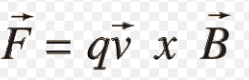
Where q is the charge, v velocity and B is the uniform magnetic field.
In the case of Electron beam q = -e then Lorentz force is given by F= -e (vxB), this force acting downward as shown in figure 1 in case of the electron beam.
Now we take when the proton beam with the same velocity enters into the magnetic field, the Lorentz force is given by, F= e(vxB) because of q= e for proton. In the case of proton Lorentz force act on the beam upward.
In figure II there are two paths of the different radius of curvature, which are going upward. The path 1 having a radius of curvature equal to the radius of curvature of electron path in figure 1 and path 2 has different value radius of curvature.
The radius of curvature is defined by
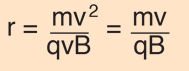
From the above equation, we can say that for the uniform magnetic field, the radius of curvature is directly proportional mass. in case of proton radius of curvature more because proton has more mass than an electron(mp>me)
So path 2 is the correct answer
thank you !!
Add Answer to:
An electron beam is directed into a uniform magnetic field and
deviates as shown in Figure...
Two parallel conductor rails with negligible resistance are connected at one end by a resistance resistor...
 Two parallel conductor rails with negligible resistance are
connected at one end by a resistance resistor R=1.40 Ω, as shown in
the figure. The rails are placed in an upwardly directed magnetic
field B= 5.00 T , which is perpendicular to the plane of the rails.
This magnetic field is uniform and independent of time. The
distance between the rails is l= 0.20 m. A conductor bar slides
without friction on the top of the two rails at a constant...
Two parallel conductor rails with negligible resistance are
connected at one end by a resistance resistor R=1.40 Ω, as shown in
the figure. The rails are placed in an upwardly directed magnetic
field B= 5.00 T , which is perpendicular to the plane of the rails.
This magnetic field is uniform and independent of time. The
distance between the rails is l= 0.20 m. A conductor bar slides
without friction on the top of the two rails at a constant...
Two metal rods, vertically placed and separated, are joined at the top. a distance of l = 50cm. The whole, whose resistance is considered contempt- It is placed within a uniform magnetic field of flo...
 Two metal rods, vertically placed and separated, are joined at
the top.
a distance of l = 50cm. The whole, whose resistance is
considered contempt-
It is placed within a uniform magnetic field of flow density B
= 0.01kT perpendicular to the plane defined by the rods. By them,
it slides downwards with constant speed of v = 1jm / s, without
friction and without interrupting the contact, a bar AB whose mass
is m = 1g. Determine the resistance...
Two metal rods, vertically placed and separated, are joined at
the top.
a distance of l = 50cm. The whole, whose resistance is
considered contempt-
It is placed within a uniform magnetic field of flow density B
= 0.01kT perpendicular to the plane defined by the rods. By them,
it slides downwards with constant speed of v = 1jm / s, without
friction and without interrupting the contact, a bar AB whose mass
is m = 1g. Determine the resistance...
VCM CAR deM - RO mesine $+2010) CM + c 22. (See. 12.2) Tenemos un letrero...
 VCM CAR deM - RO mesine $+2010) CM + c 22. (See. 12.2) Tenemos un letrero (GAS) que pesa 200N y lo vamos a colgar usando una viga y un cable como se muestra en la figura La masa de la viga es uniforme pero no se conoce ni su masa, peso o largo. El cable no tiene masa. La fuerza del gozne (FG) que soporta a la vign es de 300N a 20º con la horizontal. La tensión que...
3.0m- te -5.0m---- ya_19. (Sec. 12.2) Un sube y baja de 8.0m de largo y masa...
 3.0m- te -5.0m---- ya_19. (Sec. 12.2) Un sube y baja de 8.0m de largo y masa uniforme esta en equilibrio estático con un soporte que está a 3.0 de su extremo izquierdo y dos niños montados en sus extremos (ver figura). El niño más pequeño esta al extremo derecho y tiene masa de 40 Kg, y el niño más grande está en el extremo izquierdo y tiene masa de 80 Kg. ¿Cuál es la masa total del sube y baja?...
Question Translation: On a car of mass M, two forces act as shown in the figure above. Find an expression for the acceleration of the car in terms of T, F, and M. What happens to the acceleration if...
 Question Translation:
On a car of mass M, two forces act as shown in the figure
above. Find an expression for the acceleration of the car in terms
of T, F, and M. What happens to the acceleration if we double the
mass of the car?
An object of mass M is in free fall (the only force on the
object is its weight). Make a force diagram for this case. Use
Newton's second law to calculate the acceleration of...
Question Translation:
On a car of mass M, two forces act as shown in the figure
above. Find an expression for the acceleration of the car in terms
of T, F, and M. What happens to the acceleration if we double the
mass of the car?
An object of mass M is in free fall (the only force on the
object is its weight). Make a force diagram for this case. Use
Newton's second law to calculate the acceleration of...
The inductor shown in the figure has an inductance of 0.260 H and conducts a current...
 The inductor shown in the figure has an inductance of 0.260 H
and conducts a current in the direction that is illustrated and
that decreases to a uniform rate di / dt = -0.0180 A / s. The
induced emf in the inductor is:
a) 4.68 x 10 ^ -3V
b) -4.68 x 10 ^ -3 V
c) 25 V
d) -14.4 V
El inductor que se muestra en la figura tiene una inductancia de 0.260 H y conduce una...
The inductor shown in the figure has an inductance of 0.260 H
and conducts a current in the direction that is illustrated and
that decreases to a uniform rate di / dt = -0.0180 A / s. The
induced emf in the inductor is:
a) 4.68 x 10 ^ -3V
b) -4.68 x 10 ^ -3 V
c) 25 V
d) -14.4 V
El inductor que se muestra en la figura tiene una inductancia de 0.260 H y conduce una...
Question Translation: On a car of mass M, two forces act as shown in the figure...
 Question Translation:
On a car of mass M, two forces act as shown in the figure
above. Find an expression for the acceleration of the car in terms
of T, F, and M. What happens to the acceleration if we double the
mass of the car?
An object of mass M is in free fall (the only force on the
object is its weight). Make a force diagram for this case. Use
Newton's second law to calculate the acceleration of...
Question Translation:
On a car of mass M, two forces act as shown in the figure
above. Find an expression for the acceleration of the car in terms
of T, F, and M. What happens to the acceleration if we double the
mass of the car?
An object of mass M is in free fall (the only force on the
object is its weight). Make a force diagram for this case. Use
Newton's second law to calculate the acceleration of...
1. Consider a triangular closed case at rest that is in a horizontal electric field of...
 1. Consider a triangular closed case at rest that is in a
horizontal electric field of magnitude 7.80 x 10^4 N / C as shown
in the figure. Calculate the electrical flow (a) through the
vertical rectangular surface (back of the figure) and (b) through
the inclined surface.
2.Using the Law of Gauss, determine the electric flow in the
surfaces S1 and S2 . The charge Q= 26 μʹC
Resuelva: 10 puntos c/iu Considere una caja triangular cerrada en reposo...
1. Consider a triangular closed case at rest that is in a
horizontal electric field of magnitude 7.80 x 10^4 N / C as shown
in the figure. Calculate the electrical flow (a) through the
vertical rectangular surface (back of the figure) and (b) through
the inclined surface.
2.Using the Law of Gauss, determine the electric flow in the
surfaces S1 and S2 . The charge Q= 26 μʹC
Resuelva: 10 puntos c/iu Considere una caja triangular cerrada en reposo...
the figure shows a section of the alpine system of wagons moved by the section of...
 the figure shows a section of the alpine system of wagons moved
by the section of a cable. The maximum permitted mass of each wagon
with occupants is 2800 kg. The wagons, which travel on the support
cable, are pulled by a second cable from a tower. What is the
voltage difference between the two adjacent sections of the
traction cable if the wagons are accelerated upwards at a rate of
0.81 m / s2 and an inclination of 35...
the figure shows a section of the alpine system of wagons moved
by the section of a cable. The maximum permitted mass of each wagon
with occupants is 2800 kg. The wagons, which travel on the support
cable, are pulled by a second cable from a tower. What is the
voltage difference between the two adjacent sections of the
traction cable if the wagons are accelerated upwards at a rate of
0.81 m / s2 and an inclination of 35...
q= 5 p= 20 The simple concrete beam shown in the figure has a cross section...
 q= 5
p= 20
The simple concrete beam shown in the figure has a
cross section of 450x700 mm2 and knowing that the maximum
capacities of the concrete are those shown in the attached table
determine: A. The reactions in supports A and D. (table 1 and 2) B.
The bending moment equation. C. The corresponding values in table
3 D. The shear force equation. E. The corresponding values in
Table 4 F. The shear force diagram. (Draw the values...
q= 5
p= 20
The simple concrete beam shown in the figure has a
cross section of 450x700 mm2 and knowing that the maximum
capacities of the concrete are those shown in the attached table
determine: A. The reactions in supports A and D. (table 1 and 2) B.
The bending moment equation. C. The corresponding values in table
3 D. The shear force equation. E. The corresponding values in
Table 4 F. The shear force diagram. (Draw the values...
 Two parallel conductor rails with negligible resistance are
connected at one end by a resistance resistor R=1.40 Ω, as shown in
the figure. The rails are placed in an upwardly directed magnetic
field B= 5.00 T , which is perpendicular to the plane of the rails.
This magnetic field is uniform and independent of time. The
distance between the rails is l= 0.20 m. A conductor bar slides
without friction on the top of the two rails at a constant...
Two parallel conductor rails with negligible resistance are
connected at one end by a resistance resistor R=1.40 Ω, as shown in
the figure. The rails are placed in an upwardly directed magnetic
field B= 5.00 T , which is perpendicular to the plane of the rails.
This magnetic field is uniform and independent of time. The
distance between the rails is l= 0.20 m. A conductor bar slides
without friction on the top of the two rails at a constant...
 Two metal rods, vertically placed and separated, are joined at
the top.
a distance of l = 50cm. The whole, whose resistance is
considered contempt-
It is placed within a uniform magnetic field of flow density B
= 0.01kT perpendicular to the plane defined by the rods. By them,
it slides downwards with constant speed of v = 1jm / s, without
friction and without interrupting the contact, a bar AB whose mass
is m = 1g. Determine the resistance...
Two metal rods, vertically placed and separated, are joined at
the top.
a distance of l = 50cm. The whole, whose resistance is
considered contempt-
It is placed within a uniform magnetic field of flow density B
= 0.01kT perpendicular to the plane defined by the rods. By them,
it slides downwards with constant speed of v = 1jm / s, without
friction and without interrupting the contact, a bar AB whose mass
is m = 1g. Determine the resistance...
 VCM CAR deM - RO mesine $+2010) CM + c 22. (See. 12.2) Tenemos un letrero (GAS) que pesa 200N y lo vamos a colgar usando una viga y un cable como se muestra en la figura La masa de la viga es uniforme pero no se conoce ni su masa, peso o largo. El cable no tiene masa. La fuerza del gozne (FG) que soporta a la vign es de 300N a 20º con la horizontal. La tensión que...
 3.0m- te -5.0m---- ya_19. (Sec. 12.2) Un sube y baja de 8.0m de largo y masa uniforme esta en equilibrio estático con un soporte que está a 3.0 de su extremo izquierdo y dos niños montados en sus extremos (ver figura). El niño más pequeño esta al extremo derecho y tiene masa de 40 Kg, y el niño más grande está en el extremo izquierdo y tiene masa de 80 Kg. ¿Cuál es la masa total del sube y baja?...
 Question Translation:
On a car of mass M, two forces act as shown in the figure
above. Find an expression for the acceleration of the car in terms
of T, F, and M. What happens to the acceleration if we double the
mass of the car?
An object of mass M is in free fall (the only force on the
object is its weight). Make a force diagram for this case. Use
Newton's second law to calculate the acceleration of...
Question Translation:
On a car of mass M, two forces act as shown in the figure
above. Find an expression for the acceleration of the car in terms
of T, F, and M. What happens to the acceleration if we double the
mass of the car?
An object of mass M is in free fall (the only force on the
object is its weight). Make a force diagram for this case. Use
Newton's second law to calculate the acceleration of...
 The inductor shown in the figure has an inductance of 0.260 H
and conducts a current in the direction that is illustrated and
that decreases to a uniform rate di / dt = -0.0180 A / s. The
induced emf in the inductor is:
a) 4.68 x 10 ^ -3V
b) -4.68 x 10 ^ -3 V
c) 25 V
d) -14.4 V
El inductor que se muestra en la figura tiene una inductancia de 0.260 H y conduce una...
The inductor shown in the figure has an inductance of 0.260 H
and conducts a current in the direction that is illustrated and
that decreases to a uniform rate di / dt = -0.0180 A / s. The
induced emf in the inductor is:
a) 4.68 x 10 ^ -3V
b) -4.68 x 10 ^ -3 V
c) 25 V
d) -14.4 V
El inductor que se muestra en la figura tiene una inductancia de 0.260 H y conduce una...
 Question Translation:
On a car of mass M, two forces act as shown in the figure
above. Find an expression for the acceleration of the car in terms
of T, F, and M. What happens to the acceleration if we double the
mass of the car?
An object of mass M is in free fall (the only force on the
object is its weight). Make a force diagram for this case. Use
Newton's second law to calculate the acceleration of...
Question Translation:
On a car of mass M, two forces act as shown in the figure
above. Find an expression for the acceleration of the car in terms
of T, F, and M. What happens to the acceleration if we double the
mass of the car?
An object of mass M is in free fall (the only force on the
object is its weight). Make a force diagram for this case. Use
Newton's second law to calculate the acceleration of...
 1. Consider a triangular closed case at rest that is in a
horizontal electric field of magnitude 7.80 x 10^4 N / C as shown
in the figure. Calculate the electrical flow (a) through the
vertical rectangular surface (back of the figure) and (b) through
the inclined surface.
2.Using the Law of Gauss, determine the electric flow in the
surfaces S1 and S2 . The charge Q= 26 μʹC
Resuelva: 10 puntos c/iu Considere una caja triangular cerrada en reposo...
1. Consider a triangular closed case at rest that is in a
horizontal electric field of magnitude 7.80 x 10^4 N / C as shown
in the figure. Calculate the electrical flow (a) through the
vertical rectangular surface (back of the figure) and (b) through
the inclined surface.
2.Using the Law of Gauss, determine the electric flow in the
surfaces S1 and S2 . The charge Q= 26 μʹC
Resuelva: 10 puntos c/iu Considere una caja triangular cerrada en reposo...
 the figure shows a section of the alpine system of wagons moved
by the section of a cable. The maximum permitted mass of each wagon
with occupants is 2800 kg. The wagons, which travel on the support
cable, are pulled by a second cable from a tower. What is the
voltage difference between the two adjacent sections of the
traction cable if the wagons are accelerated upwards at a rate of
0.81 m / s2 and an inclination of 35...
the figure shows a section of the alpine system of wagons moved
by the section of a cable. The maximum permitted mass of each wagon
with occupants is 2800 kg. The wagons, which travel on the support
cable, are pulled by a second cable from a tower. What is the
voltage difference between the two adjacent sections of the
traction cable if the wagons are accelerated upwards at a rate of
0.81 m / s2 and an inclination of 35...
 q= 5
p= 20
The simple concrete beam shown in the figure has a
cross section of 450x700 mm2 and knowing that the maximum
capacities of the concrete are those shown in the attached table
determine: A. The reactions in supports A and D. (table 1 and 2) B.
The bending moment equation. C. The corresponding values in table
3 D. The shear force equation. E. The corresponding values in
Table 4 F. The shear force diagram. (Draw the values...
q= 5
p= 20
The simple concrete beam shown in the figure has a
cross section of 450x700 mm2 and knowing that the maximum
capacities of the concrete are those shown in the attached table
determine: A. The reactions in supports A and D. (table 1 and 2) B.
The bending moment equation. C. The corresponding values in table
3 D. The shear force equation. E. The corresponding values in
Table 4 F. The shear force diagram. (Draw the values...
Most questions answered within 3 hours.
-
Where is the error in this code sequence?
String s1 = "Hello";
String s2 = "ello";...
asked 10 months ago -
Financial data for Joel de Paris, Inc., for last year
follow:
Joel de Paris, Inc.
Balance...
asked 10 months ago -
Consider this reaction:
Al2(SO4)3 (aq)+ BaCl3
(aq) Al2Cl6 (aq)- +
3BaSO4(s) . What is the...
asked 10 months ago -
Suppose that Savneet is considering increasing her
recent random sample from 20 car rentals to 40...
asked 10 months ago -
Trucks arrive at an unloading terminal at an average rate of 120
per hour.
Trucks arrive...
asked 10 months ago -
Why are methanol and ethanol completely soluble in water while
octanol is not very little soluble....
asked 10 months ago -
A facilities manager at a university reads in a research report
that the mean amount of...
asked 10 months ago -
When the CuSO4 is rehydrated by adding water to the anhydrous
compound, is this an endothermic...
asked 10 months ago -
A ray of sunlight is passing from diamond into crown glass; the
angle of incidence is...
asked 10 months ago -
A block of mass 0.249 kg is placed on top of a light, vertical
spring of...
asked 10 months ago -
how do the kidneys compensate in the presences of acidosis
a) trigger hyperventilate
b) reserve acid...
asked 10 months ago -
Question 501 pts
The rental rate of capital to the firm increases. Which of the
following...
asked 10 months ago