25.00 g of steam at 373 K is added to 390 g H2O(l) at 298 K...
25.00 g of steam at 373 K is added to 390 g H2O(l) at 298 K at constant pressure of 1 bar. Is the final state of the system steam or water? Calculate (delta)S for the process. Assume that the final state is liquid water. If this is not the case, the calculated temperature will be greater than 373 K.
Homework Answers
Hi here is the solution for your question. I hope I could help you in future also. If anything is not clear to you please let me know before giving your valuable feedback.
I would like to improve that in the future.
Thanks
Solution
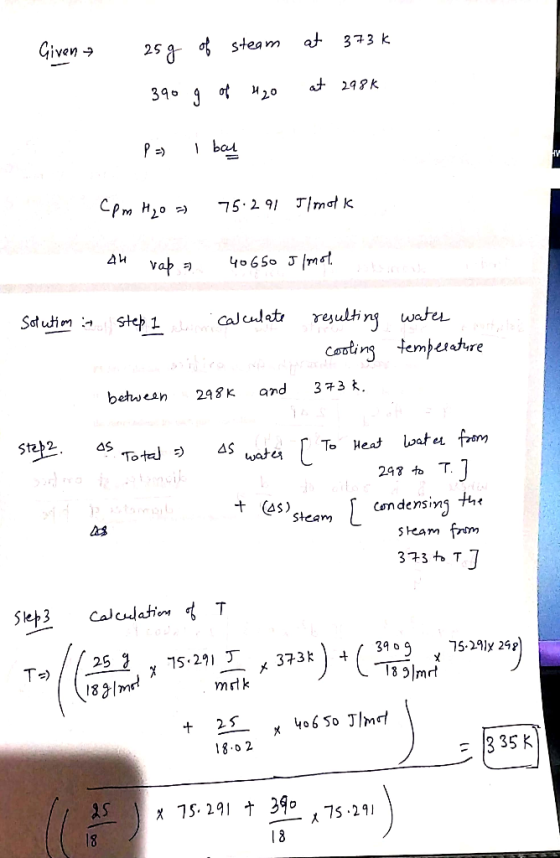
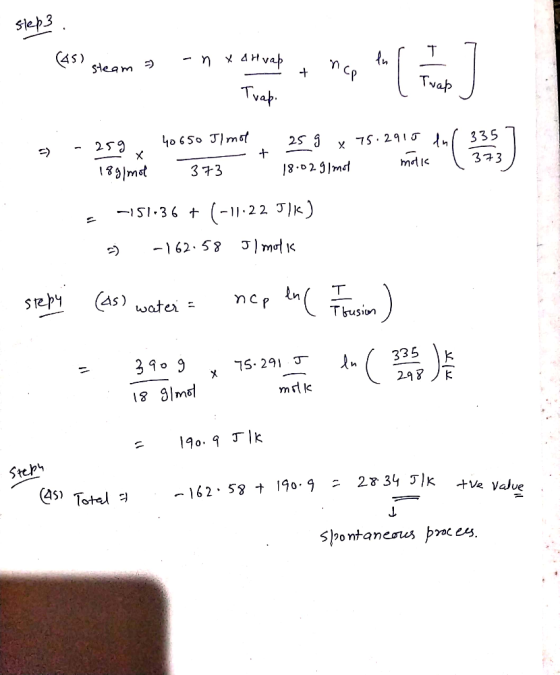
I hope it will help you. If I missed anything please let me know before giving your rating.
Thanks
P5.26 A 22.0 g mass of ice at 273 K is added to 136 g of H20() at 310. K at constant pressure. Is...
 P5.26 A 22.0 g mass of ice at 273 K is added to 136 g of H20() at 310. K at constant pressure. Is the final state of the system ice or liquid water? Calculate AS for the process. Is the process spontaneous?
P5.26 A 22.0 g mass of ice at 273 K is added to 136 g of H20() at 310. K at constant pressure. Is the final state of the system ice or liquid water? Calculate AS for...
P5.26 A 22.0 g mass of ice at 273 K is added to 136 g of H20() at 310. K at constant pressure. Is the final state of the system ice or liquid water? Calculate AS for the process. Is the process spontaneous?
P5.26 A 22.0 g mass of ice at 273 K is added to 136 g of H20() at 310. K at constant pressure. Is the final state of the system ice or liquid water? Calculate AS for...
3. 1.0 L of pure H2O(g) at T = 298 K, P = Po is mixed with 1.0 L of pure NH3 (g) at T = 298 K, P = P. The mixing is...
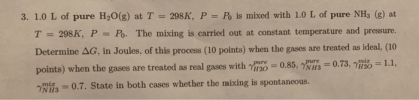 3. 1.0 L of pure H2O(g) at T = 298 K, P = Po is mixed with 1.0 L of pure NH3 (g) at T = 298 K, P = P. The mixing is carried out at constant temperature and pressure. Determine AG, in Joules, of this process (10 points) when the gases are treated as ideal, (10 points) when the gases are treated as real gases with 120 = 0.85, V = 0.73, 179120 = 1.1, i = 0.7....
5. (20 pts.) The molar heat capacity CP.m of H2O(g) from 373 K to 473 K...
 5. (20 pts.) The molar heat capacity CP.m of H2O(g) from 373 K to 473 K at a constant pressure of 1 atm is Cp,l = 30.54 +(1.03x10⁻²T) where the units of Cp.m are JK mol!. a) (10 pts.) Calculate AH if 1 mol of H20 (g) is heated from 373 to 473 K at a constant pressure of 1 bar. b) (10 pts.) Calculate AU for the same thermodynamic change of state. Assume ideal gas behavior to do this...
5) How much heat is required to convert 0.05kg of water at 298 K to super-steam...
5) How much heat is required to convert 0.05kg of water at 298 K to super-steam at 423 K. The boiling point of water is 373 K. Cm [H2O (l)] = 75.4 J/(mol. ℃) Cm [H2O (g)] = 33.6 J/(mol. ℃) ΔHvap = 40.67 75.4 J/mol
The constant-pressure molar heat capacity of H2O (s) and H2O (l) is 75.291 J K−1 mol−1...
The constant-pressure molar heat capacity of H2O (s) and H2O (l) is 75.291 J K−1 mol−1 and that of H2O (g) is 33.58 J K−1 mol−1 . Assume that the constant-pressure molar heat capacities are constant over the studied temperature range. Calculate the change in entropy of the system when 15.0 g of ice at −12.0 °C is converted to water vapour at 105.0 °C at a constant pressure of 1 bar!
The standard enthalpies of formation, at 25.00 oC, of methanol (CH4O(l)), water (H2O(l)), and carbon dioxide...
The standard enthalpies of formation, at 25.00 oC, of methanol (CH4O(l)), water (H2O(l)), and carbon dioxide (CO2(g)) are, respectively, -238.7 kJ/mol, -285.8 kJ/mol, and -393.5 kJ/mol. Calculate the change in the entropy of the surroundings (in J/K) upon the combustion of 16.9 g of methanol under a constant pressure of 1.000 atm and a temperature of 25.00 oC. N.B. combustion is the reaction of this substance with molecular oxygen to produce water and carbon dioxide.
For the following processes, calculate the indicated quanti- ties for a system consisting of 1 mol...
For the following processes, calculate the indicated quanti- ties for a system consisting of 1 mol of N2 gas. Assume ideal gas behavior. a. The gas, initially at 10 bar, is expanded tenfold in volume against a constant external pressure of 1 bar, all at 298 K. Calculate q, w, ?U and ?H for the gas. b. After the expansion in part (a), the volume is fixed, and heat is added until the temperature reaches 373 K. Calculate q, w,...
Thank you Question 5: (1 point) At 390 K, the equilibrium constant, K., for the reaction...
 Thank you
Question 5: (1 point) At 390 K, the equilibrium constant, K., for the reaction below is 1.8 x 10-?. PCIs (g) - PC1; (g) + Cl2 (g) Assume a quantity of PCIs (g) is placed in a rigid 10 L vessel and the system is allowed to reach equilibrium at a constant temperature of 390 K. Identify whether each of the following statements is true or false. At equilibrium, if the vessel contains I mole of PCs (g)...
Thank you
Question 5: (1 point) At 390 K, the equilibrium constant, K., for the reaction below is 1.8 x 10-?. PCIs (g) - PC1; (g) + Cl2 (g) Assume a quantity of PCIs (g) is placed in a rigid 10 L vessel and the system is allowed to reach equilibrium at a constant temperature of 390 K. Identify whether each of the following statements is true or false. At equilibrium, if the vessel contains I mole of PCs (g)...
A 1.00-g sample of liquid water is added to 1.00 L of N2 gas at 1.01...
A 1.00-g sample of liquid water is added to 1.00 L of N2 gas at 1.01 bar and 25 ̊C. To what volume must the system be adjusted in order for all the water to evaporate? Assuming ideal gas behavior, what will be the total pressure of the system? The vapor pressure of water is 0.0316 bar at 25 ̊C.
Determine the equilibrium constant for the following reaction at 298 K: SO3(g) + H2O(g) → H2SO4(l)...
Determine the equilibrium constant for the following reaction at 298 K: SO3(g) + H2O(g) → H2SO4(l) ΔG°rxn = -90.5 kJ mol-1 Group of answer choices 0.964 4.78 × 10¹¹ 7.31 × 10¹⁵ 1.37 × 10⁻¹⁶ 9.11 × 10⁻⁸
 P5.26 A 22.0 g mass of ice at 273 K is added to 136 g of H20() at 310. K at constant pressure. Is the final state of the system ice or liquid water? Calculate AS for the process. Is the process spontaneous?
P5.26 A 22.0 g mass of ice at 273 K is added to 136 g of H20() at 310. K at constant pressure. Is the final state of the system ice or liquid water? Calculate AS for...
P5.26 A 22.0 g mass of ice at 273 K is added to 136 g of H20() at 310. K at constant pressure. Is the final state of the system ice or liquid water? Calculate AS for the process. Is the process spontaneous?
P5.26 A 22.0 g mass of ice at 273 K is added to 136 g of H20() at 310. K at constant pressure. Is the final state of the system ice or liquid water? Calculate AS for...
 3. 1.0 L of pure H2O(g) at T = 298 K, P = Po is mixed with 1.0 L of pure NH3 (g) at T = 298 K, P = P. The mixing is carried out at constant temperature and pressure. Determine AG, in Joules, of this process (10 points) when the gases are treated as ideal, (10 points) when the gases are treated as real gases with 120 = 0.85, V = 0.73, 179120 = 1.1, i = 0.7....
 5. (20 pts.) The molar heat capacity CP.m of H2O(g) from 373 K to 473 K at a constant pressure of 1 atm is Cp,l = 30.54 +(1.03x10⁻²T) where the units of Cp.m are JK mol!. a) (10 pts.) Calculate AH if 1 mol of H20 (g) is heated from 373 to 473 K at a constant pressure of 1 bar. b) (10 pts.) Calculate AU for the same thermodynamic change of state. Assume ideal gas behavior to do this...
 Thank you
Question 5: (1 point) At 390 K, the equilibrium constant, K., for the reaction below is 1.8 x 10-?. PCIs (g) - PC1; (g) + Cl2 (g) Assume a quantity of PCIs (g) is placed in a rigid 10 L vessel and the system is allowed to reach equilibrium at a constant temperature of 390 K. Identify whether each of the following statements is true or false. At equilibrium, if the vessel contains I mole of PCs (g)...
Thank you
Question 5: (1 point) At 390 K, the equilibrium constant, K., for the reaction below is 1.8 x 10-?. PCIs (g) - PC1; (g) + Cl2 (g) Assume a quantity of PCIs (g) is placed in a rigid 10 L vessel and the system is allowed to reach equilibrium at a constant temperature of 390 K. Identify whether each of the following statements is true or false. At equilibrium, if the vessel contains I mole of PCs (g)...
Most questions answered within 3 hours.
-
Where is the error in this code sequence?
String s1 = "Hello";
String s2 = "ello";...
asked 11 months ago -
Financial data for Joel de Paris, Inc., for last year
follow:
Joel de Paris, Inc.
Balance...
asked 11 months ago -
Consider this reaction:
Al2(SO4)3 (aq)+ BaCl3
(aq) Al2Cl6 (aq)- +
3BaSO4(s) . What is the...
asked 11 months ago -
Suppose that Savneet is considering increasing her
recent random sample from 20 car rentals to 40...
asked 11 months ago -
Trucks arrive at an unloading terminal at an average rate of 120
per hour.
Trucks arrive...
asked 11 months ago -
Why are methanol and ethanol completely soluble in water while
octanol is not very little soluble....
asked 11 months ago -
A facilities manager at a university reads in a research report
that the mean amount of...
asked 11 months ago -
When the CuSO4 is rehydrated by adding water to the anhydrous
compound, is this an endothermic...
asked 11 months ago -
A ray of sunlight is passing from diamond into crown glass; the
angle of incidence is...
asked 11 months ago -
A block of mass 0.249 kg is placed on top of a light, vertical
spring of...
asked 11 months ago -
how do the kidneys compensate in the presences of acidosis
a) trigger hyperventilate
b) reserve acid...
asked 11 months ago -
Question 501 pts
The rental rate of capital to the firm increases. Which of the
following...
asked 11 months ago