Calculate the diameter of a perfectly spherical particle having a density equal to 3.5 g.cm-3 and...
Calculate the diameter of a perfectly spherical particle having a density equal to 3.5 g.cm-3 and which falls in water with terminal velocity equal to 2.5 cm.s-1. Use the Foust chart method.
Homework Answers

Add Answer to:
Calculate the diameter of a perfectly spherical particle having
a density equal to 3.5 g.cm-3 and...
A spherical particle (density 2500 kg/m3) is dropped in a tube of fluid. The diameter of...
A spherical particle (density 2500 kg/m3) is dropped in a tube of fluid. The diameter of the tube is 50mm, and the particle achieves a terminal velocity of 1 x 10⁻⁴ m/s. If the wall factor is 0.9, what is the size of the particle? Assume Rep < 0.3. Give your answer in mm, to 3 significant figures.
2. A small spherical particle (diameter = 75x10-6 m) is falling through air from a high...
 2. A small spherical particle (diameter = 75x10-6 m) is falling through air from a high elevation. Density of air is 0.85 kg/m3 and viscosity is 1.47 x 10⁻⁵ kg/m.s. Density of particle is 1,500 kg/m3. Determine the terminal velocity of the particle. (10%)
1.) Find the terminal velocity (in m/s) of a spherical bacterium (diameter 1.94 µm) falling in...
1.) Find the terminal velocity (in m/s) of a spherical bacterium (diameter 1.94 µm) falling in water. You will first need to note that the drag force is equal to the weight at terminal velocity. Take the density of the bacterium to be 1.10 ✕ 103 kg/m3. (Assume the viscosity of water is 1.002 ✕ 10−3 kg/(m · s).
Find the terminal velocity (in m/s) of a spherical bacterium (diameter 1.73 µm) falling in water....
Find the terminal velocity (in m/s) of a spherical bacterium (diameter 1.73 µm) falling in water. You will first need to note that the drag force is equal to the weight at terminal velocity. Take the density of the bacterium to be 1.10 ✕ 103 kg/m3. (Assume the viscosity of water is 1.002 ✕ 10−3 kg/(m · s).)
A spherical raindrop 1.9 mm in diameter falls through a vertical distance of 4150 m. Take...
A spherical raindrop 1.9 mm in diameter falls through a vertical distance of 4150 m. Take the cross-sectional area of a raindrop = πr2, drag coefficient = 0.45, density of water to be 1000 kg/m3, and density of air to be 1.2 kg/m3. (a) Calculate the speed a spherical raindrop would achieve falling from 4150 m in the absence of air drag. _________ m/s (b) What would its speed be at the end of 4150 m when there is air...
5) rain drop falls because the density of liquid water is much greater than the density...
 5) rain drop falls because the density of liquid water is much greater than the density of the air. Assume a raindrop is spherical and has a diameter of 5mm. Determine its terminal velocity. Use the following procedure: a. Guess a velocity and compute the Re. b. Compute the Co. c. Use Figure 12.4 to see if your computed Co matches the correct Co for that Re. If not give an improved guess for your velocity. Continue this process until...
lity that produces soluble coffee, solid spherical coffee beans from 3 different dryers having 40 μη,...
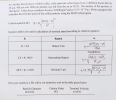 lity that produces soluble coffee, solid spherical coffee beans from 3 different dryers having 40 μη, 400 μ m ạnd 4000 um particle size fall from the air at 422 K. The density of the particles is 030 kg/m. Under these conditions for air p-0.838 kg/m1 and u-2.37x10 Pa.s. Write a program that In a facil 1 calculates the terminal speed of the coffee particles using the MATLAB program. /3 Criteria equation (K): KSPPp-p Equation table to be used in...
The drag force F acting on a spherical particle of diameter D falling slowly through a...
 The drag force F acting on a spherical particle of diameter D falling slowly through a viscous fluid at velocity u is found to be influenced by the diameter D, velocity of fall u, and the viscosity . Using the method of dimensional analysis obtain a relationship between the variables. Number of variables is a. (5) Ob. (6) c. (7) d. None of the above Number of the dimensions is e. (3) f. (4) g. (5) Number of the groups...
(a) Calculate time required for a virus particle that is 50 nm (50x10-9 m) in diameter...
(a) Calculate time required for a virus particle that is 50 nm (50x10-9 m) in diameter with a density of 1.03 g cm-3 suspended in water with a density of 1.0 g cm-3 to settle out of a water column that is 3 m deep. Assume the dynamic viscosity is 1x10⁻³ kg m-1 s-1. (b) What is the time required if the virus particle was attached to an Al(OH)3 floc that is 0.1 mm in diameter with a density of...
13.975 14.516 209 23 5.680 3.045 238 180 12 214 24 3. Calculate the terminal settling...
 13.975 14.516 209 23 5.680 3.045 238 180 12 214 24 3. Calculate the terminal settling velocity of a spherical particle in water. The particle has diameter of 0.5mm and specific gravity of 3.0. Using 10 mls for the kinetic viscosity of water in the calculation. A velocitv-contmlled orit channel is nlanned for the mayimum flowrate of2 s0m
 2. A small spherical particle (diameter = 75x10-6 m) is falling through air from a high elevation. Density of air is 0.85 kg/m3 and viscosity is 1.47 x 10⁻⁵ kg/m.s. Density of particle is 1,500 kg/m3. Determine the terminal velocity of the particle. (10%)
 5) rain drop falls because the density of liquid water is much greater than the density of the air. Assume a raindrop is spherical and has a diameter of 5mm. Determine its terminal velocity. Use the following procedure: a. Guess a velocity and compute the Re. b. Compute the Co. c. Use Figure 12.4 to see if your computed Co matches the correct Co for that Re. If not give an improved guess for your velocity. Continue this process until...
 lity that produces soluble coffee, solid spherical coffee beans from 3 different dryers having 40 μη, 400 μ m ạnd 4000 um particle size fall from the air at 422 K. The density of the particles is 030 kg/m. Under these conditions for air p-0.838 kg/m1 and u-2.37x10 Pa.s. Write a program that In a facil 1 calculates the terminal speed of the coffee particles using the MATLAB program. /3 Criteria equation (K): KSPPp-p Equation table to be used in...
 The drag force F acting on a spherical particle of diameter D falling slowly through a viscous fluid at velocity u is found to be influenced by the diameter D, velocity of fall u, and the viscosity . Using the method of dimensional analysis obtain a relationship between the variables. Number of variables is a. (5) Ob. (6) c. (7) d. None of the above Number of the dimensions is e. (3) f. (4) g. (5) Number of the groups...
 13.975 14.516 209 23 5.680 3.045 238 180 12 214 24 3. Calculate the terminal settling velocity of a spherical particle in water. The particle has diameter of 0.5mm and specific gravity of 3.0. Using 10 mls for the kinetic viscosity of water in the calculation. A velocitv-contmlled orit channel is nlanned for the mayimum flowrate of2 s0m
Most questions answered within 3 hours.
-
Where is the error in this code sequence?
String s1 = "Hello";
String s2 = "ello";...
asked 10 months ago -
Financial data for Joel de Paris, Inc., for last year
follow:
Joel de Paris, Inc.
Balance...
asked 10 months ago -
Consider this reaction:
Al2(SO4)3 (aq)+ BaCl3
(aq) Al2Cl6 (aq)- +
3BaSO4(s) . What is the...
asked 10 months ago -
Suppose that Savneet is considering increasing her
recent random sample from 20 car rentals to 40...
asked 10 months ago -
Trucks arrive at an unloading terminal at an average rate of 120
per hour.
Trucks arrive...
asked 10 months ago -
Why are methanol and ethanol completely soluble in water while
octanol is not very little soluble....
asked 10 months ago -
A facilities manager at a university reads in a research report
that the mean amount of...
asked 10 months ago -
When the CuSO4 is rehydrated by adding water to the anhydrous
compound, is this an endothermic...
asked 10 months ago -
A ray of sunlight is passing from diamond into crown glass; the
angle of incidence is...
asked 10 months ago -
A block of mass 0.249 kg is placed on top of a light, vertical
spring of...
asked 10 months ago -
how do the kidneys compensate in the presences of acidosis
a) trigger hyperventilate
b) reserve acid...
asked 10 months ago -
Question 501 pts
The rental rate of capital to the firm increases. Which of the
following...
asked 10 months ago