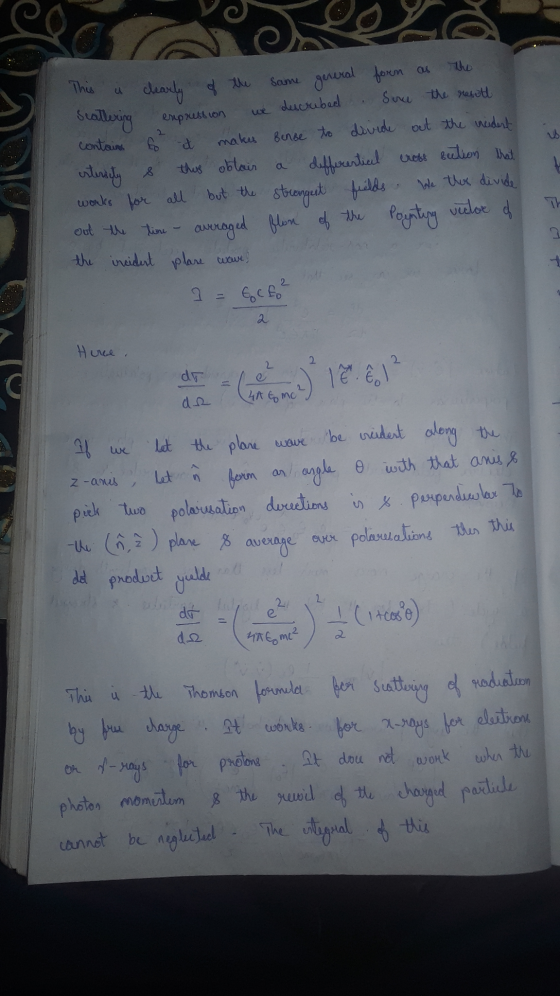
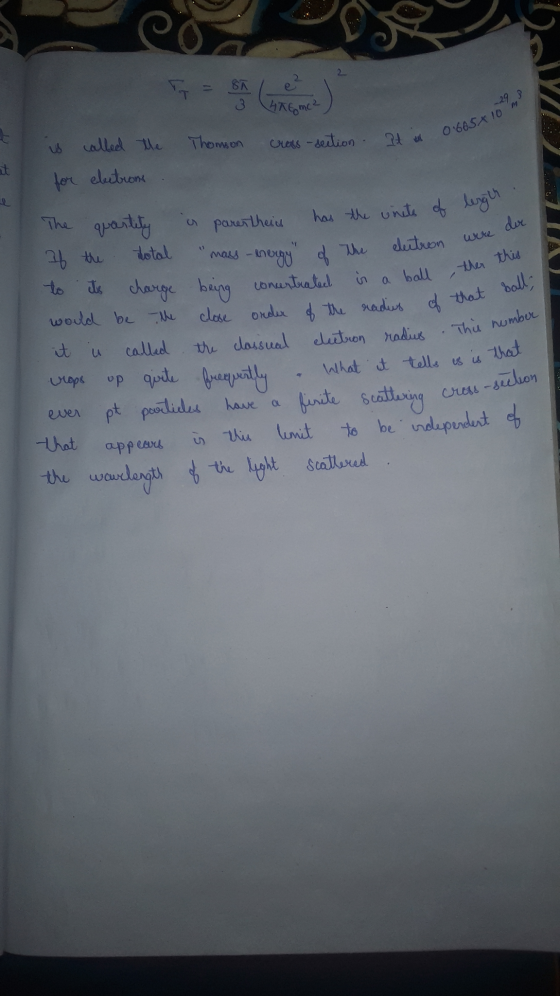
Why is Thomson scattering independent of the wavelenght of the incident photon? Is it independent of...
Homework Answers

Add Answer to:
Why
is Thomson scattering independent of the wavelenght of the incident
photon? Is it independent of...
Quantum Physics - Photon Momentum - Photon Scattering - Compton Effect 2 Photon Scattering by Electron...
 Quantum Physics - Photon Momentum - Photon Scattering - Compton Effect 2 Photon Scattering by Electron - Compton Effect E = h' Ehf h (photon's momentum) 2 Before KW 2 After h 2-1=(1-cos) (Compton effect) m. = 2.43x10- Before After KEE E is between 0° and 180° The Planck constant is 6.626x10^-34 J s. The wavelength of the incident X-ray photon is unknown. The incident photon collides with the stationary electron. After the collision, the scattered photon's motion makes an...
Quantum Physics - Photon Momentum - Photon Scattering - Compton Effect 1 Photon Scattering by Electron...
 Quantum Physics - Photon Momentum - Photon Scattering - Compton Effect 1 Photon Scattering by Electron - Compton Effect Ehf Ehr" P (photon's momentum) Before X After 2-X A Before I-cos8) (Compton effect) "=2.43 x 10⁻¹² . Affer KE - E is between 0° and 180° The Planck constant is 6.626x10^-34 J s. The wavelength of the incident X-ray photon is 0.570 nm, 1nm = 10-ºm. The incident photon collides with the stationary electron. After the collision, the scattered photon's...
In a Compton scattering experiment, the incident X-rays have a wavelength of 0.2686 nm, and the...
 In a Compton scattering experiment, the incident X-rays have a
wavelength of 0.2686 nm, and the scattered X-rays have a wavelength
of 0.2705 nm. Through what angle in the drawing are the X-rays
scattered?
E, Photon scattering from stationary electron
In a Compton scattering experiment, the incident X-rays have a
wavelength of 0.2686 nm, and the scattered X-rays have a wavelength
of 0.2705 nm. Through what angle in the drawing are the X-rays
scattered?
E, Photon scattering from stationary electron
X-rays of wavelength 3.550 Angstroms (10-10 m) incident on an aluminum target undergo Compton scattering. (a)...
 X-rays of wavelength 3.550 Angstroms (10-10 m) incident on an aluminum target undergo Compton scattering. (a) For a photon scattered at 84º relative to the incident beam, what is the wavelength of the scattered photon? m (b) What are the magnitude of the momentum and the energy of this scattered photon at this angle? momentum kg. m/s energy
In a Compton scattering experiment, an x-ray photon scatters through an angle of 12.6° from a...
 In a Compton scattering experiment, an x-ray photon scatters through an angle of 12.6° from a free electron that is initially at rest. The electron recoils with a speed of 1,400 km/s. (a) Calculate the wavelength of the incident photon. nm (b) Calculate the angle through which the electron scatters. o
that the scattering angle of the photon is twice the 2. A 0.700-MeV photon scatters off...
 that the scattering angle of the photon is twice the 2. A 0.700-MeV photon scatters off a free electron such that the scattering angre scattering angle of the electron, as shown in the figure below. a. Determine the scattering angle for the electron. Hint: use relativistic momentu b. Determine the final speed of the electron. C. What is the Compton shift in the photon's wavelength? Hint: use relativistic momentum for the electron 9-20
Activity 26-3. Compton scattering [Accompanies Section 26-3] In Compton scattering a photon collides with an electron...
 Activity 26-3. Compton scattering [Accompanies Section 26-3] In Compton scattering a photon collides with an electron that is initially at rest. (a) Rank the following quantities in order from largest to smallest. If any two quantities are the same, state this. Explain how you made your ranking. (i) The wavelength of an x-ray photon (ii) The change in wavelength of an x-ray photon in Compton scattering when it scatters through an angle of 0° (that is, the photon continues in...
In Compton scattering a photon collides with an electron that is initially at rest. (a) Rank...
In Compton scattering a photon collides with an electron that is initially at rest. (a) Rank the following quantities in order from largest to smallest. If any two quantities are the same, state this. Explain how you made your ranking. (i) The wavelength of an x-ray photon (ii) The change in wavelength of an x-ray photon in Compton scattering when it scatters through an angle of 0° (that is, the photon continues in the same direction as its initial motion)...
In Compton scattering a photon collides with an electron that is initially at rest. (a) Rank...
In Compton scattering a photon collides with an electron that is initially at rest. (a) Rank the following quantities in order from largest to smallest. If any two quantities are the same, state this. Explain how you made your ranking. (i) The wavelength of an x-ray photon (ii) The change in wavelength of an x-ray photon in Compton scattering when it scatters through an angle of 0° (that is, the photon continues in the same direction as its initial motion)...
In a Compton scattering experiment, an x-ray photon scatters through an angle of 17.0° from a...
 In a Compton scattering experiment, an x-ray photon scatters through an angle of 17.0° from a free electron that is initially at rest. The electron recoils with a speed of 1,560 km/s. (a) Calculate the wavelength of the incident photon. X Enter a number differs significantly from the correct answer. Rework your solution from the beginning and check each step carefully nm (b) Calculate the angle through which the electron scatters. 80.29 Need Help? Read It
 Quantum Physics - Photon Momentum - Photon Scattering - Compton Effect 2 Photon Scattering by Electron - Compton Effect E = h' Ehf h (photon's momentum) 2 Before KW 2 After h 2-1=(1-cos) (Compton effect) m. = 2.43x10- Before After KEE E is between 0° and 180° The Planck constant is 6.626x10^-34 J s. The wavelength of the incident X-ray photon is unknown. The incident photon collides with the stationary electron. After the collision, the scattered photon's motion makes an...
 Quantum Physics - Photon Momentum - Photon Scattering - Compton Effect 1 Photon Scattering by Electron - Compton Effect Ehf Ehr" P (photon's momentum) Before X After 2-X A Before I-cos8) (Compton effect) "=2.43 x 10⁻¹² . Affer KE - E is between 0° and 180° The Planck constant is 6.626x10^-34 J s. The wavelength of the incident X-ray photon is 0.570 nm, 1nm = 10-ºm. The incident photon collides with the stationary electron. After the collision, the scattered photon's...
 In a Compton scattering experiment, the incident X-rays have a
wavelength of 0.2686 nm, and the scattered X-rays have a wavelength
of 0.2705 nm. Through what angle in the drawing are the X-rays
scattered?
E, Photon scattering from stationary electron
In a Compton scattering experiment, the incident X-rays have a
wavelength of 0.2686 nm, and the scattered X-rays have a wavelength
of 0.2705 nm. Through what angle in the drawing are the X-rays
scattered?
E, Photon scattering from stationary electron
 X-rays of wavelength 3.550 Angstroms (10-10 m) incident on an aluminum target undergo Compton scattering. (a) For a photon scattered at 84º relative to the incident beam, what is the wavelength of the scattered photon? m (b) What are the magnitude of the momentum and the energy of this scattered photon at this angle? momentum kg. m/s energy
 In a Compton scattering experiment, an x-ray photon scatters through an angle of 12.6° from a free electron that is initially at rest. The electron recoils with a speed of 1,400 km/s. (a) Calculate the wavelength of the incident photon. nm (b) Calculate the angle through which the electron scatters. o
 that the scattering angle of the photon is twice the 2. A 0.700-MeV photon scatters off a free electron such that the scattering angre scattering angle of the electron, as shown in the figure below. a. Determine the scattering angle for the electron. Hint: use relativistic momentu b. Determine the final speed of the electron. C. What is the Compton shift in the photon's wavelength? Hint: use relativistic momentum for the electron 9-20
 Activity 26-3. Compton scattering [Accompanies Section 26-3] In Compton scattering a photon collides with an electron that is initially at rest. (a) Rank the following quantities in order from largest to smallest. If any two quantities are the same, state this. Explain how you made your ranking. (i) The wavelength of an x-ray photon (ii) The change in wavelength of an x-ray photon in Compton scattering when it scatters through an angle of 0° (that is, the photon continues in...
 In a Compton scattering experiment, an x-ray photon scatters through an angle of 17.0° from a free electron that is initially at rest. The electron recoils with a speed of 1,560 km/s. (a) Calculate the wavelength of the incident photon. X Enter a number differs significantly from the correct answer. Rework your solution from the beginning and check each step carefully nm (b) Calculate the angle through which the electron scatters. 80.29 Need Help? Read It
Most questions answered within 3 hours.
-
Where is the error in this code sequence?
String s1 = "Hello";
String s2 = "ello";...
asked 11 months ago -
Financial data for Joel de Paris, Inc., for last year
follow:
Joel de Paris, Inc.
Balance...
asked 11 months ago -
Consider this reaction:
Al2(SO4)3 (aq)+ BaCl3
(aq) Al2Cl6 (aq)- +
3BaSO4(s) . What is the...
asked 11 months ago -
Suppose that Savneet is considering increasing her
recent random sample from 20 car rentals to 40...
asked 11 months ago -
Trucks arrive at an unloading terminal at an average rate of 120
per hour.
Trucks arrive...
asked 11 months ago -
Why are methanol and ethanol completely soluble in water while
octanol is not very little soluble....
asked 11 months ago -
A facilities manager at a university reads in a research report
that the mean amount of...
asked 11 months ago -
When the CuSO4 is rehydrated by adding water to the anhydrous
compound, is this an endothermic...
asked 11 months ago -
A ray of sunlight is passing from diamond into crown glass; the
angle of incidence is...
asked 11 months ago -
A block of mass 0.249 kg is placed on top of a light, vertical
spring of...
asked 11 months ago -
how do the kidneys compensate in the presences of acidosis
a) trigger hyperventilate
b) reserve acid...
asked 11 months ago -
Question 501 pts
The rental rate of capital to the firm increases. Which of the
following...
asked 11 months ago