On Sundays people in Los Angeles consider taking a boat to Catalina Island to spend the...
On Sundays people in Los Angeles consider taking a boat to
Catalina Island to spend the day on the beach there. The utility
that a person gets from visiting Catalina is 1 − [n/120] − p, where
n is the number of visitors on the island and p is the price of
round-trip transportation (by boat). (Note that a visitor obtains
more satisfaction if there are fewer other visitors on the island.)
The utility of staying home is zero.
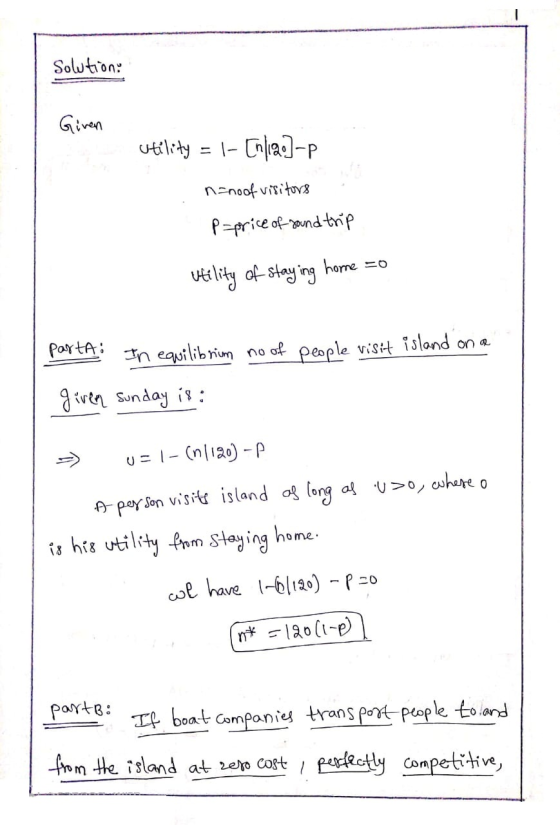
Part A: In equilibrium, how many people visit the island on a given
Sunday? (Your answer should depend on p.)
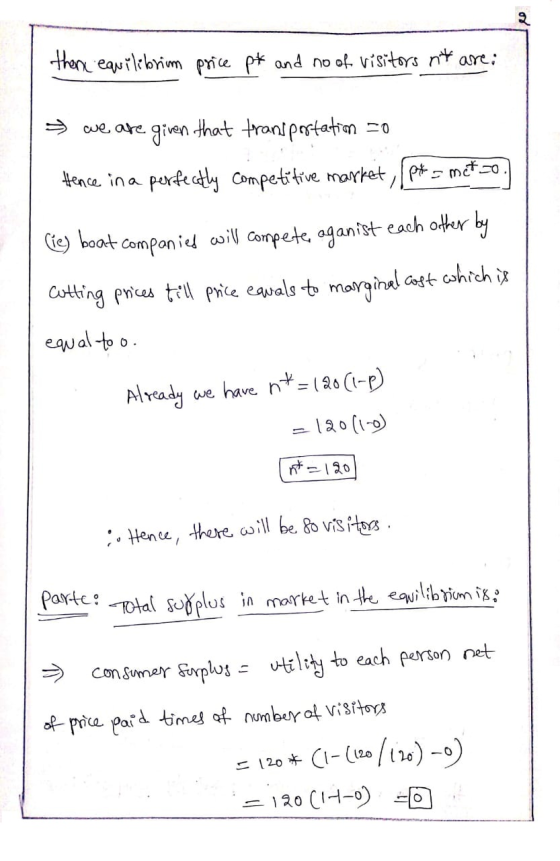
Part B: Suppose that the boat companies can transport people to and
from the island at zero cost. If the boat transportation market is
perfectly competitive, what is the equilibrium price p∗ and what is
the number of visitors n∗?
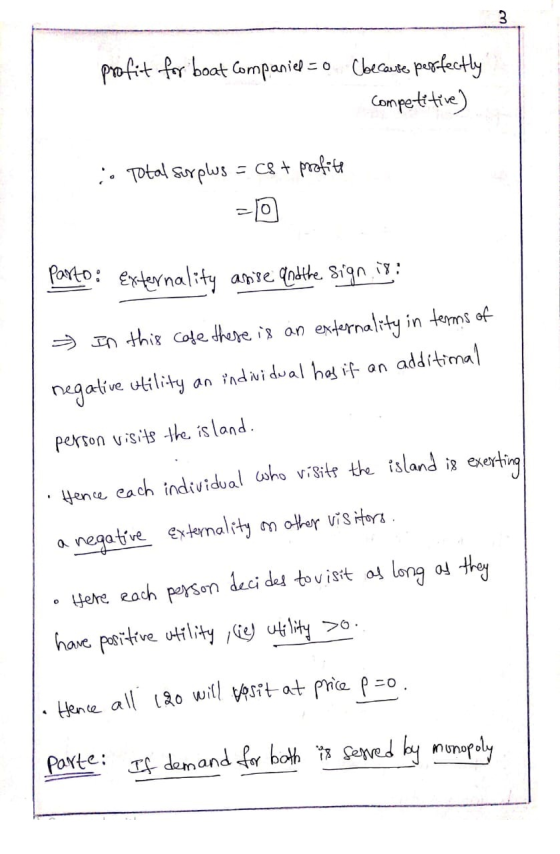
Part C: Compute the total surplus in this market in the equilibrium
of part (b).
Part D: How does an externality arise in this problem and is it
positive or negative?
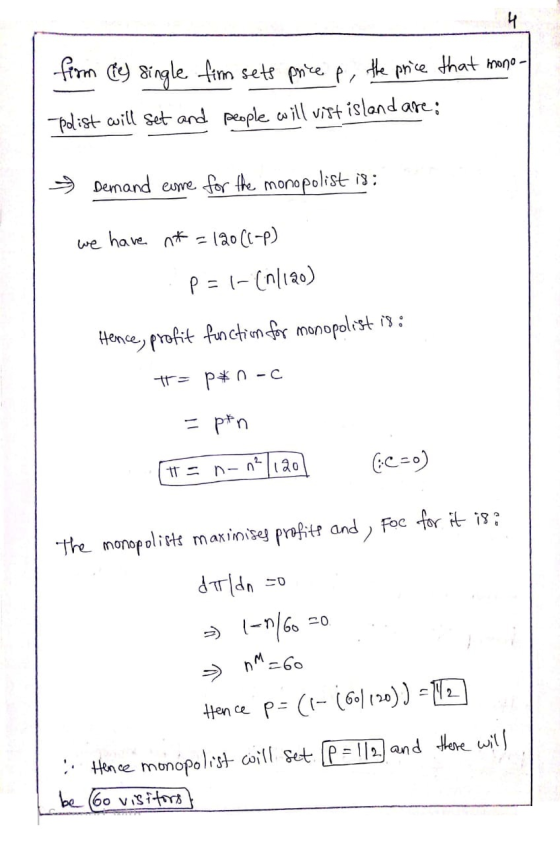
Part E: Now suppose that the demand for boat transportation is
served by a monopoly firm. That is, a single firm sets the price p.
What price will the monopolist set and how many people will visit
the island?
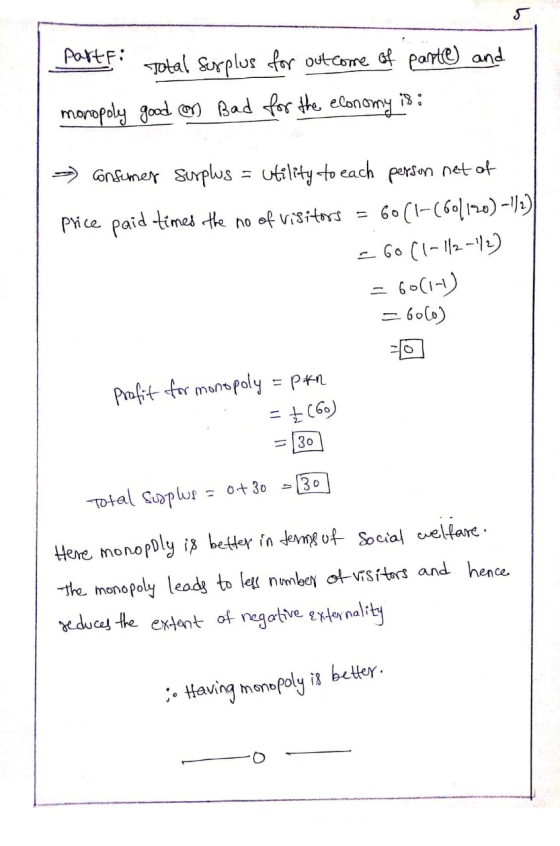
Part F: Compute the total surplus for the outcome of part (e). Is
the monopoly good or bad for the economy? Explain.
Homework Answers
Add Answer to:
On Sundays people in Los Angeles consider taking a boat to
Catalina Island to spend the...
2) Consider a location model of differentiated products where the set of possible products is the...
 2) Consider a location model of differentiated products where the set of possible products is the line segment [0,11 and consumers are uniformly distributed along the line segment. Transportation costs in this model are equal to td, where d= |x- is the distance between the consumer's ideal variety and the variety she purchases. If a consumer with ideal variety x* purchases variety x at price p, then her utility is If the consumer does not purchase the good her utility...
Q1. Sarah has decided to spend always $200 on clothing per month. Which one of the...
 Q1. Sarah has decided to spend always $200 on clothing
per month. Which one of the statements below is true?
A. Sarah’s price elasticity of demand is one because she is
maintaining her clothing expenditures as a constant fraction of the
price.
B. Sarah’s income elasticity of demand is equal to zero because her
clothing expenditure does not depend on the price.
C. Sarah’s income elasticity of demand is infinite because she is
willing to spend a huge amount of...
Q1. Sarah has decided to spend always $200 on clothing
per month. Which one of the statements below is true?
A. Sarah’s price elasticity of demand is one because she is
maintaining her clothing expenditures as a constant fraction of the
price.
B. Sarah’s income elasticity of demand is equal to zero because her
clothing expenditure does not depend on the price.
C. Sarah’s income elasticity of demand is infinite because she is
willing to spend a huge amount of...
1) Decreasing returns to scale may occur as increasing the amount of inputs used A) increases...
 1) Decreasing returns to scale may occur as increasing the amount of inputs used A) increases specialization B) may cause coordination difficulties. C) always increases the amount of output produced D) increases efficiency. 2) Which of the following statements is NOT true? A) AFC = AC - AVC C) AVC = wage/MPL B) AC = AFC + AVC D) C=F-VC 3) The more elastic the demand curve, a monopoly A) will have a larger Lemer Index. will face a lower...
13) The cost the Almy type of market 7) The market is an example of A)...
 13) The cost the Almy type of market 7) The market is an example of A) mattress: a monopoly B) com a perfectly competitive C) car insurance an oligopoly D) cell phone; a perfectly competitive 5) airplane manufacturing a monopolistically competitive 8) What is the difference between perfect competition and monopolistic competition? A) Perfect competition has a large number of small firms while monopolistic competition does not in monopolistic competition, firms produce identical goods, while in perfect competition, firms produce...
Chapter overview 1. Reasons for international trade Resources reasons Economic reasons Other reasons 2. Difference between...
Chapter overview 1. Reasons for international trade Resources reasons Economic reasons Other reasons 2. Difference between international trade and domestic trade More complex context More difficult and risky Higher management skills required 3. Basic concept s relating to international trade Visible trade & invisible trade Favorable trade & unfavorable trade General trade system & special trade system Volume of international trade & quantum of international trade Commodity composition of international trade Geographical composition of international trade Degree / ratio of...
 2) Consider a location model of differentiated products where the set of possible products is the line segment [0,11 and consumers are uniformly distributed along the line segment. Transportation costs in this model are equal to td, where d= |x- is the distance between the consumer's ideal variety and the variety she purchases. If a consumer with ideal variety x* purchases variety x at price p, then her utility is If the consumer does not purchase the good her utility...
 Q1. Sarah has decided to spend always $200 on clothing
per month. Which one of the statements below is true?
A. Sarah’s price elasticity of demand is one because she is
maintaining her clothing expenditures as a constant fraction of the
price.
B. Sarah’s income elasticity of demand is equal to zero because her
clothing expenditure does not depend on the price.
C. Sarah’s income elasticity of demand is infinite because she is
willing to spend a huge amount of...
Q1. Sarah has decided to spend always $200 on clothing
per month. Which one of the statements below is true?
A. Sarah’s price elasticity of demand is one because she is
maintaining her clothing expenditures as a constant fraction of the
price.
B. Sarah’s income elasticity of demand is equal to zero because her
clothing expenditure does not depend on the price.
C. Sarah’s income elasticity of demand is infinite because she is
willing to spend a huge amount of...
 1) Decreasing returns to scale may occur as increasing the amount of inputs used A) increases specialization B) may cause coordination difficulties. C) always increases the amount of output produced D) increases efficiency. 2) Which of the following statements is NOT true? A) AFC = AC - AVC C) AVC = wage/MPL B) AC = AFC + AVC D) C=F-VC 3) The more elastic the demand curve, a monopoly A) will have a larger Lemer Index. will face a lower...
 13) The cost the Almy type of market 7) The market is an example of A) mattress: a monopoly B) com a perfectly competitive C) car insurance an oligopoly D) cell phone; a perfectly competitive 5) airplane manufacturing a monopolistically competitive 8) What is the difference between perfect competition and monopolistic competition? A) Perfect competition has a large number of small firms while monopolistic competition does not in monopolistic competition, firms produce identical goods, while in perfect competition, firms produce...
Most questions answered within 3 hours.
-
Where is the error in this code sequence?
String s1 = "Hello";
String s2 = "ello";...
asked 11 months ago -
Financial data for Joel de Paris, Inc., for last year
follow:
Joel de Paris, Inc.
Balance...
asked 11 months ago -
Consider this reaction:
Al2(SO4)3 (aq)+ BaCl3
(aq) Al2Cl6 (aq)- +
3BaSO4(s) . What is the...
asked 11 months ago -
Suppose that Savneet is considering increasing her
recent random sample from 20 car rentals to 40...
asked 11 months ago -
Trucks arrive at an unloading terminal at an average rate of 120
per hour.
Trucks arrive...
asked 11 months ago -
Why are methanol and ethanol completely soluble in water while
octanol is not very little soluble....
asked 11 months ago -
A facilities manager at a university reads in a research report
that the mean amount of...
asked 11 months ago -
When the CuSO4 is rehydrated by adding water to the anhydrous
compound, is this an endothermic...
asked 11 months ago -
A ray of sunlight is passing from diamond into crown glass; the
angle of incidence is...
asked 11 months ago -
A block of mass 0.249 kg is placed on top of a light, vertical
spring of...
asked 11 months ago -
how do the kidneys compensate in the presences of acidosis
a) trigger hyperventilate
b) reserve acid...
asked 11 months ago -
Question 501 pts
The rental rate of capital to the firm increases. Which of the
following...
asked 11 months ago