

Homework Answers
Add Answer to:
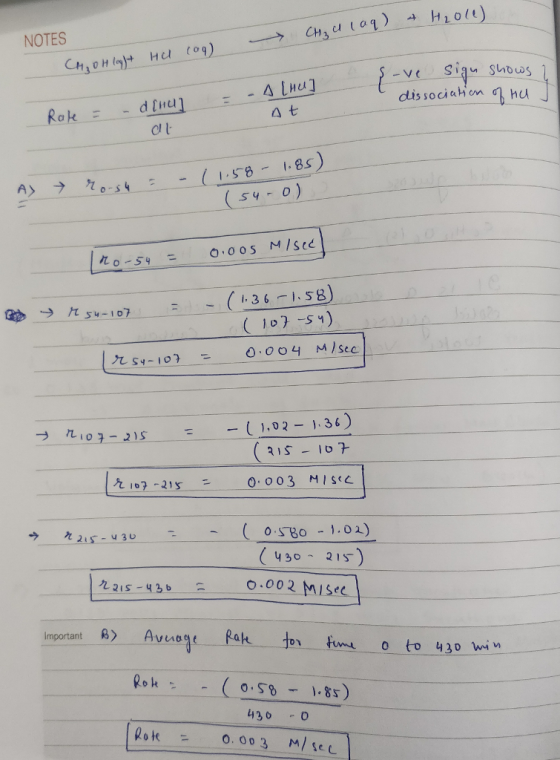
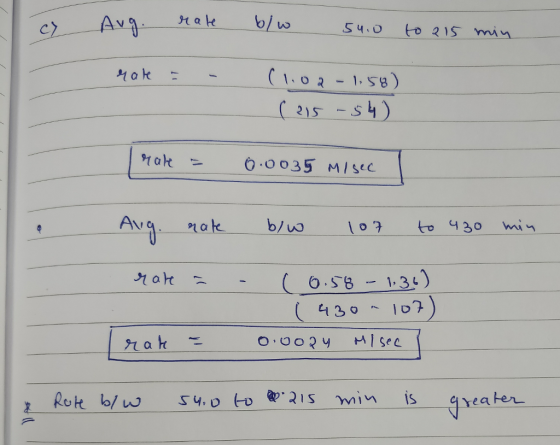
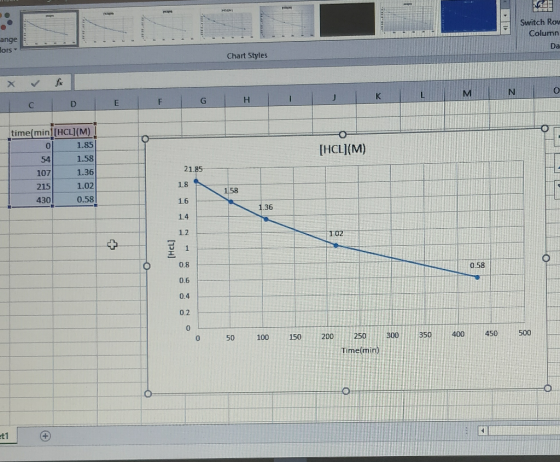
Part A Calculate the average rate of reaction, in M/s, for the time interval between each...
Constants | Periodic Table Part A Hydrogen sulfide (H2 S) is a common and troublesome pollutant...
 Constants | Periodic Table Part A Hydrogen sulfide (H2 S) is a common and troublesome pollutant in industrial wastewaters. One way to remove H2S is to treat the water with chlorine, in which case the following reaction occurs If at a given time the concentration of H2S is 2.2*10 M and that of Cl2 is 0.027 M, what is the rate of formation of Cl-? Express the rate in molarity per second to two significant figures. H2S(aq) + C12 (aq)...
A reaction of the type A→B+C has a rate constant k=3.6× 10 −5 M/s . Part...
A reaction of the type A→B+C has a rate constant k=3.6× 10 −5 M/s . Part A Part complete What is the order of the reaction? What is the order of the reaction? zeroth order first order second order SubmitPrevious Answers Correct Part B What is the molarity of A after a reaction time of 28.0 min if the initial concentration of A is 9.4×10⁻² M ? Express your answer using two significant figures. [A] [ A ] = 1920...
The decomposition of N2O5 in carbon tetrachloride proceeds as follows: What is the rate of reaction...
 The decomposition of N2O5 in carbon tetrachloride proceeds as follows: What is the rate of reaction when N205] = 0.0270? Express the rate in molarity per second to three significant figures. 2N2O3 + 4NO2 + O2 The rate law is first order in N2O5. At 64 °C the rate constant is 4.82 x 10⁻³ 3-1 IV AP R O 2 ? You may want to reference (Pages 576 - 581) Section 14.3 while completing this problem. rate = M /S...
Need help with part B and C <Assignment 16 Chap 14: Integrated Rate Law and Half...
 Need help with part B and C
<Assignment 16 Chap 14: Integrated Rate Law and Half Life Problem 14.47 Review Part B Consider the following hypothetical aqueous reaction: A (aq) → B(aq). A flask is charged with 0.065 mol of A in a total volume of 100.0 mL. The following data are collected: What is the rate constant for the reaction? Express your answer using two significant figures. Time (min) 0 10 20 30 40 Moles of A 0.065 0.051...
Need help with part B and C
<Assignment 16 Chap 14: Integrated Rate Law and Half Life Problem 14.47 Review Part B Consider the following hypothetical aqueous reaction: A (aq) → B(aq). A flask is charged with 0.065 mol of A in a total volume of 100.0 mL. The following data are collected: What is the rate constant for the reaction? Express your answer using two significant figures. Time (min) 0 10 20 30 40 Moles of A 0.065 0.051...
need help with part b and c <Assignment 16 Chap 14: Integrated Rate Law and Half...
 need help with part b and c
<Assignment 16 Chap 14: Integrated Rate Law and Half Life Problem 14.47 Review Part B Consider the following hypothetical aqueous reaction: A (aq) → B(aq). A flask is charged with 0.065 mol of A in a total volume of 100.0 mL. The following data are collected: What is the rate constant for the reaction? Express your answer using two significant figures. Time (min) 0 10 20 30 40 Moles of A 0.065 0.051...
need help with part b and c
<Assignment 16 Chap 14: Integrated Rate Law and Half Life Problem 14.47 Review Part B Consider the following hypothetical aqueous reaction: A (aq) → B(aq). A flask is charged with 0.065 mol of A in a total volume of 100.0 mL. The following data are collected: What is the rate constant for the reaction? Express your answer using two significant figures. Time (min) 0 10 20 30 40 Moles of A 0.065 0.051...
Part A The rate of the reaction in terms of the "disappearance of reactant" includes the...
 Part A The rate of the reaction in terms of the "disappearance of reactant" includes the change in the concentration of the reactant, the time interval, and the coefficient of the reactant Consider the following reaction: 2A + 3B 3C + 2D The concentrations of reactant A at three different time intervals are given. Use the following data to determine the average rate of reaction in terms of the disappearance of reactant A between time=0s and time = 20 S....
2NO(g)+O2(g)→2NO2(g) For the above reaction, the following data were collected for the rate of disappearance of...
2NO(g)+O2(g)→2NO2(g) For the above reaction, the following data were collected for the rate of disappearance of NO in the reaction: Experiment [NO] (M) [O2] (M) Initial Rate (M/s) 1 0.0126 0.0125 1.41×10⁻² 2 0.0252 0.0250 1.13×10⁻¹ 3 0.0252 0.0125 5.64×10⁻² Part A: What are the units of the rate constant? a) s−1 b) M−1s−1 c) M−2s−1 d) M−3s−1 Part B: What is the rate of disappearance of NO when [NO]=0.0725 and [O2]=0.0100? Express the rate in molarity per second to...
▼ Part A What is Larry's average velocity, in m/min, during each of these two intervals....
 ▼ Part A What is Larry's average velocity, in m/min, during each of these two intervals. Express your answer using three significant figures. Enter your answers numerically separated by a comma. Review Larry leaves home at 9:06 and runs at constant speed to the lamppost seen in (Figure 1). He reaches the lamppost at 9.08, immediately turns, and runs to the tree. Larry arrives at the tree at 9:11 m/min Submit gure < 1of1 Part B What is Larry's average...
Review Constants Periodic Tab Part A Butadiene (C4H6) reacts with itself to form a dimer with...
 Review Constants Periodic Tab Part A Butadiene (C4H6) reacts with itself to form a dimer with the formula C8H12. The reaction is second order in C4H6. Assume the rate constant at a particular temperature is 4.0 x 10⁻² M-18-1 and the initial concentration of C4H6 is 0.0180 M. What is its molarity after a reaction time of 1.30 h? Express your answer in moles per liter to two significant figures. Molarity = Submit Request Answer Part B What is the...
Part A Calculate the pH of 0.250 L of a 0.36 M formic acid-0.30 M sodium...
 Part A Calculate the pH of 0.250 L of a 0.36 M formic acid-0.30 M sodium formate buffer. Express your answer using three significant figures. ΑΣΦ pH = > Submit Request Answer Part B After the addition of 0.0050 mol of NaOH. Assume that the volume remains constant Express your answer using three significant figures. VALO o ? pH = Submit Request Answer Part C After the addition of 0.0050 mol of HCl. Assume that the volume remains constant. Express...
 Constants | Periodic Table Part A Hydrogen sulfide (H2 S) is a common and troublesome pollutant in industrial wastewaters. One way to remove H2S is to treat the water with chlorine, in which case the following reaction occurs If at a given time the concentration of H2S is 2.2*10 M and that of Cl2 is 0.027 M, what is the rate of formation of Cl-? Express the rate in molarity per second to two significant figures. H2S(aq) + C12 (aq)...
 The decomposition of N2O5 in carbon tetrachloride proceeds as follows: What is the rate of reaction when N205] = 0.0270? Express the rate in molarity per second to three significant figures. 2N2O3 + 4NO2 + O2 The rate law is first order in N2O5. At 64 °C the rate constant is 4.82 x 10⁻³ 3-1 IV AP R O 2 ? You may want to reference (Pages 576 - 581) Section 14.3 while completing this problem. rate = M /S...
 Need help with part B and C
<Assignment 16 Chap 14: Integrated Rate Law and Half Life Problem 14.47 Review Part B Consider the following hypothetical aqueous reaction: A (aq) → B(aq). A flask is charged with 0.065 mol of A in a total volume of 100.0 mL. The following data are collected: What is the rate constant for the reaction? Express your answer using two significant figures. Time (min) 0 10 20 30 40 Moles of A 0.065 0.051...
Need help with part B and C
<Assignment 16 Chap 14: Integrated Rate Law and Half Life Problem 14.47 Review Part B Consider the following hypothetical aqueous reaction: A (aq) → B(aq). A flask is charged with 0.065 mol of A in a total volume of 100.0 mL. The following data are collected: What is the rate constant for the reaction? Express your answer using two significant figures. Time (min) 0 10 20 30 40 Moles of A 0.065 0.051...
 need help with part b and c
<Assignment 16 Chap 14: Integrated Rate Law and Half Life Problem 14.47 Review Part B Consider the following hypothetical aqueous reaction: A (aq) → B(aq). A flask is charged with 0.065 mol of A in a total volume of 100.0 mL. The following data are collected: What is the rate constant for the reaction? Express your answer using two significant figures. Time (min) 0 10 20 30 40 Moles of A 0.065 0.051...
need help with part b and c
<Assignment 16 Chap 14: Integrated Rate Law and Half Life Problem 14.47 Review Part B Consider the following hypothetical aqueous reaction: A (aq) → B(aq). A flask is charged with 0.065 mol of A in a total volume of 100.0 mL. The following data are collected: What is the rate constant for the reaction? Express your answer using two significant figures. Time (min) 0 10 20 30 40 Moles of A 0.065 0.051...
 Part A The rate of the reaction in terms of the "disappearance of reactant" includes the change in the concentration of the reactant, the time interval, and the coefficient of the reactant Consider the following reaction: 2A + 3B 3C + 2D The concentrations of reactant A at three different time intervals are given. Use the following data to determine the average rate of reaction in terms of the disappearance of reactant A between time=0s and time = 20 S....
 ▼ Part A What is Larry's average velocity, in m/min, during each of these two intervals. Express your answer using three significant figures. Enter your answers numerically separated by a comma. Review Larry leaves home at 9:06 and runs at constant speed to the lamppost seen in (Figure 1). He reaches the lamppost at 9.08, immediately turns, and runs to the tree. Larry arrives at the tree at 9:11 m/min Submit gure < 1of1 Part B What is Larry's average...
 Review Constants Periodic Tab Part A Butadiene (C4H6) reacts with itself to form a dimer with the formula C8H12. The reaction is second order in C4H6. Assume the rate constant at a particular temperature is 4.0 x 10⁻² M-18-1 and the initial concentration of C4H6 is 0.0180 M. What is its molarity after a reaction time of 1.30 h? Express your answer in moles per liter to two significant figures. Molarity = Submit Request Answer Part B What is the...
 Part A Calculate the pH of 0.250 L of a 0.36 M formic acid-0.30 M sodium formate buffer. Express your answer using three significant figures. ΑΣΦ pH = > Submit Request Answer Part B After the addition of 0.0050 mol of NaOH. Assume that the volume remains constant Express your answer using three significant figures. VALO o ? pH = Submit Request Answer Part C After the addition of 0.0050 mol of HCl. Assume that the volume remains constant. Express...
Most questions answered within 3 hours.
-
Where is the error in this code sequence?
String s1 = "Hello";
String s2 = "ello";...
asked 11 months ago -
Financial data for Joel de Paris, Inc., for last year
follow:
Joel de Paris, Inc.
Balance...
asked 11 months ago -
Consider this reaction:
Al2(SO4)3 (aq)+ BaCl3
(aq) Al2Cl6 (aq)- +
3BaSO4(s) . What is the...
asked 11 months ago -
Suppose that Savneet is considering increasing her
recent random sample from 20 car rentals to 40...
asked 11 months ago -
Trucks arrive at an unloading terminal at an average rate of 120
per hour.
Trucks arrive...
asked 11 months ago -
Why are methanol and ethanol completely soluble in water while
octanol is not very little soluble....
asked 11 months ago -
A facilities manager at a university reads in a research report
that the mean amount of...
asked 11 months ago -
When the CuSO4 is rehydrated by adding water to the anhydrous
compound, is this an endothermic...
asked 11 months ago -
A ray of sunlight is passing from diamond into crown glass; the
angle of incidence is...
asked 11 months ago -
A block of mass 0.249 kg is placed on top of a light, vertical
spring of...
asked 11 months ago -
how do the kidneys compensate in the presences of acidosis
a) trigger hyperventilate
b) reserve acid...
asked 11 months ago -
Question 501 pts
The rental rate of capital to the firm increases. Which of the
following...
asked 11 months ago